
Table of Contents
The year 2026 marks a historic turning point in human history: the moment the science fiction dream of mechanical colleagues finally becomes a cubicle-side reality. We aren’t just talking about stationary arms behind yellow safety cages; we are witnessing the dawn of humanoid robots in the workforce. These machines are designed to navigate our world, use our tools, and work alongside us in environments built for people, not programs.
Driven by the rapid evolution of physical AI and embodied AI, these robots are no longer clunky prototypes. They are sophisticated “Physical AI” agents capable of learning through observation and executing complex tasks with a level of dexterity that mimics our own. From the factory floor to the hospital hallway, the integration of AI-powered robots is reshaping the global economy. Here are the top 10 ways humanoid robots are entering the workforce this year.
1. Transforming Warehouse Logistics with Intelligent Material Handling
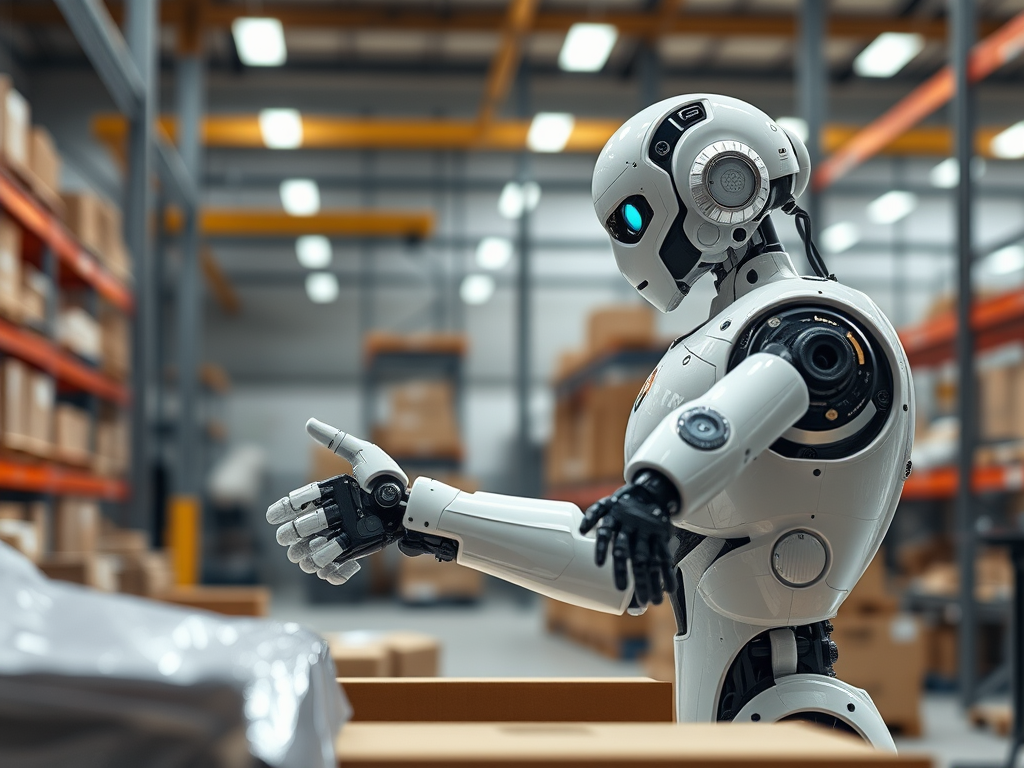
In the bustling heart of modern commerce—the warehouse—the introduction of humanoid robots in the workforce is solving the “dirty and dull” problem of logistics. Unlike traditional conveyor belts or simple autonomous mobile robots (AMRs), humanoid models like Agility Robotics’ Digit are now stepping into roles that require high-level spatial awareness and human-like movement.
Think of these robots as the ultimate “utility players” on a sports team. They don’t just move a box from Point A to Point B; they can navigate narrow aisles, climb stairs, and reach into high-stack shelves that were originally designed for human reach. Using AI-powered robots equipped with advanced computer vision, these machines can identify “empty storage totes,” pick up heavy containers (up to 35 lbs), and place them onto conveyor systems with tireless precision.
The beauty of this deployment lies in its adaptability. Most warehouses were “brownfield” sites—meaning they were built for people, not automation. Humanoid robots allow companies to automate without spending millions to retool their entire infrastructure. By handling the repetitive, back-breaking work of unloading pallets and kitting orders, these robots allow human supervisors to focus on high-value logistics management, essentially turning the warehouse into a more efficient, safer, and faster-moving organism.
2. Revolutionizing Automotive Assembly Lines
The automotive industry has long been a leader in automation, but 2026 sees a shift from static robotic arms to mobile, general-purpose humanoids. Companies like BMW and Tesla are now deploying humanoid robotics 2026 models—such as Figure 02 and Optimus Gen 2—directly into the assembly line. These robots aren’t just performing one task; they are learning to handle multiple steps in the manufacturing process.
Imagine a humanoid robot standing at an assembly station. Using its embodied AI brain, it can “see” a car door passing by, pick up a specific internal component, and precisely fit it into place. This requires a level of dexterity—often referred to as “fine motor skills”—that older robots simply lacked. These humanoids feature “16 degrees of freedom” in each hand, allowing them to manipulate tools and fasteners just as a human worker would.
This integration serves as a powerful solution to the global labor shortage in skilled manufacturing. By assigning AI-powered robots to the repetitive insertion of parts or the monotonous checking of quality standards, car manufacturers are reducing human fatigue and the risk of repetitive strain injuries. As these robots “watch” human workers through their vision systems, they continuously refine their own movements, making the factory floor a collaborative space where human and machine efficiency merge.
3. Handling Dangerous Industrial Maintenance and Inspections
One of the most profound benefits of humanoid robots in the workforce is their ability to step into “dangerous” environments where human life would be at risk. This year, we are seeing industrial-grade humanoids, like the DEEP Robotics Dr02 and Boston Dynamics’ electric Atlas, being deployed for structural inspections and hazardous material handling in environments like nuclear plants, offshore wind farms, and chemical refineries.
Consider the task of inspecting a high-pressure valve in a remote section of an oil rig. Traditionally, this might require a human to climb hazardous scaffolding or enter a confined space. A humanoid robot, however, can navigate that same terrain, using its bipedal legs to step over obstacles that would stop a wheeled robot in its tracks. These robots are often built with “IP66 protection,” meaning they can operate in pouring rain, extreme heat, or toxic atmospheres.
Equipped with a suite of sensors including LiDAR and thermal imaging, these machines act as the eyes and ears of a maintenance team. They can detect a gas leak or a structural micro-crack long before it becomes a disaster. By taking on these high-risk roles, humanoid robots are not “replacing” workers; they are acting as a protective shield, ensuring that the most hazardous jobs in our industrial infrastructure no longer require putting a human soul in harm’s way.
4. Elevating Retail Inventory and Customer Service
Step into a high-end retail store in 2026, and you might be greeted by a friendly humanoid robot instead of a static kiosk. Workplace automation trends have moved into the “front-of-house,” where robots are now assisting with both back-end inventory management and front-end customer interaction.
These robots act like the “perfect floor manager.” While one humanoid is gliding through the aisles after hours using 3D depth cameras to perform real-time inventory audits—detecting out-of-stock items with 95% accuracy—another might be on the floor during the day helping a customer find a specific pair of jeans. Because they are powered by vision-language models (similar to the AI that powers advanced chatbots), they can understand and respond to natural language commands like, “Where are the waterproof hiking boots?”
This shift allows retail employees to step away from the tedious task of “counting boxes” and “scanning barcodes” and move into “clienteling”—the art of building relationships with customers and providing personalized style advice. The robot handles the data, and the human handles the connection. This synergy is proving to be a massive “ROI” for retailers, reducing “shrinkage” (lost or stolen items) and ensuring that the shelves are always stocked, all while making the shopping experience more interactive and futuristic.
5. Supporting Healthcare Professionals and Patient Care
In the healthcare sector, humanoid robots in the workforce are beginning to address the critical shortage of nursing staff and caregivers. These robots are not meant to replace the bedside manner of a doctor, but rather to act as “Patient Care Assistants” (PCAs) that handle the heavy lifting and logistical chores of a busy hospital.
Imagine a humanoid robot tasked with the “non-clinical” duties that eat up hours of a nurse’s shift. This includes transporting linens, delivering medications to specific rooms, or even assisting in the physical lifting of patients from a bed to a wheelchair. Because they have a human-like form, they can use the same elevators, doors, and hallways as the staff without needing the hospital to be rebuilt.
More importantly, some models are designed with “soft” aesthetics and advanced social AI to provide basic companionship for the elderly. They can remind a patient to take their medicine, guide them through light physical therapy exercises, or simply provide a “voice” to talk to during long hours. By offloading these physically demanding and time-consuming tasks to AI-powered robots, healthcare professionals can spend more time on what they do best: diagnosing, treating, and empathizing with their patients.
6. Advancing Construction and Structural Demolition
Construction sites are notoriously chaotic and unstructured, making them a “final frontier” for robotics. However, 2026 is the year humanoids like the Apptronik Apollo and specialized construction models are beginning to assist in demolition and material transport. These robots represent a major leap in robotic process automation for the physical world.
In a demolition scenario, a humanoid robot can enter an unstable building to remove hazardous debris or strip out materials before human crews enter. Their ability to use “standard human tools”—like hammers, drills, and saws—is a game-changer. Instead of needing a specialized machine for every task, a single humanoid can be programmed to switch between roles, much like a human “handyman” would.
On the “build” side, these robots are being used to move heavy loads across uneven terrain. They can carry “drywall sheets” or “heavy buckets” of material up flights of stairs in buildings where elevators haven’t been installed yet. This reduces the immense physical strain on construction workers, potentially extending their careers and reducing the high rates of workplace injury in the trade. As these collaborative robots (cobots) become more common, the construction site becomes a place of precision and safety rather than just raw manual labor.
7. Streamlining Last-Mile Delivery and Urban Logistics
The “last mile”—the journey from a local distribution center to your front door—is the most expensive and complex part of the shipping process. This year, humanoid robots like 1X’s NEO are entering the workforce to solve this puzzle. Unlike a delivery van or a small “sidewalk rover,” a humanoid can walk up your driveway, navigate your porch steps, and place a package exactly where you want it.
These robots are essentially “delivery assistants” that ride along in autonomous vans. When the van reaches a neighborhood, the humanoid hops out, grabs the package, and navigates the “unstructured” environment of a suburban lawn or a busy city sidewalk. Using physical AI, they can recognize obstacles like a child’s bicycle or a sleeping dog and navigate around them safely.
This deployment is a response to the massive surge in e-commerce and the declining number of available delivery drivers. By automating the “physical walk” to the doorstep, logistics companies can significantly increase the number of deliveries made per hour. For the consumer, it means faster service and more secure package placement. For the worker, it shifts the role from “walking 10 miles a day” to “supervising a fleet of delivery robots” from a remote operations center.
8. Precision Harvesting and Agricultural Monitoring
Agriculture is currently facing a “demographic reckoning,” with an aging workforce and a lack of seasonal labor. Humanoid robots are entering the fields to provide a solution that goes beyond traditional tractors. These robots are being used for “precision harvesting”—the delicate task of picking fruits like strawberries, grapes, or citrus without bruising them.
A humanoid in the field uses its AI-powered vision to determine the exact “ripeness” of a fruit based on color and texture. Its “tactile sensors” in its fingers allow it to apply just enough pressure to pick the fruit without damaging it. This level of “soft touch” was previously impossible for robots. Furthermore, these humanoids can navigate the uneven, muddy terrain of a farm using the same bipedal balance that humans do.
Beyond harvesting, these robots act as “mobile data hubs.” As they walk through the rows, they can monitor soil health, identify pest outbreaks, and check for signs of disease on a plant-by-plant basis. This allows farmers to use “spot treatments” of fertilizer or pesticides rather than spraying an entire field, leading to more sustainable and cost-effective farming. The humanoid robot in the field is becoming the ultimate “high-tech farmhand.”
9. Modernizing Hospitality and Food Service
In the hospitality industry, the “staffing crisis” has led to a rapid adoption of collaborative robots (cobots) in humanoid form. We are seeing these robots enter restaurants and hotels not as “replacements” for waitstaff, but as “support agents” that handle the heavy lifting of service.
In a restaurant setting, a humanoid robot might be responsible for “bussing” tables—gathering heavy trays of dirty dishes and taking them to the kitchen. This is a physically taxing task that often leads to burnout for human servers. By delegating the “heavy lifting” to the robot, the human server can focus entirely on the “guest experience,” spending more time explaining the menu, taking orders, and ensuring the customers are happy.
In hotels, humanoids are being used for “room service delivery” and “concierge support.” They can navigate elevators and hallways to bring a fresh set of towels or a late-night snack to a guest’s room. This allows the hotel to maintain 24/7 service without overextending their human staff. The result is a “hybrid hospitality” model where the machine handles the “service logistics” and the human handles the “hospitality heart.”
10. Creating New Roles for Robot Trainers and Supervisors
Perhaps the most surprising way humanoid robots in the workforce are entering the economy is by creating entirely new categories of human jobs. As these robots become common, we need a “workforce for the workforce”—human experts who train, maintain, and supervise these mechanical colleagues.
The role of a “Robot Trainer” involves using “teleoperation” or “demonstration-based learning” to show the robot how to perform a new task. For example, a skilled welder might wear a haptic suit and perform a complex weld; the robot’s physical AI records the movement and “generalizes” it so it can perform the weld itself. This turns the human worker from a “doer” into a “teacher.”
Additionally, we are seeing the rise of “Automation Coordinators” who manage fleets of robots on a factory floor or in a warehouse. These individuals monitor the “Digital Nervous System” of the facility, ensuring the robots are charged, updated, and operating efficiently. This shift represents a massive “upskilling” of the workforce. While the robot takes on the manual labor, the human worker moves into a role that requires “critical thinking,” “problem-solving,” and “managerial oversight.” The entry of humanoid robots is not just about changing what we do, but how we grow as a labor force.
Further Reading
- The Second Machine Age: Work, Progress, and Prosperity in a Time of Brilliant Technologies by Erik Brynjolfsson and Andrew McAfee.
- Rise of the Robots: Technology and the Threat of a Jobless Future by Martin Ford.
- Human + Machine: Reimagining Work in the Age of AI by Paul R. Daugherty and H. James Wilson.
- Robot-Proof: Higher Education in the Age of Artificial Intelligence by Joseph E. Aoun.
Keep the Discovery Going!
Here at Zentara, our mission is to take tricky subjects and unlock them, making knowledge exciting and easy to grasp. But the adventure doesn’t stop at the bottom of this page. We are constantly creating new ways for you to learn, watch, and listen every single day.
Watch & Learn on YouTube
Visual learner? We publish 4 new videos every day, plus breaking news shorts to keep you smarter than the headlines. From deep dives to quick facts, our channel is your daily visual dose of wonder.
Click here to Subscribe to Zentara on YouTube
Listen on the Go on Spotify
Prefer to learn while you move? Tune into the Zentara Podcast! We drop a new episode daily, perfect for your commute, workout, or coffee break. Pop on your headphones and fill your day with fascinating facts.
Click here to Listen on Spotify
Every click, view, and listen helps us keep bringing honest knowledge to everyone. Thanks for exploring with us today—see you out there in the world of discovery!




Leave a Reply