
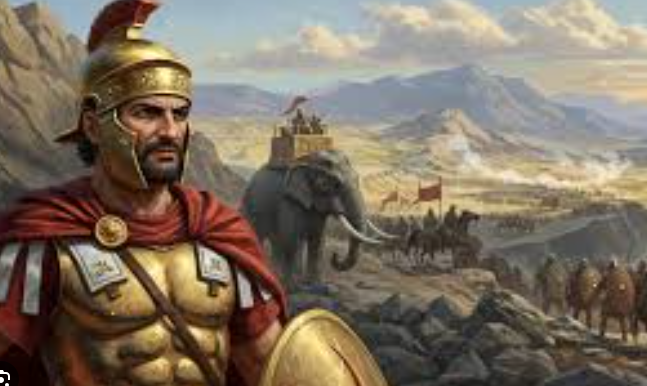
Few names from antiquity command as much respect and awe as Hannibal Barca. A Carthaginian general whose very name once made Roman mothers tremble, Hannibal was more than just a soldier; he was a strategic virtuoso who turned the Mediterranean into his personal chessboard. His campaign during the Second Punic War remains a masterclass in military science, leadership, and raw human endurance.
To understand Hannibal is to understand the art of the underdog. Facing the relentless industrial and demographic might of the Roman Republic, he relied on audacity, psychological warfare, and an uncanny ability to turn his enemies’ strengths against them. This article explores the ten greatest feats of this legendary commander, exploring how his tactical innovations and indomitable spirit changed the course of Western history.
1. The Audacious Crossing of the Alps
When we think of Hannibal Barca, the image of war elephants navigating frozen mountain passes immediately comes to mind. This wasn’t just a physical trek; it was a strategic masterstroke that defied the laws of ancient warfare. Rome felt secure behind the natural fortress of the Alps, believing no army—especially one with a baggage train and heavy cavalry—could survive the ascent.
Hannibal’s crossing of the Alps was an exercise in pure willpower. He didn’t just fight the elements; he fought hostile Gallic tribes and the crushing weight of logistics. By the time he descended into the Po Valley, he had lost nearly half his men and many of his elephants. However, the psychological impact was immeasurable. He had bypassed Rome’s naval superiority and landed a hammer blow in their own backyard. It was the ancient equivalent of a modern army appearing suddenly behind “impenetrable” missile defenses. This feat established Hannibal as a general who viewed geography not as a barrier, but as a tool for surprise.
2. The Masterful Double Envelopment at Cannae
The Battle of Cannae is widely regarded as the most perfect tactical victory in military history. Facing a Roman force that significantly outnumbered his own, Hannibal utilized a “concave” formation. He placed his weaker infantry in the center, allowing them to slowly retreat and draw the Roman legions deep into a trap.
As the Romans pushed forward, thinking they were winning, Hannibal’s elite African infantry stayed on the flanks, and his superior cavalry circled around the rear. The result was a “double envelopment”—a giant circle of death. The Roman army, packed so tightly they couldn’t even draw their swords, was systematically annihilated. Cannae remains the gold standard for military strategy and is still studied in modern war colleges today. It proved that a smaller, more disciplined force led by a genius could eradicate a superpower’s army through sheer tactical positioning.
3. The Psychological Trap at Lake Trasimene
Before Cannae, Hannibal showcased his brilliance at Lake Trasimene, orchestrating what is often called the largest ambush in history. He understood that Roman generals were often driven by political pressure to seek quick, decisive battles. Using this against the Roman consul Flaminius, Hannibal lured the Roman army into a narrow defile between the hills and the lake.
Hidden by a thick morning mist, Hannibal’s troops waited in silence. When the Romans were fully committed to the narrow path, the Carthaginians struck from the heights. With no room to maneuver and their backs to the water, the Roman legions were slaughtered. This feat highlighted Hannibal’s use of psychological warfare and environmental factors. He didn’t just fight the Roman soldiers; he fought the Roman ego, leading them into a trap where their legendary discipline became a liability.
4. Sustaining a Decade-Long Campaign Without Reinforcements
Perhaps Hannibal’s most underrated feat was his ability to maintain an army on enemy soil for 15 years. Unlike Rome, which could draw on a massive pool of Italian manpower, Hannibal was thousands of miles from Carthage. He received almost no reinforcements or supplies from his home government.
How did he survive? Through military leadership and charismatic diplomacy. Hannibal wasn’t just a general; he was a CEO of a multinational corporation of mercenaries. His army consisted of Numidians, Iberians, Gauls, and Carthaginians. He kept this disparate group loyal and motivated through a decade of “living off the land” and winning victories. His ability to maintain discipline and morale in a foreign land, surrounded by enemies, is a testament to his personal magnetism and logistical ingenuity. He turned the Roman countryside into his own supply depot, a feat of endurance rarely matched in the annals of war.
5. The Tactical Brilliance of the Battle of the Trebia
The Battle of the Trebia was Hannibal’s first major encounter with a Roman consular army, and it set the tone for the entire war. Here, Hannibal demonstrated his mastery of the “pre-game” setup. He sent his light cavalry to harass the Roman camp early in the morning, forcing the Romans to cross the freezing Trebia River before they had even eaten breakfast.
Cold, hungry, and exhausted, the Romans met a well-fed and warmed Carthaginian line. To ensure victory, Hannibal hid a detachment of 2,000 elite troops under his brother Mago in a nearby gully. At the height of the battle, Mago’s force leaped out and struck the Roman rear. This “hidden reserve” tactic shattered Roman morale. The Battle of the Trebia was a lesson in Carthaginian military tactics: victory is often decided before the first sword is even swung, through preparation and the exploitation of an enemy’s physical state.
6. Ingenious Escape via the “Oxen Torch” Trick
Even the greatest generals find themselves cornered. In 217 BCE, the Roman “Delayer,” Fabius Maximus, trapped Hannibal in a valley in Campania. The Roman’s held the only mountain pass out, and it seemed Hannibal was finally beaten.
Hannibal’s solution was pure creative genius. He gathered 2,000 oxen, tied torches to their horns, and drove them toward a different mountain path at night. The Romans, seeing the moving lights, assumed the Carthaginian army was attempting a breakout there and rushed to intercept. While the Romans were busy chasing cows, Hannibal quietly marched his entire army through the now-unguarded main pass. This feat of Hannibal showed that his intellect was just as dangerous when he was retreating as when he was attacking. He understood the “fog of war” and used it to manipulate Roman perceptions.
7. Revolutionizing Mediterranean Cavalry Warfare
Before Hannibal, cavalry was often seen as a secondary support unit. Hannibal changed that forever. He utilized his Numidian cavalry—fast, unarmored horsemen from North Africa—as the ultimate “special forces” of the ancient world. They were masters of the hit-and-run, the feigned retreat, and scouting.
At battles like Cannae and Trebia, it was the cavalry that delivered the final, decisive blow. Hannibal integrated his heavy Spanish and Gallic horsemen with the light Numidians to create a multi-layered offensive force that the Roman infantry-heavy system simply couldn’t handle. By prioritizing cavalry, Hannibal forced a shift in the history of the Second Punic War, eventually compelling Rome to develop its own superior horse units to survive. His use of mobility over brute force remains a fundamental principle of modern armored warfare.
8. The Diplomatic Dismantling of the Roman Alliance
Hannibal’s ultimate goal wasn’t just to kill Romans; it was to dismantle the “Roman Confederation.” He knew he couldn’t conquer the city of Rome itself with his limited numbers, so he focused on diplomacy and political subversion. After his crushing victories, he released Italian prisoners without ransom, telling them he wasn’t there to fight them, but to free them from Rome.
This strategy worked brilliantly for a time. Major cities like Capua and Tarentum defected to his side. By turning Rome’s allies against her, he struck at the very source of Roman power: its manpower. This feat of political maneuvering showed that Hannibal understood the Punic Wars weren’t just about battles; they were about the social and political fabric of Italy. He came closer than anyone in history to unraveling the Roman state from within.
9. Engineering the “Scorched Earth” Logistics
Logistics is the “boring” part of war that wins battles, and Hannibal was a logistical wizard. Operating in a hostile country, he developed a system of mobile granaries and fortified winter quarters. He studied the agricultural cycles of Italy to ensure his army arrived in fertile regions just as the crops were ripening.
This wasn’t just about feeding men; it was about denying resources to the enemy. Hannibal’s ability to navigate the complex ancient Mediterranean landscape while keeping tens of thousands of horses and men healthy is a feat that rivals his tactical wins. He mastered the art of the “moving base,” ensuring that his army remained a potent threat regardless of how far they were from a friendly port. His logistical prowess allowed him to maintain pressure on Rome long after any other general would have been forced to surrender.
10. The Final Stand and Legacy at the Battle of Zama
While the Battle of Zama was technically a defeat for Hannibal, his performance there cemented his status as a legendary commander. Facing Scipio Africanus—a Roman general who had spent years studying Hannibal’s own tactics—Hannibal was forced to fight with an inferior, largely green army.
Despite the odds, Hannibal nearly won. He utilized his remaining elephants and organized his infantry in three lines to absorb the Roman shock. Though he eventually lost when the Roman cavalry returned to the field, his ability to adapt his style to face a “student” who was using his own tricks against him was remarkable. Even in defeat, Hannibal’s influence was absolute. He had forced Rome to evolve, to grow, and to become the empire it eventually became. His greatest feat was perhaps his legacy: he was the “greatest adversary” who taught the world that genius is the ultimate force multiplier.
Further Reading
- Hannibal: Pride of Carthage by David Anthony Durham (A vivid historical novel)
- The Punic Wars by Adrian Goldsworthy (A comprehensive and accessible historical account)
- Hannibal by Patrick N. Hunt (A biography focusing on his leadership and tactics)
- Ghosts of Cannae by Robert L. O’Connell (An in-depth look at his most famous battle)


Leave a Reply