
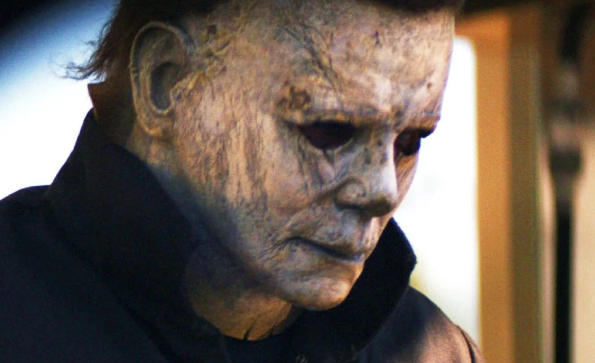
To understand the terrifying enigma known as Michael Myers, one must look past the mask and into the dark history of Haddonfield, Illinois. He is not merely a man with a blade; he is a recurring nightmare, a “Shape” that has haunted the shadows of a quiet suburban town for generations. From the chilling events on Lampkin Lane to the occult whispers of ancient curses, the lore of Michael Myers is a complex tapestry of pure, unadulterated evil. Whether he is viewed as a silent human predator or a supernatural force of nature, his fictional history remains one of the most chilling chronicles in the annals of horror.
1. The 1963 Lampkin Lane Incitement
The history of the Boogeyman begins in the deceptively peaceful town of Haddonfield on a cold October night. While the rest of the neighborhood was preoccupied with the festivities of the season, a six-year-old Michael Myers committed an act of violence that would forever stain the town’s soul. Dressed in a simple clown costume, the young boy took a butcher knife from the kitchen and ascended the stairs to his sister Judith’s bedroom. Without a word or a discernible motive, he ended her life, an act that shattered the illusion of suburban safety. This was not just a murder; it was the birth of an entity. When his parents found him standing on the lawn, knife in hand and eyes vacant, they didn’t see a child—they saw a hollow shell. This inciting incident established the core of his legend: the inexplicable transition from an innocent child to a vessel of “pure evil.” The Lampkin Lane house itself became a monument to this tragedy, sitting derelict for years as a physical reminder that evil does not die; it simply waits.
2. The Fifteen-Year Silence at Smith’s Grove
Following the events of 1963, Michael was remanded to the custody of the Smith’s Grove Sanitarium. For the next fifteen years, he became the primary study of Dr. Samuel Loomis, a man who would eventually describe his patient as having “the devil’s eyes.” During his incarceration, Michael never uttered a single word. He sat in a catatonic state, staring at a wall, seemingly oblivious to the world around him. However, Loomis realized that this was not a state of illness, but a state of waiting. Michael wasn’t recovering; he was hibernating, gathering a dark energy that the medical staff couldn’t comprehend. His silence was a weapon, a vacuum that sucked the humanity out of everyone who tried to reach him. This period of lore highlights that Michael’s internal world is entirely inaccessible. He does not feel remorse, pain, or the passage of time. He simply exists as a patient observer, waiting for the stars to align—or for a specific date to arrive—so he could return to the place where his journey began.
3. The Enigma of “The Shape”
In the chronicles of Haddonfield, Michael is rarely referred to as a man; instead, he is often called “The Shape.” This title is more than just a nickname; it defines his very nature as a folkloric entity. He is a master of the periphery, appearing in the background of photographs or the corner of a victim’s eye before vanishing into the shadows. This ability to blend into the environment suggests that he is not just a physical being, but a manifestation of the town’s collective fear. The Shape moves with a slow, mechanical precision that defies human biology. He doesn’t run, yet he is always behind you. He doesn’t hide, yet he is never seen until it is too late. By stripping away his individual identity and replacing it with the moniker of a “Shape,” the lore emphasizes that Michael is a universal terror—a blank slate upon which Haddonfield projects its worst anxieties. He is the shadow in the hallway and the rustle in the bushes, an ever-present force that exists just beyond the reach of the light.
4. The Strode Bloodline Connection
A pivotal, albeit debated, chapter of the lore involves the secret connection between Michael and Laurie Strode. In certain accounts of Haddonfield’s history, it is revealed that Laurie was actually Michael’s youngest sister, Cynthia, who was put up for adoption after the family tragedy to protect her from the Myers legacy. This revelation reframes Michael’s return to Haddonfield not as a random spree, but as a systematic attempt to “complete the set” and erase his entire lineage. His obsession with Laurie and later her daughter, Jamie Lloyd, suggests a biological imperative driven by something darker than mere sibling rivalry. He tracks his kin with a predatory instinct that transcends normal human senses, always finding them no matter how far they run or how many names they change. This “bloodline” lore adds a layer of tragic destiny to the mythos; the Myers family is not just haunted by Michael, they are tethered to him by a psychic or spiritual bond that only death can sever.
5. The Occult Curse of Thorn
Perhaps the most complex aspect of the legend is the “Curse of Thorn,” an ancient Druidic hex rooted in Celtic mythology. According to this lore, a cult of druids placed a curse on an infant from a specific bloodline to act as a sacrificial vessel. This vessel, possessed by the spirit of Thorn, is compelled to murder its entire family on the night of Samhain (Halloween) to prevent a greater sickness or catastrophe from befalling the tribe. This explains Michael’s seemingly supernatural durability and his singular focus. He is not acting of his own volition; he is a puppet of an ancient, cosmic evil. The symbol of Thorn—a constellation of stars—is often found near Michael, marking him as the chosen one of this dark ritual. This lore elevates Michael from a simple stalker to a mythological figure, a pawn in a game played by hidden forces for thousands of years. It suggests that as long as the cult exists and the stars align, the Shape will always return to spill the blood of his kin.
6. Supernatural Durability and Transcendence
One of the most terrifying aspects of the Haddonfield Boogeyman is his apparent immortality. Over the decades, Michael has survived injuries that would instantly kill any mortal man: multiple gunshots to the chest, stabbings with various implements, falls from great heights, and even being caught in massive explosions. Dr. Loomis often remarked that Michael was no longer human, and the lore supports this through the concept of “transcendence.” It is suggested that the more Michael kills, the more he “transcends” into something beyond flesh and bone. He doesn’t bleed like a normal person, and his strength seems to increase in direct proportion to the fear he inspires in his victims. This durability makes him a “force of nature” rather than a criminal. You cannot negotiate with a hurricane, and you cannot kill a shadow. This facet of his history reinforces the idea that Michael is the “Essence of Evil,” a concept that cannot be destroyed by physical means alone, as it lives on in the trauma of the survivors and the soil of the town itself.
7. The Power of the Emotionless Mask
Michael’s face is almost never seen; it is hidden behind a pale, expressionless mask with large, dark eye sockets. In the lore, this mask is not just a disguise; it is a ritualistic object that allows him to shed his humanity entirely. When Michael wears the mask, he becomes the Boogeyman; without it, he is occasionally glimpsed as a confused, aging man. The mask acts as a barrier between the “Shape” and the world of the living. It is said that when he looks through those eye holes, he doesn’t see people, but merely targets for his internal darkness. Interestingly, the mask itself seems to have a life of its own, appearing to “heal” or age alongside Michael in certain timelines. It is the face of the void—a blank, white canvas that reflects nothing but the impending doom of those who gaze upon it. For the people of Haddonfield, the mask is the ultimate symbol of the night he came home, a totem of terror that signals the end of peace and the beginning of the harvest.
8. The Psychic Link and Shared Trauma
The connection between Michael and his victims often goes beyond the physical. In the lore surrounding his niece, Jamie Lloyd, a literal psychic link is established. Jamie begins to see what Michael sees and feels his murderous urges, occasionally lapsing into a catatonic state similar to Michael’s own childhood incarceration. This suggests that Michael’s evil is a “contagion” that can be passed down through the bloodline or through intense traumatic exposure. Even those who are not related to him, like the citizens of Haddonfield, find themselves “infected” by his presence. The town’s collective psyche becomes warped, leading to mob violence and a breakdown of social order whenever he is sighted. This psychic resonance implies that Michael is more than a killer; he is a spiritual parasite that feeds on the fear and anger of the community, turning ordinary people into monsters in their desperate attempts to stop him.
9. Haddonfield as a Living Character
Haddonfield, Illinois, is not just a setting; it is an integral part of Michael Myers’ lore. The town is depicted as a place where secrets are buried deep and where the past is never truly gone. There is a sense of “cosmic coincidence” surrounding the geography of the town, from the specific layout of the streets to the way the wind howls through the trees on Halloween night. Some interpretations of the lore suggest that Haddonfield itself is cursed or “sick,” and that Michael is simply the symptom of that underlying rot. The town’s inability to move past the 1963 and 1978 massacres keeps the legend alive, providing the “energy” Michael needs to manifest. As long as Haddonfield remembers the Boogeyman, the Boogeyman has a home to return to. The relationship is symbiotic: Michael provides the town with a dark myth, and the town provides Michael with a hunting ground where every house and every hedge is a part of his macabre design.
10. The Eternal Cycle of the Boogeyman
The ultimate fact of Michael Myers’ lore is that he represents an eternal cycle. Whether he is killed, burned, or lost in a mine shaft, he inevitably returns. This cyclical nature is tied to the holiday of Halloween itself—the “Night of the Shape.” The lore suggests that Michael is a seasonal entity, a ghost of the harvest that must return to reap what has been sown. There is no “final” victory over him because he is the personification of a fundamental human fear: the fear of the unknown predator. Even when his physical body is destroyed, the legend ensures his return. New “Shapes” may rise, influenced by his legacy, or he may simply reform from the shadows of his previous crimes. He is the Boogeyman that parents warn their children about, a cautionary tale that has become a physical reality. In the world of Haddonfield, Michael Myers doesn’t just haunt the streets; he haunts the very concept of time, ensuring that every October 31st is lived in the shadow of the knife.
Further Reading
- Halloween by Curtis Richards (The original novelization that introduces the Druidic elements).
- Halloween II by Jack Martin (Deepens the Strode bloodline connection).
- The Old Myers Place by Kelly O’Rourke (Explores the haunting of the original Lampkin Lane house).
- Halloween: The Curse of Michael Myers by Howard Mahmood (Focuses on the Thorn cult mythology).




Leave a Reply