
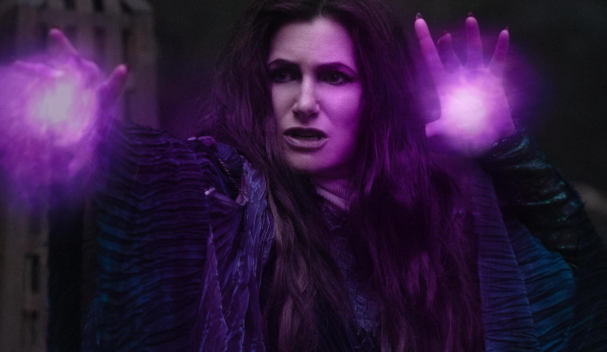
In the wake of the Westview anomaly, the Marvel Cinematic Universe took a dark, enchanting turn into the world of the occult. Agatha All Along isn’t just a sequel to the sitcom-inspired chaos of WandaVision; it is a gothic, campy, and deeply emotional exploration of what it means to be a witch in a world that fears you. Centered on the titular Agatha Harkness, the series blends horror, humor, and heart to deliver a story about the masks we wear and the magic we hide.
Trapped in a television-inspired delusion for years, Agatha’s journey begins as a desperate quest for power but evolves into something far more profound. This is a story about a “covenless” witch finding her tribe, a mother grappling with an ancient loss, and the emergence of a new magical powerhouse in the MCU. Below, we break down the ten most pivotal plot points that define this spellbinding season.
1. The Detective Agnes Illusion: Breaking the Scarlet Witch’s Curse
The story opens within a gritty, noir-inspired crime drama titled Agnes of Westview. Agatha, still under the spell of Wanda Maximoff, believes herself to be a hard-boiled detective investigating a mysterious Jane Doe. This “show within a show” serves as a brilliant meta-commentary on the nature of identity and the lingering psychic scars left by the Scarlet Witch. The illusion only shatters when a mysterious teenager and the FBI agent “Rio Vidal” force Agatha to confront the reality of her powerlessness. This sequence perfectly sets the tone: Agatha is a survivor, and her return to the world of magic is a violent, necessary awakening.
2. The Gathering of the Coven: A Journey of “Covenless” Witches
To walk the legendary Witches’ Road and regain her stolen magic, Agatha must assemble a coven. However, her reputation precedes her; she is a witch who traditionally kills her own to absorb their power. She manages to recruit a group of “specialists”: Lilia Calderu (Divination), Jennifer Kale (Potions), Alice Wu-Gulliver (Protection), and a “Green Witch” placeholder, Sharon Davis (Mrs. Hart). This ragtag group represents the marginalized and the forgotten of the magical world. Their initial distrust of Agatha creates a simmering tension, establishing the core conflict: can a predator ever truly work within a pack?
3. The Ballad of the Witches’ Road: More Than Just a Song
The key to accessing the magical realm is the “Ballad of the Witches’ Road,” a haunting melody that serves as both a map and a ritual. Throughout the series, the song is revealed to be the lifeblood of the narrative. It isn’t just a catchy tune; it is a manifestation of magical intent. Interestingly, we eventually learn that the version the world knows was curated by Agatha herself, based on a lullaby she sang to her lost son. This plot point highlights the series’ focus on music as a primal form of magic, capable of opening doors to dimensions where the rules of reality no longer apply.
4. The Trials of the Road: Confronting Generational Trauma
The Witches’ Road is not a physical path but a series of psychological gauntlets. Each trial targets a specific member of the coven, forcing them to confront their deepest fears and traumas. From Jennifer Kale’s struggle with being “bound” by magic to Alice Wu-Gulliver’s battle against a family curse, the trials serve as a metaphorical therapy session with lethal stakes. These moments are crucial because they strip away the “superhero” tropes, focusing instead on the human cost of being magical. Each witch must “growth” or perish, making their journey a literal path toward self-actualization.
5. The Revelation of “Teen”: The Return of Billy Maximoff
For much of the series, the identity of the mysterious boy helping Agatha is hidden by a “sigil” that prevents witches from hearing his name. In a stunning mid-season twist, it is revealed that “Teen” is actually William Kaplan, whose body became the vessel for the soul of Billy Maximoff (Wiccan) during the collapse of the Westview Hex. Billy’s search for his twin brother, Tommy, is the secret engine driving the plot. This revelation recontextualizes everything; he isn’t just an assistant, but a reality-warper whose presence on the Road is the only reason the trials exist at all.
6. Rio Vidal: The Green Witch is Death Herself
Throughout the season, the enigmatic Rio Vidal fluctuates between being Agatha’s lover and her executioner. The ultimate revelation is that Rio is not just a witch; she is the physical embodiment of Death. This cosmic twist explains her obsession with Agatha—the witch who has spent centuries cheating the natural order. Their relationship is the MCU’s most complex romance, a “dance macabre” where love and mortality are intertwined. Rio’s role as the “Green Witch” underscores the cyclical nature of life, where the end of the road is always the grave.
7. The Witches’ Road is a “Con”: Billy’s Unconscious Creation
In one of the most meta-textual twists in Marvel history, it is revealed that the Witches’ Road didn’t actually exist before this journey. It was a legend—a “scam” Agatha used for centuries to lure witches to their deaths so she could steal their power. However, because Billy Maximoff possesses the reality-warping abilities of his mother, he inadvertently made the Road real. Every trial, every danger, and the very path itself were born from Billy’s imagination and his need for a “quest.” This revelation forces Billy to face the guilt of the lives lost on a road he accidentally built.
8. The Tragedy of Nicholas Scratch: Agatha’s Original Sin
The series finally pulls back the curtain on Agatha’s greatest mystery: what happened to her son, Nicholas Scratch? We learn that Agatha traded her son’s life (or perhaps his soul) for the Darkhold, the Book of the Damned. However, the truth is more nuanced; she begged Death for more time with him, and for six years, they traveled together, creating the “Ballad.” His eventual passing is what hardened Agatha’s heart, turning her into the cynical predator we met in Westview. Her grief is the “ghost” that haunts every decision she makes, providing a tragic core to her villainy.
9. Lilia Calderu’s Sacrifice: Mastery of Time and Fate
Lilia Calderu, the coven’s diviner, experiences time out of order, a condition that initially seems like dementia but is revealed to be a powerful mastery of the “Maiden, Mother, Crone” cycle. In her final trial, Lilia realizes that her entire life has been leading to a single moment of sacrifice to save the others from the Salem Seven. By flipping a tarot card and embracing her destiny, she defeats the invaders and finds peace. Her arc is a beautiful exploration of the “Crone” archetype—the wisdom that comes with knowing when it is time to let go.
10. The Ultimate Sacrifice: Ghost Agatha and the Search for Tommy
In the finale, Agatha faces a choice: give Billy to Death to save herself, or save the boy who reminds her so much of her own son. In a stunning act of redemption, she chooses the latter, kissing Death and surrendering her life so Billy can live. However, because Agatha is “too stubborn to stay dead,” she returns as a ghost. The season ends with Spirit-Agatha agreeing to act as Billy’s guide as they set out to find the reincarnated Tommy Maximoff. This new status quo transforms Agatha from a power-hungry antagonist into a spectral mentor, setting a new course for magic in the MCU.
Further Reading
- Agatha Harkness: The Darkhold Diaries by Various Authors
- Scarlet Witch & Quicksilver: The Family Ties by James Robinson
- Young Avengers: Style > Substance by Kieron Gillen and Jamie McKelvie
- Witches of New Salem by Steve Engelhart

Leave a Reply