
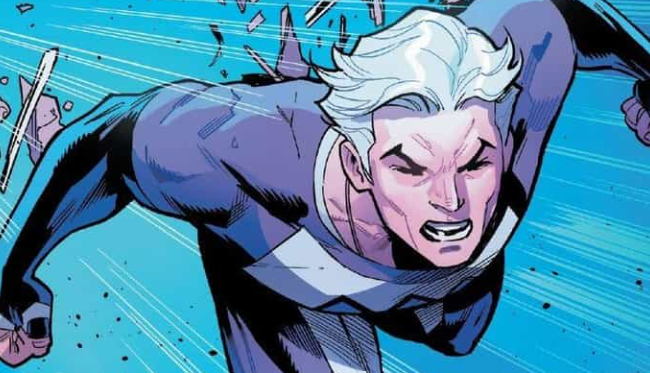
In the sprawling landscape of Marvel Comics, few characters are as polarizing, complex, or misunderstood as Pietro Maximoff, better known as Quicksilver. Often overshadowed by his twin sister, the reality-warping Scarlet Witch, or his (sometimes) father, the Master of Magnetism, Magneto, Quicksilver is far more than just “the guy who runs fast.” He is a character defined by a prickly exterior, a fierce protective streak, and a physiological burden that makes his every waking moment a test of patience.
While general audiences may recognize him from various cinematic iterations, the comic book history of Pietro Maximoff is a labyrinth of shifting origins, tragic romances, and moral ambiguity. To truly understand Quicksilver is to understand a man who lives in a world made of glass and moving in slow motion. He isn’t just a speedster; he is one of the most psychologically nuanced characters in the Marvel Universe. Whether he is leading a team of government-sponsored mutants or attempting to steal the sacred mists of the Inhumans, Pietro’s journey is a high-velocity roller coaster.
Below, we dive into the hidden history, biology, and secrets of the Silver Speedster that even some die-hard comic fans might have missed.
1. The “ATM Analogy”: Living in a World of Snails
To understand why Quicksilver is famously arrogant and short-tempered, you have to understand how he perceives time. In a classic issue of X-Factor, Pietro provides what has become the definitive explanation for his personality: the ATM analogy. Imagine you are standing in line at an automated teller machine. The person in front of you doesn’t know how to use the card reader, takes forever to type their PIN, and constantly stops to look at the instructions. Now, imagine that everyone you encounter, every day of your life, is that person.
Because Pietro’s brain processes information and movements at superhuman speeds, a normal conversation feels like an eternity of agonizingly slow syllables. When he is waiting for a door to open or a computer to boot up, it feels like hours to him. This chronic impatience isn’t just a character flaw; it is a direct result of his biology. He isn’t necessarily a “jerk” by nature; he is simply a man who has been waiting in the world’s longest, slowest line for his entire existence. This perspective adds a layer of tragic isolation to his character, as he can never truly “sync up” with the people he loves.
2. The Great Paternity Retcon: Not a Mutant After All?
For decades, it was an established “fact” in Marvel lore that Pietro and Wanda Maximoff were the mutant children of Magneto. This connection defined their character arcs, fueling their internal struggles between heroism and their father’s extremist legacy. However, one of the most shocking revelations in recent comic history completely upended this foundation. It was revealed that Quicksilver and the Scarlet Witch are not mutants at all, nor are they the biological children of Magneto.
Instead, their powers were the result of genetic experimentation by the High Evolutionary on Wundagore Mountain. The High Evolutionary kidnapped the twins when they were infants, experimented on their DNA to grant them powers, and then returned them to their adoptive parents, the Maximoffs, disguised as “mutants” to hide his handiwork. This revelation sent Pietro into a tailspin, as his identity had been built on his status as a “homo superior.” While the comic book world is known for its shifting status quos, this change fundamentally altered Quicksilver’s place in the Marvel Universe, moving him from the “mutant” category to a unique product of fringe science.
3. A Founding Member of the Brotherhood of Evil Mutants
While Quicksilver is often associated with the Avengers, his debut in X-Men #4 was as a villain—or at least, an antagonist. Pietro and Wanda were founding members of the original Brotherhood of Evil Mutants, led by Magneto. However, their reasons for joining weren’t rooted in a desire for world domination or mutant supremacy. They were driven by a debt of gratitude.
After a superstitious mob attacked Wanda, Magneto intervened and saved her life. Feeling a deep sense of obligation, Pietro followed Magneto to protect his sister, despite his growing distaste for Magneto’s violent methods. This early period of his life established the core of his character: his unwavering, almost obsessive loyalty to Wanda. Even when they were committing crimes, Pietro acted as a stabilizing force, often trying to temper Magneto’s cruelty and ensuring Wanda’s safety above all else. This transition from “villain” to hero was one of the earliest examples of complex character redemption in Silver Age comics.
4. He Was Part of “Cap’s Kooky Quartet”
One of the most significant turning points in Avengers history occurred when the original powerhouse lineup—including Iron Man, Thor, and Giant-Man—left the team. They were replaced by a trio of reformed villains: Hawkeye, Scarlet Witch, and Quicksilver, all led by Captain America. This era is affectionately known as “Cap’s Kooky Quartet.”
At the time, this was a massive risk for the Avengers’ reputation. Quicksilver, in particular, struggled with the transition. His arrogance and distrust of humans made him a difficult teammate, and he frequently clashed with the hot-headed Hawkeye. However, under Captain America’s mentorship, Pietro learned the true meaning of heroism. Being an Avenger gave him a sense of purpose outside of his sister’s shadow, though his prickly personality remained a staple of the team’s dynamics. This era proved that Quicksilver was capable of being a hero, even if he did so with a constant scowl on his face.
5. His Physiology Is Built for Extreme G-Force
Super-speed isn’t just about moving your legs quickly; it requires a total biological overhaul. Quicksilver’s body is a marvel of evolutionary (or experimental) engineering. To survive the friction and atmospheric pressure of moving at supersonic speeds, his joints are reinforced with tendons as strong as steel cables. His bones are significantly denser than a normal human’s to withstand the impact of his feet hitting the ground at thousands of miles per hour.
Furthermore, his respiratory system is hyper-efficient, allowing him to extract oxygen from the air even when moving at speeds that would normally create a vacuum around him. His stomach acids are also incredibly potent, allowing him to metabolize food almost instantly to fuel the massive caloric burn required by his speed. Most impressively, his brain’s four lobes have been adapted to handle the sensory input of high-speed travel, meaning his “reaction time” is practically instantaneous. He doesn’t just run fast; his entire physical form is a high-performance machine designed for velocity.
6. The Terrigen Mist Addiction and Power Boost
Following a period where he lost his powers due to the events of House of M, Pietro became desperate to regain his speed. This desperation led him to the Inhuman city of Attilan, where he stole the Terrigen Mists—the sacred substance that grants Inhumans their powers. In a reckless move, Pietro exposed himself to the mists repeatedly, which had a transformative and volatile effect on his abilities.
Initially, the mists didn’t just restore his speed; they allowed him to “jump” through time. He could travel short distances into the future, essentially appearing in two places at once or attacking enemies before they even saw him move. However, this power came at a grave cost to his mental and physical health, leading to a period of instability where he even experimented on his own daughter, Luna. This dark chapter highlighted the “addictive” nature of Pietro’s speed; without his velocity, he felt diminished and worthless, showing the depths of his insecurity.
7. He Was Once Married into the Inhuman Royal Family
Quicksilver’s personal life is as fast-paced and turbulent as his superhero career. One of his most significant relationships was with Crystal, the elemental princess of the Inhuman Royal Family. After being wounded in battle, Pietro was nursed back to health by Crystal, and the two quickly fell in love. Their marriage was a major political event in the Marvel Universe, symbolizing a union between “mutants” and Inhumans.
The couple eventually had a daughter named Luna. However, the marriage was plagued by Pietro’s temper, his frequent absences with the Avengers, and Crystal’s own infidelity. Despite the eventual dissolution of their marriage, this period of Pietro’s life provided him with a family unit that softened his edges—at least temporarily. His role as a father remains one of the few things that can truly humble him, and his relationship with Luna continues to be a driving force for his occasional attempts at personal growth.
8. The Psychological Depth of the X-Factor Era
In the 1990s, writer Peter David took over the X-Factor title and gave Quicksilver some of the best character development in his history. Rather than treating him as a generic speedster, David leaned into Pietro’s psychology. He portrayed Quicksilver as a man suffering from high-functioning anxiety and a deep-seated feeling of being an outsider among outsiders.
During this time, Pietro served as a government-contracted hero, which suited his structured, often militaristic mindset. It was in this series that his “slow-motion world” perspective was fully explored, turning his rudeness into a sympathetic trait. Fans began to realize that Quicksilver’s life is essentially a sensory nightmare of noise and lag. This era cemented him as a fan favorite because it moved past his powers and looked at the burden of his gifts, making him one of the most relatable “difficult” characters in comics.
9. His Relationship with Scarlet Witch Is… Complicated
It is impossible to discuss Quicksilver without discussing Wanda Maximoff. The bond between the twins is the most consistent element of their history. They have been each other’s sole protectors through poverty, experimentation, and villainy. However, this bond has often crossed into unhealthy territory. Pietro is notoriously overprotective of Wanda, often to the point of interfering with her happiness or manipulating her decisions.
In certain alternate realities, such as the Ultimate Marvel universe, this relationship was depicted as being even more disturbingly close, a creative choice that remains controversial among fans. In the main continuity, however, their relationship is a cycle of intense loyalty and deep estrangement. When Wanda’s powers caused her to lose touch with reality, Pietro was often the one who enabled her or tried to hide her from the consequences of her actions. Their “twin connection” is a source of both their greatest strength and their most significant failures.
10. He Is Not Just a “Runner”—He Is a Combat Expert
Many people assume that if you can catch Quicksilver, you can beat him. This is a massive misconception. Pietro has been trained in hand-to-hand combat by none other than Captain America himself. When you combine world-class martial arts training with the ability to throw hundreds of punches in a single second, you get a devastating combatant.
Pietro uses his speed to create “cyclone” effects, spinning his arms to create localized tornadoes that can lift cars or knock out groups of enemies. He can also vibrate his molecules to pass through solid objects, much like DC’s The Flash, though he does this far less frequently. His combat style is a blur of kinetic energy, using the momentum of his speed to hit with the force of a freight train. He doesn’t just run away from fights; he ends them before the opponent can even blink.
Further Reading
- X-Factor: Visionaries – Peter David Vol. 1 by Peter David
- Avengers: Nights of Wundagore by David Michelinie
- Son of M by David Hine
- Quicksilver: No Surrender by Saladin Ahmed


Leave a Reply