
Building upon the revolutionary foundation of its predecessor, Spider-Man: Across the Spider-Verse (2023) arrived as a seismic event in both the superhero genre and the medium of animation. Directed by Joaquim Dos Santos, Kemp Powers, and Justin K. Thompson, and written by the powerhouse trio of Phil Lord, Christopher Miller, and David Callaham, the film expands the horizons of the “Spider-Verse” to a scale previously thought impossible. It shifts the focus from a simple origin story to a complex exploration of fate, systemic structures, and the personal cost of heroism. This deep dive provides an exhaustive breakdown of the film’s narrative journey and ten expansive facts regarding its unprecedented production.
Plot Synopsis: Defying the Weaver’s Loom
The story begins on Earth-65, focusing on Gwen Stacy. Struggling with the isolation of her secret identity and the grief of losing her best friend, Peter Parker (who became the Lizard in her world), Gwen is at a breaking point. Her father, Captain George Stacy, is leading a manhunt for Spider-Woman, believing she is Peter’s murderer. During a battle with an anachronistic, Renaissance-styled version of The Vulture at the Guggenheim Museum, Gwen is assisted by two multiversal Spider-People: the hardened Jessica Drew (a pregnant Spider-Woman) and the intense Miguel O’Hara (Spider-Man 2099). When George corners Gwen and she reveals her identity, his refusal to back down leads her to abandon her home and join Miguel’s “Spider-Society,” an elite task force dedicated to repairing multiversal anomalies.
Meanwhile, on Earth-1610, sixteen months have passed since the events of the first film. Miles Morales is balancing the pressures of being Brooklyn’s only Spider-Man with his parents’ high expectations and his looming college applications. He encounters The Spot (Dr. Jonathan Ohnn), a scientist whose body was transformed into a mass of interdimensional portals during the Alchemax collider explosion. Initially dismissed by Miles as a “villain of the week,” the Spot reveals a deep-seated vendetta: he blames Miles for his mutation, and more shockingly, reveals that he was the scientist who brought the Earth-42 spider to Miles’ universe—meaning Miles was never meant to be Spider-Man.
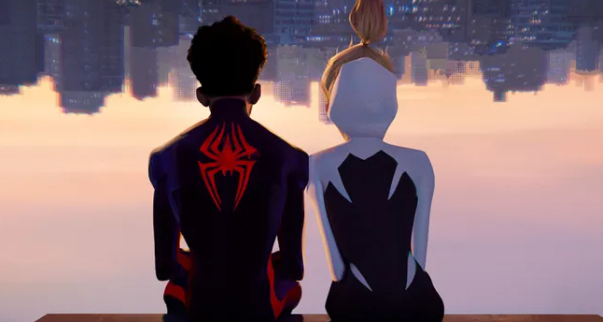
The Spot begins traveling the multiverse to absorb more power from other colliders, intending to become a god-like threat. Gwen is sent to Miles’ dimension on a reconnaissance mission to track the Spot. Although she is forbidden from seeing Miles, they reunite and share a tender moment overlooking the city. Miles secretly follows Gwen through a portal to Mumbattan (Earth-50101), where they team up with the charismatic Pavitr Prabhakar (Spider-Man India) and the rebellious Hobie Brown (Spider-Punk).
The conflict reaches a turning point when the Spot attempts to destroy Mumbattan’s collider. During the chaos, Miles saves Inspector Singh (the father of Pavitr’s girlfriend), an act that inadvertently disrupts a “Canon Event.” The group is whisked away to the Spider-Society’s headquarters in Nueva York (Earth-928), where Miles meets hundreds of Spider-variants. There, Miguel O’Hara explains the harsh reality of the multiverse: every Spider-Person’s life is governed by “Canon Events”—preordained tragedies (like the death of a police captain close to Spider-Man) that must occur to maintain the stability of their reality. Disrupting these events causes the universe to unravel and collapse.
Miguel reveals the devastating truth: Miles’ father, Jefferson Davis, is slated to become police captain in two days and is destined to die at the hands of the Spot. Miguel insists that Miles must allow this to happen to save the entire multiverse. Miles, refusing to accept a destiny built on tragedy, breaks out of containment. This triggers a massive, breathtaking chase across Nueva York as the entire Spider-Society pursues Miles to prevent him from reaching home. During the chase, Miguel snaps, pinning Miles down and callously labeling him the “original anomaly”—the mistake that caused the death of the original Peter Parker and the creation of the Spot.
With the help of Hobie, who quits the Society in protest, and Margo Kess (Spider-Byte), Miles uses a “Go Home Machine” to teleport back to his universe. However, the machine scans his DNA, which originated from the Earth-42 spider. Miles arrives home and confesses his identity to his mother, Rio Morales, only to realize with horror that he isn’t on Earth-1610. He is on Earth-42—a dark, crime-ridden world where his father is dead, and there is no Spider-Man to protect the city.
In a chilling final twist, Miles is captured by his Uncle Aaron, who is still alive in this reality. He is then confronted by the Earth-42 version of himself, who has become the Prowler. Back on Earth-1610, the Spot arrives to begin his assault. Gwen, having been exiled from the Spider-Society for her role in Miles’ escape, reconciles with her own father (who resigned as captain, proving the “canon” can be changed). She assembles a new team—including Peter B. Parker, Pavitr, Hobie, Margo, and the veterans from the first film (Spider-Man Noir, Peni Parker, and Spider-Ham)—to find Miles and save him from the Prowler and the impending multiversal collapse. The film ends on a pulse-pounding cliffhanger as the two Miles Morales face off.
10 Interesting Facts: Technical Prowess and Production Secrets
1. The Largest Crew in Animation History
While the first film was a massive undertaking with 180 animators, Across the Spider-Verse shattered records by employing a crew of over 1,000 animators. This represents the largest crew ever assembled for a single animated feature film. This massive scale was necessary to accommodate the six distinct art styles required for the different universes, ranging from the watercolor aesthetics of Earth-65 to the futuristic, ink-heavy lines of Earth-928. The production was so complex that work continued until just weeks before the theatrical release.
2. The 14-Year-Old Lego Prodigy
One of the most heartwarming production stories involves the Lego universe sequence. After a 14-year-old animator named Preston Mutanga posted a shot-for-shot Lego recreation of the film’s trailer on YouTube using the software Blender, producers Phil Lord and Christopher Miller were so impressed that they reached out to him. Mutanga was hired to animate the entire Lego segment of the film from his home in Toronto. He worked on the scenes during his spring break and after finishing his school homework, consulting with the directors via video calls.
3. Spider-Punk’s “Chaotic” Frame Rates
Hobie Brown (Spider-Punk), voiced by Daniel Kaluuya, is a technical marvel. To reflect his anarchist nature, the animators gave him a “collage” aesthetic inspired by 1970s London punk zines. Most uniquely, different parts of Hobie’s body are animated at different frame rates simultaneously. His jacket might be on “fours” (6 frames per second), his body on “threes” (8 frames per second), and his guitar on “twos” (12 frames per second). This creates a constant, vibrating visual dissonance that ensures he never looks “settled” in the frame, perfectly capturing his anti-establishment personality.
4. Gwen’s “Mood Ring” Universe
The art style of Earth-65 (Gwen’s world) was designed to look like a “living watercolor painting.” The colors in the background are not static; they function as a “mood ring” that shifts based on Gwen’s emotional state. During the emotional confrontation with her father, the colors bleed and drip down the screen like wet paint. To achieve this, Sony’s technical team developed a tool called Rebelle, which simulated the physical properties of paint on paper, allowing the colors to flow and blend dynamically in response to the character’s voice performances and movements.
5. The “Syd Mead” Influence on Nueva York
To design Miguel O’Hara’s world, the production team drew heavy inspiration from the legendary futurist Syd Mead, the visual mastermind behind Blade Runner and Tron. The world of Earth-928 is characterized by clean, sharp vertical lines and a “blueprint” aesthetic that contrasts sharply with the gritty, graffiti-inspired look of Miles’ Brooklyn. The animators used a technical process called “non-photorealistic rendering” to give the world a sense of “technical illustration” rather than organic life, emphasizing Miguel’s rigid, law-abiding personality.
6. The Expressionist Roots of The Spot
The visual design of The Spot underwent an evolution from a “goofy villain” to a “multiversal horror.” His look was inspired by the works of Austrian expressionist painter Egon Schiele. The animators used “scratchy” line work and an unfinished sketch aesthetic to make him look like a drawing that is constantly being erased and redrawn. As he gains power, his spots—which are individually rigged objects—become more erratic and “ink-heavy,” eventually becoming a void that swallows the background entirely.
7. Mumbattan and Indrajal Comics
The universe of Spider-Man India (Pavitr Prabhakar) is a fusion of Manhattan and Mumbai, dubbed “Mumbattan.” The visual style was meticulously researched to pay homage to the Indrajal Comics published in India during the 1970s. This style includes specific printing artifacts, vibrant color palettes common in Indian pop art, and architectural motifs that blend futuristic skyscrapers with traditional Indian temples. The “Mandala” patterns seen in the collider sequence were also used to represent the spiritual connection Pavitr feels toward his role as a protector.
8. Miguel O’Hara’s “Animalistic” Movement
Unlike Miles or Peter B. Parker, who move with a fluid, athletic grace, Miguel O’Hara was designed to move like a predator. Because the 2099 version of Spider-Man lacks the “sticky” skin of his counterparts and instead uses talons, his movement is more about “tearing” through the environment. The animators studied the movements of big cats and panthers to give Miguel a heavier, more aggressive silhouette. This is most evident in the “Go Home” sequence, where he chases Miles through the headquarters using brute force and animalistic lunges.
9. Live-Action and Multiversal Cross-Pollination
The film pushed the boundaries of the “Spider-Verse” by including live-action segments, most notably the appearance of Mrs. Chen from the Venom universe and a cameo by Donald Glover as a version of the Prowler trapped in the Spider-Society. These were not just easter eggs but were technically integrated into the animated environment. The crew had to match the lighting and color grading of the live-action footage to the specific “Spider-Society” art style to ensure the characters didn’t look like they were simply superimposed, but rather physically present in that dimension.
10. The Structural Influence of “The Empire Strikes Back”
Producers Lord and Miller have explicitly stated that Across the Spider-Verse was structured as their Empire Strikes Back. This influenced everything from the color palette (which becomes significantly darker and more saturated as the film progresses) to the ending. The choice to end on a cliffhanger was a calculated risk that allowed the creators to spend more time on character-building conversations, such as the two-year-long development of the rooftop conversation between Miles and Gwen, ensuring that the emotional stakes matched the visual spectacle.


Leave a Reply