
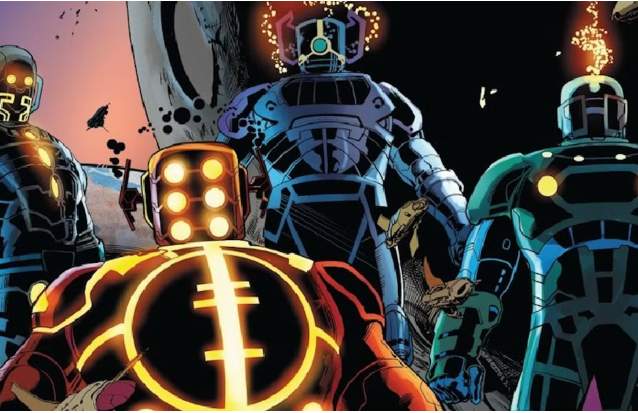
In the vast, shimmering tapestry of the Marvel Universe, there are beings that make the Avengers look like ants and make planetary gods like Odin or Zeus seem like mere mortals. These are the Celestials—titanic, armor-clad entities that stride through the cosmos like silent, judging mountains. Since their introduction to the comic book mythos, they have stood as the ultimate “gardeners” of the multiverse, responsible for the creation of entire species and the destruction of worlds that fail their inscrutable tests.
To understand the Celestials is to look into the very engine room of existence. They are not merely aliens from a distant galaxy; they are the physical manifestations of cosmic intent. Clad in impenetrable armor that towers two thousand feet high, these “Space Gods” represent a scale of power and mystery that defines the cosmic hierarchy of Marvel Comics. This guide delves into the essential history, terrifying power, and profound influence of the Celestials, offering a definitive look at the beings who shaped the destiny of humanity.
1. The Primordial Origins of the First Firmament
The story of the Celestials begins before the multiverse even existed. In the beginning, there was only the “First Firmament,” a singular, sentient universe that existed in total solitude. To ease its loneliness, this consciousness created life: the Aspirants and the Celestials. While the Aspirants were loyal servants who worshipped the First Firmament, the Celestials were rebels. They possessed a desire for a “multi-verse”—a dynamic, evolving reality where life could change, grow, and die rather than remaining static and subservient.
This philosophical rift led to the War in Heaven, a conflict of such staggering proportions that it shattered the First Firmament. The fragments of that original universe became the first multiverse. The Celestials emerged as the victors, and they took it upon themselves to travel through this new, fractured reality to seed life and guide evolution. They are, in essence, the parents of the multiverse, though they are parents who rarely speak and often judge their children with cold, calculating indifference. This origin cements their role not as mere visitors, but as the foundational architects of everything that currently exists in the Marvel cosmic landscape.
2. The Inscrutable Nature of the Celestial Armor
One of the most striking things about a Celestial is their appearance. They are always seen in massive, ornate suits of armor that feature no visible eyes, mouths, or skin. These suits are not just protective gear; they are the vessels that contain the Celestials’ true forms. Within these two-thousand-foot shells resides pure, concentrated cosmic energy. In fact, many believe that a Celestial is not a biological entity at all, but a sentient localized explosion of power held together by sheer will and advanced technology.
The armor itself is nearly indestructible, capable of withstanding the impact of a supernova or a direct assault from the combined might of Earth’s strongest heroes. Because they never speak verbally—communicating instead through immense telepathic pulses or the actions of their “Gatherers”—their armor serves as their only identity. The designs are often vibrant and complex, suggesting a culture and a sense of aesthetics that are entirely alien to the human mind. To look upon a Celestial is to look upon a machine that is also a god, a silent sentinel whose very presence warps the gravity and atmosphere of the planet it stands upon.
3. The Four Great Hosts of Earth
The Celestials do not simply visit a planet and stay there; they arrive in “Hosts” to perform specific functions over millions of years. Earth has been visited by four primary Celestial Hosts, each marking a major turning point in human history. The First Host arrived roughly one million years ago to perform genetic experiments on Earth’s ancestors, creating the three distinct branches of humanity: the Eternals, the Deviants, and “normal” humans with a latent potential for mutation.
The subsequent Hosts served to monitor the progress of these experiments. The Second Host returned to judge the Deviants, whose chaotic evolution had led them to conquer the world; this visit resulted in the Great Cataclysm that sank Atlantis. The Third Host inspected the development of human civilization, and the Fourth Host arrived in the modern era to deliver a final judgment on whether humanity deserved to continue existing. This “Host” system demonstrates their patient, methodical approach to creation. They are like scientists checking in on a petri dish, willing to wait eons to see if their “crop” yields the desired results or if the entire batch needs to be incinerated.
4. Genetic Engineering: Eternals, Deviants, and Mutants
The most direct impact the Celestials have had on the Marvel Universe is the creation of the superhuman race. During the First Host, a Celestial known as Zgreb the Aspirant (and later others) manipulated the DNA of early hominids. They created the Eternals—near-immortal, powerful beings intended to be the guardians of the planet—and the Deviants—unstable, constantly mutating creatures who often fell into darkness. However, the most significant change they made was the “seeding” of the human genome with a dormant gene.
This latent genetic potential is the reason why humans in the Marvel Universe can gain powers through radiation, chemicals, or natural mutation. The X-Gene, which creates Mutants, is a direct byproduct of Celestial interference. In this sense, every superhero on Earth owes their existence to the genetic tampering of these space gods. The Celestials didn’t just create life; they created a world where life had the capacity to become godlike itself. This makes the relationship between humanity and the Celestials deeply personal, as we are effectively their long-term biological experiment.
5. Arishem the Judge and the Hierarchy of Power
While there are many Celestials, they operate under a strict and terrifying hierarchy. At the forefront of their judicial process is Arishem the Judge. Arishem is one of the most powerful and feared of their kind, distinguished by his red armor and the circular vents on his faceplate. It is Arishem who holds the power of life and death over a world. When a Host concludes its observation, Arishem stands in judgment; if he turns his thumb down, the planet is targeted for total annihilation.
Other notable Celestials include Exitar the Exterminator, a being even larger than the standard Celestial who is summoned specifically to destroy worlds that fail Arishem’s judgment. There is also Eson the Searcher, who seeks out new life, and Jemiah the Analyzer, who records and categorizes all genetic data. This specialization shows that the Celestials are a highly organized collective. They do not act on whim or emotion; they follow a cosmic protocol that has been refined over billions of years, making their “judgments” feel less like an act of malice and more like a cold, unavoidable law of nature.
6. The Celestial Seed and Planetary Reproduction
A recurring and often terrifying concept in Marvel lore is the idea that planets are not just rocks, but incubators. In certain interpretations of their mythos, a Celestial begins its life as a “seed” planted within the core of a planet. Over millions of years, the Celestial embryo feeds on the energy of the world, eventually “hatching” and destroying the host planet in the process. This provides a dark motivation for their protection of certain worlds—they aren’t protecting the people, they are protecting the egg.
This lifecycle explains why the Celestials are so invested in the genetic health of a planet’s inhabitants. The sentient life on the surface often serves as a protective layer or a source of energy for the growing god within. While this “Earth X” interpretation isn’t always the primary canon in every era, it remains a pillar of Celestial lore that highlights their cosmic indifference. To a Celestial, the extinction of a billion humans is a small price to pay for the birth of one of their own. They view planets the way humans view fertile soil: a place to plant a crop and move on once the harvest is complete.
7. Knowhere: The Severed Head of a God
One of the most famous locations in the Marvel cosmic landscape is “Knowhere,” a space station built inside the hollowed-out, severed head of a long-dead Celestial. Knowhere sits at the literal edge of the universe and serves as a neutral ground for travelers, traders, and cosmic entities. The fact that a severed Celestial head is large enough to house an entire city—complete with its own atmosphere and gravity—gives a vivid sense of the sheer physical scale of these beings.
The mystery of how this Celestial died remains one of the great enigmas of the cosmos. To kill a Celestial is an act of such power that it usually requires another Celestial or a force of equal cosmic standing, such as the King in Black or a wielder of the Infinity Stones. Knowhere serves as a grim reminder that even the “immortal” space gods can fall. It also provides a unique look at Celestial biology; the “brain matter” and spinal fluids of the deceased god are often harvested as incredibly powerful, albeit dangerous, scientific resources.
8. Tiamut the Dreaming Celestial: The Rebel
Not all Celestials follow the collective will of the Host. Tiamut, known as the Dreaming Celestial, is a fascinating exception to the rule of silent conformity. During the Second Host, Tiamut disagreed with his brethren regarding the judgment of Earth. He believed that the Celestials were overstepping their bounds, leading to a civil war among the gods. Tiamut was eventually overpowered, his essence stripped away, and his body entombed beneath the mountains of Earth in a state of eternal “dreaming.”
For eons, Tiamut remained a sleeping giant, his presence subtly influencing the psychic landscape of humanity. When he eventually awoke, he did not immediately destroy the world; instead, he began to question his own nature and the nature of the “Fulcrum” (the power the Celestials serve). Tiamut’s story is one of the few instances where a Celestial demonstrates something akin to an individual soul or a moral conscience. His presence in San Francisco’s Golden Gate Park as a silent, unmoving statue became a landmark of the Marvel Universe, representing the thin line between a cosmic judge and a planetary guardian.
9. The Progenitor and the Origin of Superpowers
Long before the First Host, a lone, dying Celestial known as the Progenitor fell to Earth. Infected by an ancient cosmic horde, the Progenitor died in the primordial soup of the young planet. As his god-like blood and fluids seeped into the Earth’s ecosystem, they fundamentally altered the biological potential of the world. This “original sin” of Celestial death is often cited as the true reason why Earth is such a hotbed for superhuman activity compared to other planets.
The Progenitor’s remains acted as a catalyst, accelerating evolution and ensuring that life on Earth would always be “extraordinary.” This means that humans are not just an experiment the Celestials visited; we are a species born from the literal remains of a fallen space god. This connection explains the Celestials’ recurring interest in Earth. They aren’t just looking at a random planet; they are looking at a world that was “poisoned” by the essence of one of their own, making Earth a unique anomaly in the multiverse that must be constantly monitored and, eventually, judged.
10. The Celestials vs. The Cosmic Entities
Where do the Celestials stand in the “pecking order” of the Marvel Universe? While they are immensely powerful, they are not the absolute top of the pyramid. They exist alongside other abstract entities like Galactus, Eternity, and Death. Interestingly, Galactus—the Devourer of Worlds—is often seen as a necessary counterbalance to the Celestials. While the Celestials create and seed life, Galactus consumes the energy of planets to prevent the universe from being “overrun” by Celestial expansion.
The Celestials have also faced off against the “Skyfathers,” the leaders of Earth’s ancient pantheons. In one of the most famous battles in comic history, Odin donned the Destroyer armor, infused with the life force of all of Asgard, to challenge the Fourth Host. Even with that incredible power, the Celestials stood their ground, effortlessly melting the Destroyer armor and proving that the “Gods” of myth are mere children compared to the Architects of the Universe. They represent the “Hard Science” of the cosmos—unfeeling, universal, and ultimately superior to the magic and mythology of lesser beings.
Further Reading
- Eternals by Jack Kirby – Jack Kirby
- The Celestials Saga (Thor #283-301) – Roy Thomas and Mark Gruenwald
- Earth X – Jim Krueger and Alex Ross
- Fantastic Four: Solve Everything – Jonathan Hickman
- Eternals – Neil Gaiman and John Romita Jr.




One response to “10 Things You Should Know About The Celestials – Marvel Comics”
[…] 10 Things You Should Know About The Celestials – Marvel Comics […]