
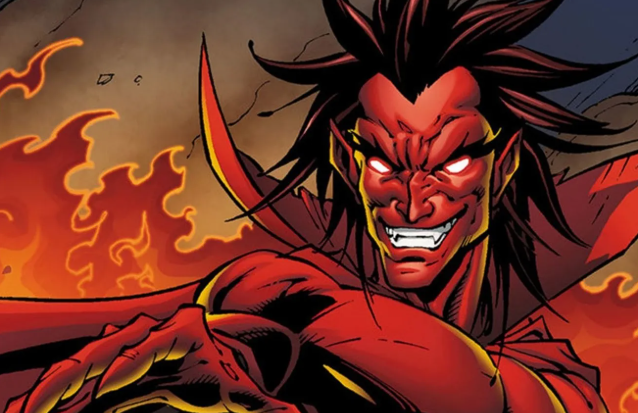
In the vast and often cosmic landscape of the Marvel Universe, heroes face threats ranging from street-level thugs to planet-eating entities. However, there is one figure who doesn’t just want to conquer the world or destroy the stars—he wants to own your very soul. That figure is Mephisto. Often mistaken for the biblical Satan, Mephisto is an extra-dimensional demon of immense power who thrives on the corruption of the innocent and the desperation of the powerful. He is the ultimate “deal-maker,” a cosmic predator who operates through contracts, fine print, and the exploitation of human desire.
To understand Mephisto is to understand the darkest corners of the Marvel mythos. He is not a brute-force villain who simply punches his way to victory; he is a chess master who thinks in centuries, planting seeds of discord that may not bloom for generations. Whether he is tempting a grieving hero with the return of a loved one or whispering poisonous advice into the ear of a cosmic tyrant, Mephisto remains the quintessential personification of evil. This guide explores the essential truths about the Lord of Lies, providing a comprehensive look at the demon who has fundamentally altered the lives of Marvel’s greatest icons.
1. He Is Not the Biblical Satan
One of the most common misconceptions about Mephisto is that he is the literal Devil from Abrahamic theology. While he frequently adopts the imagery, name, and sulfurous stench associated with Satan to intimidate mortals, he is actually an extra-dimensional demon. In the Marvel Universe, there are many “Hell-Lords,” including Hela, Pluto, and Satannish, each ruling their own pocket dimension. Mephisto is simply the most prominent and ambitious of these entities. He uses the “Satan” persona as a marketing tool, recognizing that human beings are more likely to fear—and negotiate with—a figure they already recognize from their own cultural nightmares.
Because he is not a singular theological entity, Mephisto’s power is tied specifically to his own dimension, often referred to as the Netherworld or simply “Hell.” Outside of this realm, his power can fluctuate, which is why he relies so heavily on manipulation and contracts rather than direct physical confrontation. He is a creature of ego and artifice, a being who has spent eons crafting a brand of evil that is as much about psychological theater as it is about mystical might. By pretending to be the ultimate source of evil, he gains a psychological advantage over his victims before a single word is even spoken.
2. The Architect of the Ghost Rider’s Curse
Perhaps Mephisto’s most famous act of manipulation involves the creation of the Ghost Rider. When a young stunt cyclist named Johnny Blaze discovered his mentor was dying of cancer, he turned to the occult for help. Mephisto appeared, offering a deal: the mentor’s life in exchange for Blaze’s soul. In typical Mephisto fashion, the mentor was cured of cancer only to die in a stunt accident moments later. Mephisto then bonded Blaze’s soul to the demon Zarathos, transforming him into the Spirit of Vengeance. This act wasn’t just about obtaining a soul; it was about creating a weapon that would serve Mephisto’s interests on the mortal plane.
The relationship between Mephisto and the Ghost Rider is one of eternal conflict. Mephisto views the Rider as his “property,” while the various hosts (Blaze, Danny Ketch, and others) fight to use their hellish powers for justice. This cycle of bondage and rebellion is a perfect example of how Mephisto operates. He doesn’t just want to win; he wants to trap his victims in a state of perpetual irony and suffering. By giving Blaze exactly what he asked for—but in the most devastating way possible—Mephisto proved that the “Spirit of Vengeance” was born from a foundation of pure, calculated cruelty.
3. The Infamous “One More Day” Agreement
In one of the most controversial storylines in comic book history, Mephisto demonstrated that he could break the strongest bonds of love. When Aunt May was dying from a gunshot wound, Spider-Man (Peter Parker) was desperate enough to listen to the devil. Mephisto offered to save May’s life, but he didn’t want Peter’s soul—he wanted Peter’s marriage to Mary Jane Watson. Mephisto’s reasoning was purely sadistic: a soul is a finite prize, but erasing a “pure” love that was destined to span lifetimes provided him with a unique, transcendent joy. He wanted to rob the universe of a symbol of hope.
The deal, known as “One More Day,” resulted in a rewritten reality where Peter and Mary Jane were never married. This event highlights Mephisto’s role as a meta-textual threat; he doesn’t just change the plot, he changes the very history and status quo of the Marvel Universe. For Mephisto, the “kill” is secondary to the “corrupt.” By forcing a hero like Spider-Man to make a deal with the devil to save a loved one, Mephisto effectively tainted the morality of one of the world’s most selfless heroes. He thrives on the “dirty win,” knowing that the hero will have to live with the secret cost of their survival forever.
4. His Endless Obsession with the Silver Surfer
While Mephisto targets many heroes, he has a particular, almost romantic obsession with the Silver Surfer. To Mephisto, the Surfer represents the ultimate prize: a soul of absolute purity. Having been the herald of Galactus, Norrin Radd has witnessed the destruction of worlds but has maintained a spirit of self-sacrifice and nobility. Mephisto finds this purity offensive and spends much of his time attempting to tempt, break, or trick the Surfer into committing a single act of evil. He has offered the Surfer everything from his home planet of Zenn-La to the love of his life, Shalla-Bal.
The battles between the two are rarely physical; they are spiritual debates and psychological wars. Mephisto has subjected the Surfer to illusions of paradise and the depths of despair, all in an attempt to get him to kneel. The Surfer’s continued resistance is a source of constant frustration for the demon. This dynamic illustrates Mephisto’s primary motivation: he isn’t just a hoarder of souls; he is a connoisseur. He values the souls of the virtuous far more than those of the wicked, seeing the corruption of a “saint” as the highest form of artistic achievement in the dark arts.
5. A Realm That Reflects His Twisted Will
Mephisto’s domain is a pocket dimension that he has shaped to resemble the traditional depictions of Hell. It is a place of fire, brimstone, and eternal torment, but its most dangerous attribute is that it is an extension of Mephisto himself. Within his realm, he is virtually omnipotent. He can reshape the landscape, create lifelike illusions, and manipulate the passage of time. The “souls” he has collected are kept here in various states of agony, often serving as decorative ornaments or playthings for his amusement.
However, the realm is also a source of vulnerability. Because his power is so deeply tied to this dimension, he is significantly weakened when he leaves it. This is why he often uses avatars, projections, or deals to influence the Earthly plane. Entering Mephisto’s realm is a death sentence for most mortals, as the very atmosphere is designed to erode one’s willpower and sanity. It is a psychological labyrinth where the walls speak of your failures and the shadows take the form of your deepest regrets. For Mephisto, “home” is a place where he can be the absolute god of everyone else’s misery.
6. The Master of Legalistic Trickery
Mephisto is often described as the “ultimate lawyer” of the Marvel Universe. Unlike other villains who might use a “magic wand” to get what they want, Mephisto uses a contract. He is bound by a personal and cosmic code that requires his victims to enter into agreements of their own free will. He cannot simply steal a soul; it must be surrendered. This makes him far more dangerous than a standard monster, as he uses the victim’s own desires and weaknesses against them. He is the master of the “monkey’s paw” scenario—giving you exactly what you asked for in a way that makes you wish you hadn’t.
This reliance on contracts means that Mephisto is always looking for a loophole. He will omit crucial details, use ambiguous language, or wait for the perfect moment of emotional instability to present his terms. To beat Mephisto, one must often out-think him or find a legal flaw in his demonic pacts. Heroes like Doctor Strange and Black Panther have successfully navigated these waters, but even then, the cost is usually high. Mephisto’s commitment to the “letter of the law” over the “spirit of the law” makes him a terrifying reflection of human greed and the dangers of seeking shortcuts to happiness.
7. His Treacherous Role in the Infinity Gauntlet
During the legendary events involving the Infinity Gauntlet, Mephisto played a role that perfectly showcased his opportunistic nature. When Thanos wiped out half of all life in the universe, Mephisto didn’t join the heroes to stop him; instead, he became Thanos’s sycophantic advisor. He spent the entire crisis whispering in the Mad Titan’s ear, offering “advice” that was actually designed to subtly undermine Thanos’s confidence and lead to his eventual defeat. Mephisto wasn’t being a hero; he simply didn’t want another being to possess the ultimate power of the universe.
Mephisto’s behavior during this time was a masterclass in double-crossing. He bowed and scraped before Thanos while simultaneously looking for any opportunity to seize the Gauntlet for himself. He understands that in the presence of a god-like being, the best position to be in is the shadow. By positioning himself as a loyal servant, he ensured his own survival while waiting for the inevitable moment when the “new god” would slip up. This incident serves as a reminder that Mephisto has no true allies—only people he hasn’t betrayed yet.
8. The Progenitor of Blackheart and Mephista
Even a demon king occasionally desires a legacy, though Mephisto’s version of fatherhood is predictably dark. He created his “son,” Blackheart, from the accumulated energy of centuries of murder and evil in a specific location on Earth. However, instead of a loving relationship, Mephisto raised Blackheart to be as ruthless and treacherous as himself. This backfired, as Blackheart eventually attempted to overthrow his father and take control of the Netherworld. Mephisto also has a daughter, Mephista, who has similarly clashed with her father and various Earthly heroes.
These “children” represent Mephisto’s attempts to diversify his influence, but they also highlight his inability to truly trust anyone. He views his progeny as extensions of his own power rather than independent beings. The constant infighting between Mephisto and Blackheart is a staple of Marvel’s occult storylines, proving that in the pits of Hell, the only thing more dangerous than a demon king is his ambitious heir. This cycle of betrayal is Mephisto’s own creation, a reflection of the fact that an existence built on lies cannot sustain even the simplest of familial bonds.
9. Vulnerability to Divine Power and Purity
For all his cosmic power, Mephisto is not invincible. He has several key weaknesses that heroes have exploited over the years. First and foremost is his vulnerability to genuine divine power and holy artifacts. While he is an extra-dimensional being, he is susceptible to the energy of “true” light. Items like the Eyes of Agamotto or the power of pure, selfless spirits can cause him immense physical and spiritual pain. He also cannot stand the presence of absolute, uncorrupted innocence, which acts like a psychic irritant to his demonic nature.
Additionally, Mephisto is bound by the rules of the dimensions. If he is defeated in his own realm, it can take him centuries to reform his power. He is also susceptible to the “Great Powers” of the universe, such as the Living Tribunal or Eternity, who view him as a necessary but subservient part of the cosmic balance. This suggests that Mephisto is a “functional” evil—a part of the universe’s ecosystem that exists to provide a choice between dark and light. When he oversteps those bounds, the universe itself often finds a way to correct his path.
10. The Eternal Tempter of the Human Race
Ultimately, Mephisto’s greatest power is not his hellfire or his shapeshifting; it is his understanding of the human heart. He knows that everyone, no matter how heroic, has a price. Whether it’s the return of a lost parent, the healing of a broken body, or the erasure of a shameful mistake, Mephisto knows how to find the crack in the armor. He is the eternal tempter, a being who proves that the greatest threats aren’t the ones that break your bones, but the ones that make you compromise your soul.
His presence in the Marvel Universe ensures that there is always a moral weight to the characters’ choices. He reminds us that power always comes with a cost and that there are no truly “easy” fixes for life’s tragedies. As long as there is greed, grief, and ambition, Mephisto will be there, waiting in the shadows with a pen and a piece of parchment. He is the ultimate reminder that the greatest battles are fought within ourselves, and that the devil’s greatest trick isn’t making you believe he doesn’t exist—it’s making you believe you need his help.
Further Reading
- Silver Surfer: Judgment Day by Stan Lee and John Buscema
- Spider-Man: One More Day by J. Michael Straczynski and Joe Quesada
- Doctor Strange & Doctor Doom: Triumph and Torment by Roger Stern and Mike Mignola
- Ghost Rider: Resurrected by Howard Mackie



