
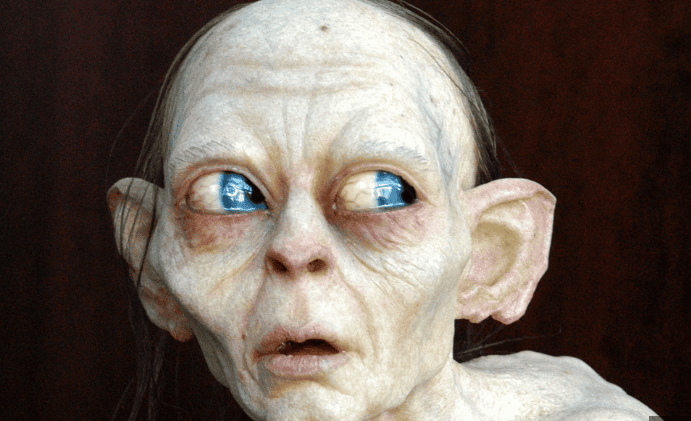
Few characters in literary history evoke as much simultaneous pity and Revulsion as the creature known as Gollum. Born from the imagination of J.R.R. Tolkien, Gollum serves as a dark mirror to the protagonists of The Lord of the Rings, showing exactly what happens when a soul is utterly consumed by an object of ultimate power. Whether you are a newcomer to Middle-earth or a seasoned traveler of the Misty Mountains, understanding Gollum is key to understanding the central themes of Tolkien’s legendarium: the corrupting nature of evil and the unexpected power of mercy.
Below is a deep dive into the history, psychology, and biology of the creature who was once a simple river-dweller named Sméagol.
1. The Humble Origins of a River-Folk Stoor
Before he was a “slimy thing” living in the roots of the mountains, Gollum was a member of the River-folk, a branch of the Stoor hobbits. The Stoors were known for being broader and heavier than other hobbits, and they had a unique affinity for water and boats. Sméagol lived in a matriarchal society led by his formidable grandmother, spending his days exploring the banks of the Anduin River.
This origin is crucial because it explains why the One Ring was able to take hold of him so effectively. Like all hobbits, Sméagol possessed a natural resilience to magic, but his specific personality—inquisitive, secretive, and slightly selfish—provided the perfect soil for the Ring’s malice to grow. Unlike the heroic Frodo, Sméagol was already prone to “looking at the roots of things” and seeking out hidden knowledge, a trait that the Ring exploited to turn him inward, away from the light of the sun and the company of his kin.
2. A Birthday Present Bathed in Blood
The turning point of Sméagol’s life occurred on his birthday during a fishing trip with his friend (or cousin) Déagol in the Gladden Fields. When Déagol discovered a gold ring at the bottom of the river, the malevolent power of the One Ring acted almost instantaneously. Sméagol demanded the ring as a “birthday present,” and when Déagol refused, Sméagol strangled him to death.
This act of murder is the defining moment of Gollum’s existence. By spilling blood for the Ring, he bypassed the slow corruption that others experienced and immediately fell under its shadow. The “Precious” became his only companion and his only master. He used the Ring’s power of invisibility to spy on his people and learn secrets, eventually becoming so obnoxious and disruptive that his grandmother exiled him from the community. This rejection drove him into the wild, where the light of the sun became an unbearable reminder of his guilt.
3. The Biological Toll of Five Centuries in Darkness
One of the most fascinating aspects of Gollum is his physical transformation. After his exile, he crawled into the dark heart of the Misty Mountains. Over nearly 500 years, his body adapted to a life of perpetual shadow, cold, and dampness. His skin became pale and translucent, his limbs lengthened and grew spindly, and his feet and hands became webbed and powerful for climbing and swimming.
Perhaps most striking were his eyes, which grew large and luminous, functioning like lamps to see in the pitch black. His digestive system also adapted; he developed a revulsion for “hobbit-food” (like bread and cooked meat), preferring raw fish and the occasional young goblin. The name “Gollum” itself is a biological byproduct of this life—a wet, guttural sucking sound he made in his throat as he struggled with the physical and psychological weight of the Ring’s influence.
4. An Unnatural Longevity Beyond Mortal Limits
The One Ring is not a gift-giver; it is a thief. While it granted Sméagol a life span far exceeding that of any hobbit, it did not provide “true” life. Bilbo Baggins famously described the feeling as being “spread thin, like butter scraped over too much bread.” For Gollum, this stretching lasted for centuries. He did not age in the traditional sense; he simply persisted.
This longevity was a form of torture. The Ring held his spirit to his body long after his mind had begun to fracture. It preserved him only so it could continue to be carried and protected. This “fading” effect is a central mechanic of Tolkien’s world—mortals who use Great Rings eventually become shadows, existing in both the physical world and the unseen world. Gollum remained just on the edge of becoming a wraith, tethered to the physical world only by his singular obsession with the gold.
5. The Great Psychological Divide: Sméagol vs. Gollum
Gollum is perhaps the most famous literary example of a split personality. The Ring’s influence caused his psyche to fracture into two distinct personas: Sméagol and Gollum. Sméagol represents the vestigial remains of the hobbit he once was—timid, desperate for connection, and capable of remembering kindness. Gollum represents the Ring’s corruption—malicious, paranoid, and obsessed with the “Precious.”
These two halves often held audible debates, a phenomenon known as “the Slinker and the Stinker.” Sméagol (the Slinker) would try to please his masters (like Frodo), while Gollum (the Stinker) would plot their demise. This internal conflict is what makes the character so tragic; there is a flickering candle of humanity still burning inside him, but the overwhelming shadow of the Ring constantly threatens to snuff it out.
6. The Riddle-Game and the Loss of the Precious
The encounter between Bilbo Baggins and Gollum is the most pivotal event in the history of the Third Age. Deep in the Goblin-town tunnels, Gollum lost his “Precious.” For the first time in centuries, the Ring had decided to leave him, sensing the growing power of its true master, Sauron. When Bilbo stumbled upon the Ring in the dark, he unknowingly set the fate of the world in motion.
The subsequent riddle-game was more than just a test of wits; it was a clash of cultures. Gollum’s riddles were dark, focused on death, wind, and darkness. Bilbo’s riddles were of the sun, daisies, and everyday life. When Bilbo won by asking, “What have I got in my pocket?” Gollum’s rage and despair were total. The loss of the Ring did not free him; it only gave him a new, singular purpose: to hunt down the “thief” and reclaim his heart’s desire.
7. Torture in the Dungeons of Barad-dûr
After losing the Ring, Gollum eventually ventured out of the mountains. His search led him toward the land of Mordor, drawn by the dark magnetism of the Ring’s creator. He was captured by Sauron’s forces and taken to the Dark Tower of Barad-dûr. There, he was subjected to unspeakable horrors as the Dark Lord sought information about the Ring’s whereabouts.
Under torture, Gollum revealed two words: “Shire” and “Baggins.” These two words changed everything, directing the Nazgûl to the home of the hobbits. However, Gollum’s resilience was so great that even Sauron could not fully break him. He was eventually released—not out of mercy, but as a “hound” that Sauron hoped would lead his servants to the Ring. This period of his life cemented his hatred for both the “Good” folk of the world and the “Great Eye” that had tormented him.
8. The Impossible Guide Through the Dead Marshes
When Frodo and Sam took on the task of bringing the Ring to Mount Doom, they encountered Gollum in the Emyn Muil. Rather than killing him, Frodo chose to show him mercy, a decision that Gandalf had foreseen as vital. Gollum, bound by a promise “on the Precious,” became their guide through the treacherous Dead Marshes and up to the gates of Mordor.
During this journey, the character of Sméagol briefly resurfaced. He showed genuine loyalty to “Master” Frodo, who treated him with a dignity he hadn’t felt in centuries. However, the constant presence of the Ring—hanging around Frodo’s neck—and the harsh treatment by Samwise Gamgee (who never trusted him) eventually pushed the Gollum personality back to the forefront. This tension created one of the most suspenseful dynamics in the entire narrative.
9. The Betrayal at Cirith Ungol
The ultimate proof of Gollum’s corruption was his plot to lead the hobbits into the lair of Shelob, the Great Spider. Gollum believed that if Shelob killed the hobbits and tossed aside their clothes and belongings, he could scavenge the Ring from the remains. He felt that Shelob was a power he could bargain with, or at least a force that would do his dirty work without claiming the Ring for herself.
This betrayal highlights the tragedy of his character. Just moments before the betrayal, Gollum watched Frodo sleeping and felt a wave of old, hobbit-like affection. For a split second, he was on the verge of repentance. But Sam woke up and spoke harshly to him, and the moment passed forever. Gollum chose the spider over the friend, sealing his own doom alongside his plan.
10. The Accidental Savior of Middle-earth
The story of Gollum concludes at the Cracks of Doom. When Frodo finally reached the fire, he succumbed to the Ring’s power and refused to destroy it. At that moment, the world was lost—until Gollum intervened. In a final, desperate struggle, Gollum bit the finger off Frodo’s hand, reclaiming his “Precious” at last.
In his blind joy, dancing on the edge of the abyss, Gollum slipped and fell into the lava. By his own greed and obsession, he achieved what no hero could: the destruction of the One Ring. Tolkien often remarked that while Gollum was an evil creature, his part was “ordered” by a higher providence. It was Frodo’s initial mercy in sparing Gollum’s life that ultimately allowed the quest to succeed. Gollum died as he lived—consumed by the gold, yet serving a purpose far greater than he could ever comprehend.
Further Reading
- The Hobbit by J.R.R. Tolkien
- The Fellowship of the Ring by J.R.R. Tolkien
- The Two Towers by J.R.R. Tolkien
- The Return of the King by J.R.R. Tolkien
- The Letters of J.R.R. Tolkien edited by Humphrey Carpenter
- 10 Things You Should Know About Strider Aragorn II – Lord Of The Rings
- 10 Things You Should Know About Gandalf – Lord Of The Rings
- 10 Things You Should Know About Gollum – Lord Of The Rings



