
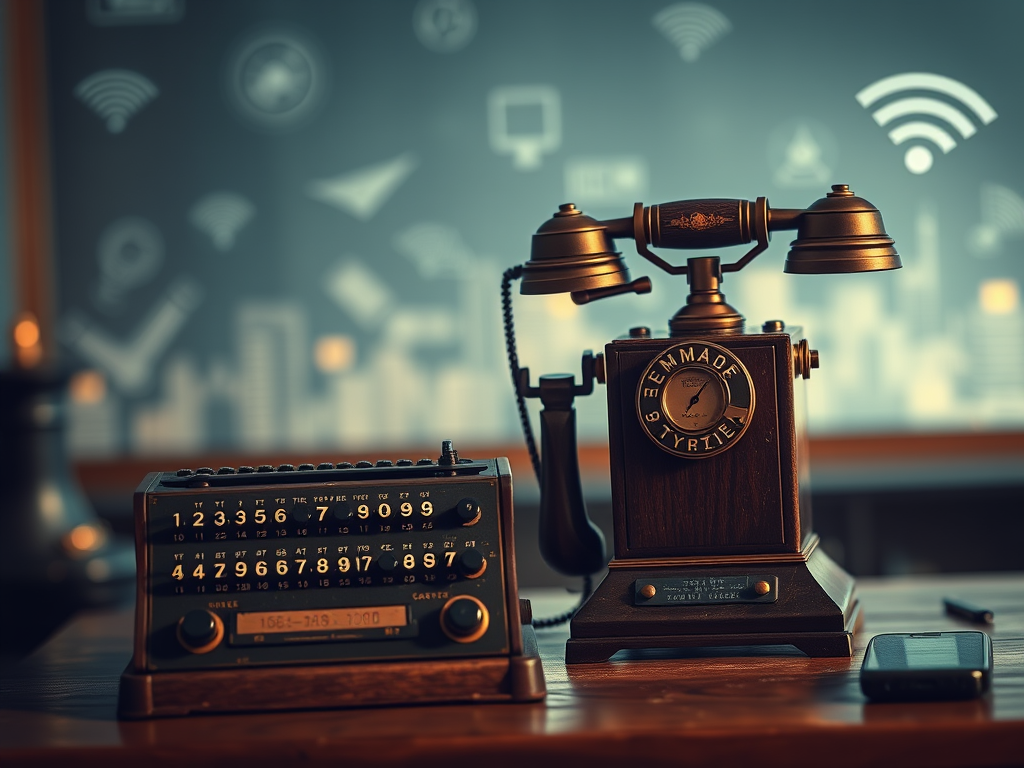
Have you ever sent a text message, video called a friend, or binge-watched your favourite show online? These everyday miracles are possible thanks to an amazing journey of invention and discovery in how we communicate. For thousands of years, humans have been finding clever ways to share information over distances, from simple smoke signals to the super-fast internet we use today. It’s a story packed with brilliant ideas and technologies that have shrunk our world and connected us in ways our ancestors could only dream of.
Imagine trying to send an urgent message before phones or the internet! It wasn’t easy. But human ingenuity has always found a way. This list will take you on a whirlwind tour of ten giant leaps in communication history, starting with a system of dots and dashes and ending with the invisible waves that bring the internet to your devices. Get ready to explore how these communication milestones changed everything!
1. Talking with Dots and Dashes: The Telegraph and Morse Code Magic
Long before you could instantly message a friend, sending information across long distances was a real challenge. Enter the electric telegraph, a game-changing invention from the 1830s, most famously developed by Samuel Morse. Imagine it like a super-long, invisible wire that could carry messages almost instantly! But how did it speak? Through Morse Code, a special alphabet made of dots (short signals) and dashes (long signals). Each letter and number had its own unique pattern, like “dot-dash” for “A” or “dash-dot-dot-dot” for “B.” Operators would tap out messages, which would travel as electrical pulses along the wires to a receiver at the other end. This was revolutionary! Suddenly, news, business information, and personal messages could cross countries, and even oceans (with undersea cables!), in minutes or hours instead of days or weeks. It was the first time humanity truly conquered long-distance communication with electricity, laying the groundwork for all the electronic communication that followed.
2. “Mr. Watson, Come Here!”: The Telephone Lets Voices Travel
While the telegraph was amazing for sending written messages, imagine the excitement when a machine could actually carry human voices over wires! This dream became reality thanks to inventors like Alexander Graham Bell, who is famously credited with patenting the first practical telephone in 1876. The legendary first words spoken over a telephone were supposedly Bell calling his assistant: “Mr. Watson, come here, I want to see you.” Think about it: for the first time, you could hear the actual voice of someone miles away, with all its emotion and personality. It was like magic! Early telephones were clunky and expensive, and you often had to go through an operator to connect your call. But the invention of the telephone transformed business and personal life, making real-time, two-way voice conversations possible across cities and eventually, the world. It was a huge step towards the instant voice calls we take for granted today.
3. Wireless Wonders: Radio Waves Send Messages Through the Air
Next up in our communication journey is the marvel of radio! Imagine sending messages not through wires, but invisibly through the air itself. That’s the magic Guglielmo Marconi and other pioneers unlocked in the late 19th and early 20th centuries. They figured out how to use electromagnetic waves, or radio waves, to transmit signals. At first, this was used for Morse Code messages, just like the telegraph, but without the need for physical cables. This was huge for ships at sea, allowing them to communicate over vast expanses of ocean. Then came an even bigger leap: sending voice and music! By the 1920s, public radio broadcasts began, and families would gather around their radio sets to listen to news, music, dramas, and sports. The history of radio communication shows it became the first mass broadcast medium, bringing shared experiences and information into homes worldwide, long before television or the internet.
4. Pictures in Your Living Room: The Dawn of Television
After hearing voices and music through the air, the next big question was: could we send pictures too? The answer was a resounding YES, with the invention of television! Early TV experiments started in the 1920s, with pioneers like John Logie Baird and Philo Farnsworth developing ways to capture moving images, convert them into electrical signals, transmit them through the air (or via cable), and then reassemble them on a screen. Imagine the wonder of seeing the first flickering black and white images appearing on a small screen! By the mid-20th century, television began to take off, bringing news, entertainment, and major world events directly into people’s homes. For the first time, families could see what was happening far away, from presidential speeches to moon landings. Television fundamentally changed how we consumed information and entertainment, becoming a dominant cultural force for decades.
5. The Space Connection: Satellites Beam Signals Around the Globe
How do you send TV signals or phone calls across vast oceans instantly? While undersea cables were one answer, another came from looking up to the stars: communication satellites! The idea is simple but brilliant: launch a satellite into orbit around the Earth, and it can act like a giant mirror in the sky. Signals are beamed up to the satellite from one point on Earth, and the satellite then relays them down to another point, potentially thousands of miles away. The first communication satellite, Telstar, was launched in 1962 and made live transatlantic television broadcasts possible. Satellites revolutionized global broadcasting, long-distance phone calls, and even early forms of GPS. They overcame the limitations of Earth’s curvature and physical barriers, making truly worldwide, real-time communication a practical reality. This satellite communication technology is a key part of our interconnected world today.
6. Computers Start Talking: The Birth of the Internet
Perhaps the most transformative communication invention of the last century is the Internet. It didn’t appear overnight but evolved from an idea in the 1960s for the U.S. military to have a communication network that could survive an attack. This network, called ARPANET, allowed computers in different locations to “talk” to each other by sending data in small packets. Scientists and academics then started using it to share research. Key developments like TCP/IP (the basic communication language of the internet) and the Domain Name System (which gives us website addresses like google.com) made it more usable. The real explosion for the public came with the invention of the World Wide Web by Tim Berners-Lee in the early 1990s, which made the internet visual and easy to navigate with browsers. Suddenly, a vast universe of information, communication, and connection was just a click away, leading to the digital age we live in.
7. Your Mail Goes Digital: The Rise of Email
Before the internet became a household name, one of its earliest “killer apps” was email (electronic mail). Imagine being able to type a letter on a computer and have it arrive in someone else’s digital mailbox almost instantly, anywhere in the world, without a stamp! Ray Tomlinson is credited with sending the first true network email in 1971, and he also introduced the “@” symbol to separate the user’s name from their host machine. In the early days, email was mostly used by scientists and people in universities. But as more people got access to computers and networks, email became an incredibly popular way to communicate for both personal and business reasons. It was faster than traditional mail (often called “snail mail”), cheaper, and allowed for easy forwarding and group messages. How email changed communication is profound; it paved the way for instant messaging and our constantly connected digital lives.
8. The World in Your Pocket: Mobile Phones Go Mainstream
While early “car phones” existed from the mid-20th century, they were bulky and incredibly expensive. The dream of a truly personal, portable mobile phone that you could carry anywhere began to become a reality in the 1980s and 1990s. These first “brick phones” were still quite large by today’s standards, but they were revolutionary because they untethered voice communication from fixed lines. You could make calls on the go! As technology improved, mobile phones got smaller, cheaper, and added new features like text messaging (SMS). The evolution of mobile phones was rapid. No longer did you need to be at home or in an office to make or receive a call. This ability to communicate from almost anywhere fundamentally changed social interactions, business practices, and personal safety. It was the foundation for the smartphones that are now central to so many lives.
9. Beyond Voice: Smartphones and the App Revolution
The mobile phone took an even bigger leap forward with the arrival of the smartphone in the late 2000s. These weren’t just for calls and texts anymore. With powerful processors, larger touchscreens, and internet connectivity (initially 3G, then 4G, and now 5G), smartphones became pocket-sized computers. The key innovation was the “app” – small software programs that allowed you to do almost anything: browse the web, watch videos, play games, get directions, manage your finances, and, of course, communicate in a dozen new ways through social media, instant messaging, and video chat. The impact of smartphones on communication has been immense. They put the internet, and a world of information and connection, directly into our hands, 24/7. This has reshaped industries, social norms, and how we interact with the world and each other, making communication more instant, visual, and versatile than ever before.
10. Invisible Connections: Wi-Fi and Truly Wireless Internet
Our final stop is a technology many of us use every single day without much thought: Wi-Fi. Imagine the internet, but without any pesky wires connecting your computer or phone to the wall! That’s what Wi-Fi gives us. Developed in the late 1990s, Wi-Fi uses radio waves (like the radio and TV we talked about earlier, but on different frequencies) to create a wireless local area network (WLAN). This network allows your devices – laptops, smartphones, tablets, smart TVs, game consoles – to connect to the internet and to each other without physical cables. You just need to be within range of a wireless router. How Wi-Fi works is by transmitting data back and forth using these radio signals. It has made internet access incredibly convenient, allowing us to be online in cafes, airports, schools, and homes, moving around freely with our devices. It’s the invisible backbone of much of our modern digital communication.
From the simple taps of Morse code to the complex data streams of Wi-Fi, the journey of communication technology has been incredible. Each step built on the last, driven by human curiosity and the desire to connect. What will the next big leap be?
Further Reading
For those interested in diving deeper into the fascinating history of communication, here are a few books that are great for younger readers and those new to the topic:
- “The Telephone: The Life Story of a Technology” by David L. Woods. (While a bit more detailed, it offers a good look into the telephone’s impact.)
- “Crystal Fire: The Birth of the Information Age” by Michael Riordan and Lillian Hoddeson. (This book covers the invention of the transistor, which is crucial for modern electronics, including communication devices.)
- “Where Wizards Stay Up Late: The Origins of the Internet” by Katie Hafner and Matthew Lyon. (A classic and engaging story of how the internet was born.)
- “The Victorian Internet: The Remarkable Story of the Telegraph and the Nineteenth Century’s On-Line Pioneers” by Tom Standage. (Shows how revolutionary the telegraph was in its time.)
- “How to Inventions Work” by DK (Dorling Kindersley). (General invention books like these often have excellent, visual sections on communication technologies suitable for the target age.)






Leave a Reply