
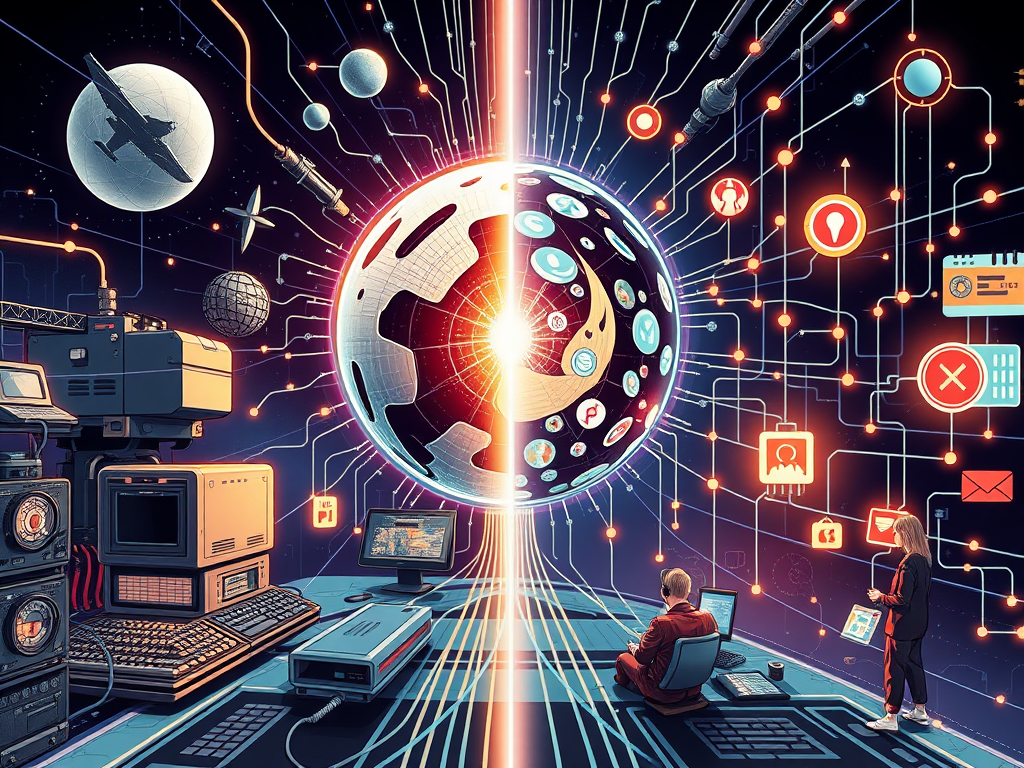
From a Cold War-era military project to the globe-spanning, life-altering network of today, the internet’s evolution has been nothing short of revolutionary. It’s a story of visionary scientists, disruptive entrepreneurs, and transformative technologies that have fundamentally reshaped how we communicate, work, learn, and live. Pinpointing just ten moments in this sprawling history is a formidable task, but certain events stand out as critical turning points that set the stage for the digital world we now inhabit. These are the sparks of genius and the crucial breakthroughs that built the internet, one packet of data at a time.
1. The Dawn of a Network: The Birth of ARPANET (1969)
Long before the world knew of emails or websites, the seed of the internet was planted in the fertile ground of military research. In the midst of the Cold War, the U.S. Department of Defense’s Advanced Research Projects Agency (ARPA) sought to create a decentralized communication network that could withstand a potential nuclear attack. The result was ARPANET. On October 29, 1969, a message was sent from a computer at UCLA to one at the Stanford Research Institute. The intended message was “LOGIN,” but the system crashed after transmitting just two letters: “LO.” This humble, partial message marked the birth of remote computer networking and the first successful test of “packet switching,” the revolutionary technique of breaking down data into small blocks for more efficient transmission. ARPANET was the primordial soup from which the internet would emerge, establishing the foundational principles of a resilient, interconnected network.
2. Creating a Common Language: The Invention of TCP/IP (1974)
In the early days of networking, different computer networks couldn’t easily communicate with each other; they all spoke different digital languages. The solution came in the form of the Transmission Control Protocol/Internet Protocol, or TCP/IP. Developed by computer scientists Vinton Cerf and Robert Kahn, TCP/IP created a universal standard for data transmission. Think of it as the internet’s Rosetta Stone. TCP is responsible for breaking down data into packets and reassembling them at their destination, ensuring accuracy, while IP is the addressing system that makes sure the packets get to the right place. This two-part system allowed different networks to be linked together into a “network of networks”—the very definition of the internet. The adoption of TCP/IP as the standard for ARPANET in 1983 was the moment the modern internet truly became a possibility, creating a unified and scalable framework for global connectivity.
3. Giving the Internet a User-Friendly Face: The World Wide Web (1990)
The internet in its early days was a powerful tool, but it was far from user-friendly, accessible only to those who could navigate complex command-line interfaces. British computer scientist Tim Berners-Lee, working at the European research organization CERN, changed all that. He envisioned a system of information management that used hypertext to link documents and resources across the internet. In 1990, he brought this vision to life by creating the three foundational technologies of the web: HTML (HyperText Markup Language), the formatting language for web pages; URL (Uniform Resource Locator), the address system for finding documents; and HTTP (Hypertext Transfer Protocol), the protocol that allows for the linking and retrieval of web pages. This “World Wide Web” was not the internet itself, but an application built on top of it, transforming it from a text-based data repository into a graphical, interconnected universe of information.
4. Opening the Floodgates: The Mosaic Web Browser (1993)
While Tim Berners-Lee had created the first web browser, it was a team at the University of Illinois that brought the web to the masses. Their creation, Mosaic, was the first browser to display images directly within the text of a web page, rather than in a separate window. This seemingly small innovation had a monumental impact, making the web a visually engaging and intuitive experience for the first time. Mosaic’s user-friendly graphical interface and its availability on multiple operating systems made it an instant hit. It was the “killer app” that ignited the public’s imagination and sparked the explosive growth of the web in the mid-1990s. The success of Mosaic not only popularized the internet but also laid the groundwork for the commercial browsers that would follow, most notably Netscape Navigator and Internet Explorer.
5. Taming the Digital Frontier: The Rise of Google (1998)
As the World Wide Web exploded in popularity, it created a new problem: how to find anything in its vast and chaotic expanse. Early search engines existed, but they often returned irrelevant results. In 1998, two Stanford PhD students, Larry Page and Sergey Brin, launched a new search engine with a revolutionary approach. Their system, which they called Google, used an algorithm called PageRank that ranked the importance of a webpage by the number and quality of links pointing to it. This “citation” model proved incredibly effective at delivering relevant and reliable search results. Google’s clean interface and superior search technology quickly made it the dominant player in the field, transforming the web from a disorganized library into a searchable, accessible repository of global knowledge. The ability to “Google it” became a fundamental part of the internet experience, shaping how we learn, shop, and interact with information.
6. The Boom and Bust: The Dot-Com Bubble (Late 1990s – 2001)
The late 1990s saw a period of frenzied speculation in internet-based companies, or “dot-coms.” Fueled by excitement over the new digital economy, venture capitalists poured billions of dollars into startups, often with little more than a business plan and a “.com” in their name. This speculative bubble drove the stock market to dizzying heights, but it was unsustainable. Many of these companies had no viable path to profitability, and in 2000 and 2001, the bubble burst in spectacular fashion. The resulting stock market crash wiped out trillions of dollars in wealth and led to the failure of countless internet companies. While the dot-com bust was a painful correction, it was also a crucial turning point. It cleared away the hype and forced the industry to focus on sustainable business models, paving the way for the more mature and resilient internet giants that would emerge in the following years.
7. The Internet Becomes Social: The Launch of Facebook (2004)
The internet had always been a social medium, from early email and forums to the first social networking sites. But it was the launch of Facebook in 2004 that truly ushered in the era of social media. Initially limited to Harvard students, Facebook’s clean interface and focus on real-world identities quickly set it apart. As it expanded, it became a global phenomenon, connecting billions of people and creating a new paradigm for online interaction. Facebook and the platforms that followed, like Twitter and Instagram, transformed the internet into a space for personal expression, social connection, and community building on an unprecedented scale. They also introduced new challenges, raising complex questions about privacy, data, and the impact of social networks on society and democracy.
8. The Internet in Your Pocket: The Introduction of the iPhone (2007)
Before 2007, accessing the internet on a mobile phone was a clunky and frustrating experience. The introduction of the Apple iPhone changed everything. With its large touchscreen, intuitive user interface, and, most importantly, a full-featured web browser that rendered web pages just as they appeared on a desktop, the iPhone made the mobile internet a reality for the masses. The subsequent launch of the App Store created a thriving ecosystem of mobile applications, further integrating the internet into the fabric of our daily lives. The iPhone and the smartphone revolution it ignited untethered the internet from the desktop computer, allowing us to be connected anytime, anywhere. This shift to mobile has had a profound impact on everything from e-commerce and media consumption to how we navigate the world around us.
9. The Need for Speed: The Widespread Adoption of Broadband
In the early days of the internet, most users connected via slow dial-up modems. This limited the types of content that could be accessed and made for a frustratingly slow user experience. The widespread adoption of broadband internet, through technologies like DSL, cable, and fiber optics, was a game-changer. This always-on, high-speed connection transformed the internet from a text-based medium into a rich multimedia platform. It made possible the streaming of video and music, online gaming, video conferencing, and the sharing of large files. Broadband was the essential infrastructure upgrade that enabled the modern, media-rich internet we know today, paving the way for services like YouTube and Netflix to become household names.
10. The Invisible Foundation: The Rise of Cloud Computing
In recent years, one of the most significant shifts in the internet’s architecture has been the rise of cloud computing. Instead of storing data and running applications on individual computers or local servers, cloud computing allows us to access these resources over the internet from vast, powerful data centers operated by companies like Amazon, Google, and Microsoft. This “invisible” infrastructure has become the backbone of the modern internet. It powers everything from our email and social media feeds to the streaming services we use and the mobile apps on our phones. Cloud computing has enabled businesses to scale their operations with unprecedented flexibility and has been a key driver of innovation in areas like artificial intelligence and big data. It represents a fundamental shift in how we think about and use computing resources, making the internet more powerful, accessible, and resilient than ever before.
Further Reading
For those interested in a deeper dive into the incredible story of how the internet came to be, these books offer fascinating and accessible accounts:
- “Where Wizards Stay Up Late: The Origins of the Internet” by Katie Hafner and Matthew Lyon
- “The Innovators: How a Group of Hackers, Geniuses, and Geeks Created the Digital Revolution” by Walter Isaacson
- “How the Internet Happened: From Netscape to the iPhone” by Brian McCullough
- “The Code: Silicon Valley and the Remaking of America” by Margaret O’Mara
Here at Zentara.blog, our mission is to take those tricky subjects and unlock them, making knowledge exciting and easy to grasp for everyone. But the adventure doesn’t stop on this page! We’re constantly exploring new frontiers and sharing discoveries across the digital universe. Want to dive deeper into more mind-bending Top 10s and keep expanding your world? Come join us on our other platforms – we’ve got unique experiences waiting for you on each one!
Get inspired by visual wonders and bite-sized facts: See the world through Zentara’s eyes on Pinterest!
Pin our fascinating facts and stunning visuals to your own boards. Explore Pins on Pinterest: https://uk.pinterest.com/zentarablog/
Discover quick insights and behind-the-scenes peeks: Hop over to Tumblr for snippets, quotes, and unique content you won’t find anywhere else. It’s a different flavour of discovery! Follow the Fun on Tumblr: https://www.tumblr.com/zentarablog
Ready for deep dives you can listen to or watch? We’re bringing our accessible approach to video and potentially audio! Subscribe to our YouTube channel and tune into future projects that make learning pop! Subscribe on YouTube: https://www.youtube.com/@ZentaraUK
Seeking even more knowledge in one place? We’ve compiled some of our most popular topic deep dives into fantastic ebooks! Find them on Amazon and keep the learning journey going anytime, anywhere. Find Our Ebooks on Amazon: https://www.amazon.co.uk/s?k=Zentara+UK&ref=nb_sb_noss
Connect with us and fellow knowledge seekers: Join the conversation on BlueSky! We’re sharing updates, thoughts, and maybe even asking you what wonders we should explore next. Chat with Us on BlueSky: https://bsky.app/profile/zentarablog.bsky.social
Perfect for learning on the move! We post multiple 10-minute podcasts per day on Spotify. Pop on your headphones and fill your day with fascinating facts while you’re out and about! Listen on Spotify: https://open.spotify.com/show/3dmHbKeDufRx95xPYIqKhJFollow us on Instagram for bytesize knowledge! We post multiple posts per day on our official Instagram account. https://www.instagram.com/zentarablog/ Every click helps us keep bringing honest, accessible knowledge to everyone. Thanks for exploring with us today – see you out there in the world of discovery!




Leave a Reply