
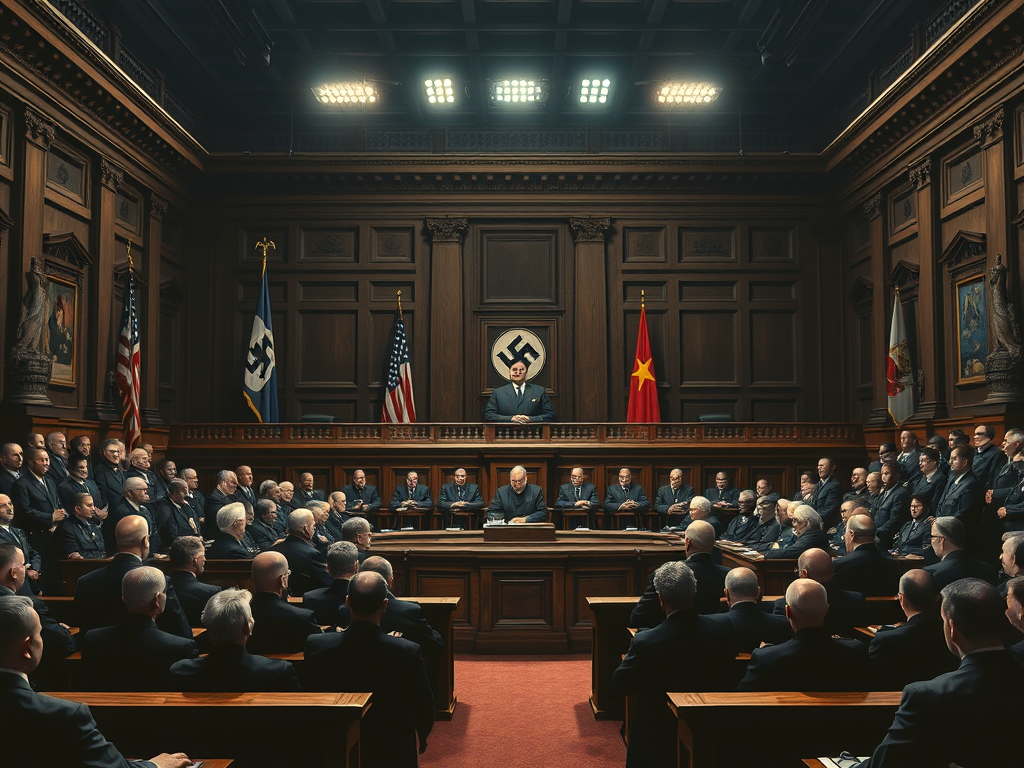
Imagine a huge worldwide game, but instead of sports, it’s about justice. After a terrible conflict, the winning team decides that simply ending the game isn’t enough. They want to make sure the people who caused the worst harm are held responsible, not just as a country, but as individuals. That’s exactly what happened with the Nuremberg Trials after World War II.
When World War II ended in 1945, the full extent of Nazi Germany’s horrific crimes against humanity became clear, especially the systematic murder of millions of Jewish people in the Holocaust. The victorious Allied powers (the United States, Great Britain, France, and the Soviet Union) faced a huge question: how should they deal with the Nazi leaders who were responsible for these atrocities? Some wanted immediate revenge, but others believed that justice should be served through a fair trial.
So, they decided to create something entirely new: an international military tribunal. This meant judges and lawyers from different countries would come together to put the most powerful surviving Nazi leaders on trial for their crimes. The trials took place in the city of Nuremberg, Germany, a place that had once been a symbol of Nazi power with its massive propaganda rallies. The Nuremberg Trials weren’t just about punishing individuals; they were about showing the world that even in wartime, there are rules, and that leaders, no matter how powerful, cannot commit terrible crimes and expect to get away with it. They laid the foundation for international law and human rights as we know them today. Let’s explore ten key aspects of these historic trials.
1. A World First: The International Military Tribunal
The Nuremberg Trials were truly a world first. Before this, there had been no international court where leaders of a defeated nation were put on trial by victorious powers for crimes committed during a war. The Allies created the International Military Tribunal (IMT) to prosecute the most significant surviving Nazi officials.
Imagine four different countries, all with their own laws and traditions, coming together to create one brand-new courtroom with shared rules for a never-before-seen type of trial. Judges and prosecutors were appointed from the United States, Great Britain, France, and the Soviet Union. This cooperative effort was a massive undertaking, showing the world’s determination to establish a new kind of justice and accountability for horrific acts committed in wartime.
2. Choosing Nuremberg: A Symbolic Location
The city of Nuremberg was chosen as the location for the trials for a very powerful symbolic reason. Before the war, Nuremberg had been the site of massive Nazi Party rallies, where Hitler and other Nazi leaders spewed their hateful speeches and showcased their power.
Imagine holding a trial for a bully in the very playground where they used to torment others. By holding the trials in Nuremberg, the Allies aimed to symbolize the downfall of the Nazi regime and replace its symbols of hatred with symbols of justice and the rule of law. The Palace of Justice, a large courthouse that survived the war, was selected as the venue, giving the trials a solemn and official setting.
3. The Defendants: High-Ranking Nazi Officials
The main Nuremberg Trial (the International Military Tribunal) focused on the highest-ranking surviving Nazi leaders. These included figures like Hermann Göring (Hitler’s right-hand man and head of the Luftwaffe), Rudolf Hess, Joachim von Ribbentrop (Foreign Minister), and Albert Speer (Hitler’s architect and armaments minister).
Imagine the top members of a criminal gang, the ones who planned all the terrible deeds, finally being caught and brought to justice. Adolf Hitler, Heinrich Himmler, and Joseph Goebbels, the very top leaders, avoided trial by committing suicide before the war ended. However, the trial of these other key figures ensured that those who had directed the Nazi regime’s horrific policies would face direct accountability for their actions.
4. The Charges: New Legal Concepts for New Crimes
The trials introduced groundbreaking legal concepts that had never been clearly defined in international law before. The defendants were charged with four main types of crimes:
- Crimes Against Peace: For planning and waging aggressive war.
- War Crimes: For violations of the laws and customs of war (like mistreating prisoners or civilians).
- Crimes Against Humanity: For extermination, enslavement, deportation, and other inhumane acts committed against civilian populations, especially in connection with racial or political persecution. This was a crucial new concept.
- Conspiracy: For participating in a common plan to commit these crimes.
Imagine having to invent new rules to describe new kinds of terrible wrongdoing that hadn’t been fully understood before. “Crimes Against Humanity,” in particular, was a revolutionary idea that sought to protect individuals from atrocities committed by their own governments, even during peacetime. These charges laid the groundwork for modern international criminal law.
5. The Evidence: Nazi Documents and Eyewitness Accounts
The prosecution at Nuremberg presented overwhelming evidence against the defendants. Crucially, much of this evidence came from the Nazis’ own documents, including meticulous records of their plans, orders, and atrocities. They also used films, photographs, and the powerful, heartbreaking testimonies of Holocaust survivors.
Imagine the criminals themselves having kept detailed diaries and notes of their crimes, which are then used against them in court! This was a key part of the prosecution’s strategy. Using Nazi documents proved beyond doubt that the Holocaust was a systematic, planned extermination, not just random acts of violence. The eyewitness accounts of survivors, who bravely recounted their suffering in the camps, brought the human cost of the crimes powerfully into the courtroom.
6. “Following Orders” Defense: Rejected by the Court
A common defense raised by many of the defendants was that they were simply “following orders” from their superiors. They argued that they were not personally responsible for the atrocities because they were just obeying commands.
Imagine a student who cheats on a test and says, “But my friend told me to!” The court strongly rejected this argument. The judges declared that individuals are responsible for their actions, even in wartime, and that merely “following orders” does not excuse participation in crimes against humanity or war crimes. This principle, known as the “Nuremberg Principle,” became a cornerstone of international law, emphasizing individual accountability and establishing that there are universal moral boundaries that no order can override.
7. The Verdicts: Guilt, Innocence, and Punishment
After nearly a year of testimony and arguments, the tribunal delivered its verdicts in October 1946. Of the 22 defendants who appeared in court, 19 were found guilty, and 3 were acquitted (found not guilty). Twelve of those found guilty were sentenced to death by hanging, including Hermann Göring (who committed suicide hours before his execution). Others received long prison sentences.
Imagine a jury deliberating on the fate of people who committed unimaginable evil, and then delivering their solemn judgment. The range of verdicts showed that the court aimed for fairness, even for those accused of the most heinous crimes. The punishments reflected the severity of their involvement in the Nazi regime’s atrocities, sending a clear message about accountability.
8. Subsequent Trials: More Justice in Nuremberg
The main International Military Tribunal was only the first set of trials held in Nuremberg. After its conclusion, the United States held 12 additional “subsequent Nuremberg trials” in the same Palace of Justice. These trials prosecuted hundreds more German officials, including doctors who conducted horrific human experiments, industrialists who used slave labor, and judges who perverted justice.
Imagine expanding the initial trial to bring even more people involved in terrible acts to justice. These subsequent trials further exposed the vast network of individuals who supported and carried out the Nazi regime’s crimes, from military leaders to professionals in various fields. In all, nearly 200 defendants were tried in these follow-up proceedings, with many convicted and sentenced.
9. The Legacy: Birth of International Criminal Law
The Nuremberg Trials had a profound and lasting impact on international law and human rights. They established the critical precedent that individuals, regardless of their position or power, can be held criminally responsible for crimes against peace, war crimes, and crimes against humanity.
Imagine these trials as planting the first seeds of a new global legal system designed to protect people from the worst kinds of abuses. The “Nuremberg Principles” directly influenced the creation of the United Nations Genocide Convention (which outlawed genocide) and the Universal Declaration of Human Rights. They also laid the groundwork for future international criminal courts, like the International Criminal Court (ICC), which today tries individuals for war crimes, genocide, and crimes against humanity.
10. A Warning for the Future: Never Again
Perhaps the most important legacy of the Nuremberg Trials is their role as a powerful warning for the future. By documenting the Nazi atrocities and holding the perpetrators accountable, the trials aimed to ensure that such horrors would “never again” be allowed to happen.
Imagine a courtroom echoing through time, reminding all future leaders and nations of the terrible consequences of hatred, aggression, and the violation of human rights. The trials provided an undeniable record of what happened and a clear legal framework for prosecuting those who commit similar crimes. They continue to serve as a vital reminder that while the fight for justice is often long and difficult, it is essential to prevent future atrocities and to build a more just and humane world.
Further Reading
- “The Nuremberg Trials (World History)” by R. G. Grant (A good overview for students)
- “Judgment at Nuremberg” by Abby Mann (The screenplay for the classic film, offers dramatic insight)
- “The Trial of the Major War Criminals before the International Military Tribunal, Nuremberg, 14 November 1945 – 1 October 1946” (The actual proceedings, for very dedicated readers)
- “Facing History and Ourselves: The Holocaust and Human Behavior” (An excellent educational resource that contextualizes the trials)
- “Ordinary Men: Reserve Police Battalion 101 and the Final Solution in Poland” by Christopher R. Browning (Helps understand how ordinary people could become perpetrators, relevant to the “following orders” defense)
Here at Zentara.blog, our mission is to take those tricky subjects and unlock them, making knowledge exciting and easy to grasp for everyone. But the adventure doesn’t stop on this page! We’re constantly exploring new frontiers and sharing discoveries across the digital universe.
Want to dive deeper into more mind-bending Top 10s and keep expanding your world? Come join us on our other platforms – we’ve got unique experiences waiting for you on each one!
- Get inspired by visual wonders and bite-sized facts: See the world through Zentara’s eyes on Pinterest! Pin our fascinating facts and stunning visuals to your own boards. Explore Pins on Pinterest: https://uk.pinterest.com/zentarablog/
- Discover quick insights and behind-the-scenes peeks: Hop over to Tumblr for snippets, quotes, and unique content you won’t find anywhere else. It’s a different flavour of discovery! Follow the Fun on Tumblr: https://www.tumblr.com/zentarablog
- Ready for deep dives you can listen to or watch? We’re bringing our accessible approach to video and potentially audio! Subscribe to our YouTube channel and tune into future projects that make learning pop! Subscribe on YouTube: https://www.youtube.com/@ZentaraUK
- Seeking even more knowledge in one place? We’ve compiled some of our most popular topic deep dives into fantastic ebooks! Find them on Amazon and keep the learning journey going anytime, anywhere. Find Our Ebooks on Amazon: https://www.amazon.co.uk/s?k=Zentara+UK&ref=nb_sb_noss
- Connect with us and fellow knowledge seekers: Join the conversation on BlueSky! We’re sharing updates, thoughts, and maybe even asking you what wonders we should explore next. Chat with Us on BlueSky: https://bsky.app/profile/zentarablog.bsky.social
- Perfect for learning on the move! We post multiple 10-minute podcasts per day on Spotify. Pop on your headphones and fill your day with fascinating facts while you’re out and about! Listen on Spotify: https://open.spotify.com/show/3dmHbKeDufRx95xPYIqKhJ
- Follow us on Instagram for bytesize knowledge! We post multiple posts per day on our official Instagram account.
https://www.instagram.com/zentarablog/
Every click helps us keep bringing honest, accessible knowledge to everyone. Thanks for exploring with us today – see you out there in the world of discovery!




Leave a Reply