
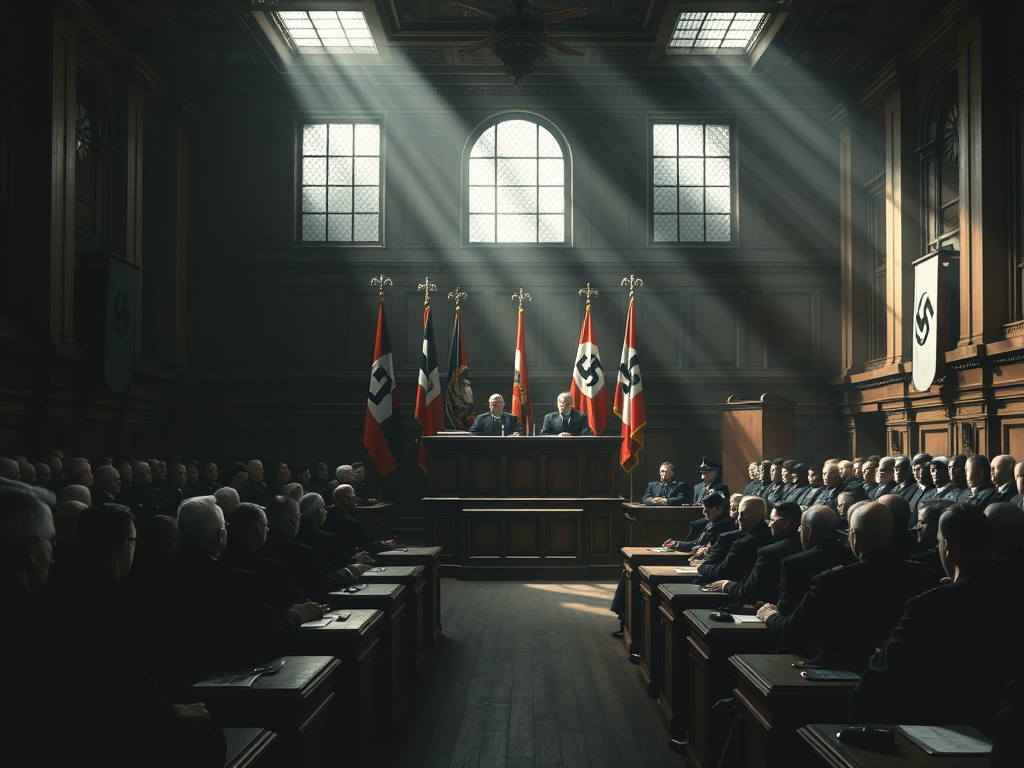
When we look back from the vantage point of late 2025, the Nuremberg trials (or Nürnberg trials) stand as the foundational pillar of modern international law. Just over 80 years ago, in a city reduced to rubble, the four major Allied powers—the United States, Great Britain, the Soviet Union, and France—convened the International Military Tribunal (IMT). Their goal was unprecedented: to hold individuals, rather than just states, legally responsible for the horrors of World War II.
While many know the trials resulted in the execution of high-ranking Nazis, the internal mechanics and legal “firsts” of the proceedings are often far more intriguing and “dark” than the history books suggest. From the secret technology that allowed the trial to function in four languages to the controversial psychiatric evaluations of the defendants, Nuremberg was a high-stakes experiment in justice. This deep dive uncovers the fundamental and enduring aspects of the trials that shaped how we define “evil” and “accountability” in the modern world.
1. The Trials Were Almost Replaced by Summary Executions
It is a common misconception that the Allies were always in agreement about holding a trial. In reality, some of the most powerful leaders in the world wanted to skip the courtroom entirely. British Prime Minister Winston Churchill initially advocated for the summary execution of high-ranking Nazi officials. He believed their crimes were so self-evident that a trial would only give them a platform for propaganda. Even Joseph Stalin, during the Tehran Conference, half-jokingly suggested executing 50,000 to 100,000 German officers to “cripple” the nation’s military future.
The push for a formal trial came primarily from the United States, led by Secretary of War Henry Stimson and Supreme Court Justice Robert H. Jackson. They argued that if the Allies simply killed the Nazis without a trial, the world would see it as a “high-grade lynching party” rather than a triumph of civilization over tyranny. They wanted to build a “record of history” so vast and irrefutable that future generations could never deny the Holocaust. This debate is a fundamental aspect of the history of the International Military Tribunal, highlighting the tension between the desire for vengeance and the necessity of the rule of law.
2. IBM Invented the “Real-Time” Courtroom for the Trial
Before Nuremberg, international trials were painfully slow. A lawyer would speak in English, and everyone would wait while a translator repeated it in French, then Russian, then German. A one-hour session could take four hours. To solve this, the Allies turned to IBM, which developed a revolutionary simultaneous translation system. This was the first time in history that people from four different nations could argue a case in real-time.
Participants wore yellow headsets (an “above average” piece of tech for 1945) and could switch between five channels to hear the live translation. The interpreters worked in “fishbowls”—glass-enclosed booths—at the side of the courtroom. To ensure accuracy, the system used a “light signal” method: if a speaker was talking too fast for the translators to keep up, a yellow light would flash on the podium. If they needed to stop entirely, a red light would appear. This IBM simultaneous translation at Nuremberg didn’t just save time; it proved that a multi-lingual world could achieve justice together, and it remains the standard for the United Nations today.
3. The Word “Genocide” Was Coined Specifically for the Trial
We use the word “genocide” frequently today, but it didn’t exist when the war began. It was coined in 1944 by a Polish-Jewish lawyer named Raphael Lemkin. He combined the Greek word genos (race or tribe) with the Latin cide (killing). Lemkin had lost 49 members of his family in the Holocaust and spent years documenting Nazi atrocities. He served as an advisor to the American prosecution team at Nuremberg, fighting to get the term included in the indictment.
Interestingly, while the indictment mentioned “genocidal acts,” the judges at the IMT primarily convicted the defendants of Crimes Against Humanity. At the time, “genocide” was seen as a sociological concept rather than a firm legal one. It wasn’t until the UN Genocide Convention in 1948 that it became a distinct international crime. This distinction is one of the most critical facts about the Nuremberg trials, as it shows how legal language often has to be “invented” to match the scale of the crimes being prosecuted.
4. The Prosecution Used the Nazis’ Own “Selfies” Against Them
The American lead prosecutor, Robert H. Jackson, made a strategic decision that changed the course of the trial: he would rely on “the Germans’ own words and records.” The Allies had captured millions of documents, but the most damning evidence came from the Nazis’ strange obsession with documentation. They had photographed and filmed their own atrocities with bureaucratic precision—what we might call “genocidal selfies” today.
During the trial, the courtroom was darkened to show films of the liberation of concentration camps. The prosecutors also presented a 51-page report from an SS General, stamped “Secret Reich Matter,” which used a “coffin icon” to count the thousands of Jews murdered in the Baltic states. By using Nazi war criminal records and their own photography, the prosecution made it impossible for the defendants to claim they “didn’t know.” It turned the trial into a mirror, forcing the men in the dock to watch their own crimes on the big screen, a moment that left even the most hardened observers in the Palace of Justice in shock.
5. The “Superior Orders” Defense Was Formally Outlawed
The most common defense used by the Nazis was: “I was only following orders” (known as the Nuremberg Defense). They argued that under German law, refusing an order from a superior was a crime, and therefore they should not be held responsible for the outcome. The judges at Nuremberg fundamentally rejected this, establishing a principle that remains a cornerstone of international law today.
The tribunal ruled that “the fact that a person acted pursuant to order of his Government or of a superior shall not free him from responsibility.” They argued that there is a “moral choice” even in the face of death and that individuals have a duty to disobey orders that are “manifestly illegal” or violate the basic laws of humanity. This rejection of sovereign immunity ensured that “just doing my job” would never again be a valid excuse for participating in a massacre. It is an “enduring aspect” of the trial that still influences how modern militaries train their soldiers on the ethics of engagement.
6. The Trial Was Held in Nuremberg for a “Dark” Reason
The Allies didn’t choose the city of Nuremberg just because it had a standing courthouse. The location was deeply symbolic. Nuremberg was the “soul” of the Nazi movement—the site of the massive Nuremberg Rallies where Hitler had addressed hundreds of thousands of followers under the “Cathedral of Light.” It was also where the infamous Nuremberg Laws were passed in 1935, which stripped Jewish citizens of their rights.
By holding the trial in the Palace of Justice Nuremberg, the Allies were performing a legal exorcism. They wanted to witness the “death of Nazi Germany” in the very place where it had been most vibrantly celebrated. Practically, the Palace of Justice was also one of the few large buildings in Germany that hadn’t been completely leveled by Allied bombing, and it had a large prison attached to it via an underground tunnel, making it a “secure fortress” for holding the 22 major war criminals.
7. A Psychiatrist Tried to Find the “Nazi Gene”
During the trial, an American psychiatrist named Douglas Kelley and a psychologist named Gustave Gilbert were given unprecedented access to the defendants. Their mission was to determine if the Nazi leaders were “monsters” or if they were “insanely brilliant.” Kelley spent hundreds of hours interviewing Hermann Göring, the highest-ranking Nazi on trial, hoping to find a psychological common thread among the men.
What they found was perhaps the most “dark” fact of all: the Nazis weren’t legally “insane.” In fact, their IQ tests showed they were highly intelligent (Göring scored a 138). Kelley concluded that there was no “Nazi gene” and that these men were “normal” in a psychological sense, driven by ambition, narcissism, and a total lack of empathy. This revelation led to the concept of the “banality of evil”—the idea that ordinary people, when placed in a specific system, can perform extraordinary horrors. The psychological battle between Kelley and Göring became so intense that it was later adapted into several books and the 2025 film Nuremberg.
8. The “Doctors Trial” Created the Rules for Your Doctor Today
While the main IMT trial focused on political leaders, a series of 12 subsequent Nuremberg trials followed. The most famous was the “Doctors Trial,” where 23 physicians were prosecuted for performing horrific experiments on concentration camp prisoners. They had tested how long a human could survive in freezing water and injected people with malaria and mustard gas.
The verdict of this trial included a 10-point statement that we now know as the Nuremberg Code. This is the foundation of modern medical ethics. It established that the “voluntary consent of the human subject is absolutely essential.” Every time you sign a waiver at a doctor’s office or participate in a clinical trial today, you are benefiting from the legal protections created as a direct result of the Nuremberg trials. As of late 2025, the Nuremberg Code remains the “gold standard” for bioethics, proving that the trial’s legacy extends far beyond the history of war.
9. One Major Defendant Was Tried “In Absentia”
Not all of the 22 defendants were physically in the room. Martin Bormann, Hitler’s powerful private secretary, had vanished in the final days of the war. Because the Allies didn’t know if he was alive or dead, they decided to try him in absentia (in his absence). He was found guilty and sentenced to death by hanging.
For decades, Bormann became a “ghost” of the Nazi regime, with rumors placing him in South America alongside Josef Mengele. It wasn’t until 1972, and later confirmed by DNA in 1998, that his remains were found near the site of Hitler’s bunker in Berlin; he had actually died by suicide in 1945. The fact that the Nuremberg judges were willing to sentence a “ghost” shows how determined they were to complete the legal record, ensuring that even those who escaped physical capture could not escape the judgment of history.
10. Hermann Göring’s Final Act of Defiance
The trial ended with 12 death sentences by hanging. Hermann Göring, who considered himself a “soldier” and a “gentleman,” was horrified by the idea of being hanged, which he viewed as a “dishonorable” way for a high-ranking officer to die. He petitioned the court to be executed by firing squad instead. When the judges refused, Göring took justice into his own hands.
On the night of October 15, 1946—just hours before he was scheduled to go to the gallows—Göring committed suicide by swallowing a smuggled capsule of potassium cyanide. To this day, it is a mystery how he got the pill; theories range from it being hidden in his pipe to a sympathetic American guard smuggling it in. His suicide was a final “dark” blow to the Allies, as it allowed him to escape the ultimate public humiliation of the gallows. Despite this, the remaining ten executions went forward the next day, bringing a formal close to the most significant trial in human history.
Further Reading
- “Nuremberg: Infamy on Trial” by Joseph E. Persico
- “The Anatomy of the Nuremberg Trials: A Personal Memoir” by Telford Taylor (The Chief Counsel for the subsequent trials)
- “East West Street: On the Origins of ‘Genocide’ and ‘Crimes Against Humanity’” by Philippe Sands
- “Interrogations: The Nazi Elite in Allied Hands, 1945” by Richard Overy
Keep the Discovery Going!
Here at Zentara, our mission is to take tricky subjects and unlock them, making knowledge exciting and easy to grasp. But the adventure doesn’t stop at the bottom of this page. We are constantly creating new ways for you to learn, watch, and listen every single day.
Watch & Learn on YouTube
Visual learner? We publish 4 new videos every day, plus breaking news shorts to keep you smarter than the headlines. From deep dives to quick facts, our channel is your daily visual dose of wonder.
Click here to Subscribe to Zentara on YouTube
Listen on the Go on Spotify
Prefer to learn while you move? Tune into the Zentara Podcast! We drop a new episode daily, perfect for your commute, workout, or coffee break. Pop on your headphones and fill your day with fascinating facts.
Click here to Listen on Spotify
Every click, view, and listen helps us keep bringing honest knowledge to everyone. Thanks for exploring with us today—see you out there in the world of discovery!




Leave a Reply