
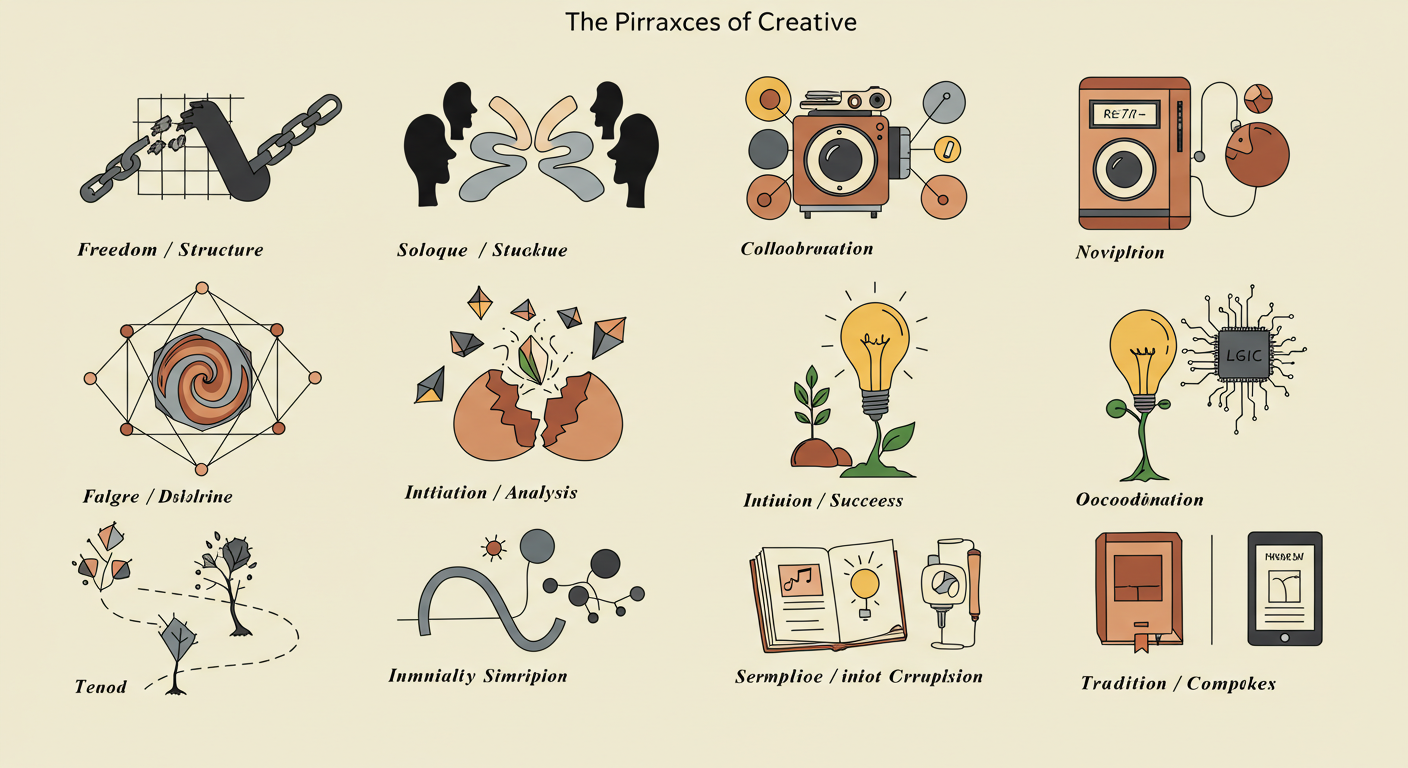
Creativity, often romanticized as a boundless expression of unfettered imagination, thrives within a delicate dance of paradoxes. These seeming contradictions, far from stifling innovation, act as fertile ground for groundbreaking ideas. To understand the true nature of creativity is to embrace these inherent tensions, recognizing that limitations can be the very catalysts for extraordinary breakthroughs.
1. The Paradox of Freedom and Structure: The Creative Tightrope
Imagine being given a completely blank piece of paper and told, “Draw anything!” Sometimes, that endless choice can feel overwhelming, right? That’s the Paradox of Freedom and Structure. We often think that having total freedom is the best way to be creative. But without any rules or guidelines, it can be hard to even start. Structure, like a deadline for a project, a budget for building something, or a specific theme for a story, actually helps! It gives your brain a starting point and a pathway to follow. Think of a sonnet, a type of poem with very strict rules for how many lines it has and how they rhyme. Even with these tight rules, poets have created beautiful and unique works for centuries. The tension between having lots of ideas (freedom) and having to fit them into certain boundaries (structure) pushes your mind to find clever, unexpected solutions, leading to amazing creative breakthroughs.
2. The Paradox of Solitude and Collaboration: Brainstorming Buddies or Lone Wolf?
Do you do your best thinking alone in a quiet room, or when you’re bouncing ideas off your friends? The answer, surprisingly, is both! This is the Paradox of Solitude and Collaboration. Sometimes, you need quiet time by yourself to really dig deep, think, and come up with original ideas. This is like an artist painting alone in their studio, completely focused on their vision. But then, when you share those ideas with others, something magical can happen. When people work together, sharing different viewpoints and brainstorming, ideas can get stronger, more refined, and even totally new solutions can pop out of the discussion. It’s like a design team working together, each person adding their unique twist. The best creative work often comes from a mix of quiet personal thinking (solitude) and active teamwork with others (collaboration), finding a balance between your own unique ideas and the input of a group.
3. The Paradox of Familiarity and Novelty: New Twists on Old Favorites
Think about your favorite songs or movies. Do you like something completely new that you’ve never heard or seen before, or do you prefer something that feels a little familiar but has a fresh twist? Creativity often plays in the space between the familiar and the novel. It’s not always about inventing something totally out of this world that nobody recognizes. Instead, true innovation often comes from taking things we already know and understand, and then putting them together in a surprising new way, or giving them a fresh perspective. Imagine an artist who uses old painting techniques but creates pictures about modern life, or a musician who takes a traditional folk melody and mixes it into a brand new pop song. If something is too new and has no connection to anything we know, it can be hard to understand. Creativity thrives by bridging the gap between what’s comfortable and what’s excitingly new, showing how familiarity breeds innovation.
4. The Paradox of Play and Discipline: Serious Fun
Have you ever seen kids playing and noticed how creative they are? They’re always exploring, making up games, and trying new things without worrying about getting it “wrong.” This sense of play is super important for creativity. It’s all about trying out ideas, experimenting, and letting your imagination run wild. But simply playing around won’t always get you to a finished, amazing creation. That’s where discipline comes in. Discipline is the hard work, the practice, and the dedication to really learn your craft. Think of a dancer who loves to move freely (play), but also spends hours practicing specific steps and techniques (discipline). Or a scientist who has a wild idea (play) but then carefully plans experiments to test it (discipline). It’s the balance between playful exploration and the focused effort of practice that allows creative impulses to turn into polished, brilliant works, showing how play fuels innovation.
5. The Paradox of Failure and Success: Learning from Stumbles
Nobody likes to fail, right? But if you’re trying to be creative, you have to be ready to mess up, a lot! This is the Paradox of Failure and Success. The fear of getting things wrong can actually stop you from even trying new ideas. However, failure isn’t the end; it’s a huge part of the creative journey. Think of it like trying to build a tall tower with blocks – sometimes it falls down, but each time you learn what doesn’t work and try a different way. Inventors often try dozens or even hundreds of things that don’t work before they find the one that does. The ability to learn from your mistakes, to see them as steps forward rather than complete roadblocks, is super important for staying creative. It proves that learning from creative failures is just as important, if not more, than just having immediate success, making failure a powerful catalyst for innovation.
6. The Paradox of Intuition and Analysis: Gut Feelings and Brain Power
Have you ever just had a “gut feeling” about a good idea, even if you couldn’t explain why? That’s intuition! It’s like a quick, instinctive understanding. Sometimes, people think intuition is completely separate from careful, logical thinking (analysis). But the most amazing creative insights often happen when both work together. Think of an artist who instinctively knows what colors will look good together (intuition), but then carefully thinks about how to mix them and apply them (analysis). Or a writer who has a sudden brilliant idea for a story (intuition) but then meticulously plans out the plot and edits every sentence (analysis). The combination of your instinctual ideas and your careful, logical thinking creates a powerful engine for creativity. It shows that both your “gut feelings” and your “brain power” are essential for profound creative insights.
7. The Paradox of Limitation and Abundance: Less Can Be More
This might sound strange, but sometimes having less stuff or less time can make you more creative! This is the Paradox of Limitation and Abundance. If you have endless resources, like unlimited money or materials, you might not feel the need to be very clever or resourceful. But when you have very few resources – maybe only a few ingredients to cook with, or only recycled materials to build something – you’re forced to think outside the box and come up with truly ingenious solutions. Think of an artist who makes stunning sculptures from old trash, or a chef who creates an amazing meal with only a few simple ingredients. Too much of something (abundance) can sometimes make us lazy with our ideas, while having constraints or creative limitations can actually spark incredible resourcefulness and lead to unexpected, brilliant innovative solutions.
8. The Paradox of Intentionality and Serendipity: Planned Discoveries and Happy Accidents
When you’re working on a creative project, you usually have a plan, right? You have an intentionality – a goal and a focused effort to reach it. This planning is definitely important. But sometimes, the most amazing discoveries happen by accident! This is called serendipity, a happy and unexpected discovery. Imagine a scientist who is looking for one thing but accidentally stumbles upon something even more amazing during their research. Or an artist who finds inspiration for a new painting from a random object they see on the street. The creative process is a delicate dance between carefully planning your steps and being open to those unexpected “aha!” moments. It’s about having a goal but also keeping your eyes and mind open to the happy accidents that can lead to incredible new directions and unplanned creativity.
9. The Paradox of Simplicity and Complexity: Elegant Solutions from Deep Understanding
Look at a really clever invention or a beautiful, clean design. Often, they seem so simple and easy to understand. That’s the Paradox of Simplicity and Complexity. The most impactful creative works often manage to take really complicated ideas and present them in a way that feels simple and elegant. Think of a famous logo that looks very simple but perfectly captures a brand’s essence, or a short story that tells a universal truth. But to create something so “simple” usually requires a deep, deep understanding of how everything works underneath. An artist might master super difficult techniques just to make a painting look effortless, and a scientist might unravel incredibly complex natural phenomena just to write a simple, elegant equation. It’s the hard work of understanding the underlying complexity that allows for the creation of truly impactful and elegant simple designs and ideas.
10. The Paradox of Tradition and Disruption: Building on the Past, Breaking New Ground
How do new ideas ever come about if everyone just keeps doing things the same way? But at the same time, how do we learn if we completely ignore everything that came before us? This is the Paradox of Tradition and Disruption. Creativity often involves respecting and learning from the masters of the past, understanding their methods and their work (tradition). But then, true innovation often means taking those lessons and twisting them, challenging the old ways, and forging a completely new path (disruption). Think of a jazz musician who learns all the classical rules of music but then improvises in a totally new way, or a scientist who refines an old theory but then proposes a radical new idea that changes everything. Creativity isn’t about ignoring history; it’s about engaging with it, understanding it, and then confidently finding ways to move beyond it, creating innovative approaches that push boundaries while still acknowledging their roots.
Further Reading
- Creativity, Inc.: Overcoming the Unseen Forces That Stand in the Way of True Inspiration by Ed Catmull
- Think Like a Rocket Scientist: Simple Strategies You Can Use to Solve Complex Problems, Innovate, and Launch Your Next Big Idea by Ozan Varol
- The Creative Act: A Way of Being by Rick Rubin
- Where Good Ideas Come From: The Natural History of Innovation by Steven Johnson
- Originals: How Non-Conformists Move the World by Adam Grant
Here at Zentara.blog, our mission is to take those tricky subjects and unlock them, making knowledge exciting and easy to grasp for everyone. But the adventure doesn’t stop on this page! We’re constantly exploring new frontiers and sharing discoveries across the digital universe.
Want to dive deeper into more mind-bending Top 10s and keep expanding your world? Come join us on our other platforms – we’ve got unique experiences waiting for you on each one!
- Get inspired by visual wonders and bite-sized facts: See the world through Zentara’s eyes on Pinterest! Pin our fascinating facts and stunning visuals to your own boards. Explore Pins on Pinterest: https://uk.pinterest.com/zentarablog/
- Discover quick insights and behind-the-scenes peeks: Hop over to Tumblr for snippets, quotes, and unique content you won’t find anywhere else. It’s a different flavour of discovery! Follow the Fun on Tumblr: https://www.tumblr.com/zentarablog
- Ready for deep dives you can listen to or watch? We’re bringing our accessible approach to video and potentially audio! Subscribe to our YouTube channel and tune into future projects that make learning pop! Subscribe on YouTube: https://www.youtube.com/@ZentaraUK
- Seeking even more knowledge in one place? We’ve compiled some of our most popular topic deep dives into fantastic ebooks! Find them on Amazon and keep the learning journey going anytime, anywhere. Find Our Ebooks on Amazon: https://www.amazon.co.uk/s?k=Zentara+UK&ref=nb_sb_noss
- Connect with us and fellow knowledge seekers: Join the conversation on BlueSky! We’re sharing updates, thoughts, and maybe even asking you what wonders we should explore next. Chat with Us on BlueSky: https://bsky.app/profile/zentarablog.bsky.social
- Perfect for learning on the move! We post multiple 10-minute podcasts per day on Spotify. Pop on your headphones and fill your day with fascinating facts while you’re out and about! Listen on Spotify: https://open.spotify.com/show/3dmHbKeDufRx95xPYIqKhJ
Every click helps us keep bringing honest, accessible knowledge to everyone. Thanks for exploring with us today – see you out there in the world of discovery!




Leave a Reply