
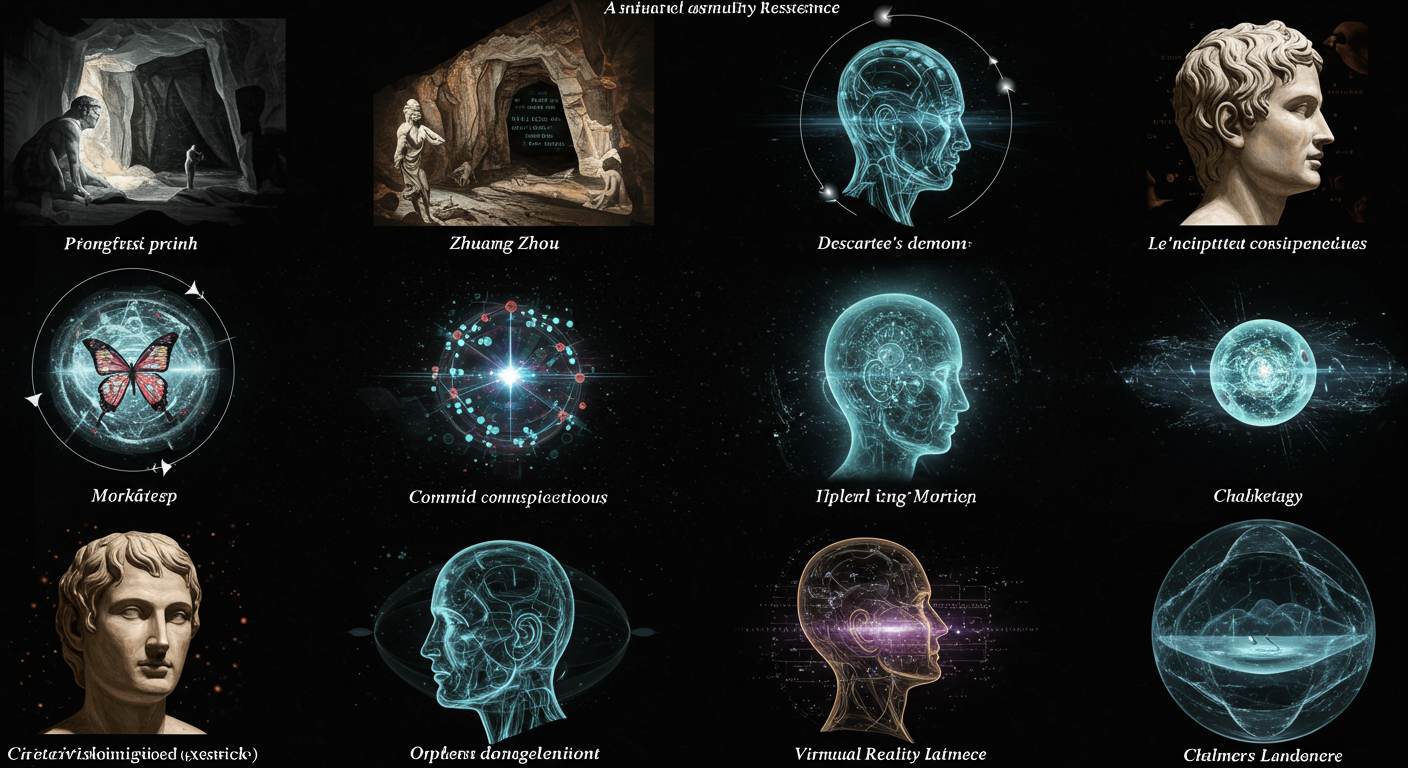
The notion that our reality might be a sophisticated simulation, a digital construct conceived by a more advanced intelligence, has transcended the realm of science fiction, permeating philosophical discourse and scientific inquiry. While definitive proof remains elusive, a remarkable lineage of thinkers, spanning millennia, have articulated concepts that eerily foreshadow the modern simulation hypothesis. Their insights, though often couched in different terminologies, reveal a persistent human fascination with the nature of reality and the possibility of a constructed universe.
1. Plato (c. 428-348 BCE): The Allegory of the Cave
Imagine being chained in a dark cave your whole life, only able to see shadows dancing on a wall, believing those shadows are all that is real. Then, one day, you break free and step outside into the bright sunlight, seeing real trees, real people, and a whole new world! This famous story, called the Allegory of the Cave, was told by the ancient Greek philosopher Plato. While Plato used it to talk about how our senses can fool us and how difficult it is to find true knowledge, it sounds a lot like our modern idea of a simulation. The shadows are like the pixels on a screen, showing us a limited, made-up reality. The world outside the cave is like a higher, more real world where the “simulators” might live. Plato’s ancient insight truly foreshadowed the idea that our perceived reality might not be the complete picture.
2. Zhuang Zhou (c. 369-286 BCE): The Butterfly Dream
Have you ever woken up from a really vivid dream and for a moment, you weren’t sure if you were still dreaming or if you were awake? That’s exactly the kind of thought the ancient Chinese philosopher Zhuang Zhou had. In one of his most famous stories, he dreamt he was a butterfly, fluttering happily. When he woke up, he wondered: Was he Zhuang Zhou, who had just dreamed he was a butterfly? Or was he actually a butterfly right now, dreaming he was Zhuang Zhou? This simple yet profound question, known as the Butterfly Dream, makes us wonder about what’s real and what’s just an illusion. It makes us consider that our experiences might not be as solid as we think, perfectly echoing the modern idea that our perceived reality could be a dream-like simulation, making us question the very core of our existence.
3. René Descartes (1596-1650): The Evil Demon Argument
Imagine a super powerful, super tricky evil genius who spends all their time trying to fool you. This genius could make you believe that everything you see, hear, and feel is real, even if it’s all just an illusion created in your mind. This spooky thought experiment was proposed by the French philosopher René Descartes. He wasn’t saying such a demon actually exists, but he used this “evil demon argument” to try and figure out what, if anything, he could truly know for sure. His idea directly connects to the simulation hypothesis: if an evil demon could trick us into believing in a false reality, couldn’t a super-advanced computer program do the same thing? Descartes’s skepticism about our sensory experiences makes us question if we’re living in a fabricated world controlled by an external force, much like a complex simulation.
4. Gottfried Wilhelm Leibniz (1646-1716): The Monadology
Imagine tiny, invisible building blocks, each one like a miniature universe, containing a unique view of everything that exists. These are “monads,” a concept by the German philosopher and mathematician Gottfried Wilhelm Leibniz. He believed that everything in the universe was made up of these “monads” – tiny, self-contained units that don’t interact with each other directly but somehow reflect the entire universe from their own unique perspective. This idea is surprisingly similar to the simulation hypothesis. Think of each monad as an individual program or a small “agent” within a giant simulation. Each one experiences its own distinct reality, but all these individual experiences somehow fit together to create the complex universe we see. Leibniz’s concept of perfectly synchronized, isolated realities within a grand system feels very much like a digital world where each part is running its own code.
5. George Berkeley (1685-1753): Immaterialism
“To be is to be perceived.” This famous phrase from the Irish philosopher George Berkeley sums up his idea called Immaterialism. He believed that physical objects don’t exist on their own; they only exist as ideas in someone’s mind. So, that tree outside your window only exists because you (or someone, or even God) are perceiving it. If nobody is perceiving it, it’s not “there.” While Berkeley’s ideas were connected to his religious beliefs, they sound very much like the simulation hypothesis. If reality is fundamentally made of ideas and perceptions, then it’s not a big leap to imagine that those ideas and perceptions could be created or projected into our minds by a sophisticated simulation. His philosophy makes us question the very nature of existence, suggesting that our world is a construct of our minds, or perhaps, a digital program designed to generate those perceptions.
6. Edgar Allan Poe (1809-1849): Eureka: A Prose Poem
You might know Edgar Allan Poe for his spooky stories and dark poetry. But he also wrote a very unusual book called “Eureka: A Prose Poem,” where he shared his ideas about the universe! In this work, Poe imagined the universe starting from a single, original particle, which then expanded and diversified everything through a “divine volition” – basically, the will of a single, powerful being. This idea, while written in a very poetic and mystical style, hints at the concept of a creator deliberately constructing a universe, much like a programmer might design and build a simulated world. Poe’s vision of a universe emanated from a singular intelligent force, where matter and energy spread out from a central point, strikingly aligns with the fundamental principles of a constructed reality, making him an unexpected early thinker about a universe born from a powerful will.
7. Hans Moravec (1948-present): Simulation Argument and Postbiological Minds
Fast forward to our modern age, and we find Hans Moravec, a brilliant scientist who pioneered robotics and artificial intelligence. Moravec has explored truly groundbreaking ideas about what the future might hold, especially concerning computers and consciousness. He’s talked about the possibility of “uploading” human minds into computers, creating digital versions of ourselves. If we could do that, then these “postbiological minds” (minds that aren’t tied to a physical body) could then create their own incredibly detailed simulated realities. This idea directly addresses the simulation hypothesis: if we could potentially create such advanced simulations, then it’s possible that our own reality is one of them, created by a super-advanced civilization or even our own future selves. Moravec’s work bridges the gap between science fiction and scientific possibility, making the idea of a simulated existence a tangible future, or present, reality.
8. Frank Tipler (1947-present): The Omega Point Theory
Get ready for another mind-bending idea! Frank Tipler is a physicist who developed a controversial theory called the Omega Point Theory. He suggests that at the very, very end of time, as the universe is collapsing or reaching its final state, a super-advanced civilization will use all the remaining energy and computing power to create a massive simulation. This simulation would be so powerful that it could contain all possible realities, including perhaps even our own past. It’s like a cosmic supercomputer running every possible history! While it’s a speculative theory, it directly tackles the idea that our existence could be part of a simulated environment created by incredibly advanced future technology. Tipler’s theory provides a fascinating framework for how a simulated reality could come into being, not as a random event, but as the ultimate culmination of cosmic evolution.
9. Nick Bostrom (1973-present): The Simulation Argument
If you’ve heard about the simulation hypothesis, chances are you’ve heard of Nick Bostrom. This Swedish philosopher wrote a super famous paper in 2003 called “Are You Living in a Computer Simulation?”. His Simulation Argument is a logical way of thinking that says at least one of three things must be true:
- It’s very unlikely that advanced civilizations like ours will ever reach a point where they can create highly realistic simulations.
- If they do reach that point, it’s very unlikely they’d want to run lots of these simulations.
- Therefore, the most likely option is that we are almost certainly living in a simulation right now! Bostrom’s argument, based on probabilities, has sparked a huge debate and made many scientists and thinkers seriously consider the possibility of a simulated existence, pushing the idea from science fiction into mainstream philosophical and scientific discussion.
10. David Chalmers (1966-present): The Virtual Reality Hypothesis
David Chalmers is a well-known philosopher who thinks deeply about consciousness and what it means to be “real.” He has explored the idea that our reality could be a form of virtual reality, so incredibly advanced that we wouldn’t be able to tell the difference between it and a “physical” world. He argues that even if we were in a simulation, our experiences within that simulation would still be real to us. It’s like if you were completely immersed in a virtual game – your feelings, thoughts, and what you see in the game are real to you, even if the world isn’t physically “there.” Chalmers’s work doesn’t just ask if we could be in a simulation, but what that would mean for our consciousness and experiences. His ideas push us to redefine what “reality” truly means if our entire world is effectively a complex and detailed digital construct.
Further Reading
- Nick Bostrom’s “Are You Living in a Computer Simulation?” (The original paper, available online and foundational)
- Simulation Theory: A Very Short Introduction by Riccardo Manzotti (A good overview of the concept and its implications)
- The Fabric of Reality by David Deutsch (Explores deep questions about physics, computation, and reality)
- The Matrix and Philosophy: Welcome to the Desert of the Real edited by William Irwin (Explores the philosophical ideas behind the movie “The Matrix,” which popularized simulation theory)
- Sophie’s World: A Novel About the History of Philosophy by Jostein Gaarder (Introduces many of these philosophical ideas in a story format for younger readers)

Leave a Reply