
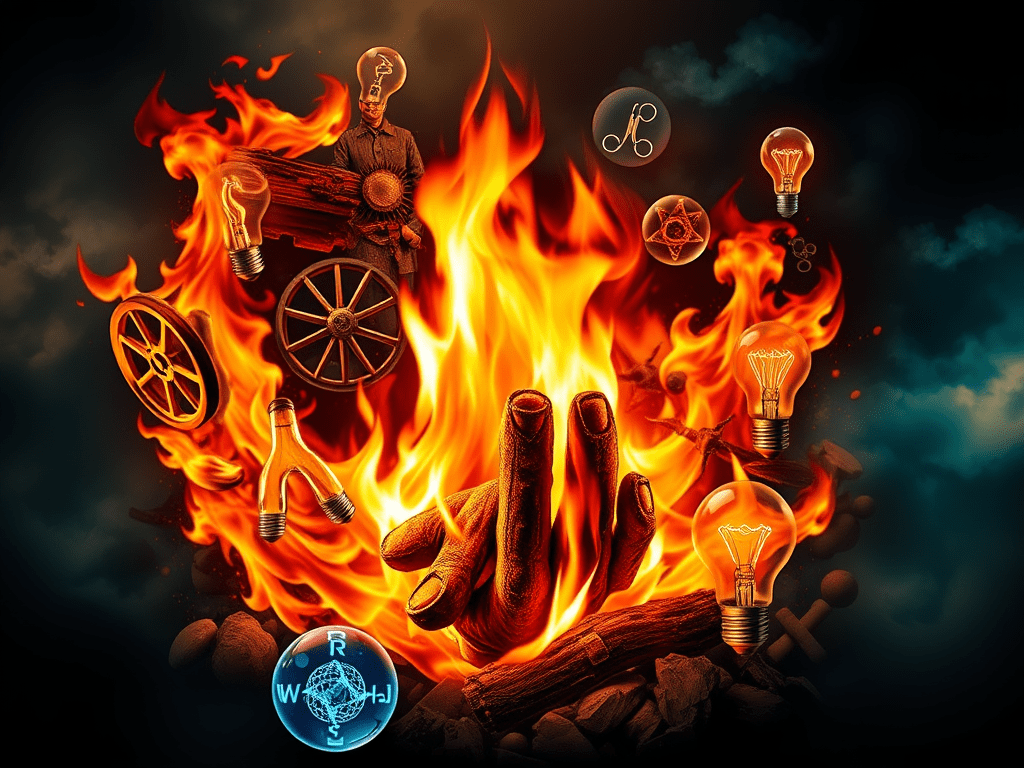
Have you ever wondered how we got things like smartphones, medicine that cures sickness, or even just light switches on the wall? It wasn’t magic! It was science. Throughout history, curious people have asked questions, done experiments, and made incredible discoveries. These weren’t just small changes; some scientific breakthroughs completely transformed how humans live, work, and understand the world. They solved huge problems, opened up new possibilities, and set the stage for even more amazing advancements.
Table of Contents
Imagine a world without fire to keep warm, wheels to move things, or ways to share ideas quickly. It’s hard, right? That’s because science has been shaping our world for thousands of years. These important inventions and discoveries didn’t just happen overnight. They were often the result of years of work, building on the ideas of others. Let’s explore ten of the greatest scientific discoveries that truly changed the course of human history and understand the massive impact of science on humanity. Get ready to be amazed by the power of curiosity and discovery!
1. Mastering Fire: Humanity’s First Great Power Tool
Long before computers or cars, one discovery lit up the world: the control of fire. This wasn’t just about having a bonfire; mastering fire was one of the earliest and most important scientific discoveries. Think about it – before fire, early humans ate raw food, shivered in the cold, and were vulnerable to predators in the dark. Learning to create and control fire changed everything. Suddenly, they could cook their food, making it safer to eat, easier to digest, and unlocking more nutrients. Fire provided warmth, allowing humans to survive in colder climates and expand across the globe. It offered protection, keeping dangerous animals away at night. It also became a gathering point, encouraging social interaction and storytelling around the campfire. Mastering fire was a massive leap in technology and a key step in human evolution, giving us a powerful tool to shape our environment and improve our chances of survival. It was the spark that ignited human civilization.
2. The Wheel: Rolling into a New Era of Transport and Technology
Can you imagine a world without wheels? No bikes, no cars, no skateboards, not even wheelbarrows! The invention of the wheel, around 3500 BC in Mesopotamia (modern-day Iraq), seems simple now, but it was a revolutionary scientific discovery that changed the world. Initially, it might have been used for making pottery, but its real power came when it was turned on its side and attached to an axle. This created carts and chariots, making it possible to transport heavy goods and people over long distances much more easily than ever before. This boosted trade, allowed armies to move faster, and helped cities grow. But the wheel’s impact goes beyond transport. It’s a fundamental part of countless machines, from water wheels used for grinding grain or irrigation to tiny gears inside clocks and engines. The wheel is a cornerstone of mechanics and engineering, demonstrating a basic principle of physics that we still rely on constantly. It truly set human progress in motion.
3. The Printing Press: Spreading Ideas Like Wildfire
Before the mid-1400s, books were rare and incredibly expensive. Each one had to be copied by hand, letter by letter, usually by monks in monasteries. It took ages, and only the very wealthy or the church could afford them. Then, Johannes Gutenberg, a German inventor, perfected the printing press with movable type around 1440. This was one of the most important inventions and discoveries ever made. Suddenly, books and pamphlets could be mass-produced quickly and cheaply. Information, stories, and new ideas could spread across Europe and the world faster than ever imagined. This fueled the Renaissance, the Reformation, and the Scientific Revolution by allowing scholars, scientists, and thinkers to share their work, debate ideas, and build upon each other’s knowledge. It helped standardize languages and made literacy accessible to more people, not just the elite. The printing press democratized knowledge and fundamentally changed how information was shared, paving the way for modern education and media.
4. Laws of Motion and Gravity: Understanding How the Universe Works
Have you ever dropped something and watched it fall? Or thrown a ball and seen it curve through the air? For centuries, people saw these things happen, but it was Sir Isaac Newton, an English scientist in the late 1600s, who figured out the rules behind them. His Laws of Motion and the Law of Universal Gravitation were major scientific advancements. Newton explained that objects stay still or keep moving unless a force acts on them (inertia), that force equals mass times acceleration (F=ma), and that for every action, there’s an equal and opposite reaction. Crucially, he realized that the same force pulling an apple from a tree to the ground is what keeps the Moon orbiting the Earth and the planets orbiting the Sun: gravity. This was mind-blowing! It provided a mathematical framework to understand and predict how things move, both on Earth and in space. These laws became the foundation of classical physics and engineering, allowing us to design bridges, buildings, cars, airplanes, and even spacecraft. Newton gave us the rulebook for the physical world.
5. Germ Theory: Unmasking the Invisible Enemies That Cause Disease
For thousands of years, people believed diseases were caused by bad smells (miasma), curses, or imbalances in the body. Sickness was a mystery. Then, in the mid-1800s, scientists like Louis Pasteur (France) and Robert Koch (Germany) provided convincing evidence for the Germ Theory of Disease. This revolutionary idea proposed that many diseases are caused by tiny living organisms – microorganisms like bacteria and viruses – too small to see without a microscope. These “germs” could invade the body and multiply, causing illness. This discovery changed medicine and public health forever. It led to understanding how diseases spread (like through contaminated water or coughing) and emphasized the importance of hygiene – washing hands, sterilizing medical instruments (pioneered by Joseph Lister using antiseptics), and pasteurizing milk to kill harmful bacteria. Germ theory paved the way for developing vaccines and antibiotics, dramatically increasing human lifespan and making surgeries much safer. It was a pivotal moment in the history of science breakthroughs, revealing the invisible world responsible for so much suffering.
6. Harnessing Electricity: Powering the Modern World
Imagine flipping a switch and… nothing happens. No lights, no computer, no TV, no fridge. Electricity is so central to modern life that we often take it for granted. While people knew about static electricity for centuries (think rubbing a balloon on your hair), it wasn’t until the 18th and 19th centuries that scientists like Benjamin Franklin, Alessandro Volta, Michael Faraday, and later Thomas Edison began to understand, generate, and control it. Harnessing electricity was not a single discovery but a series of major scientific advancements. Learning how to generate electrical currents, store them in batteries, and transmit them over wires transformed society. Electric light extended the day beyond sunset, changing how people worked and socialized. Electric motors powered factories, leading to mass production and the Industrial Revolution. Later, electricity enabled countless technologies: telegraphs, telephones, radio, television, computers, and the internet. It made homes safer by reducing the need for open flames for light and heat. Electricity truly electrified every aspect of human life, creating the technological world we live in today.
7. Vaccination: Training Our Bodies to Fight Disease
Smallpox, polio, measles – these diseases used to kill or disable millions of people. Today, thanks to vaccination, they are largely preventable, and smallpox has even been completely eradicated. The concept of vaccination is a monumental scientific discovery that changed the world. It began in the late 1700s with Edward Jenner, an English doctor. He noticed that milkmaids who caught cowpox, a mild disease, didn’t seem to get the deadly smallpox. He hypothesized that exposure to the weaker disease protected them. He tested his idea by intentionally exposing a boy to cowpox and then later to smallpox – the boy didn’t get sick! Jenner had discovered the principle of vaccination: introducing a weakened or inactive form of a germ (or a part of it) into the body teaches the immune system to recognize and fight off the real disease if it encounters it later. This breakthrough, further developed by scientists like Louis Pasteur, has saved countless lives and is one of the most effective public health interventions ever devised, preventing widespread epidemics and protecting vulnerable populations.
8. Penicillin and Antibiotics: The Magic Bullets Against Bacteria
Before the 1940s, a simple cut could lead to a deadly infection. Diseases like pneumonia, scarlet fever, or tuberculosis were often fatal. There were no effective treatments for bacterial infections. That changed dramatically with the discovery and development of antibiotics, starting with penicillin. In 1928, Scottish scientist Alexander Fleming accidentally discovered that a mold, Penicillium notatum, produced a substance that killed bacteria in his petri dishes. He realized its potential, but it took over a decade for scientists Howard Florey and Ernst Chain to figure out how to purify penicillin and produce it in large enough quantities to use as medicine during World War II. The impact was immediate and profound. Soldiers survived wounds and infections that would previously have killed them. Penicillin became known as a “wonder drug,” ushering in the age of antibiotics. This discovery revolutionized medicine, making bacterial infections treatable, surgeries safer, and contributing significantly to the increase in human lifespan in the 20th century. It remains one of the most important medical discoveries.
9. The Structure of DNA: Unlocking the Secret Code of Life
Why do children resemble their parents? How does a tiny seed grow into a giant tree? The answers lie in DNA (Deoxyribonucleic Acid). For decades, scientists knew there was something inside cells that carried hereditary information, but they didn’t know what it looked like or how it worked. In 1953, James Watson and Francis Crick, using crucial data from Rosalind Franklin and Maurice Wilkins, unveiled the structure of DNA: the famous double helix. Imagine a twisted ladder. The sides of the ladder are made of sugar and phosphate molecules, and the rungs are made of pairs of chemical bases (Adenine with Thymine, Guanine with Cytosine – A, T, G, C). The specific sequence of these bases forms the genetic code – the instruction manual for building and operating a living organism. This discovery was a cornerstone of modern biology. It explained how genetic information is stored, copied, and passed down through generations. Understanding DNA structure opened the door to genetics, genetic engineering, DNA fingerprinting (used in forensics), understanding genetic diseases, and developing new therapies. It gave us the blueprint of life itself.
10. The Internet: Connecting the World in an Instant
While perhaps more of a technological marvel built on scientific principles (like electricity and computing), the development and spread of the Internet has fundamentally reshaped humanity in just a few decades. Starting as a government research project (ARPANET) in the late 1960s, it evolved through the development of protocols like TCP/IP and the World Wide Web (invented by Tim Berners-Lee in 1989). The Internet connects billions of computers worldwide, allowing instant communication and access to vast amounts of information. Think about how it has changed things: how we learn (online resources), how we shop (e-commerce), how we socialize (social media), how we work (remote collaboration), how we get news, and how we entertain ourselves. It has broken down geographical barriers, fostered global communities, and accelerated scientific research through rapid data sharing. While it also presents challenges, the Internet represents an unprecedented leap in communication technology, arguably one of the most impactful inventions and discoveries of the modern era, connecting humanity in ways previously unimaginable.
Further Reading
If you want to dive deeper into the amazing world of science and discovery, check out these books:
- A Short History of Nearly Everything (Young Readers Edition) by Bill Bryson – A fun and accessible journey through the history of science, from the Big Bang to the rise of civilization.
- The Way Things Work Now by David Macaulay – Fantastic illustrations explain the principles behind hundreds of machines and inventions, including many based on these discoveries.
- Horrible Science series by Nick Arnold & Tony De Saulles (e.g., Fatal Forces, Vicious Veg, Microscopic Monsters) – Gross-out facts and funny illustrations make learning about physics, biology (including germs!), and other science topics entertaining.
- Who Was? series (various authors, e.g., Who Was Isaac Newton?, Who Was Louis Pasteur?, Who Was Marie Curie?) – Easy-to-read biographies of famous scientists that bring their discoveries to life.
- DK Eyewitness Books: Invention or DK Eyewitness Books: Great Scientists by DK – Visually rich books exploring key inventions and the people behind scientific breakthroughs throughout history.
To continue your journey of discovery and learning with Zentara:
🎙️ Tune into our daily Zentara Unlocked podcast for more fascinating insights across a universe of topics. 🎧 Catch our Spotify Channel here: https://open.spotify.com/show/3dmHbKeDufRx95xPYIqKhJ 📺 Explore engaging visual content and dive deeper on our Zentara YouTube Channel. 📚 Deepen your understanding with our ebooks, available for purchase on Amazon, and our audiobooks, ready for listening on Audible. Many of these compile our most sought-after topics for easy, on-the-go access!



Leave a Reply