
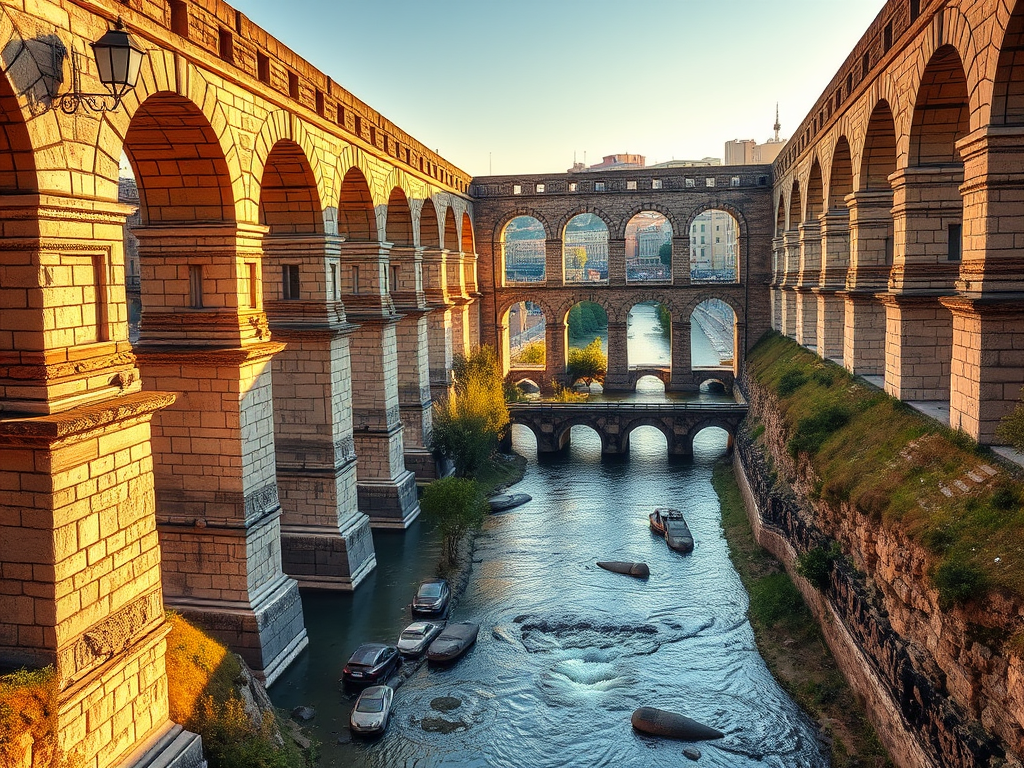
Rome, the Eternal City! When you think of Rome, you probably imagine the Colosseum, the Pantheon, and delicious pasta. It’s a city where ancient history seems to whisper from every stone, where emperors once ruled, and gladiators fought. But beyond the famous sights, Rome holds countless secrets, from astonishing ancient inventions that still amaze us today, to quirky modern quirks and surprising facts.
Rome isn’t just old stones; it’s a vibrant, living city where the past and present blend in fascinating ways. It’s a place where you can walk in the footsteps of emperors one moment and discover a hidden cat sanctuary the next. Many of the things we take for granted today, from concrete to efficient road networks, have their roots in the brilliant minds of ancient Romans. And even in modern Rome, there are unique traditions and unexpected details that make it truly special.
In this article, we’re going on an exciting journey to uncover ten ancient secrets and modern marvels of Rome that you might never have heard about. Get ready to be amazed by the engineering genius of the past, the origins of common phrases, and the surprising charm of this timeless city!
1. The Mighty Roman Aqueducts: Ancient Water Superhighways
Imagine living in a city without easy access to fresh, clean water. Ancient Rome faced this problem as it grew, but they solved it with incredible brilliance: the aqueducts. These weren’t just simple pipes; they were vast, complex systems of channels, tunnels, and magnificent arched bridges that carried water from distant springs and mountains directly into the city, sometimes over many miles!
The Romans used a clever understanding of gravity, building the aqueducts with a slight, continuous downward slope to ensure the water flowed smoothly. Some parts were underground, while others were spectacular stone arches that still stand today, like the Pont du Gard (in France, but built by Romans). This incredible engineering feat provided water for public baths, fountains, and even private homes, making Rome one of the cleanest and most advanced cities of its time. The aqueducts are a powerful testament to ancient Roman ingenuity, proving that they were master builders who planned for the long term.
2. Roman Concrete: A Recipe for Endurance
When you look at ancient Roman structures like the Pantheon or the Colosseum, you might wonder how they’ve managed to stand for thousands of years. The secret lies partly in Roman concrete, a material far superior to anything else available at the time, and surprisingly durable. Unlike modern concrete, which often degrades over centuries, Roman concrete has shown incredible longevity, especially when used underwater.
Scientists have discovered that Roman concrete, particularly the type used for structures like harbors, included volcanic ash (pozzolana) and lime. When mixed with water, this created a chemical reaction that made the concrete incredibly strong and resistant to saltwater erosion, actually getting stronger over time! This ingenious blend allowed the Romans to build massive domes, strong bridges, and lasting structures that modern engineers still marvel at. It’s a “lost art” in some ways, teaching us that sometimes the oldest methods hold the greatest secrets to durability.
3. “All Roads Lead to Rome”: The Original Superhighway Network
Have you ever heard the saying, “All roads lead to Rome”? It’s not just a catchy phrase; it reflects a historical truth! The ancient Romans built an astonishing network of roads that connected their vast empire. These weren’t just dirt tracks; they were meticulously engineered, paved roads designed for efficiency and durability, allowing armies, goods, and messengers to travel quickly.
At the heart of this network was Rome itself. The famous Via Appia (Appian Way), parts of which you can still walk on today, is a prime example of their road-building prowess. These roads featured multiple layers of stone, gravel, and sand, often with drainage systems. Their purpose was to ensure swift military movements and easy trade, cementing Rome’s control. This extensive and well-maintained road system was a modern marvel of its time, far beyond anything else in the world, and truly made Rome the central hub of its empire, giving rise to that enduring saying.
4. Rome’s Ancient Sewers: The Cloaca Maxima
It might not be the most glamorous topic, but one of ancient Rome’s most impressive, and often overlooked, engineering feats is its sewer system, particularly the Cloaca Maxima. Built thousands of years ago, potentially starting as early as the 6th century BCE, this massive underground drainage system was designed to drain the swamps of Rome and carry waste from the city into the River Tiber.
Think of it as an ancient super-sewer! It was an incredibly sophisticated system for its time, using clever construction techniques and continuous maintenance. While parts of it are now integrated into modern sewers, sections of the original Cloaca Maxima are still functioning today, over 2,500 years later! This highlights the Roman understanding of sanitation and public health, a concept that was far ahead of its time. It’s a “hidden” marvel because you can’t see most of it, but its continued existence is a testament to the Romans’ genius in urban planning and engineering.
5. The Whispering Walls of Pasquino: Rome’s Original Social Media
In a small piazza near Piazza Navona stands an ancient, battered statue fragment. It’s known as Pasquino, and it’s not just any old piece of stone; it’s a unique piece of Rome’s “social media” history! For centuries, from the 16th century onwards, people would attach anonymous satirical poems, criticisms, and witty comments (called “pasquinades”) to the statue, often aimed at popes, politicians, or powerful figures.
These “pasquinades” were a way for Romans to express their opinions, grievances, and humor without revealing their identities, as openly criticizing authorities could be dangerous. Pasquino became a “talking statue,” a public forum where the voice of the common people could be heard. While not an invention, it’s a fascinating social phenomenon that shows how people found creative ways to communicate and critique in a time without newspapers, let alone the internet. It’s a living echo of Rome’s spirited and often rebellious past.
6. The Cat Colonies of Rome: Feline Free Spirits
Walk around Rome, especially near ancient ruins like the Colosseum, the Roman Forum, or the Largo di Torre Argentina (which holds the remains of four Roman temples), and you’ll quickly notice something charming and unique: a thriving population of stray cats. These aren’t just random strays; they form organized colonies, often looked after by dedicated volunteers and protected by law.
Rome has a long history with cats, seeing them as symbols of good luck and natural pest controllers. The Roman cat colonies are protected by a law that states any colony of five or more cats cannot be moved. This means these feline residents have a special status. They add a whimsical and sometimes unexpected element to Rome’s ancient grandeur, reminding you that life continues to flourish amidst the ruins, with these independent cats being a beloved part of the city’s character.
7. The Pantheon’s Unreinforced Concrete Dome: A Masterpiece of Engineering
The Pantheon is one of ancient Rome’s most perfectly preserved buildings, a stunning temple-turned-church that has stood for nearly 2,000 years. Its most astonishing feature is its massive dome, which was the largest unreinforced concrete dome in the world for over 1,300 years! Unreinforced means there are no steel bars inside the concrete, like in modern domes, to help it hold its shape.
How did they do it? The Roman engineers used incredibly clever techniques. They used lighter aggregates (like pumice stone) in the concrete as the dome got higher, reducing its weight. They also built stepped rings on the exterior to reinforce the base and created a large circular opening at the top, the “oculus,” which lightens the load and provides natural light. The Pantheon’s dome is a breathtaking example of Roman architectural and engineering genius, demonstrating their profound understanding of materials and structural forces without the aid of modern calculations or tools.
8. The Fountains of Rome: Ancient Aqueducts Meet Artistic Flair
Rome is famously known as the “city of fountains,” with thousands of them gracing its piazzas and street corners, from the grand Trevi Fountain to countless smaller, charming ones. What makes these fountains a “modern marvel” rooted in ancient history? They are direct descendants of the Roman aqueduct system.
Many of Rome’s most famous fountains are still fed by the same ancient aqueduct lines that brought water into the city thousands of years ago. The engineers of the Renaissance and Baroque periods tapped into these existing water sources to create magnificent works of art, celebrating the abundance of water that Rome possessed thanks to its Roman ancestors. So, when you toss a coin in the Trevi Fountain, you’re not just enjoying a beautiful artwork; you’re witnessing the continuation of ancient Roman water management, transformed into a display of artistic brilliance.
9. Roman Numerals: Still Around, But Why Not Everyday?
You’ve probably seen Roman numerals (like I, V, X, L, C, D, M) on clocks, movie titles, or the Super Bowl. They were the standard counting system in ancient Rome and throughout Europe for centuries. They are a fascinating part of Rome’s legacy that we still use in specific ways today.
Why haven’t they changed everything and replaced our everyday numbers (1, 2, 3…)? While visually striking, Roman numerals are much harder to use for complex math. Imagine trying to do multiplication or division with them! They don’t have a zero, and their value depends on their position (e.g., IV is 4, but VI is 6), which makes calculations very cumbersome. The Arabic numeral system (what we use today), which includes zero and uses place value much more simply, proved to be far more efficient for mathematics and became dominant. Roman numerals are a great example of an ancient system that was ingenious for its time but was eventually surpassed by a more practical innovation.
10. The Vatican’s Swiss Guard: A Unique and Ancient Army
While technically its own tiny country within Rome, Vatican City holds a unique and ancient military force: the Swiss Guard. Instantly recognizable by their brightly colored, striped uniforms (said to be designed by Michelangelo, though this is debated!), these are not just ceremonial guards. They are highly trained soldiers responsible for the Pope’s safety and the security of Vatican City.
The Swiss Guard has a fascinating history, dating back to 1506. Swiss mercenaries were known for their bravery and loyalty, and Pope Julius II hired them to be his personal protectors. To join, a candidate must be a Swiss Catholic male, unmarried, at least 174 cm (5’8″) tall, and have completed basic training in the Swiss Army. Their unique combination of ancient tradition, strict requirements, and modern training makes them a truly unique and living link to the past, a surprising and colourful “ancient secret” still operating as a modern marvel in the heart of Rome.
Rome truly is a city of endless discovery, where every corner seems to hold a story, and the echoes of ancient genius meet the quirks of modern life. From the hidden flows of water to the wisdom embedded in its surviving structures and the charm of its feline residents, Rome continues to amaze and teach us about human ingenuity, resilience, and the fascinating journey of civilization.
Further Reading
- “Rome in Spectacular Cross-Section” by Stephen Biesty (Illustrates Roman engineering in amazing detail)
- “Who Were the Romans?” by Janet Parker (A great introduction to ancient Roman life)
- “History of the World (DK Eyewitness)” (Contains sections on ancient Rome and its impact)
- “Usborne History of Britain: Romans” (Explores Roman influence, including engineering, in an accessible way)
- “If You Were a Kid in Ancient Rome” by Susan Martineau (A fun look at daily life in ancient Rome)
Here at Zentara.blog, our mission is to take those tricky subjects and unlock them, making knowledge exciting and easy to grasp for everyone. But the adventure doesn’t stop on this page! We’re constantly exploring new frontiers and sharing discoveries across the digital universe.
Want to dive deeper into more mind-bending Top 10s and keep expanding your world? Come join us on our other platforms – we’ve got unique experiences waiting for you on each one!
- Get inspired by visual wonders and bite-sized facts: See the world through Zentara’s eyes on Pinterest! Pin our fascinating facts and stunning visuals to your own boards. Explore Pins on Pinterest: https://uk.pinterest.com/zentarablog/
- Discover quick insights and behind-the-scenes peeks: Hop over to Tumblr for snippets, quotes, and unique content you won’t find anywhere else. It’s a different flavour of discovery! Follow the Fun on Tumblr: https://www.tumblr.com/zentarablog
- Ready for deep dives you can listen to or watch? We’re bringing our accessible approach to video and potentially audio! Subscribe to our YouTube channel and tune into future projects that make learning pop! Subscribe on YouTube: https://www.youtube.com/@ZentaraUK
- Seeking even more knowledge in one place? We’ve compiled some of our most popular topic deep dives into fantastic ebooks! Find them on Amazon and keep the learning journey going anytime, anywhere. Find Our Ebooks on Amazon: https://www.amazon.co.uk/s?k=Zentara+UK&ref=nb_sb_noss
- Connect with us and fellow knowledge seekers: Join the conversation on BlueSky! We’re sharing updates, thoughts, and maybe even asking you what wonders we should explore next. Chat with Us on BlueSky: https://bsky.app/profile/zentarablog.bsky.social
- Perfect for learning on the move! We post multiple 10-minute podcasts per day on Spotify. Pop on your headphones and fill your day with fascinating facts while you’re out and about! Listen on Spotify: https://open.spotify.com/show/3dmHbKeDufRx95xPYIqKhJ
Every click helps us keep bringing honest, accessible knowledge to everyone. Thanks for exploring with us today – see you out there in the world of discovery!




Leave a Reply