
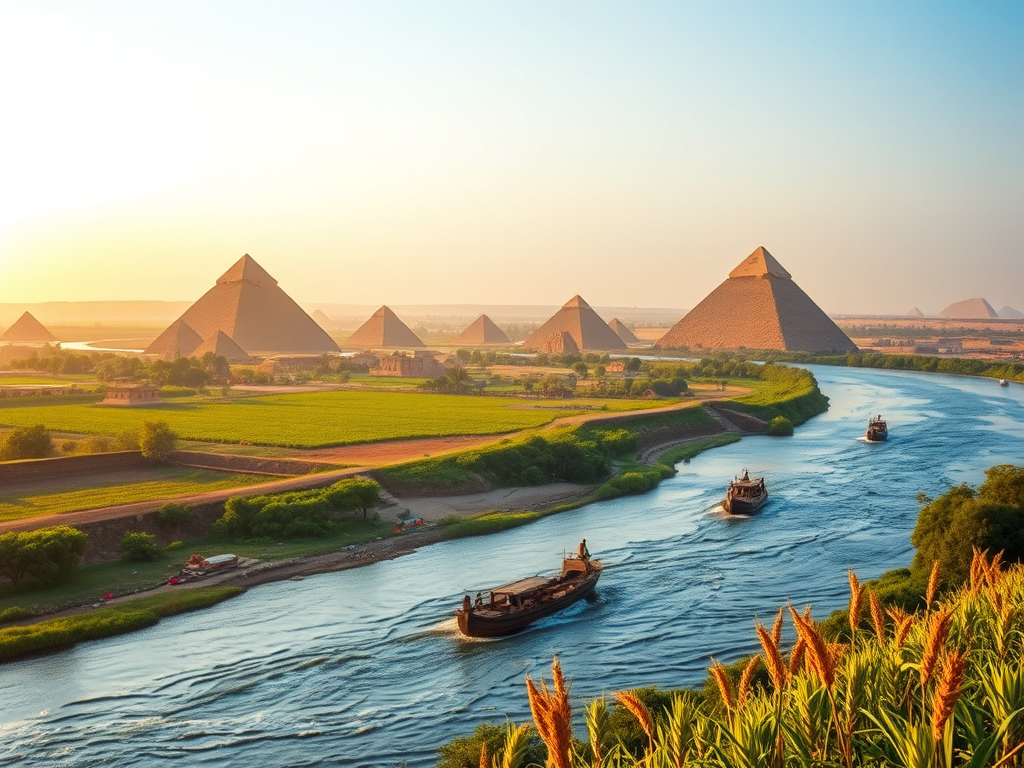
Imagine trying to build a town, grow food, or travel long distances thousands of years ago without modern technology. It would be incredibly difficult! Ancient people quickly learned that living near a river made life much easier. Rivers provided fresh water for drinking and farming, they offered a way to travel and trade using boats, and their floods often left behind rich soil perfect for growing crops.
Because of this, many of the earliest and greatest human civilizations grew up in ancient river valleys. These rivers weren’t just convenient; they were absolutely essential. They dictated where people lived, how they farmed, how they traded, and sometimes even influenced their beliefs and myths. Understanding these major world rivers is like understanding the cradle of human history.
Let’s explore 10 amazing rivers and see the powerful role they played in shaping the civilizations that depended on them.
1. The Nile: The Lifeline of Ancient Egypt
When you think of ancient Egypt, you probably picture pyramids, pharaohs, and vast deserts. But none of that would have been possible without the Nile River. Flowing north through a dry landscape, the Nile was the absolute lifeline for the ancient Nile River civilization.
Each year, the Nile would flood its banks, and when the waters receded, they left behind a layer of incredibly fertile black soil. This soil was perfect for growing crops like wheat and barley, allowing the Egyptians to produce enough food to feed a large population. The river also served as the main highway, allowing easy travel and trade up and down the long country using boats. This helped unify Egypt and made administration and defense much easier. The predictability of the Nile’s flood cycle even influenced their religion and calendar. The history of rivers is deeply tied to farming, and the Nile is the prime example of a river creating an agricultural paradise in a desert.
2. The Tigris and Euphrates: The Rivers of Mesopotamia
In the Middle East, between the Tigris and Euphrates rivers, lay a region known as Mesopotamia. This name literally means “land between the rivers.” This area is often called the “Cradle of Civilization” because some of the very first cities and empires arose here, thanks to these two rivers.
Like the Nile, the Tigris and Euphrates provided water for irrigation in a dry climate, allowing people to farm. However, their floods were less predictable than the Nile’s, which encouraged the people of Mesopotamia (like the Sumerians, Akkadians, Babylonians, and Assyrians) to develop complex irrigation systems, build canals, and create early forms of government to manage these projects. The rivers also facilitated trade, connecting different cities and regions. The constant interaction and occasional conflict over resources in this ancient river valley spurred innovation in writing (like cuneiform), law codes (like Hammurabi’s Code), and mathematics. The history of rivers as engines of innovation is perfectly captured here.
3. The Indus: The Heart of a Mysterious Civilization
Thousands of years ago, in what is now Pakistan and northwest India, a sophisticated civilization thrived along the Indus River and its tributaries. We call them the Indus River Valley Civilization. What’s amazing is that we know less about their writing than the Egyptians or Mesopotamians, but their cities were incredibly advanced!
Cities like Mohenjo-Daro and Harappa were well-planned with grid-like streets, advanced drainage systems, and public baths. This level of organisation suggests a well-structured society, all made possible by the resources provided by the Indus River. The river’s waters allowed for farming in the fertile valley, and it likely served as a crucial route for trade, connecting this civilization with distant lands. The decline of this civilization is partly a mystery, with some theories involving shifts in the river’s course or changes in climate affecting the waterway they depended on. The Indus River was the essential foundation for these ancient, organised urban centres.
4. The Yellow River (Huang He): The Mother River of China
In northern China, the Yellow River, or Huang He, is often called the “Mother River” because Chinese civilization is said to have begun in its valley. The river gets its name from the yellowish silt it carries, called loess, which is very fertile for farming.
The Yellow River valley was where early Chinese agriculture, particularly the farming of millet, flourished. This allowed communities to grow and eventually form early dynasties. However, the Yellow River is also known as “China’s Sorrow” because its course has shifted dramatically and unpredictably over the centuries, causing devastating floods. Managing the river, building dikes, and dealing with floods became a major challenge that encouraged large-scale cooperation and the development of strong central governments in China. The Yellow River China is a powerful symbol of both the life-giving and destructive power of rivers in history, shaping a resilient and unified culture around the need to manage its flow.
5. The Yangtze River (Chang Jiang): Connecting China’s South and North
China is a vast country, and while the Yellow River was important in the north, the Yangtze River, or Chang Jiang, the longest river in Asia, played a crucial role in the south and in connecting the whole country.
The Yangtze flows through a region with a different climate, perfect for growing rice. The fertile Yangtze Delta became a major agricultural powerhouse, supporting large populations. More importantly, the Yangtze served as a massive transportation and trade artery, linking the prosperous southern regions with the political centres in the north (often via canals like the Grand Canal, which connected it to the Yellow River). Control of the Yangtze was often key to controlling China, and many important cities grew along its banks. The Yangtze River highlights how rivers helped civilizations by not just providing resources, but also by serving as essential infrastructure for trade, communication, and political unity across vast distances. It was key to China’s internal connection.
6. The Ganges: A Sacred River in India
For millions of people in India, the Ganges River (Ganga) is more than just a source of water; it is a sacred river, considered a goddess. Flowing from the Himalayas across northern India, it has been central to life and culture for thousands of years.
The Ganges valley is an extremely fertile and densely populated region, relying heavily on the river for agriculture. The river provides water for drinking, irrigation, and transportation. But its impact goes much deeper. It is the heartland of Hindu culture and religion, with countless myths, rituals, and festivals centered around the river. Pilgrims travel from all over to bathe in its waters, which are believed to cleanse sins. Major historical empires and kingdoms also rose and fell in the fertile and well-connected Ganges plain. The Ganges River importance shows how rivers can shape not just the practical aspects of survival, but also the spiritual and cultural identity of a civilization, serving as a vital artery for sustenance and faith.
7. The Danube: A River Through the Heart of Europe
The Danube River is Europe’s second-longest river, flowing through more countries than any other river in the world. From Germany to the Black Sea, it passes through or borders countries like Austria, Hungary, Serbia, and Romania, connecting diverse cultures and histories.
For centuries, the Danube served as a highway for trade, allowing goods and ideas to travel across Central and Eastern Europe. It also often acted as a natural border between empires and kingdoms, such as the Roman Empire’s northern frontier. Important cities like Vienna, Budapest, and Belgrade grew on its banks because of the access to water, trade, and transportation it provided. The Danube River history is a tapestry of different peoples, conflicts, and exchanges, all facilitated by this major waterway. It highlights how rivers helped civilizations by acting as corridors for migration, conquest, trade, and cultural diffusion across a continent.
8. The Mississippi: The Great River of North America
In North America, the Mississippi River system, including its major tributary the Missouri, is a giant artery that drains a vast area of the continent. While perhaps not the cradle of the very earliest human civilizations on Earth, it was incredibly important for the development and expansion of people in North America.
For Native American tribes, the Mississippi and its tributaries were vital for transportation, fishing, and accessing resources. Later, as European settlers moved westward, the Mississippi became the primary highway for trade and travel, allowing goods like furs, timber, and agricultural products to be transported easily. Major cities like St. Louis and New Orleans grew at key points along the river. Control of the Mississippi was strategically important, influencing wars and territorial expansion. The Mississippi River facts demonstrate its role as a massive natural infrastructure that facilitated movement, trade, and the growth of settlements across a huge part of a continent, shaping the modern history of the United States.
9. The Amazon: A River of Unmatched Biodiversity and Mystery
The Amazon River in South America is the largest river in the world by the amount of water it carries, and it flows through the vast Amazon rainforest. While it didn’t host centralized empires like those along the Nile or Tigris/Euphrates in the same way, it shaped the lives of countless indigenous civilizations in unique ways.
The sheer scale of the Amazon and its dense rainforest environment meant that civilizations developed differently here. People adapted to the forest and river, using the river for transport, fishing, and accessing the incredible biodiversity of the rainforest for food, medicine, and building materials. Complex societies existed along its banks, though many were impacted by disease and external pressures after the arrival of Europeans. The Amazon River facts highlight how a river can shape civilizations not just through agriculture, but by providing access to immense natural resources and serving as the primary network for connection in a challenging environment. It’s a river that fostered diverse cultures adapted to its unique ecosystem.
10. The Rhine: Europe’s Industrial and Cultural Backbone
Flowing from the Alps through industrial heartlands to the North Sea, the Rhine River has been one of Europe’s most important waterways for trade, transport, and historical boundaries.
Like the Danube, the Rhine served as a border for the Roman Empire and later for various kingdoms and states. Its accessibility and position made it ideal for transporting goods, especially coal and steel during the industrial revolution. Many important cities like Basel, Strasbourg, Cologne, and Rotterdam are located along its banks, thriving on the trade and industry the river supported. The Rhine River shows how rivers helped civilizations by becoming central arteries for economic activity, transporting raw materials and finished goods that powered industrial growth and wealth across different nations. It’s a river that shaped modern European history through trade and industry.
Conclusion
From providing life-giving water for ancient farms to serving as highways for trade and even holding deep religious meaning, rivers have truly been the cradles and conduits of human civilization. The stories of the Nile, the Tigris and Euphrates, the Indus, the Yellow River, the Yangtze, the Ganges, the Danube, the Mississippi, the Amazon, and the Rhine are just a few examples of how these incredible natural wonders have shaped where and how people live, trade, and build societies. Even today, billions of people still rely on rivers for water, power, and transportation, showing that the vital connection between humans and rivers is as strong as ever.
Further Reading
Want to learn more about amazing rivers and the people who lived near them? Check out these books:
- Rivers: A Visual Encyclopedia by DK (Great for geography and facts about many rivers)
- National Geographic Kids Everything Rivers: Flow with Facts, Photos, and Fun by Jill Esbaum
- The Street Beneath My Feet by Charlotte Guillain (Follows what’s beneath you, eventually hitting water tables and rivers – connects local to global)
- Ancient Civilizations by various authors (Look for books specifically covering Mesopotamia, Egypt, Indus Valley, and Ancient China)
- Paddle-to-the-Sea by Holling C. Holling (A classic children’s book following a wooden figure’s journey through the Great Lakes and Mississippi system, illustrating river connections)
Here at Zentara.blog, our mission is to take those tricky subjects and unlock them, making knowledge exciting and easy to grasp for everyone. But the adventure doesn’t stop on this page! We’re constantly exploring new frontiers and sharing discoveries across the digital universe.
Want to dive deeper into more mind-bending Top 10s and keep expanding your world? Come join us on our other platforms – we’ve got unique experiences waiting for you on each one!
- Get inspired by visual wonders and bite-sized facts: See the world through Zentara’s eyes on Pinterest! Pin our fascinating facts and stunning visuals to your own boards. Explore Pins on Pinterest: https://uk.pinterest.com/zentarablog/
- Discover quick insights and behind-the-scenes peeks: Hop over to Tumblr for snippets, quotes, and unique content you won’t find anywhere else. It’s a different flavour of discovery! Follow the Fun on Tumblr: https://www.tumblr.com/zentarablog
- Ready for deep dives you can listen to or watch? We’re bringing our accessible approach to video and potentially audio! Subscribe to our YouTube channel and tune into future projects that make learning pop! Subscribe on YouTube: https://www.youtube.com/@ZentaraUK
- Seeking even more knowledge in one place? We’ve compiled some of our most popular topic deep dives into fantastic ebooks! Find them on Amazon and keep the learning journey going anytime, anywhere. Find Our Ebooks on Amazon: https://www.amazon.co.uk/s?k=zentara+uk&crid=2273NA7RAJ1EU&sprefix=zentara+uk%2Caps%2C90&ref=nb_sb_noss
- Connect with us and fellow knowledge seekers: Join the conversation on BlueSky! We’re sharing updates, thoughts, and maybe even asking you what wonders we should explore next. Chat with Us on BlueSky: https://bsky.app/profile/zentarablog.bsky.social
- Perfect for learning on the move! We post multiple 10-minute podcasts per day on Spotify. Pop on your headphones and fill your day with fascinating facts while you’re out and about! Listen on Spotify: https://open.spotify.com/show/3dmHbKeDufRx95xPYIqKhJ
Every click helps us keep bringing honest, accessible knowledge to everyone. Thanks for exploring with us today – see you out there in the world of discovery!




Leave a Reply