
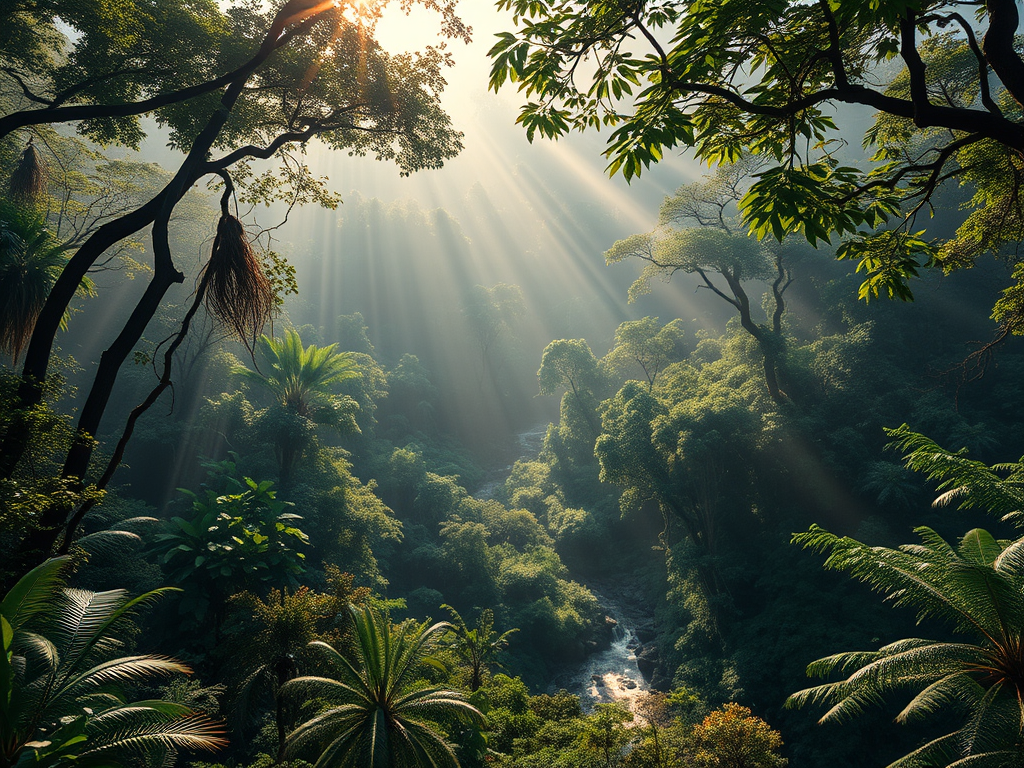
Stretching across a vast swathe of South America, the Amazon Rainforest is more than just a dense collection of trees; it is the Earth’s most magnificent and complex life-support system. A realm of staggering biodiversity, mythic scale, and profound global importance, it ignites our imagination with images of winding rivers, elusive wildlife, and ancient mysteries. But beyond the popular imagery lies a world of scientific wonders that are more fascinating than any fiction. From creating its own weather to its surprising connection with the Sahara Desert, the Amazon is a living, breathing entity whose secrets we are only just beginning to unravel. Join us on an expedition into the heart of this incredible ecosystem as we explore ten fascinating facts that reveal the true wonder of the largest rainforest on Earth.
1. It’s So Immense, It Generates Its Own Weather
The sheer scale of the Amazon is difficult to comprehend, but one of its most incredible features is its ability to act as a continental weather engine. The forest contains an estimated 390 billion trees, each of which acts like a biological water fountain. Through a process called transpiration, these trees draw up vast quantities of water from the ground and release it as vapour into the atmosphere. Collectively, this process is so powerful that the Amazon creates its own rainfall and generates enormous “flying rivers”—vast corridors of airborne moisture that flow through the sky. These atmospheric rivers, carrying more water than the Amazon River itself, travel across the continent, providing essential rainfall to major agricultural regions in Brazil, Paraguay, and Argentina. In essence, the rainforest is its own giant, self-watering sprinkler system, a testament to the power of a healthy, intact ecosystem to regulate and sustain itself and the lands far beyond its borders.
2. It’s a “Library of Life” Holding 10% of All Known Species
If you were to gather all the known species of plants and animals on Earth, one in every ten would call the Amazon home. This unparalleled biodiversity makes the rainforest a living, breathing “library of life.” It is home to an estimated 2.5 million species of insects, over 40,000 species of plants, around 3,000 species of fish, and more than 2,000 species of birds and mammals. On a single hectare (about 2.5 acres) of Amazonian soil, you can often find more tree species than exist in all of North America. Scientists continue to discover new species at a remarkable rate, with a new plant or animal species being described, on average, every other day. What’s even more staggering is that this is just what we know. The vast majority of the Amazon’s biodiversity, particularly its insects and microorganisms, remains a complete mystery, making it the planet’s last great frontier of biological discovery.
3. It’s Not the “Lungs of the Earth,” But It Is a Climate Hero
The Amazon is famously nicknamed the “Lungs of the Earth,” creating a popular image of the forest breathing in carbon dioxide and breathing out the oxygen we depend on. While the Amazon does produce a colossal amount of oxygen through photosynthesis (around 20% of the world’s total), this analogy is a misconception. The rainforest consumes almost all the oxygen it produces through the respiration of its plants and the decomposition of organic matter on the forest floor. Its true superpower in the climate change fight is its role as a massive carbon sink. The forest’s billions of trees and its rich soils have absorbed and locked away an enormous amount of carbon dioxide from the atmosphere over millennia. Scientists estimate the Amazon stores between 150 and 200 billion metric tons of carbon. When the forest is cut down and burned, this stored carbon is released back into the atmosphere, which is why deforestation is a major driver of global warming. So, think of the Amazon less as a lung and more as a giant, planetary carbon sponge.
4. The Amazon River is a True Titan of Water
The river that gives the rainforest its name is just as awe-inspiring as the forest itself. While the Nile is slightly longer, the Amazon River is, by an enormous margin, the largest river in the world by discharge volume. It pumps a mind-boggling 209,000 cubic metres of water into the Atlantic Ocean every second. This is more than the next seven largest rivers in the world combined. The freshwater outflow is so powerful that it dilutes the salinity of the ocean for more than 160 kilometres offshore. The river is so wide in places that from one bank, you cannot see the other, and remarkably, for its entire 6,400-kilometre length, not a single bridge crosses it. To traverse the river, communities rely entirely on boats and ferries. This watery giant, fed by over 1,100 tributaries, is the lifeblood of the entire ecosystem, shaping the land and sustaining its incredible diversity of life.
5. It’s a Living Pharmacy with Untapped Cures
For centuries, indigenous peoples of the Amazon have relied on the forest’s immense botanical diversity for their traditional medicine. This knowledge is not mere folklore; it is a profound understanding of the forest’s chemical secrets. In fact, the global medical community owes a significant debt to the Amazon. It is estimated that around 25% of all Western pharmaceuticals are derived from rainforest ingredients, yet less than 5% of tropical plants have been analysed for their medicinal potential. Quinine, the first effective treatment for malaria, comes from the bark of the Andean Cinchona tree. Curare, a plant-derived muscle relaxant used in modern surgery, was first used as a poison on blowgun darts by Amazonian tribes. The rainforest is essentially a living, self-replicating pharmaceutical laboratory, holding the potential for countless undiscovered cures for human diseases. Protecting this biodiversity is not just an environmental issue; it’s a matter of human health.
6. It’s Home to Hundreds of Indigenous Cultures, Including the Last Uncontacted Peoples
The Amazon is often pictured as a pristine, untouched wilderness, but it has been shaped by and home to human beings for at least 11,000 years. Today, it is inhabited by nearly 400 distinct indigenous groups, each with its own unique language, culture, and deep ancestral connection to the forest. These communities hold an encyclopaedic knowledge of the ecosystem, passed down through generations. Even more remarkably, the Amazon is believed to be home to the last remaining uncontacted tribes on the planet. These are groups who, by choice, live in voluntary isolation from the outside world. An estimated 100 such groups are thought to exist, mostly in the remote border areas of Brazil and Peru. Their existence is a powerful reminder that the rainforest is not an empty landscape but a mosaic of ancient human cultures, whose survival is inextricably linked to the health of the forest itself.
7. It’s Fertilised by Sand from the Sahara Desert
One of the most astonishing ecological connections on our planet links the largest desert with the largest rainforest. The soil in the Amazon basin is ancient, heavily weathered, and surprisingly poor in essential nutrients, particularly phosphorus. So, how does this incredibly lush forest thrive? The answer blows across the Atlantic Ocean. Each year, powerful winds pick up an average of 182 million tons of dust from the Bodélé Depression in Chad—an ancient lakebed in the Sahara Desert. This dust, rich in phosphorus from crushed fish skeletons and microorganisms that once lived in the lake, travels over 2,600 kilometres across the ocean. Around 22,000 tons of this crucial phosphorus falls on the Amazon basin annually, acting as a vital fertiliser that replenishes the nutrients lost to rainfall. This incredible intercontinental delivery service perfectly illustrates the interconnectedness of Earth’s systems, where the bones of a dead Saharan lake give life to the vibrant Amazonian forest.
8. The Forest Floor is a World of Perpetual Twilight
The iconic image of a rainforest is one of a dense, impenetrable jungle. While true in places, the structure of the primary forest is highly organised into distinct layers. At the top is the emergent layer, with giant trees that tower above everything else. Below this is the main canopy, a continuous, leafy ceiling formed by the crowns of most of the forest’s trees. This layer is so dense that it acts like a giant green umbrella, blocking up to 98% of the sunlight from reaching the ground. As a result, the understory and the forest floor exist in a state of perpetual twilight. Because so little light gets through, the forest floor in mature rainforests is often surprisingly clear of heavy vegetation. This dark, humid world has its own unique ecosystem, adapted to low-light conditions, where decomposition and the recycling of nutrients are the main events in the drama of life.
9. It Harbours Some of the Planet’s Most Bizarre and Wonderful Creatures
While jaguars, monkeys, and macaws are the famous poster children of the Amazon, the rainforest is also home to some of the most uniquely adapted creatures imaginable. Swimming in its rivers is the Boto, or pink river dolphin, a freshwater dolphin with a flexible neck that can turn its head 90 degrees. Clinging to its leaves are glass frogs, whose abdominal skin is completely transparent, allowing you to see their internal organs, including their tiny, beating heart. The Jesus Christ lizard has earned its name for its astonishing ability to run across the surface of the water to escape predators. And lurking in its murky waters is the electric eel—which is actually a type of knifefish, not a true eel—capable of generating a powerful electric shock of up to 600 volts to stun its prey. These are just a few examples of the endless evolutionary marvels that the Amazon’s unique environment has produced.
10. It Is Disappearing at a Frightening Pace
This final fact is the most critical and sobering. Despite its vastness and importance, the Amazon is under severe threat. An estimated 17% of the rainforest has already been lost, and the rate of deforestation remains alarmingly high. The primary drivers are man-made: vast areas are cleared for cattle ranching and soy plantations, while illegal logging, mining, and road construction fragment the landscape further. This destruction has devastating consequences. It pushes countless species towards extinction, displaces indigenous communities, and disrupts the “flying rivers” that provide rain to the continent. Crucially, as the forest is burned, it releases its massive stores of carbon back into the atmosphere, accelerating the very climate change it helps to mitigate. Scientists warn that we are approaching a “tipping point,” beyond which large parts of the forest could irreversibly degrade into a dry savanna. The fate of this global treasure rests in our hands, making its conservation one of the most urgent challenges of our time.
Further Reading
To delve deeper into the wonders, history, and challenges of the Amazon Rainforest, these books offer captivating and insightful journeys:
- “The Lost City of Z: A Tale of Deadly Obsession in the Amazon” by David Grann
- “The River of Doubt: Theodore Roosevelt’s Darkest Journey” by Candice Millard
- “One River: Explorations and Discoveries in the Amazon Rain Forest” by Wade Davis
- “The Amazon: What Everyone Needs to Know” by Mark J. Plotkin
Here at Zentara.blog, our mission is to take those tricky subjects and unlock them, making knowledge exciting and easy to grasp for everyone. But the adventure doesn’t stop on this page! We’re constantly exploring new frontiers and sharing discoveries across the digital universe. Want to dive deeper into more mind-bending Top 10s and keep expanding your world? Come join us on our other platforms – we’ve got unique experiences waiting for you on each one!
Get inspired by visual wonders and bite-sized facts: See the world through Zentara’s eyes on Pinterest!
Pin our fascinating facts and stunning visuals to your own boards. Explore Pins on Pinterest: https://uk.pinterest.com/zentarablog/
Discover quick insights and behind-the-scenes peeks: Hop over to Tumblr for snippets, quotes, and unique content you won’t find anywhere else. It’s a different flavour of discovery! Follow the Fun on Tumblr: https://www.tumblr.com/zentarablog
Ready for deep dives you can listen to or watch? We’re bringing our accessible approach to video and potentially audio! Subscribe to our YouTube channel and tune into future projects that make learning pop! Subscribe on YouTube: https://www.youtube.com/@ZentaraUK
Seeking even more knowledge in one place? We’ve compiled some of our most popular topic deep dives into fantastic ebooks! Find them on Amazon and keep the learning journey going anytime, anywhere. Find Our Ebooks on Amazon: https://www.amazon.co.uk/s?k=Zentara+UK&ref=nb_sb_noss
Connect with us and fellow knowledge seekers: Join the conversation on BlueSky! We’re sharing updates, thoughts, and maybe even asking you what wonders we should explore next. Chat with Us on BlueSky: https://bsky.app/profile/zentarablog.bsky.social
Perfect for learning on the move! We post multiple 10-minute podcasts per day on Spotify. Pop on your headphones and fill your day with fascinating facts while you’re out and about! Listen on Spotify: https://open.spotify.com/show/3dmHbKeDufRx95xPYIqKhJFollow us on Instagram for bytesize knowledge! We post multiple posts per day on our official Instagram account. https://www.instagram.com/zentarablog/ Every click helps us keep bringing honest, accessible knowledge to everyone. Thanks for exploring with us today – see you out there in the world of discovery!




Leave a Reply