
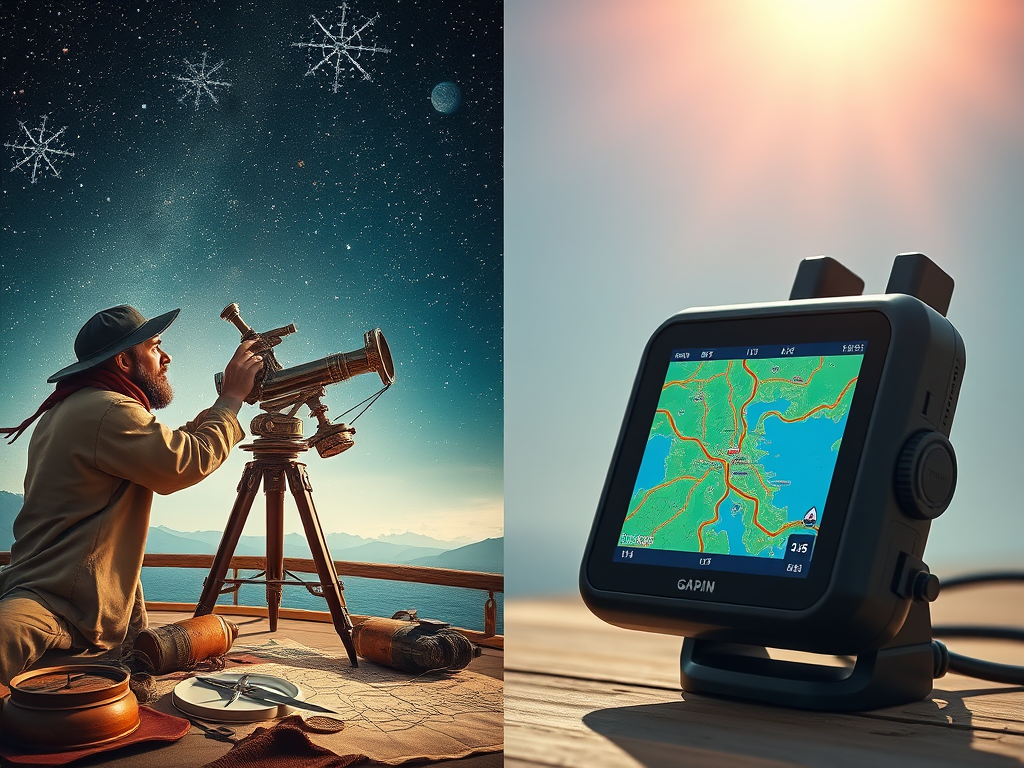
Have you ever used your phone or a special device in a car to find your way to a new place? Or maybe tracked a package you ordered online, or seen how scientists monitor wildlife? All of these amazing things are possible thanks to something called GPS. GPS stands for Global Positioning System. It’s like having a magical compass and map that can tell you exactly where you are, almost anywhere on Earth, at any time.
Today, GPS feels like a normal part of life, but it’s actually a relatively recent invention with a really interesting story behind it. It wasn’t developed by just one person or in one go; it was a complex project that took many years, a lot of money, and the hard work of countless scientists and engineers. Its origins are tied to space, military needs, and a desire to always know ‘where am I?’ Let’s explore the top 10 fascinating facts about the history of GPS!
1. Navigating Before GPS: Stars, Sextants, and Signals
For thousands of years, humans have been explorers, travelers, and traders. But before GPS, finding your way, especially over long distances like across oceans or vast land areas, was a massive challenge. Early navigators relied on natural signs – the position of the sun and stars, landmarks, or even the direction of prevailing winds.
More advanced techniques involved using tools like the compass (which points north based on the Earth’s magnetic field) and the sextant (which measures the angle between a celestial object like the sun or a star and the horizon to determine latitude). While these methods were incredibly clever and allowed for impressive voyages, they had limitations. They required clear weather to see the sky, they were less accurate, and determining longitude (your east-west position) was particularly tricky until reliable chronometers (very accurate clocks) were developed to measure time difference from a known meridian. These challenges highlighted the need for a more reliable, all-weather system, setting the stage for the eventual origin of GPS.
2. Sputnik’s Unexpected Gift: The Dawn of Satellite Tracking
The true spark that ignited the idea for satellite navigation came from an unexpected place: the launch of the Soviet Union’s Sputnik satellite in 1957. This event kicked off the “Space Race” and got scientists around the world thinking deeply about satellites and their capabilities. At Johns Hopkins Applied Physics Laboratory (APL) in the United States, scientists Dr. Richard Kirschner and Dr. William Guier were listening to the radio signals Sputnik was transmitting.
As Sputnik orbited the Earth, they noticed something fascinating: the frequency of the radio signal they received changed slightly as the satellite moved closer to or farther away from them. This is due to the Doppler effect, the same phenomenon that makes a siren sound higher in pitch as it approaches you and lower as it moves away. Kirschner and Guier realized that if they could track Sputnik’s position by analyzing the Doppler shift of its signal, then maybe, just maybe, if you knew the satellite’s position, you could use the same principle in reverse to figure out your own position on Earth! This key observation from Sputnik was a fundamental step in the history of GPS satellite technology.
3. Transit: The U.S. Navy’s First Satellite Navigation System
Inspired by the Sputnik observation, the U.S. Navy quickly saw the potential for satellite-based navigation, particularly for submarines needing to know their precise location to fire missiles accurately. This led to the development of Transit, the world’s first operational satellite navigation system. The first Transit satellite was launched in 1960, and the system became available for military use in 1964.
Transit worked differently from modern GPS. It used a constellation of satellites in polar orbits. To get a position fix, a user on the ground (or at sea) had to wait for a Transit satellite to pass overhead. By measuring the Doppler shift of the satellite’s signal as it passed, the user could calculate their position. This process took time and could only provide an update every hour or so. While revolutionary for its time, Transit had limitations in accuracy and availability. However, it proved the concept of satellite navigation and provided valuable experience that would be crucial for developing a more advanced system, showing the evolution of scanning technology from Earth-based to satellite-based methods for position fixing.
4. The Need for Something Better: Constant, Global Coverage
Transit was a great start, but its limitations – particularly the need to wait for a satellite pass and the relatively slow update rate – made it unsuitable for many potential applications. The U.S. military needed a navigation system that could provide continuous, real-time positioning anywhere on Earth, at any time, and work for fast-moving vehicles like airplanes.
Several branches of the military and government agencies were working on different concepts for advanced navigation systems in the 1960s. There was a need to combine these efforts and create a truly robust and universal system. This led to the critical decision to develop a new, comprehensive system that would overcome the limitations of Transit and other experimental methods. This realization that a continuous, global system was needed was a major driving force in the history of GPS, pushing for the development of the technology we know today.
5. The Genesis of NAVSTAR GPS: Uniting the Efforts
The official starting point for the system that would become GPS is generally considered to be 1973. In that year, the U.S. Department of Defense decided to merge the separate navigation satellite programs being pursued by the different branches of the military (the Navy’s Transit follow-on, the Air Force’s System 621B, and the Army’s Project Timation). The goal was to create a single, comprehensive, and highly accurate satellite navigation system.
This new joint program was initially known as the Navigation System Using Timing And Ranging, or NAVSTAR. It was an ambitious project that required developing entirely new technology, including more accurate atomic clocks for satellites and sophisticated ground control systems. The decision to combine the efforts and create NAVSTAR GPS was a pivotal moment in the history of GPS, laying the groundwork for the global utility of the system. It involved years of planning, research, and significant investment to answer the question of how GPS was developed.
6. Building the Constellation: Putting Satellites in Orbit
Developing the technology was one thing; actually building and launching a constellation of satellites to provide global coverage was another massive undertaking. The GPS concept required a specific arrangement of satellites in medium Earth orbit (MEO) – higher than low Earth orbit satellites like Transit, but lower than geostationary satellites. This orbit allows each satellite to be visible from a large area of the Earth for a significant amount of time.
The first experimental GPS satellite, called Navstar 1, was launched in 1978. Over the next two decades, more and more satellites were built and launched using various rockets. The goal was to have at least 24 operational satellites in orbit to ensure that a user anywhere on Earth could always see at least four satellites, which is the minimum number needed for an accurate 3D position fix (latitude, longitude, and altitude). Putting these satellites into space was a slow, deliberate process, crucial to making the GPS satellite history a reality and demonstrating when was GPS invented through its deployment.
7. The Three Pillars of GPS: Space, Control, and User Segments
To understand how GPS works, it helps to think of it as having three main parts, or “segments”:
- The Space Segment: This is the constellation of GPS satellites orbiting the Earth. Each satellite broadcasts precise timing signals and information about its own position.
- The Control Segment: This is a global network of ground stations, antennas, and monitors run by the U.S. military. They track the satellites, check their health, update their orbits and clocks, and send commands to them. This segment is vital for maintaining the accuracy of the GPS signals.
- The User Segment: This is you! It includes all the GPS receivers used by people on the ground, at sea, or in the air – everything from handheld GPS devices and car navigation systems to the chip in your smartphone. These receivers listen for signals from the satellites to calculate their position.
All three segments must work together for GPS to function, illustrating how does GPS work as a complete system, from the satellites in orbit to the device in your hand.
8. Selective Availability: A Period of Intentional Inaccuracy
For many years, although the GPS system was in orbit and functioning, its most accurate signal was deliberately restricted from civilian users. This was known as “Selective Availability” (SA). The U.S. military was concerned that potential adversaries could use the highly accurate GPS signal against them.
To implement SA, the military intentionally degraded the accuracy of the public GPS signal, making it less precise. Only military and authorized government users with special receivers could access the more accurate signal. This meant that early civilian GPS devices were less accurate than they are today, sometimes off by up to 100 meters. However, as GPS technology became more widespread and the geopolitical landscape changed, the rationale for SA diminished. In 2000, under President Bill Clinton, Selective Availability was switched off. This immediately made civilian GPS much more accurate and paved the way for its widespread adoption, marking a significant event in the recent history of GPS.
9. From Military Tool to Everyday Technology
Originally conceived and developed primarily for military purposes – precision bombing, troop movements, and submarine navigation – GPS began to find its way into civilian hands even before Selective Availability was turned off. Early civilian GPS receivers were expensive, bulky, and mostly used by specialized groups like surveyors, serious hikers, and boaters.
However, with the discontinuation of Selective Availability in 2000 and the rapid advancement of microelectronics, GPS receivers became smaller, cheaper, and more power-efficient. This led to their integration into a huge range of consumer devices. Dedicated car navigation systems became popular, and then, crucially, smartphones started including GPS chips. This integration into smartphones was a game-changer, making GPS technology accessible to billions of people and enabling countless new applications and services. The shift from a niche military tool to indispensable everyday technology is a remarkable part of how GPS was developed for broader use.
10. Beyond NAVSTAR: The World of GNSS
While the U.S. Global Positioning System (NAVSTAR GPS) was the first and is still the most widely used global navigation satellite system, it is no longer the only one. Recognizing the strategic importance of satellite navigation and wanting independent systems, other countries and regions have developed their own constellations.
Collectively, these systems are known as Global Navigation Satellite Systems, or GNSS. Major GNSS include:
- GLONASS: Developed by Russia.
- Galileo: Developed by the European Union.
- BeiDou: Developed by China.
Modern GPS receivers (like the one in your phone) can often use signals from multiple GNSS constellations simultaneously. This makes the positioning even more accurate and reliable, especially in challenging environments like urban canyons or areas with obstructed views of the sky. The existence of these other systems shows the continued evolution of scanning technology from a single source to a multi-constellation approach, ensuring greater accuracy and resilience for satellite navigation worldwide.
The story of GPS is a fantastic example of how scientific discovery, technological innovation, and strategic needs can combine to create something that fundamentally changes the world. From tracking early satellites to guiding billions of people every day, GPS has a truly fascinating history.
Further Reading
- GPS Made Easy: Using Handheld GPS Receivers and Mapping Software by Lawrence Letham (Focuses on practical use but often includes historical context)
- How Satellites See the World by Joanne Richter (Explores satellite technology, including navigation)
- The Age of the Earthfinders: The Story of Modern Navigation by Jim Thorne (May cover the transition from older methods to GPS)
- Introduction to GPS: The Global Positioning System by Ahmed El-Rabbany (More technical, but accessible sections might be useful for an advanced reader)
Here at Zentara.blog, our mission is to take those tricky subjects and unlock them, making knowledge exciting and easy to grasp for everyone. But the adventure doesn’t stop on this page! We’re constantly exploring new frontiers and sharing discoveries across the digital universe.
Want to dive deeper into more mind-bending Top 10s and keep expanding your world? Come join us on our other platforms – we’ve got unique experiences waiting for you on each one!
- Get inspired by visual wonders and bite-sized facts: See the world through Zentara’s eyes on Pinterest! Pin our fascinating facts and stunning visuals to your own boards. Explore Pins on Pinterest: https://uk.pinterest.com/zentarablog/
- Discover quick insights and behind-the-scenes peeks: Hop over to Tumblr for snippets, quotes, and unique content you won’t find anywhere else. It’s a different flavour of discovery! Follow the Fun on Tumblr: https://www.tumblr.com/zentarablog
- Ready for deep dives you can listen to or watch? We’re bringing our accessible approach to video and potentially audio! Subscribe to our YouTube channel and tune into future projects that make learning pop! Subscribe on YouTube: https://www.youtube.com/@ZentaraUK
- Seeking even more knowledge in one place? We’ve compiled some of our most popular topic deep dives into fantastic ebooks! Find them on Amazon and keep the learning journey going anytime, anywhere. Find Our Ebooks on Amazon: https://www.amazon.co.uk/s?k=zentara+uk&crid=2273NA7RAJ1EU&sprefix=zentara+uk%2Caps%2C90&ref=nb_sb_noss
- Connect with us and fellow knowledge seekers: Join the conversation on BlueSky! We’re sharing updates, thoughts, and maybe even asking you what wonders we should explore next. Chat with Us on BlueSky: https://bsky.app/profile/zentarablog.bsky.social
- Perfect for learning on the move! We post multiple 10-minute podcasts per day on Spotify. Pop on your headphones and fill your day with fascinating facts while you’re out and about! Listen on Spotify: https://open.spotify.com/show/3dmHbKeDufRx95xPYIqKhJ
Every click helps us keep bringing honest, accessible knowledge to everyone. Thanks for exploring with us today – see you out there in the world of discovery!




Leave a Reply