
Table of Contents
Tap. Beep. “In 500 feet, turn left.”
Today, we move through the world guided by an invisible, all-knowing oracle in our pockets. We cross oceans, find obscure restaurants, and hike new trails with a placid, digital certainty. GPS (Global Positioning System) is a flat-out miracle of modern science, a network of satellites that tells us exactly where we are, all the time. But this entire system is less than a few decades old.
For 99.9% of human history, to “navigate” meant something completely different. It wasn’t a passive act of following instructions; it was an active, intellectual, and deeply sensory art. It was a high-stakes blend of mathematics, astronomy, and a profound, intimate connection with the natural world. A mistake didn’t mean a 10-minute detour; it could mean starvation, shipwreck, or being lost forever.
So how did we, a species of explorers, manage to map the entire globe, from the icy poles to the vast, empty Pacific? We did it with a toolkit of genius, one built from the stars, the sun, the sea, and the clever, relentless power of the human brain.
1. Piloting: The Primal Art of Following the Coast
This is the oldest and most intuitive form of navigation, so fundamental that we still use its name. “Piloting” is simply the art of guiding a vessel by a “pilot”—not a person, but a familiar, fixed object. It’s the “turn left at the big mountain” of the ancient world.
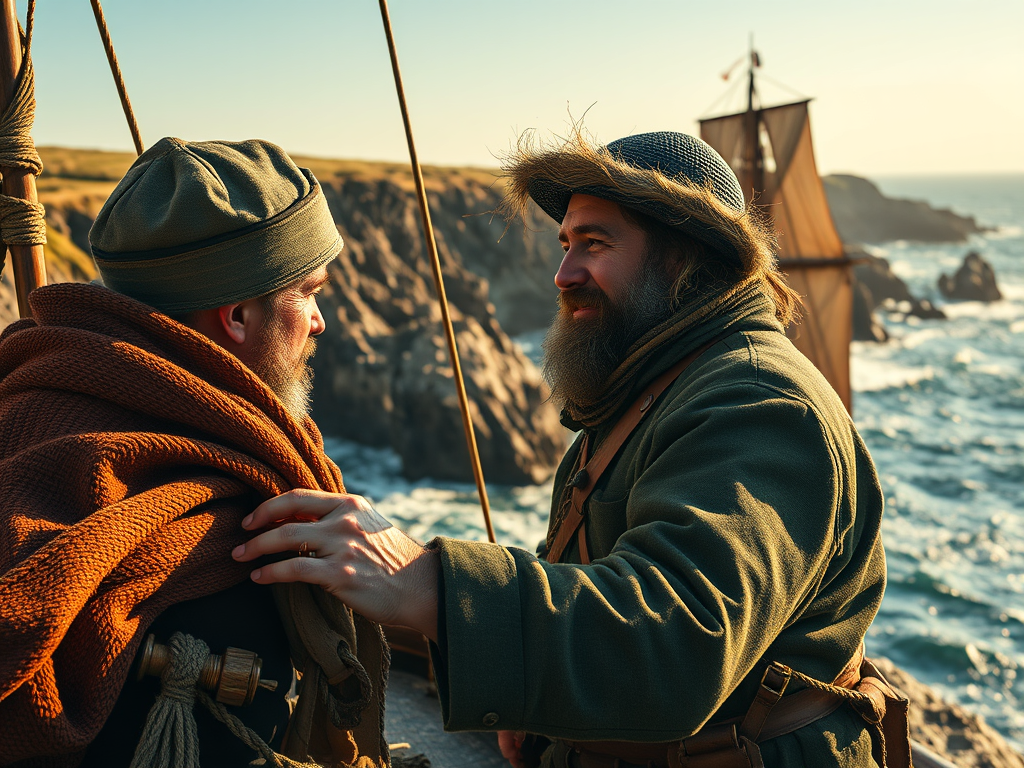
For the earliest sailors, from the Greeks in the Mediterranean to the Vikings hugging the coasts, the open ocean was a terrifying void. The safe way to travel was to “pilot,” keeping the shore in sight at all times. Captains relied on a mental inventory of landmarks: a uniquely shaped cliff, a river mouth, a prominent headland, or a “sea mark” (a man-made tower or beacon).
They used simple tools to augment this. A “sounding lead”—a lead weight on a long rope, often with a hollowed-out bottom filled with tallow—was dropped over the side. When it hit the bottom, the depth told them how far they were from shore, and the tallow would bring up a sample of the seabed (sand? mud? shells?), which a skilled pilot, using his experience and charts, could use to get a rough fix on his location. It was navigation by “eyeballing” and by “feel,” and it dominated sea travel for millennia.
2. The Sun: The Original, Ever-Present Compass
The first and most obvious beacon in the sky is the sun. It rises in the east and sets in the west. This simple, profound fact gave all of humanity its first and most reliable directional compass. A sailor lost at sea could, on a clear day, get a basic sense of his four cardinal directions.
But how could you use it with more precision? For that, you use a shadow. Ancient navigators used a “shadow stick.” By placing a stick vertically on a flat surface, they could track its shadow. The shadow is shortest at “local noon,” the exact moment the sun is at its highest point in the sky. When the shadow is shortest, it points exactly true north (in the northern hemisphere) or true south (in the southern hemisphere).
Even more simply, you can mark the tip of the stick’s shadow in the morning, then draw a circle around the stick using that shadow’s length as the radius. When the shadow re-touches that circle in the afternoon, mark it again. A straight line drawn between that first and second mark is a perfect East-West line. It’s a natural clock and compass rolled into one, a gift from our own star.
3. Steering by Starlight: The Universe as a Map
What happens when the sun goes down? The sky transforms into an even more complex and beautiful map: the celestial sphere. While the sun gave a general direction, the stars offered a way to find a precise location, specifically your latitude (your North-South position).
In the Northern Hemisphere, one star is king: Polaris, the North Star. Because of its unique position, almost perfectly aligned with the Earth’s axis of rotation, Polaris does not move. As the planet turns, all the other stars appear to spin around it in great circles, but Polaris stays fixed. It is the anchor point of the entire sky.
To find it, navigators used “pointer stars” in familiar constellations, like the two stars at the end of the Big Dipper’s “cup.” More importantly, the altitude of Polaris—how high it is above the horizon—is a direct measurement of your latitude. If you are at the North Pole, Polaris is 90° overhead. If you are at the equator, it is 0° on the horizon. By measuring that one simple angle, you know exactly how far north you are. In the south, navigators used the Southern Cross as a guide, though it was less precise.
4. Dead Reckoning: The Log, the Line, and the Educated Guess
What do you do on a cloudy day, in the middle of the empty ocean, with no sun, stars, or landmarks? You turn to the “dark art” of dead reckoning. The term “dead” is likely a shortening of “deduced,” and it’s a simple, if nerve-wracking, calculation:
- “I know my last ‘fixed’ position (e.g., the port I left).”
- “I know my direction (from my compass).”
- “I know my speed.”
- “Therefore, I can calculate my new, estimated position.”
This is like navigating a dark room by counting your steps. But how do you measure speed on water? For centuries, sailors used a “chip log” or “ship’s log.” This was a small, wedge-shaped piece of wood (“the chip”) tied to a long rope. The rope had knots tied in it at precise, regular intervals (47 feet, 3 inches). A sailor would throw the chip in the water and let the rope spool out, using a 28-second sandglass as a timer. The number of knots that passed through his hands before the sand ran out was the ship’s speed in “knots,” or nautical miles per hour—a term we still use today.
5. The Magnetic Compass: The Tiny Revolution That Changed Everything
The single greatest leap in pre-modern navigation was the magnetic compass. Its invention (or at least, its first use in navigation) is credited to the Chinese around the 11th century. It’s a piece of “magic” that works on a fundamental principle of physics: the Earth itself is a giant magnet. A small, magnetized piece of iron (a needle) will always try to align itself with the planet’s magnetic field, pointing to Magnetic North.
This was a profound game-changer. For the first time, a sailor had a reliable, all-weather, 24/7 source of direction. It didn’t matter if it was foggy, cloudy, or the middle of the day. The needle always pointed the way.
It wasn’t a perfect tool. Navigators quickly learned they had to account for “variation” (the difference between true north and magnetic north, which changes depending on where you are) and “deviation” (the magnetic effect of the iron on their own ship). But combined with dead reckoning and a chart, the compass unlocked the world’s oceans.
6. Polynesian Wayfinding: Navigating by Swells, Birds, and Memory
While Europeans were clinging to their compasses, an entirely different and arguably more sophisticated form of navigation was happening in the Pacific. Polynesian “wayfinders” were the masters of the open ocean, crossing thousands of miles of empty water to find tiny, pinprick islands. They did it without any metal instruments.
Their “computer” was their brain, and their “sensors” were their entire bodies. They memorized a “star compass”—not a fixed map, but the rising and setting points of dozens of stars as they moved through the sky. They navigated by feeling the ocean. They could sense up to five different ocean swells (waves) at once, feeling how these swells, which travel for thousands of miles, would be blocked, bent, or reflected by distant, unseen atolls. They read the flight paths of birds, the colour of the clouds at sunset, and the subtle changes in the wind. It was an art of total environmental connection, passed down through oral tradition and almost lost to history.
7. The Astrolabe: A Pocket-Sized Model of the Universe
Back in Europe, the race was on to make celestial navigation more precise. The astrolabe, whose name means “star-taker,” was a beautiful, intricate brass instrument that was essentially a 2D model of the sky. It was a pocket-sized analog computer, perfected by Islamic and Persian astronomers.
An astrolabe had a fixed plate (the mater) engraved with a map of the sky at a specific latitude, and a rotating “rete” on top that showed the positions of the brightest stars. It was a multi-tool. By aligning the parts and taking a sight, a user could find the time of day, the date, and, most importantly for navigation, the altitude of the sun or a star. Like the North Star, the sun’s altitude at noon also reveals your latitude. The astrolabe was the “high-tech” instrument of the medieval world, allowing a navigator to find his North-South position on a rocking ship.
8. The Sextant: The Tool That Mastered Latitude at Sea
The astrolabe had a major flaw: it was a heavy, solid disk that had to be held up by hand. On a pitching, rolling ship deck, trying to get an accurate reading was a nightmare. The solution, perfected in the 1700s, was the sextant.
A sextant is a brilliant, more specialized tool that is far more accurate. Its genius is its use of mirrors. A navigator doesn’t point the whole tool at the sky. Instead, he looks at the horizon through a small telescope. Using a set of mirrors, he “brings down” the image of the sun, moon, or star, moving a radial arm until the celestial body appears to be touching the line of the horizon.
This was revolutionary because it meant the navigator was measuring the angle relative to the horizon, so the ship’s rocking motion affected both the horizon and the star equally, canceling out the error. The sextant became the enduring symbol of navigation, a tool so precise it was still standard-issue on naval vessels as a backup even after GPS was invented.
9. The Chronometer: Solving the Impossible “Longitude Problem”
This is the big one. The greatest mystery of the ancient world. Finding your latitude (North-South) was easy. Finding your longitude (East-West) was considered impossible.
The problem is this: the Earth rotates. There is no fixed “east” or “west” star to measure. Your longitude is a problem of time, not space. Here’s the logic: The Earth turns 360° in 24 hours, or 15° per hour. If you know the exact time at a “home” port (like Greenwich, England) and you know the exact time it is at your “local” position (which you can find by observing the sun at its highest point), the difference in time tells you your position.
If your local noon is 1:00 PM in Greenwich, you are one hour “behind,” or 15° West. The problem? Clocks in the 1700s were pendulum-based and would stop, slow down, or rust on a violent, humid ship. The solution was the “marine chronometer,” a rugged, non-pendulum clock invented by a carpenter named John Harrison. His masterpiece finally gave sailors a way to carry “Greenwich time” with them, and in doing so, unlocked the ability to map the world’s longitude.
10. Cartography: The Paper “Save Point” for All Explorers
All of these techniques—the compass, the sextant, the chronometer—are just fleeting moments of data. They tell you where you are right now. The final, and perhaps most important, piece of the puzzle is cartography: the map.
A map, or nautical chart, is the “database” of navigation. It’s the “save point” that allows one explorer’s hard-won discovery to become the next explorer’s known route. Early “portolan charts” were masterpieces of the 14th and 15th centuries. They were not based on latitude and longitude, but on compass bearings. They were a spiderweb of lines radiating from compass roses, showing a pilot the exact bearing to get from one port to another.
As latitude and longitude were mastered, maps became grids. The Mercator projection, while it distorts the size of the poles, was a genius invention for sailors because a straight line drawn on a Mercator map is a constant compass bearing, making it the perfect tool for plotting a course. The map is the tool that tied all the others together.
Conclusion
Our tiny reliance on the GPS satellite signal can feel like a weakness, a disconnect from the world our ancestors knew so intimately. We no longer “feel” the swells or read the stars. But these ancient methods are not truly “lost.” They are the foundational logic upon which our new-world miracle is built.
GPS, after all, is just a high-tech solution to the same ancient problems. It uses a “constellation” of satellites as “stars.” It uses hyper-accurate atomic “chronometers” to measure time. And it presents the result on a digital “map.” The tools have changed, but the genius of our ancestors lies in the fact that they asked the right questions—”Where am I?” and “Which way do I go?”—and found the answers in the sun, the sea, and the sky.
Further Reading
For those who want to dive deeper into the incredible history of how we found our way, here are a few essential books:
- Longitude: The True Story of a Lone Genius Who Solved the Greatest Scientific Problem of His Time by Dava Sobel.
- The single best and most thrilling account of John Harrison and his quest to invent the marine chronometer. A must-read.
- The Discoverers: A History of Man’s Search to Know His World and Himself by Daniel J. Boorstin.
- A classic, sweeping history of human exploration, with fantastic sections dedicated to time, navigation, and mapping.
- We, the Navigators: The Ancient Art of Landfinding in the Pacific by David Lewis.
- The definitive and fascinating story of how Polynesian wayfinders mastered the Pacific, written by a man who sailed with them.
Here at Zentara.blog, our mission is to take those tricky subjects and unlock them, making knowledge exciting and easy to grasp for everyone. But the adventure doesn’t stop on this page! We’re constantly exploring new frontiers and sharing discoveries across the digital universe. Want to dive deeper into more mind-bending Top 10s and keep expanding your world? Come join us on our other platforms – we’ve got unique experiences waiting for you on each one!
Get inspired by visual wonders and bite-sized facts: See the world through Zentara’s eyes on Pinterest!
Pin our fascinating facts and stunning visuals to your own boards. Explore Pins on Pinterest: https://uk.pinterest.com/zentarablog/
Discover quick insights and behind-the-scenes peeks: Hop over to Tumblr for snippets, quotes, and unique content you won’t find anywhere else. It’s a different flavour of discovery! Follow the Fun on Tumblr: https://www.tumblr.com/zentarablog
Ready for deep dives you can listen to or watch? We’re bringing our accessible approach to video and potentially audio! Subscribe to our YouTube channel and tune into future projects that make learning pop! Subscribe on YouTube: https://www.youtube.com/@ZentaraUK
Seeking even more knowledge in one place? We’ve compiled some of our most popular topic deep dives into fantastic ebooks! Find them on Amazon and keep the learning journey going anytime, anywhere. Find Our Ebooks on Amazon: https://www.amazon.co.uk/s?k=Zentara+UK&ref=nb_sb_noss
Connect with us and fellow knowledge seekers: Join the conversation on BlueSky! We’re sharing updates, thoughts, and maybe even asking you what wonders we should explore next. Chat with Us on BlueSky: https://bsky.app/profile/zentarablog.bsky.social
Perfect for learning on the move! We post multiple 10-minute podcasts per day on Spotify. Pop on your headphones and fill your day with fascinating facts while you’re out and about! Listen on Spotify: https://open.spotify.com/show/3dmHbKeDufRx95xPYIqKhJFollow us on Instagram for bytesize knowledge! We post multiple posts per day on our official Instagram account. https://www.instagram.com/zentarablog/ Every click helps us keep bringing honest, accessible knowledge to everyone. Thanks for exploring with us today – see you out there in the world of discovery!




Leave a Reply