
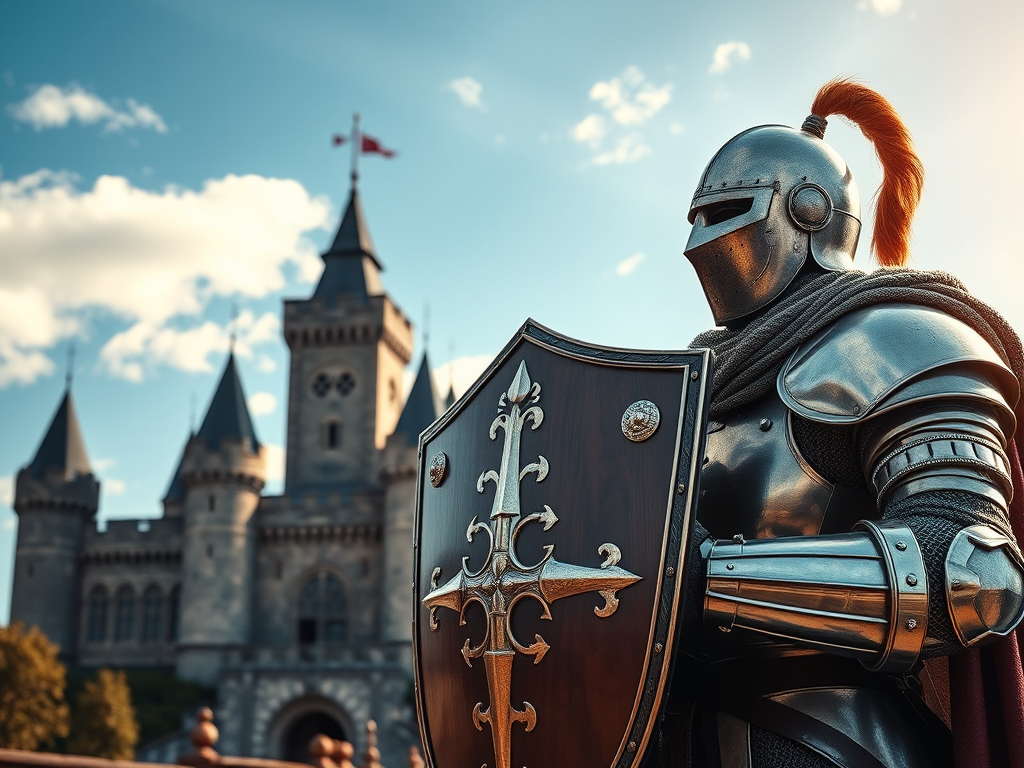
Okay, grab your imaginary shields and banners! We’re about to charge into the Age of Chivalry to explore the amazing world of knights and castles. These symbols of the Middle Ages (roughly from the 5th to the 15th century) fill our imaginations with images of shining armor, towering fortresses, brave heroes, and daring rescues.
But just like an old suit of armor, some of our ideas about knights and castles might have a few rusty spots or be a bit bent out of shape by movies, legends, and misunderstandings. Are you ready to uncover the real story behind these medieval marvels? Let’s lower the drawbridge and find out the truth behind ten common misconceptions!
Top 10 Misconceptions About Knights and Castles!
1. All Knights Were Noble Heroes Who Lived by the Code of Chivalry
The Myth: Every knight was a shining example of bravery, politeness, and honor, always protecting the weak, respecting ladies, and living perfectly by the rules of chivalry.
The Real Story: Chivalry was definitely an important ideal in the Middle Ages, a kind of moral code for knights that emphasized bravery, loyalty, and courteous behavior. However, like any set of ideals, not every knight lived up to it perfectly. Some knights were indeed very honorable, but others could be brutal, greedy, or self-serving, especially during wartime. “Chivalry” also meant different things at different times and could be quite complex – sometimes it applied more to how knights treated other nobles rather than common people. So, while many knights strived to be chivalrous, the reality was often more complicated than the storybook image of a perfect hero.
2. Knights Were Constantly Jousting and Fighting in Tournaments
The Myth: A knight’s life was one big series of exciting tournaments, with knights constantly charging at each other with lances, trying to knock their opponents off their horses for glory and the admiration of cheering crowds.
The Real Story: Tournaments, which included jousting (two knights on horseback charging at each other with lances) and the mêlée (a mock group battle), were indeed popular events in the Middle Ages. They were a way for knights to practice their combat skills, win fame, and sometimes even prizes. However, knights weren’t jousting every day! Tournaments were special occasions, often held by kings or great nobles. A knight’s daily life was more likely to involve training with weapons, managing their lands and estates (if they had them), serving their lord in various duties, or preparing for and fighting in actual wars, which were far less glamorous and much more dangerous than a tournament.
3. Knight’s Armor Was So Heavy They Couldn’t Move If They Fell
The Myth: Knights clanked around in suits of armor that were so incredibly heavy and cumbersome that if they fell off their horse, they’d be stuck on their backs like an overturned beetle, unable to get up.
The Real Story: A full suit of plate armor, which became common in the later Middle Ages (15th century), could weigh around 44 to 55 pounds (20-25 kg). While that’s definitely heavy, the weight was cleverly distributed over the whole body, not just in one spot. This meant that a fit knight could actually move quite well – they could walk, run, mount a horse, and even get up if they fell down, though it might take some effort! Tournament armor, designed for maximum protection in specific events like jousting, could sometimes be heavier than battlefield armor. Knights also didn’t wear their full armor all the time – only when preparing for battle or a tournament.
4. Castle Sieges: Always Non-Stop Action and Epic Battles!
The Myth: When a castle was under siege, it was a constant barrage of arrows, catapult stones flying, and knights scaling walls in dramatic, day-and-night battles until a winner emerged.
The Real Story: While some sieges did involve fierce assaults, many were actually long, drawn-out affairs that relied more on cutting off the castle’s supplies and waiting for the defenders to run out of food and water. This could take weeks, months, or even years! Attackers might try to undermine walls by digging tunnels, use siege engines like trebuchets to hurl big rocks (and sometimes even diseased animals to spread sickness!), or try to bribe someone inside. Disease and starvation were often bigger threats to those inside the castle than direct attacks. So, while there were moments of intense fighting, a lot of a siege involved strategy, patience, and trying to wear the other side down.
5. Castles: Just Cold, Dark, Drafty, and Awful Places to Live
The Myth: Medieval castles were nothing but damp, dark, freezing stone boxes with tiny windows, no comforts, and terrible smells – basically miserable places to live.
The Real Story: Compared to our modern homes with central heating and electricity, medieval castles would certainly seem uncomfortable! However, for their time, they weren’t all bad, especially for the lord and lady. Castle builders included features for comfort. Large fireplaces provided heat (though they could be smoky). Tapestries hung on stone walls didn’t just look nice; they also helped keep out drafts and added a layer of insulation. Windows, while small in early castles for defense, became larger in later periods, letting in more light. Nobles had private chambers that were often warmer and more decorated. They had furniture, and sanitation, while basic (garderobes or “latrines” were essentially toilets that emptied outside the castle wall or into a cesspit), was considered. Life was definitely different, but they found ways to make their stone homes as livable as possible.
6. Every Castle Had a Spooky Dungeon Full of Torture Devices
The Myth: Deep beneath every medieval castle lay a terrifying dungeon, complete with chains, racks, iron maidens, and other gruesome torture instruments, where prisoners languished in misery.
The Real Story: While some castles did have cells or areas for holding prisoners (often in the gatehouse or a tower basement), the idea of a dedicated “dungeon” primarily used for horrific torture in every castle is an exaggeration, often fueled by later Gothic novels and movies. Imprisonment in the Middle Ages wasn’t always a long-term punishment like it is today; often, prisoners were held awaiting trial, ransom, or a political solution. While torture was certainly used in medieval times to get confessions or information, the elaborate, purpose-built torture chamber wasn’t a standard feature of all castles. Many rooms now shown as “dungeons” might have originally been storerooms or even water cisterns.
7. Knights Only Ever Fought with Swords
The Myth: The sword is the ultimate symbol of the knight, and it was the only weapon they really used in battle or for duels.
The Real Story: While the sword was indeed a knight’s iconic personal weapon and a symbol of their status, they were skilled with a variety of weapons suited for different combat situations. On horseback, the lance was a primary weapon for charging. For close combat, especially against armored opponents, knights used maces (heavy clubs, often with a flanged head), battle-axes, and war hammers, which were better at denting armor or delivering crushing blows. Daggers were also essential as a last resort or for fighting in very close quarters. So, a knight was more like a walking arsenal, trained to use the best tool for the job, not just a sword-swinger!
8. Becoming a Knight: Just Be Brave and Someone Taps You with a Sword!
The Myth: If you were a brave peasant or a heroic young man, you could easily become a knight, perhaps by performing a great deed and getting dubbed on the battlefield by a grateful king.
The Real Story: Becoming a knight in the Middle Ages was usually a long, tough, and expensive process, generally reserved for those of noble birth. A boy destined for knighthood often began his training around the age of 7 as a page in a noble household, learning manners, basic weapon skills, and how to serve. Around age 14, he might become a squire, directly serving a knight, caring for his armor and horse, and accompanying him into battle. This was like an apprenticeship. Only after years of training, proving his skill and loyalty (usually around age 21), could a squire be formally “dubbed” a knight in a special ceremony. While sometimes men were knighted on the battlefield for bravery, this was more the exception than the rule.
9. Damsels in Distress: Always Waiting for a Knight to Rescue Them
The Myth: Medieval ladies, especially noblewomen, were always delicate “damsels in distress,” frequently getting kidnapped by villains or dragons and passively waiting in a tower for a brave knight to come and save them.
The Real Story: The “damsel in distress” is a very popular theme in medieval romances and stories, but it doesn’t reflect the reality for all medieval women. Women in the Middle Ages had varied lives and roles. Noblewomen could be powerful figures, managing large estates and households, especially when their husbands were away at war or court. They could inherit property and sometimes even influence politics. While life had dangers, and women could certainly be victims of violence or political maneuvering, they weren’t perpetually helpless. The image of the constantly imperiled maiden often served as a plot device in stories to showcase the knight’s heroism, rather than accurately depicting the everyday lives and capabilities of medieval women.
10. Medieval Feasts: Non-Stop Food Fights and Flying Chicken Legs!
The Myth: Medieval banquets were chaotic free-for-alls where people gorged themselves, threw food around, tossed bones over their shoulders for the dogs, and had terrible table manners.
The Real Story: While medieval feasts, especially for the nobility, could be incredibly lavish and involve many courses of rich food and drink, they weren’t usually the messy food fights often shown in movies. There was a definite sense of etiquette and manners, though different from ours today. For example, guests often washed their hands before and during meals, and sharing cups and trenchers (thick slices of bread used as plates) was common. There were rules about how to behave at the table, as described in courtesy books. While dogs might have been around to snatch scraps, the image of constant, deliberate messiness is an exaggeration. Feasts were important social and political events, and demonstrating good (medieval) manners was part of showing one’s status.
The Middle Ages were a complex and fascinating time! By looking past the myths, we can get a clearer picture of what life was truly like for the knights in their shining (but practical!) armor and the people who lived within those mighty castle walls.
Further Reading
Want to learn more about the real lives of knights and the secrets of their castles? Check out these books:
- “DK Eyewitness Books: Knight” by Christopher Gravett: Full of detailed pictures and information about a knight’s training, armor, weapons, and life.
- “DK Eyewitness Books: Castle” by Christopher Gravett: Explores the architecture, defense, and daily life within medieval castles.
- “You Wouldn’t Want to Be a Medieval Knight!” by Fiona Macdonald: A fun and factual look at the less glamorous side of being a knight.
- “Castle” by David Macaulay: A beautifully illustrated book that explains how a fictional Welsh castle is designed and built, showing many real features.
- “The Knight and the Dragon” by Tomie dePaola: A charming picture book, more on the fictional side, but captures the spirit of knighthood for younger readers.
Here at Zentara.blog, our mission is to take those tricky subjects and unlock them, making knowledge exciting and easy to grasp for everyone. But the adventure doesn’t stop on this page! We’re constantly exploring new frontiers and sharing discoveries across the digital universe.
Want to dive deeper into more mind-bending Top 10s and keep expanding your world? Come join us on our other platforms – we’ve got unique experiences waiting for you on each one!
- Get inspired by visual wonders and bite-sized facts: See the world through Zentara’s eyes on Pinterest! Pin our fascinating facts and stunning visuals to your own boards. Explore Pins on Pinterest: https://uk.pinterest.com/zentarablog/
- Discover quick insights and behind-the-scenes peeks: Hop over to Tumblr for snippets, quotes, and unique content you won’t find anywhere else. It’s a different flavour of discovery! Follow the Fun on Tumblr: https://www.tumblr.com/zentarablog
- Ready for deep dives you can listen to or watch? We’re bringing our accessible approach to video and potentially audio! Subscribe to our YouTube channel and tune into future projects that make learning pop! Subscribe on YouTube: https://www.youtube.com/@ZentaraUK
- Seeking even more knowledge in one place? We’ve compiled some of our most popular topic deep dives into fantastic ebooks! Find them on Amazon and keep the learning journey going anytime, anywhere. Find Our Ebooks on Amazon: https://www.amazon.co.uk/s?k=Zentara+UK&ref=nb_sb_noss
- Connect with us and fellow knowledge seekers: Join the conversation on BlueSky! We’re sharing updates, thoughts, and maybe even asking you what wonders we should explore next. Chat with Us on BlueSky: https://bsky.app/profile/zentarablog.bsky.social
- Perfect for learning on the move! We post multiple 10-minute podcasts per day on Spotify. Pop on your headphones and fill your day with fascinating facts while you’re out and about! Listen on Spotify: https://open.spotify.com/show/3dmHbKeDufRx95xPYIqKhJ
Every click helps us keep bringing honest, accessible knowledge to everyone. Thanks for exploring with us today – see you out there in the world of discovery!




Leave a Reply