
The Middle Ages, often mistakenly labeled as a “Dark Age” between the fall of Rome and the rise of the Renaissance, was in fact a period of profound ingenuity and innovation. While the Roman Empire left behind a legacy of grand architecture and engineering, the medieval period built upon this foundation with a different kind of progress. This era wasn’t about building massive aqueducts or colosseums; it was about practical, life-changing inventions that laid the groundwork for the modern world. Think of it as a shift from monumental displays of power to a slow, steady revolution in everyday life. These inventions, from the seemingly simple to the truly complex, transformed society from the ground up, impacting everything from farming and warfare to education and exploration. They are the silent architects of the world we live in today, often overlooked but deeply influential. Let’s delve into the ten most important medieval inventions that shaped the course of history and paved the way for a new era of progress.
1. The Printing Press and the Spread of Knowledge
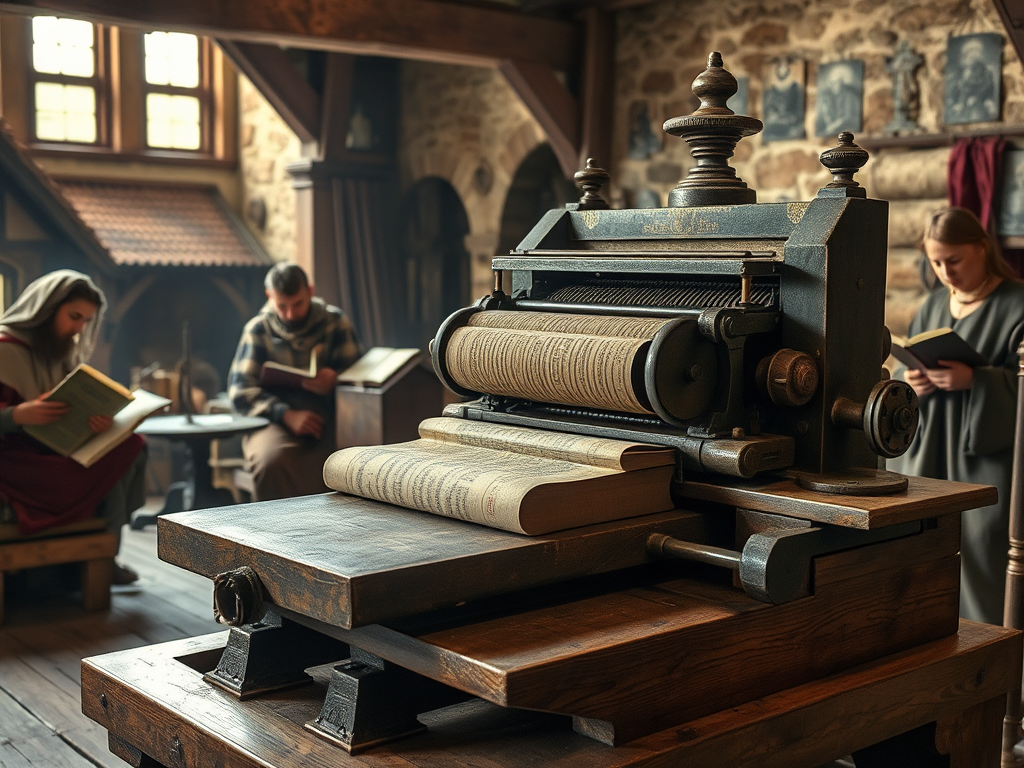
Before the 15th century, a book was a rare and valuable artifact, meticulously copied by hand, a process so slow and labor-intensive that it was largely confined to the cloisters of monasteries. Knowledge was a luxury, accessible only to the wealthy elite and the clergy. Then, around 1440, a German goldsmith named Johannes Gutenberg introduced his revolutionary movable-type printing press to Europe. This wasn’t just a new machine; it was a societal game-changer. Suddenly, books could be produced in a fraction of the time and at a fraction of the cost. The printing press worked like a giant stamp, using individual metal letters (the “movable type”) that could be arranged to form words, sentences, and entire pages. Once a page was set, it could be inked and pressed onto paper countless times. The impact was immediate and monumental. Ideas, from religious texts like the Gutenberg Bible to scientific theories and political pamphlets, could now be mass-produced and disseminated across the continent. This democratized knowledge, fueling the Renaissance, spurring the Protestant Reformation, and creating a new class of literate individuals. It laid the foundation for a world where information could travel farther and faster than ever before. The printing press was the medieval equivalent of the internet, igniting a revolution of ideas and forever changing how humanity learns and communicates.
2. The Heavy Plough and the Agricultural Revolution
For centuries, European farming was held back by the limitations of the light, Roman-style plough, which was effective on the thin, dry soils of the Mediterranean but struggled with the dense, clay-rich earth of Northern Europe. The solution came in the form of the heavy plough, a technological marvel that fundamentally changed agricultural practices. This new plough featured a wheeled coulter to cut the soil vertically, a plowshare to slice it horizontally, and most importantly, a moldboard to turn the furrow over. This single design improvement unlocked the potential of vast, fertile lands that had previously been unworkable. The heavy plough required more power, which led to the use of teams of oxen and, later, horses with the invention of the horse collar. This cooperative farming model spurred the formation of communities and led to a “cerealization” of Europe, where grain production soared. Increased food supply meant a growing population, which in turn led to the rise of towns, trade, and a more complex society. This innovation was the engine that drove medieval economic growth and population expansion, proving that a simple change in tools could have a massive and lasting ripple effect on an entire civilization.
3. Eyeglasses and the Extension of Life
Before the invention of eyeglasses, a person’s working life was often curtailed by failing eyesight, a natural consequence of aging. Craftsmen, scholars, and artisans—whose livelihoods depended on fine, detailed work like reading, writing, or weaving—were forced to retire early as their vision deteriorated. Then, in late 13th-century Italy, a simple yet brilliant solution emerged: eyeglasses. These first “reading aids” consisted of two convex lenses mounted in frames, which were initially balanced on the nose. While we don’t know the exact inventor, their creation was a watershed moment. For the first time, presbyopia, or age-related farsightedness, could be corrected. This had a profound effect on intellectual and economic life. Skilled workers could continue their trades for years, if not decades, longer. Monks and scholars could continue copying and studying texts, preserving and expanding knowledge. The invention of eyeglasses effectively extended the productive lifespan of a society’s most valuable intellectual and skilled labor, leading to an acceleration in research, literacy, and craftsmanship. It was a clear example of how a relatively small, personal invention could have a monumental impact on the collective progress of an entire era.
4. The Mechanical Clock and the Structure of Time
Imagine a world where time is not a precise, measurable commodity but a fluid concept dictated by the sun and the seasons. This was the reality for most of human history until the late Middle Ages. Sundials and water clocks existed, but they were unreliable, especially in cloudy weather or at night. The invention of the mechanical clock in the late 13th and early 14th centuries changed everything. These early clocks, with their intricate system of gears and weights, were first installed in monasteries to regulate the hours of prayer, but their utility soon spread to towns and cities. The “escapement” mechanism was the key innovation, allowing the slow, steady release of energy that made accurate timekeeping possible. This invention introduced a new rhythm to daily life, organizing work, trade, and social activities around a fixed, shared schedule. For the first time, a city could operate on a unified timetable. This new, objective measure of time was essential for the rise of a more complex, urban society, laying the foundation for modern concepts of punctuality, efficiency, and industrial organization. The mechanical clock didn’t just tell time; it transformed the very nature of it, turning an abstract concept into a tangible, and manageable, resource.
5. The Stirrup and the Rise of Cavalry
While the stirrup may seem like a simple piece of equestrian equipment, its introduction to Europe was a military and social revolution. Originating in Asia, the stirrup arrived in the West in the 8th century, fundamentally changing the nature of mounted warfare. Prior to this, a rider on horseback had a precarious perch, limiting their ability to deliver a powerful blow without falling off. The stirrup provided a solid platform, allowing a rider to stand and use the full force of their body and the horse’s momentum to deliver a devastating lance charge. This “shock combat” transformed the horseman into a living battering ram, giving rise to the heavily armored cavalry, the knights who would come to dominate the battlefield for centuries. The stirrup also had a profound social impact, as the expense of maintaining a horse, armor, and training became a marker of an elite warrior class. This helped solidify the feudal system, where lords granted land to knights in exchange for military service. The stirrup didn’t just make a knight more effective; it created the very concept of the knight as a powerful, dominant force in medieval society.
6. The Lateen Sail and the Expansion of Trade
For much of the early medieval period, maritime travel in Europe was dominated by the square-rigged sail, which was excellent for sailing with the wind but struggled to make headway against it. This limited trade routes and made long-distance voyages a risky and time-consuming endeavor. The introduction of the lateen sail, a triangular sail design from the Mediterranean and Indian Ocean, revolutionized naval technology. The lateen sail’s shape and rigging allowed it to “tack,” or sail effectively into the wind in a zigzag pattern. This meant that ships were no longer prisoners of the prevailing winds. They could navigate more complex routes, travel year-round, and access a wider range of ports. This innovation drastically reduced the time and cost of sea travel, leading to an explosion in international trade and exploration. It facilitated the growth of powerful maritime republics like Venice and Genoa and, in the centuries that followed, was a critical component of the ships that launched the Age of Discovery. The lateen sail wasn’t just a better sail; it was a key that unlocked a new era of global connectivity and commerce.
7. Gunpowder and the End of Feudal Warfare
Gunpowder, a volatile and transformative substance, was a Chinese invention that made its way to Europe in the 13th and 14th centuries. Initially used for fireworks and signaling, its military potential was quickly realized. While early firearms were crude, unreliable, and often more dangerous to the user than the enemy, the technology evolved rapidly. Cannons, in particular, represented a fundamental shift in warfare. The high walls of a feudal castle, once an impregnable defense, were now vulnerable to the force of a cannonball. This innovation began to erode the dominance of the armored knight and the fortress, the very pillars of the feudal system. Warfare became less about individual combat between knights and more about sieges and the tactical use of artillery. The expense of producing and using gunpowder weapons also favored central, powerful monarchies over small, independent nobles. The introduction of gunpowder wasn’t just a military advancement; it was a political one, helping to bring about the decline of feudalism and the rise of the nation-state.
8. The Windmill and the Harnessing of Nature
The Roman Empire relied on human and animal power for its daily tasks, but the Middle Ages saw a more widespread and innovative use of natural energy sources. The water mill was a powerful workhorse, but its use was restricted to locations with flowing rivers. The invention of the vertical windmill in Europe in the 12th century provided a solution for regions without a reliable water source. These ingenious machines, with their massive sails, harnessed the power of the wind to grind grain, press olives, and pump water. They were a testament to medieval engineering and a crucial step in moving beyond muscle-based labor. Windmills allowed for the mechanization of agriculture and industry in new geographical areas, increasing productivity and freeing up labor for other tasks. Along with water mills, the windmill represented a significant leap forward in energy production, paving the way for the later industrial revolutions by demonstrating the power and efficiency of inanimate energy sources.
9. The Horse Collar and Enhanced Agricultural Productivity
Before the invention of the horse collar, horses were typically harnessed using a yoke that pressed against their throat, restricting their breathing and severely limiting the amount of weight they could pull. This made oxen the preferred animal for heavy ploughing, as they were better suited to the yoke. The horse collar, an invention that came from China and was adopted in Europe in the 10th century, changed this dynamic entirely. The collar, a rigid, padded harness, rested on the horse’s shoulders, allowing the animal to pull without choking. This simple innovation unlocked a horse’s full pulling power. Horses are faster and have more stamina than oxen, which meant that a single horse could plough a field faster and more efficiently. This increased agricultural output and allowed for the cultivation of more land. The widespread adoption of the horse collar was a critical factor in the agricultural boom of the High Middle Ages, a silent partner to the heavy plough in driving the expansion of European farming and supporting a burgeoning population.
10. The Rudder and Improved Navigation
Early medieval ships were steered by a “steerboard,” essentially a large paddle on the side of the vessel. This method was effective on smaller ships but became unwieldy and less reliable on larger vessels and in rough seas. The stern-post rudder, a medieval innovation that likely arrived from China around the 12th century, was a far superior solution. Mounted centrally on the back of the ship, the rudder offered much greater directional control and stability. This improved maneuverability allowed for the construction of larger ships, which could carry more cargo, endure harsher weather, and travel to more distant destinations. It was a key technological advance that, when combined with the lateen sail, made European maritime power possible. The rudder transformed sailing from a matter of passive drift to one of active control, enabling the grand voyages of exploration and the global trade networks that would define the modern world. Its impact on long-distance navigation and naval warfare was incalculable.
Further Reading
- Medieval Technology and Social Change by Lynn Townsend White Jr.
- The Medieval Machine: The Industrial Revolution of the Middle Ages by Jean Gimpel
- The Horizon Book of the Middle Ages by Morris Bishop
- A Distant Mirror: The Calamitous 14th Century by Barbara W. Tuchman
Here at Zentara.blog, our mission is to take those tricky subjects and unlock them, making knowledge exciting and easy to grasp for everyone. But the adventure doesn’t stop on this page! We’re constantly exploring new frontiers and sharing discoveries across the digital universe. Want to dive deeper into more mind-bending Top 10s and keep expanding your world? Come join us on our other platforms – we’ve got unique experiences waiting for you on each one!
Get inspired by visual wonders and bite-sized facts: See the world through Zentara’s eyes on Pinterest!
Pin our fascinating facts and stunning visuals to your own boards. Explore Pins on Pinterest: https://uk.pinterest.com/zentarablog/
Discover quick insights and behind-the-scenes peeks: Hop over to Tumblr for snippets, quotes, and unique content you won’t find anywhere else. It’s a different flavour of discovery! Follow the Fun on Tumblr: https://www.tumblr.com/zentarablog
Ready for deep dives you can listen to or watch? We’re bringing our accessible approach to video and potentially audio! Subscribe to our YouTube channel and tune into future projects that make learning pop! Subscribe on YouTube: https://www.youtube.com/@ZentaraUK
Seeking even more knowledge in one place? We’ve compiled some of our most popular topic deep dives into fantastic ebooks! Find them on Amazon and keep the learning journey going anytime, anywhere. Find Our Ebooks on Amazon: https://www.amazon.co.uk/s?k=Zentara+UK&ref=nb_sb_noss
Connect with us and fellow knowledge seekers: Join the conversation on BlueSky! We’re sharing updates, thoughts, and maybe even asking you what wonders we should explore next. Chat with Us on BlueSky: https://bsky.app/profile/zentarablog.bsky.social
Perfect for learning on the move! We post multiple 10-minute podcasts per day on Spotify. Pop on your headphones and fill your day with fascinating facts while you’re out and about! Listen on Spotify: https://open.spotify.com/show/3dmHbKeDufRx95xPYIqKhJFollow us on Instagram for bytesize knowledge! We post multiple posts per day on our official Instagram account. https://www.instagram.com/zentarablog/ Every click helps us keep bringing honest, accessible knowledge to everyone. Thanks for exploring with us today – see you out there in the world of discovery!




Leave a Reply