
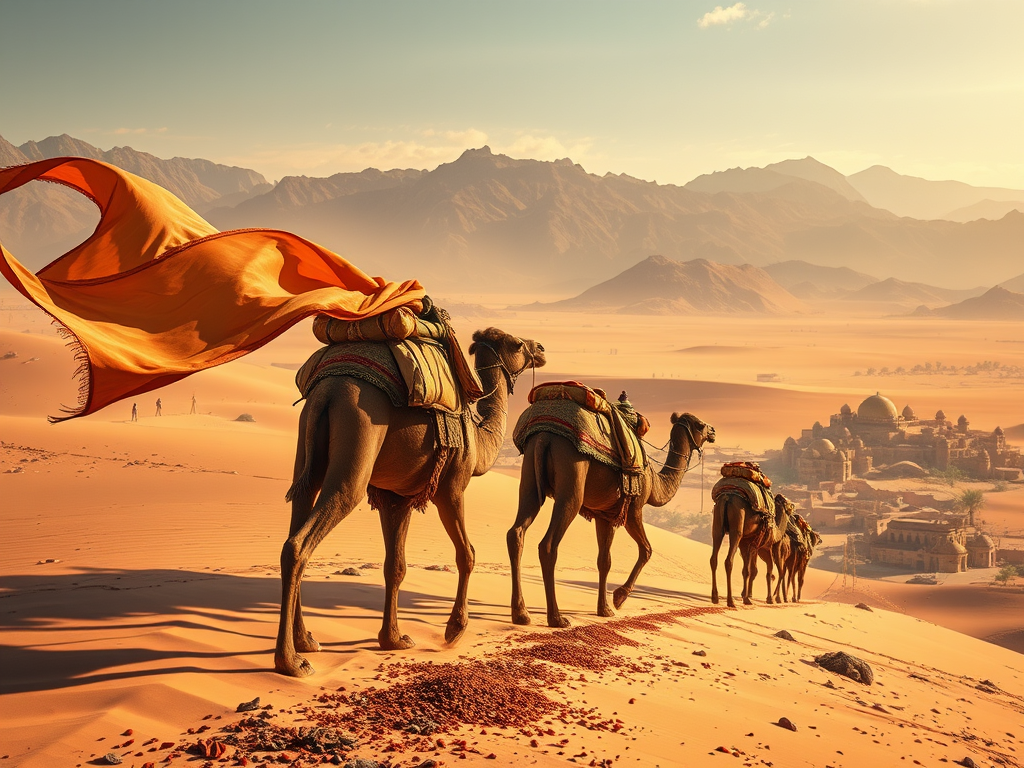
Have you ever wondered how people in ancient times got things from far away? Imagine a world without super-fast planes or giant cargo ships. How did someone in Rome get beautiful silk from China, or how did spices from India reach kitchens in Egypt? The answer lies in amazing ancient superhighways of trade – vast networks of roads and sea paths that crisscrossed the globe, connecting distant lands and diverse cultures. These weren’t just routes for swapping goods; they were channels for ideas, inventions, religions, and stories that literally shaped the world we live in today. These ancient trade routes were the lifelines of civilizations, powering economies and fostering incredible cultural exchange ancient routes. Let’s explore ten of the most important ones!
1. The Silk Road: More Than Just Silk Connecting East and West
When you hear “Silk Road history,” you probably picture long caravans of camels trekking across deserts, laden with shimmering silk. And you’d be right! But this legendary network, stretching over 4,000 miles (6,400 kilometers), was so much more. It wasn’t a single road but a web of interconnected pathways linking China with the Mediterranean world, passing through bustling oasis towns and treacherous mountain ranges. Think of it like the internet of the ancient world, but instead of data, it carried precious cargo. While silk was a star commodity, eagerly sought by the Romans who paid fortunes for it, many other goods journeyed along these paths. China also exported tea, porcelain (fine china), and paper, while from the West came gold, silver, glassware, wool, and horses. Beyond goods, the Silk Road was a major route for spreading religions like Buddhism, Christianity, and Islam, as well as art, technologies like papermaking, and even games! It truly was a melting pot of cultures and a testament to how ancient trade shaped civilizations.
2. The Spice Routes: Aromatic Adventures Across the Seas
Imagine your food without pepper, cinnamon, or cloves! For centuries, these and other exotic spices were worth more than gold, and the quest for them fueled incredible sea voyages along what we call the Spice Routes. These were primarily ancient maritime trade networks connecting Southeast Asia (like the “Spice Islands” – the Moluccas in Indonesia) and India with the Middle East, East Africa, and eventually Europe. Sailors bravely navigated the Indian Ocean, mastering monsoon winds to carry fragrant cargoes of pepper, ginger, nutmeg, and cinnamon. These weren’t just flavor enhancers; spices were used in medicines, perfumes, and religious rituals. The Spice Trade significance was immense; it drove exploration, led to the rise and fall of powerful trading empires (like Venice and later Portugal and the Netherlands), and eventually spurred explorers like Christopher Columbus to seek new sea routes to the East. These routes, sometimes called the Maritime Silk Road, were just as vital as their land-based counterparts in weaving the world closer together.
3. The Trans-Saharan Routes: Gold, Salt, and Desert Caravans
Picture a vast sea of sand – the Sahara Desert, the largest hot desert in the world. Now imagine lines of camels, sometimes thousands at a time, patiently plodding across it. This was the reality of the Trans-Saharan trade routes, connecting West African kingdoms south of the Sahara with North Africa, the Middle East, and Europe. What made people brave such a harsh journey? Two main things: gold and salt. West Africa was rich in gold, a universally prized metal. But they lacked salt, which was essential for preserving food and for life itself, especially in a hot climate. North African merchants brought huge slabs of salt from desert mines. So, a fascinating trade developed: gold for salt, often ounce for ounce! But that wasn’t all. Kola nuts, slaves, textiles, and manufactured goods also crossed the desert. The Trans-Saharan trade impact was enormous, leading to the rise of powerful empires like Ghana, Mali (think of Mansa Musa’s legendary wealth!), and Songhai, and spreading Islam deep into West Africa.
4. The Amber Road: “Gold of the North” Travels South
Long before silk or spices captured widespread imagination, another precious material was being traded across Europe: amber. This beautiful, fossilized tree resin, often called “the gold of the North,” was found along the shores of the Baltic Sea and the North Sea. From as early as the Bronze Age, the Amber Road snaked its way south, carrying this lightweight treasure from modern-day Poland and Lithuania, through Central Europe, across the Alps, and down to the Mediterranean civilizations like Greece and Rome. Think of amber as ancient jewelry, prized for its warm glow and believed to have magical or medicinal properties. The Amber Road Europe wasn’t a single, paved highway but a network of riverways and overland tracks. It connected diverse cultures, allowing not just the exchange of amber for goods like metals, wine, and tools from the south, but also the flow of ideas and technologies, helping to link northern and southern Europe in a surprisingly interconnected prehistoric world.
5. The Incense Route: Fragrant Trails of Arabia
Close your eyes and imagine the rich, sweet smell of frankincense and myrrh. These fragrant tree resins, harvested in Southern Arabia (modern-day Yemen and Oman) and the Horn of Africa, were incredibly valuable in the ancient world. They were used in religious ceremonies by Egyptians, Greeks, and Romans, in perfumes, and as medicines. The Incense Route was a network of land and sea paths established to transport these precious Incense Route goods. Camel caravans would travel for months along the western edge of the Arabian desert, heading towards Mediterranean ports like Gaza, where the incense would then be shipped across the Roman Empire and beyond. These routes brought immense wealth to the Arabian kingdoms that controlled the trade, like the Nabataeans who built the stunning city of Petra. The trade also carried spices from India, ivory from Africa, and pearls, making Southern Arabia a crucial hub in the ancient global economy.
6. The Tin Route: Fueling the Bronze Age
What do you get when you mix copper and tin? Bronze! This strong, versatile metal transformed ancient societies, leading to an entire era named after it – the Bronze Age. Copper was relatively common, but tin was much rarer. One of the most important ancient sources of tin was Cornwall in Britain, and also areas in Spain and France. The Tin Route was the network that brought this vital ingredient from these far-flung northern and western regions to the civilizations of the Mediterranean and the Near East. This was a challenging trade, often involving dangerous sea voyages across the Bay of Biscay and along the Atlantic coast, or long overland treks. Imagine ancient Britons mining tin, then trading it with Phoenician or Greek sailors who had journeyed thousands of miles. The Tin Route demonstrates how ancient trade shaped civilizations by enabling technological advancement. Without tin, there would have been no widespread use of bronze tools and weapons, which were critical for agriculture, construction, and warfare, significantly impacting the development of early societies.
7. The Roman Roads: Paving the Way for Empire and Commerce
“All roads lead to Rome,” the saying goes, and there’s a lot of truth to it! The Romans were master engineers, and they built an incredible network of over 250,000 miles (400,000 kilometers) of roads across their vast empire, from Britain to Syria, from Spain to Germany. While initially built for their legions – to move troops quickly and efficiently – these well-constructed, paved roads became vital arteries for trade and communication. Imagine straight, durable roads with milestones, bridges, and even roadside inns (mansiones)! This infrastructure made travel faster, safer, and more reliable. Goods like wine, olive oil, pottery, metals, and agricultural products flowed easily between provinces. The Roman roads didn’t just carry goods; they spread Roman culture, language (Latin), laws, and ideas, helping to unify the diverse peoples within the empire. This sophisticated system of ancient trade routes was a key factor in the Roman Empire’s success and its lasting legacy.
8. The Grand Trunk Road: An Ancient Highway of India
Stretching across the northern part of the Indian subcontinent for over 1,500 miles (2,400 kilometers) is one of Asia’s oldest and longest major roads: the Grand Trunk Road, or GT Road. Its origins go back over 2,500 years, known in ancient times as “Uttarapatha” (Northern Road). Emperors like Chandragupta Maurya and Ashoka in the 3rd century BCE recognized its importance, planting trees and building rest houses for travelers. Later, rulers like Sher Shah Suri in the 16th century significantly upgraded it. Think of it as the main street of northern India for millennia! It connected major cities, facilitated trade in textiles, horses, and agricultural products, and was crucial for armies and pilgrims. The Grand Trunk Road has witnessed countless historical events and the march of empires. Its enduring presence highlights the critical role of established ancient trade routes in fostering economic activity, enabling governance, and supporting cultural exchange ancient routes within and beyond regions. Even today, parts of this ancient highway are still in use, a living testament to its historical significance.
9. The Persian Royal Road: Speedy Delivery in an Ancient Empire
Imagine needing to send an urgent message across a massive empire that stretched from modern-day Turkey to Iran. The Achaemenid Persian Empire, one of the largest ancient empires, faced this challenge. King Darius I, around 500 BCE, developed the Royal Road to solve it. This highway spanned about 1,677 miles (2,699 kilometers) from Susa in Persia to Sardis in western Anatolia (Turkey). What made it special was its efficiency. There were posting stations with fresh horses and riders roughly every 15-20 miles. This relay system meant that royal messengers could cover the entire distance in about seven to nine days, an incredible speed for the time! The Greek historian Herodotus wrote admiringly, “Neither snow, nor rain, nor heat, nor gloom of night stays these couriers from the swift completion of their appointed rounds.” While primarily for official and military use, the Persian Royal Road also greatly benefited trade, making the movement of goods safer and more predictable, contributing to the empire’s wealth and stability, and showcasing how ancient trade shaped civilizations through effective administration.
10. The Viking Sea Routes: Norsemen Navigating for Trade and Treasure
When we think of Vikings (roughly 8th to 11th centuries CE), images of fierce warriors and longship raids often come to mind. But the Vikings were also skilled traders and incredible explorers. Their longships, capable of navigating both open oceans and shallow rivers, allowed them to establish extensive ancient maritime trade networks. These routes stretched from Scandinavia eastwards deep into Russia (along rivers like the Volga and Dnieper, reaching the Byzantine Empire and even the Middle East), and westwards to Britain, Ireland, Iceland, Greenland, and even briefly to North America! They traded goods like furs, amber (yes, them too!), walrus ivory, and slaves for silver, silks, spices, wine, and weapons. Viking trading towns like Hedeby (in modern Germany) and Birka (in Sweden) became bustling international hubs. The Viking Sea Routes were crucial for connecting Northern Europe with the wider world, leading to significant cultural exchange ancient routes and leaving a lasting mark on the areas they reached.
These ten routes are just a glimpse into the vast web of connections that existed in the ancient world. From the shimmering silk carried across Asian deserts to the fragrant incense of Arabia, and the sturdy tin that helped forge an age, these pathways did more than move goods. They moved people, spread knowledge, mixed cultures, and laid the foundations for the interconnected global society we know today.
Further Reading
If you’re curious to learn more about these fascinating ancient connections, here are a few books you might enjoy:
- The Silk Roads: A New History of the World by Peter Frankopan (A more advanced read, but offers incredible insights – perhaps with a grown-up!)
- You Wouldn’t Want to Be a Silk Road Trader!: A Deadly Journey to the East by John Malam (A fun, engaging style for younger readers)
- Spice: The History of a Temptation by Jack Turner (Focuses on the spice trade and its impact)
- The Vikings: A Very Short Introduction by Julian D. Richards (A concise overview of Viking life, including their trade)
- Ancient Worlds: A Global History of Antiquity by Michael Scott (Provides broader context on ancient civilizations and their interactions)




Leave a Reply