
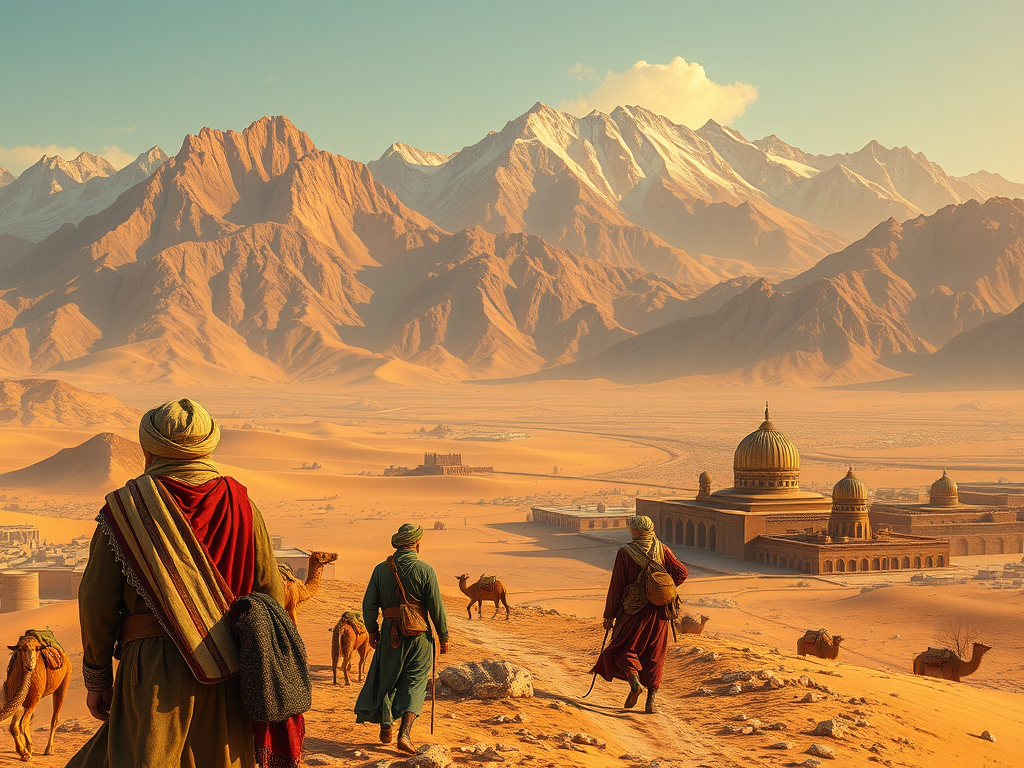
Imagine a time before airplanes, before cars, and even before trains. How did people get goods, ideas, and even their very cultures from one side of the world to another? The answer lies in trade routes – ancient pathways, both over land and across vast oceans, that connected distant civilizations. These weren’t just lines on a map; they were lifelines that breathed life into cities, fueled the rise and fall of empires, and sparked incredible exchanges of knowledge, technology, and art.
These historical trade networks weren’t always easy journeys. They often crossed harsh deserts, towering mountains, and treacherous seas, requiring immense courage and ingenuity from the merchants and explorers who dared to traverse them. But the rewards were great: exotic spices, precious metals, luxurious silks, and invaluable new ideas. The geographical paths these routes carved out literally shaped where cities grew, where power concentrated, and how different cultures learned from one another, creating the interconnected world we live in today.
In this article, we’ll embark on a historical journey to explore ten major trade routes that profoundly influenced global geography, economics, and cultural exchange, from ancient times right up to the modern era. We’ll trace their paths, uncover their significance, and understand how they helped weave the intricate tapestry of human history. Get ready to discover the invisible threads that have connected humanity for millennia!
1. The Silk Road: Connecting East and West for Millennia
Perhaps the most famous and influential of all historical trade networks, the Silk Road was not a single road but a vast network of interconnected overland routes that stretched from East Asia (primarily China) all the way to the Mediterranean Sea. Active for over 1,500 years, from roughly 130 BCE to the 15th century CE, it was primarily known for the trade of luxurious Chinese silk to the West, but countless other goods moved along its paths: spices, tea, porcelain, jade from the East, and wool, gold, and glass from the West. Its geographical path wound through deserts, across formidable mountain ranges like the Pamirs, and through fertile oases. This network fundamentally shaped the geography of Central Asia, causing oasis cities like Samarkand, Bukhara, and Kashgar to flourish as vibrant hubs of commerce and culture. Beyond goods, the Silk Road was a powerful conduit for the exchange of ideas, technologies (like papermaking and gunpowder), religions (such as Buddhism and Islam), and even diseases, profoundly impacting the civilizations it connected.
2. The Spice Routes: Maritime Highways of Flavor and Fortune
While the Silk Road dominated overland trade, the Spice Routes emerged as critical maritime networks, primarily connecting the “Spice Islands” of Southeast Asia (modern-day Indonesia and Malaysia) with India, the Middle East, East Africa, and eventually Europe. Dating back to antiquity, these sea lanes became particularly prominent from the 7th century onwards, reaching their peak during the Age of Exploration (15th-17th centuries) when European powers sought direct access to highly coveted spices like pepper, cloves, cinnamon, and nutmeg. The geographical significance of these routes is immense: they turned key maritime choke points like the Strait of Malacca, the Strait of Hormuz, and the Suez Canal (once built) into strategically vital passages. Coastal cities and port hubs like Calicut, Venice, and Lisbon rose to prominence, becoming centers of immense wealth and power. The Spice Routes not only brought new flavors to kitchens worldwide but also spurred advancements in shipbuilding, navigation, and cartography, fundamentally reshaping global exploration and trade.
3. The Trans-Saharan Trade Routes: Gold, Salt, and Empires of West Africa
Spanning the vast, formidable Sahara Desert, the Trans-Saharan Trade Routes were a network of caravan paths that linked the gold-rich kingdoms of West Africa (like Ghana, Mali, and Songhai) with the Mediterranean coast and North Africa. Active from roughly the 8th to the 17th centuries CE, these routes defied the extreme geographical challenge of the desert, relying on the resilience of camels and the expertise of Berber traders. The primary goods exchanged were gold and enslaved people from the south, traded for salt (a vital commodity) and manufactured goods from the north. The geography of these routes led to the rise of powerful trading cities and empires along the desert’s edge, such as Timbuktu, Gao, and Djenné, which became centers of learning and Islamic scholarship. The Trans-Saharan trade facilitated the spread of Islam into West Africa and profoundly influenced the political, economic, and cultural development of the entire region, creating a distinctive cultural zone across the Sahel.
4. The Amber Road: Connecting Northern Europe to the Mediterranean
One of Europe’s oldest established trade routes, the Amber Road, transported amber from the Baltic Sea region (modern-day Poland, Lithuania, and Russia’s Kaliningrad Oblast) southwards to the Mediterranean Sea. Dating back to the Bronze Age (around 3000 BCE), this route was driven by the high demand for amber, prized for its beauty and believed medicinal properties. The geographical path primarily followed rivers like the Vistula and Elbe, and overland trails through Central Europe, reaching the Adriatic Sea (Aquileia) and ultimately Rome and beyond. The Amber Road played a significant role in connecting distinct European cultural zones, facilitating early cultural exchange and the spread of technologies between Northern and Southern Europe. It led to the development of trade settlements and fortifications along its length, influencing the early economic and political geography of Central and Eastern Europe long before the advent of major empires.
5. The Grand Trunk Road: An Artery of the Indian Subcontinent
Stretching over 2,400 kilometers (1,500 miles) across the Indian subcontinent, the Grand Trunk Road is one of Asia’s oldest and longest major roads, connecting Afghanistan with Bangladesh (via Pakistan and India). Its origins date back thousands of years, with significant development under the Maurya Empire, the Mughal Empire, and later British colonial rule. While not primarily a “trade route” in the same sense as the Silk Road, it served as a vital artery for internal and regional trade, military movement, and administrative control. Its geographical path traversed diverse landscapes, from mountains to fertile plains, linking major cities like Kabul, Lahore, Delhi, Kolkata, and Dhaka. The Grand Trunk Road profoundly shaped the demographic and economic geography of the subcontinent, fostering cultural exchange between diverse communities, facilitating the spread of languages and religions, and remaining a crucial transport corridor to this day, a testament to its enduring importance.
6. The Incense Route: Arabian Peninsula’s Aromatic Wealth
The Incense Route was a network of land and sea routes that transported frankincense and myrrh, highly valuable aromatic resins, from their sources in Southern Arabia (modern-day Yemen and Oman) through the Arabian Peninsula to the Mediterranean world and Mesopotamia. Active from roughly the 7th century BCE to the 3rd century CE, this trade was incredibly lucrative. The geographical challenges of the Arabian desert led to the development of specialized camel caravans and fortified trading towns along the route, such as Petra (in modern Jordan) and Palmyra (in modern Syria), which became immensely wealthy and powerful due to their control over the trade. These cities emerged as vital cultural crossroads, blending Arabian, Roman, and Near Eastern influences. The Incense Route highlights how demand for specific, geographically limited resources could drive the creation of complex trade networks and shape the rise of influential desert empires and trading states.
7. The Roman Road Network: An Empire’s Arteries of Trade and Control
While not a single “trade route” in the same way as the Silk Road, the vast network of Roman roads (over 400,000 km or 250,000 miles at its peak) was fundamental to shaping the geography and economy of the Roman Empire and, by extension, much of Europe, North Africa, and the Near East. Built primarily for military speed and administrative control, these engineered roads also facilitated unprecedented levels of trade and cultural exchange within the Empire’s vast borders. Goods like grain, wine, olive oil, pottery, and manufactured goods moved efficiently across the Mediterranean basin. The existence of these roads encouraged urbanization, connecting cities and fostering economic growth in regions that were once isolated. They left a lasting geographical legacy, with many modern European roads still following Roman paths, and played a crucial role in the dissemination of Roman law, Latin language, and Roman culture across diverse conquered territories.
8. The Hanseatic League Trade Routes: North European Maritime Dominance
From the 13th to the 17th centuries, the Hanseatic League, a powerful confederation of merchant guilds and market towns, dominated trade in Northern Europe. Their trade routes primarily spanned the Baltic and North Seas, connecting coastal cities from London in the west to Novgorod in the east, and inland cities along major rivers. Key goods traded included fish (especially herring), timber, grain, furs, tar, and salt. The geographical influence of the Hanseatic League was profound: it led to the rise and prosperity of numerous port cities like Lübeck, Hamburg, Bruges, and Bergen, which developed distinctive architectural styles and shared cultural norms. The League fostered economic integration across the region, established common trade laws, and maintained naval power to protect its interests. This network created a cohesive economic zone in Northern Europe, shaping its urban geography and contributing to its later maritime dominance.
9. The Triangle Trade: A Brutal Global Exchange
The Triangle Trade, operating primarily from the 16th to the 19th centuries, was a transatlantic trade route that profoundly shaped global geography and demography, though its legacy is one of immense human suffering. This route connected three points: Europe (especially Britain, France, Spain, Portugal, and the Netherlands), West Africa, and the Americas (including the Caribbean). Goods like manufactured products, rum, and textiles were shipped from Europe to Africa. In Africa, these goods were exchanged for enslaved people, who were then forcibly transported across the Atlantic (the horrific “Middle Passage”) to the Americas to work on plantations producing raw materials like sugar, tobacco, cotton, and coffee. These raw materials were then shipped back to Europe. This brutal network fueled the growth of European colonial empires, created vast wealth for some, and devastated African societies while fundamentally shaping the racial and economic geography of the Americas. Its impact on global migration patterns and the distribution of wealth remains evident today.
10. Modern Global Shipping Lanes: The Invisible Highways of Today’s Economy
While ancient routes are fascinating, the most impactful trade routes shaping global geography today are the invisible, highly efficient modern global shipping lanes. These maritime highways carry over 90% of the world’s traded goods, forming the backbone of our interconnected global economy. Key geographical choke points like the Panama Canal, the Suez Canal, the Strait of Malacca, and the Strait of Hormuz are more critical than ever, with massive container ships carrying everything from electronics to agricultural products. The routes connect major port cities and industrial centers worldwide, making them global hubs. The need for efficiency and speed constantly drives the evolution of these routes, impacting geopolitical strategies, energy security, and the location of manufacturing and distribution centers. These modern routes continue the historical trend of trade shaping our world, influencing climate, pollution, and the distribution of resources on a global scale.
Further Reading
To delve deeper into the fascinating world of trade routes and their impact:
- The Silk Roads: A New History of the World by Peter Frankopan
- Salt: A World History by Mark Kurlansky
- Ocean of Trade: South Asian Merchants, Africa and the Indian Ocean, c. 1750-1850 by Pedro Machado
- The Atlas of Economic Geography by J. F. Horrabin (classic text on geographical impact of economics)
Here at Zentara.blog, our mission is to take those tricky subjects and unlock them, making knowledge exciting and easy to grasp for everyone. But the adventure doesn’t stop on this page! We’re constantly exploring new frontiers and sharing discoveries across the digital universe.
Want to dive deeper into more mind-bending Top 10s and keep expanding your world? Come join us on our other platforms – we’ve got unique experiences waiting for you on each one!
- Get inspired by visual wonders and bite-sized facts: See the world through Zentara’s eyes on Pinterest! Pin our fascinating facts and stunning visuals to your own boards. Explore Pins on Pinterest: https://uk.pinterest.com/zentarablog/
- Discover quick insights and behind-the-scenes peeks: Hop over to Tumblr for snippets, quotes, and unique content you won’t find anywhere else. It’s a different flavour of discovery! Follow the Fun on Tumblr: https://www.tumblr.com/zentarablog
- Ready for deep dives you can listen to or watch? We’re bringing our accessible approach to video and potentially audio! Subscribe to our YouTube channel and tune into future projects that make learning pop! Subscribe on YouTube: https://www.youtube.com/@ZentaraUK
- Seeking even more knowledge in one place? We’ve compiled some of our most popular topic deep dives into fantastic ebooks! Find them on Amazon and keep the learning journey going anytime, anywhere. Find Our Ebooks on Amazon: https://www.amazon.co.uk/s?k=Zentara+UK&ref=nb_sb_noss
- Connect with us and fellow knowledge seekers: Join the conversation on BlueSky! We’re sharing updates, thoughts, and maybe even asking you what wonders we should explore next. Chat with Us on BlueSky: https://bsky.app/profile/zentarablog.bsky.social
- Perfect for learning on the move! We post multiple 10-minute podcasts per day on Spotify. Pop on your headphones and fill your day with fascinating facts while you’re out and about! Listen on Spotify: https://open.spotify.com/show/3dmHbKeDufRx95xPYIqKhJ
- Follow us on Instagram for bytesize knowledge! We post multiple posts per day on our official Instagram account.
https://www.instagram.com/zentarablog/
Every click helps us keep bringing honest, accessible knowledge to everyone. Thanks for exploring with us today – see you out there in the world of discovery!




Leave a Reply