
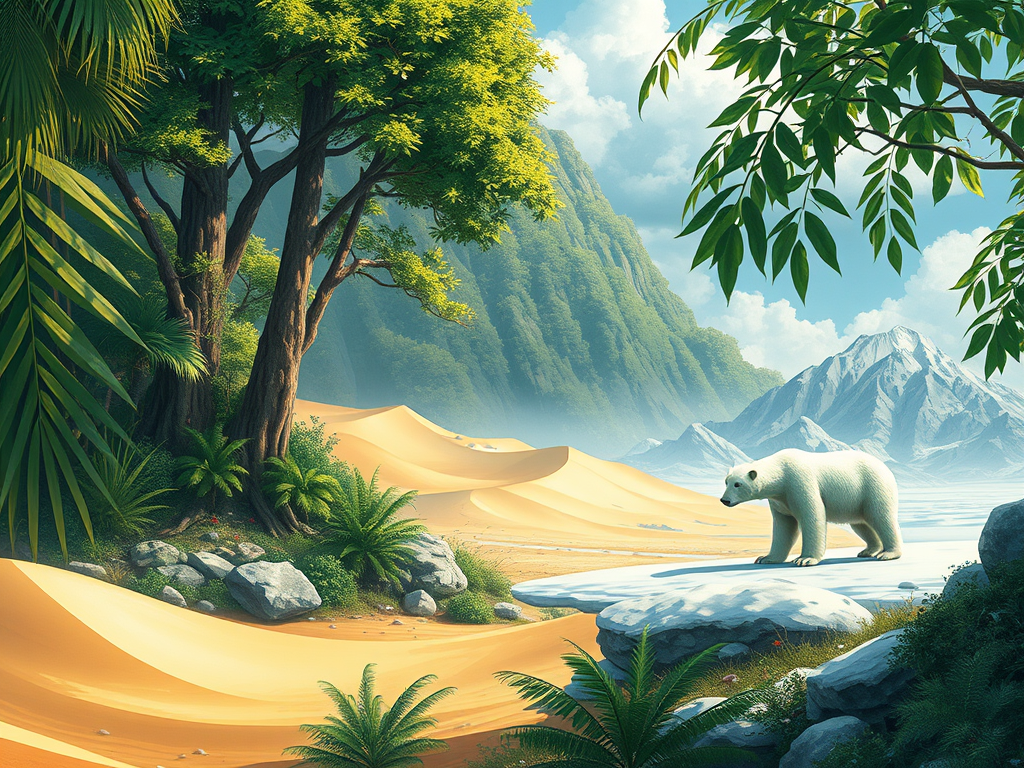
Have you ever wondered why polar bears live in icy lands while camels thrive in sandy deserts? Or why lush jungles are packed with colourful birds and monkeys, but wide-open grasslands are home to speedy cheetahs and towering giraffes? It all comes down to their special homes, or “biomes”! Our planet is a giant patchwork of different environments, each with its own unique climate, plants, and animals that are perfectly suited to live there. Learning about what are biomes is like taking a grand tour of Earth’s most amazing natural addresses. So, grab your explorer’s hat as we investigate the major Earth habitats and discover what makes each one so special!
1. Our Amazing Planet: What Exactly is a Biome?
So, what defines a biome? Think of a biome as a really large area on Earth that has a similar climate (the typical weather over a long time), similar types of soil, and therefore, similar kinds of plants and animals living there. It’s much bigger than just a local habitat, like a pond or a small wood. Biomes can stretch across entire continents! The main things that determine what a biome is like are temperature and how much precipitation (rain or snow) it gets. These factors decide which plants can grow, and the types of plants then determine which animals can live there, creating unique Earth’s ecosystems for children (and adults!) to study and admire. From scorching deserts to icy tundra, each biome is a fascinating world of its own, full of life that has adapted to survive and thrive in those particular conditions.
2. Tropical Rainforests: Earth’s Lush Green Lungs
Tropical rainforests are like giant, steamy greenhouses, found near the Earth’s equator. They are famous for being incredibly hot and wet all year round, getting lots of rainfall. This warm, damp climate is perfect for growing an amazing variety of plants – more than in any other biome! Towering trees form a dense canopy high above the ground, creating different layers where various animals live. These forests are bursting with life; in fact, about half of all the different types of plants and animals on Earth are found in tropical rainforests! You’ll find colourful parrots, swinging monkeys, slithering snakes, incredible insects, and beautiful flowers like orchids. Plant and animal life in biomes like the rainforest are incredibly diverse, making them vital for our planet’s health – they even help produce the oxygen we breathe!
3. Deserts: Lands of Extremes (Hot and Cold)
When you hear “desert,” you probably think of sizzling hot sand dunes, right? While many deserts, like the Sahara in Africa, are very hot during the day, they can get surprisingly cold at night because there are no clouds to hold in the heat. And believe it or not, there are cold deserts too, like the Gobi Desert in Asia or even the icy “deserts” of Antarctica (because they get so little precipitation)! The main characteristic of any desert is that it’s very dry, receiving less than 25 cm (10 inches) of rain per year. Characteristics of different biomes like deserts mean plants and animals have amazing adaptations to survive with so little water. Cacti store water in their stems, and many desert animals, like fennec foxes and kangaroo rats, are nocturnal, meaning they only come out at night when it’s cooler.
4. Savannas: Grasslands with Scattered Trees
Savannas are vast, open grasslands with scattered trees, found mainly in parts of Africa, Australia, South America, and India. They have warm temperatures all year round, but they also have distinct wet and dry seasons. During the wet season, grasses grow tall and lush, providing plenty of food for grazing animals. In the long dry season, the grasses turn brown, and water can be scarce. Plant and animal life in world biomes like the savanna include some of the most iconic animals on Earth: think of herds of zebras, wildebeest, and gazelles, as well as predators like lions, cheetahs, and hyenas. Elephants, giraffes, and baobab trees (which can store water in their huge trunks) are also famous savanna residents. Many animals here are adapted to migrate long distances to find food and water.
5. Temperate Grasslands: Seas of Grass
Temperate grasslands are vast, open areas where grasses are the main type of plant life, with very few trees or shrubs. You might know them by other names, like prairies in North America, pampas in South America, steppes in Asia, or veld in South Africa. These biomes typically have hot summers and cold winters, with moderate rainfall – not enough to support a forest, but more than a desert gets. The soil is often very fertile, making these areas important for farming. Animals found in temperate grasslands include grazing mammals like bison (in North America) and horses, as well as burrowing animals like prairie dogs. Many birds and insects also call these grassy plains home. One of the key characteristics of different biomes here is the open space, which means animals often have adaptations for running fast or living underground for protection.
6. Temperate Deciduous Forests: Forests of Four Seasons
If you live in a place with warm summers, cool winters, and leaves that change colour in autumn, you might be familiar with a temperate deciduous forest! These beautiful forests are found in parts of North America, Europe, and Asia. “Deciduous” means the trees here (like oak, maple, beech, and hickory) shed their leaves in the fall to save energy and water during the cold winter. This biome experiences four distinct seasons: spring, summer, autumn, and winter. They receive a good amount of precipitation throughout the year. Plant and animal life in world biomes such as these include a wide variety of creatures like deer, squirrels, raccoons, foxes, black bears, and many types of birds that might migrate south for the winter. The forest floor is rich with wildflowers, ferns, and mosses.
7. Taiga (Boreal Forests): The Great Northern Forests
Stretching across vast areas of Canada, Alaska, Scandinavia, and Russia, the taiga, also known as the boreal forest, is the largest land biome on Earth! It’s a cold, northern forest dominated by coniferous (cone-bearing) evergreen trees like pine, spruce, and fir. These trees have needle-like leaves that are well-suited to shed snow and conserve water during the long, cold, and snowy winters. Summers in the taiga are short and mild. The soil is often acidic and not very fertile. Animals living in the taiga are adapted to the harsh conditions. They include moose, reindeer (caribou), bears, wolves, lynx, beavers, and many hardy birds and insects. Many animals have thick fur for warmth, and some hibernate during the winter or migrate to warmer areas. World biomes explained simply always highlight the taiga’s vastness and cool climate.
8. Tundra: The Cold, Treeless Lands
The tundra is the coldest and one of the driest biomes on Earth, found in the Arctic regions and on the tops of very high mountains (alpine tundra). It’s a vast, treeless plain where the ground beneath the surface, called permafrost, is permanently frozen all year round! Winters are extremely long, dark, and freezing, while summers are very short and cool, though the sun might shine for 24 hours a day during part of the summer. Because of the permafrost and harsh conditions, only low-growing plants like mosses, lichens, grasses, and small shrubs can survive. Animals of the tundra, such as Arctic foxes, Arctic hares, caribou, lemmings, and polar bears (in coastal Arctic tundra), have amazing adaptations like thick fur, layers of fat, and camouflage (white fur in winter) to cope with the extreme cold. This is a key part of learning about habitats on Earth.
9. Freshwater Biomes: Worlds of Rivers, Lakes, and Wetlands
Not all biomes are on land! Freshwater biomes are aquatic (water-based) environments that have low salt concentrations. They include a wide variety of habitats like ponds, lakes, streams, rivers, and wetlands (such as swamps and marshes). Characteristics of different biomes in freshwater depend on factors like water depth, how fast the water flows, temperature, and nutrient levels.
- Lakes and Ponds: These are bodies of standing fresh water. Larger lakes can have different zones with different plant and animal life.
- Rivers and Streams: These are flowing bodies of water. The speed of the flow affects what can live there.
- Wetlands: These are areas where the land is saturated with water for at least part of the year. They are super important habitats for many birds, fish, amphibians, and insects. Plants like water lilies and cattails, and animals like fish, frogs, turtles, ducks, and beavers are common in freshwater biomes.
10. Marine Biomes: The Vast Ocean Realms
Marine biomes are the largest biomes on Earth, covering about 70% of our planet’s surface! These are the saltwater environments of our oceans. Marine biomes are incredibly diverse and include:
- Oceans: Vast, deep bodies of saltwater, divided into different zones based on depth and sunlight. The sunlit zone near the surface is full of tiny plankton, which form the base of the ocean food web, supporting fish, sharks, whales, and dolphins. The deep ocean is dark and cold, home to uniquely adapted creatures.
- Coral Reefs: Often called the “rainforests of the sea,” these are vibrant underwater structures built by tiny animals called corals. They are found in warm, shallow, clear waters and are teeming with colourful fish and other marine life.
- Estuaries: These are areas where freshwater rivers meet the salty ocean, creating a unique mix of water and habitats for many species. Exploring Earth’s major habitats wouldn’t be complete without understanding the immense and vital marine world.
Exploring Earth’s biomes helps us understand how interconnected life is and how wonderfully plants and animals have adapted to all sorts of conditions. Each biome plays an important role in the health of our planet!
Further Reading
If you’re eager to learn more about Earth’s amazing biomes and the creatures that inhabit them, check out these fantastic books:
- “The Incredible Ecosystems of Planet Earth” by Rachel Ignotofsky. (Known for beautiful illustrations and accessible information about different ecosystems).
- “Many Biomes, One Earth” by Sneed B. Collard III. (Takes readers on a tour of the world’s biomes).
- “A Forest Habitat (Introducing Habitats series)” by Kelley Macaulay or similar titles in habitat series (e.g., by National Geographic Kids or DK). (Series books often cover individual biomes in detail).
- “Over and Under the Pond” by Kate Messner, illustrated by Christopher Silas Neal. (A beautifully illustrated book focusing on a freshwater habitat).
- “Planet Earth: A Beginner’s Guide (The Young Scientists Series)” by Tom Jackson. (Often covers broader Earth science topics including habitats and ecosystems in a kid-friendly way).




Leave a Reply