
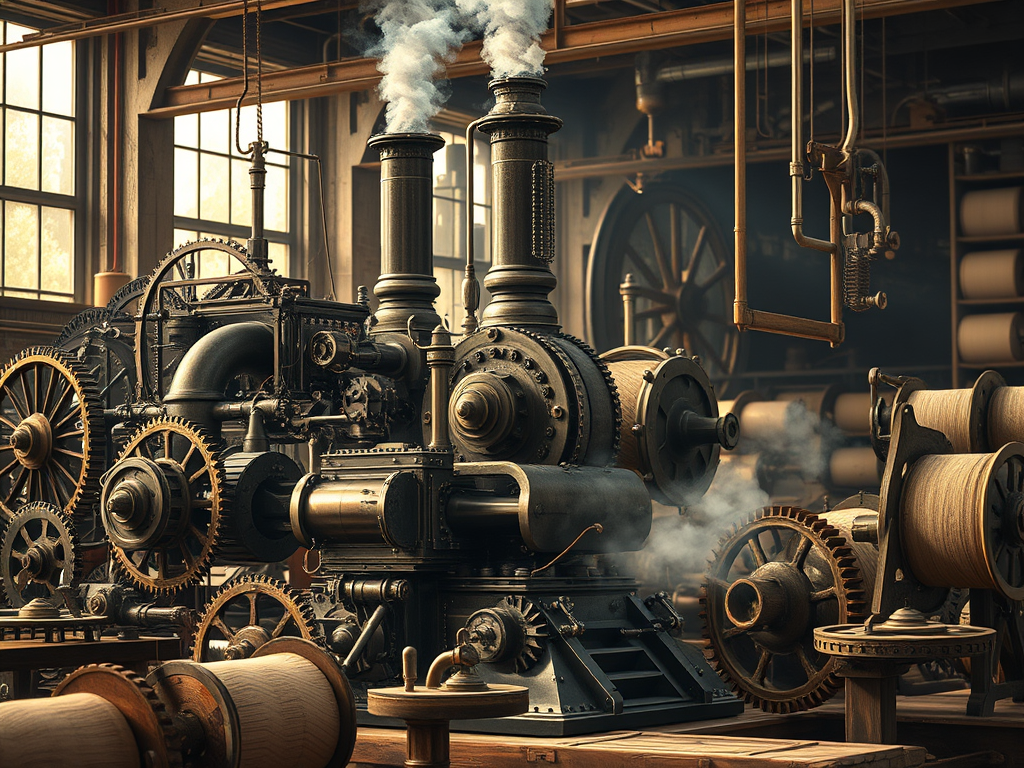
The Industrial Revolution, beginning in Great Britain in the late 18th century and spreading globally throughout the 19th, was a period of profound technological advancement and societal transformation. It marked a radical shift from agrarian, handcraft-based economies to industrial, machine-driven production. This era was characterized by an explosion of inventions that not only revolutionized manufacturing processes but also dramatically reshaped daily life, transportation, communication, and the very fabric of society. The impact of these innovations was far-reaching, leading to unprecedented economic growth, urbanization, and the rise of the factory system, but also bringing about significant social challenges.
At its core, the Industrial Revolution was about harnessing new sources of power and applying scientific knowledge to practical problems. It fundamentally altered the way goods were produced, leading to mass production, reduced costs, and a wider availability of consumer products. This shift was not merely technological; it was a complex interplay of economic, social, and cultural forces that propelled humanity into the modern age. This article highlights ten pivotal innovations that acted as catalysts for this revolutionary period, each playing a crucial role in dismantling the old order and building a new, industrialized world.
1. The Steam Engine: Powering the Revolution
While earlier versions existed, James Watt’s improvements to the steam engine in the late 1760s and 1770s truly unlocked its potential as the primary power source of the Industrial Revolution. Watt’s engine was far more efficient than its predecessors, requiring less fuel and providing a more consistent and powerful output. This innovation liberated factories from the need to be located near rivers for water power, allowing them to be built anywhere coal was available. The steam engine revolutionized industries from textiles to mining, providing the muscle for factories, pumping water out of deep coal mines, and eventually powering locomotives and steamships. It was the fundamental enabler, transforming manufacturing from a manual, intermittent process into a continuous, mechanized system, laying the very foundation of modern industrial society.
2. The Spinning Jenny: Revolutionizing Textile Production
The textile industry was at the forefront of the Industrial Revolution, and James Hargreaves’ invention of the Spinning Jenny in 1764 was a game-changer. Before the Jenny, spinning yarn was a slow, labor-intensive process, often done in cottages by hand. Hargreaves’ machine allowed a single worker to spin multiple spools of thread simultaneously, significantly increasing yarn output. This dramatically boosted the efficiency of textile production and lowered costs. While initially hand-powered, its success spurred further innovations, such as Richard Arkwright’s water frame and Samuel Crompton’s spinning mule, which mechanized and scaled up yarn production even further. The Spinning Jenny shifted textile manufacturing from a cottage industry to a factory-based system, creating demand for new power sources and eventually leading to the mass production of affordable fabrics.
3. The Power Loom: Mechanizing Weaving
Following the increased production of yarn thanks to the Spinning Jenny and its successors, Edmund Cartwright’s invention of the power loom in 1785 addressed the bottleneck in weaving. While Cartwright’s initial design was rudimentary, it paved the way for the mechanization of cloth production. The power loom allowed for much faster and more efficient weaving, capable of producing wide lengths of fabric with far less human effort than traditional hand looms. Its widespread adoption, particularly after further refinements in the early 19th century, transformed the weaving industry, centralizing production in factories and significantly increasing the output of finished textiles. This invention, alongside the spinning innovations, cemented the textile industry’s shift to mechanized mass production, making clothing more affordable and widely available.
4. The Cotton Gin: Fueling the Textile Boom
While the previous textile innovations focused on production, Eli Whitney’s invention of the cotton gin in 1793 revolutionized the processing of raw cotton. Before the cotton gin, separating cotton fibers from their sticky seeds was an extremely laborious and time-consuming manual task. Whitney’s machine used a simple mechanism of a wire screen and small wire hooks to quickly and easily separate the fibers. This dramatically lowered the cost and increased the speed of cotton processing. The cotton gin made short-staple cotton, which could be grown widely across the American South, incredibly profitable. While a technological marvel, its immediate and devastating consequence was an explosion in the demand for cotton and, tragically, a massive increase in the reliance on enslaved labor in the Southern United States to cultivate and pick the cotton, thus entrenching the institution of slavery.
5. The Bessemer Process: Mass Production of Steel
For centuries, iron was the primary metal for construction and manufacturing, but it was often brittle or difficult to work with. Steel, a stronger and more versatile alloy of iron, was expensive and difficult to produce in large quantities. Henry Bessemer’s process, patented in 1856, revolutionized steel production by providing a cost-effective and efficient method for mass-producing steel from molten pig iron. The Bessemer converter blew air through molten iron to remove impurities, creating steel with greater consistency and strength. This innovation made steel widely available and affordable, leading to its widespread use in everything from railways and bridges to skyscrapers, machinery, and armaments. It fundamentally transformed construction, transportation, and industrial manufacturing, ushering in the “Age of Steel.”
6. Interchangeable Parts: The Dawn of Mass Production
Before the concept of interchangeable parts, products were often custom-made, with each component uniquely fitted. If a part broke, a new one had to be custom-made or the entire product replaced. Eli Whitney is often credited with popularizing the concept of interchangeable parts in the late 18th century through his work on manufacturing muskets for the U.S. government. The idea was to standardize components so that identical parts could be mass-produced and easily swapped out. This innovation was foundational for the development of mass production and the assembly line. It significantly reduced manufacturing costs, increased production speed, simplified repairs, and lessened the reliance on highly skilled artisans. Interchangeable parts revolutionized industries beyond firearms, impacting machinery, textiles, and laying the groundwork for consumer goods manufacturing.
7. The Telegraph: Instantaneous Long-Distance Communication
Prior to the telegraph, long-distance communication relied on slow methods like mail or signal flags. Samuel Morse’s development of the electric telegraph in the 1830s and 1840s, along with Morse Code, revolutionized communication by allowing near-instantaneous transmission of messages over vast distances via electrical signals sent along wires. The first successful long-distance telegraph line in the U.S. was established in 1844. This invention dramatically sped up business transactions, news dissemination, and military communications. It made the world feel much smaller and more interconnected, facilitating the growth of international trade, coordinating railway traffic, and influencing political and social dynamics by enabling rapid information exchange across continents. It was the precursor to all modern electronic communication.
8. The Steam Locomotive: Transforming Transportation
While steam engines powered factories, their application to transportation was equally revolutionary. Richard Trevithick built the first full-scale working railway steam locomotive in 1804, though George Stephenson’s “Locomotion No. 1” (1825) and “Rocket” (1829) proved the commercial viability of steam railways. The steam locomotive drastically reduced travel times and transportation costs for both goods and people. Railways could transport raw materials to factories and finished goods to markets far more efficiently than canals or roads. The rapid expansion of railway networks across Britain, Europe, and North America fueled industrial growth, connected distant regions, stimulated the coal and iron industries, and fundamentally reshaped demographics by enabling urbanization and easier migration. It was a visible symbol of the new industrialized world.
9. The Factory System: Centralizing Production and Labor
While not a single invention, the development and widespread adoption of the factory system was a fundamental innovation in the organization of labor and production during the Industrial Revolution. This system brought machines and workers together under one roof, often powered by a central source like a steam engine. It replaced the dispersed “cottage industry” model, where work was done in homes. Factories allowed for economies of scale, strict division of labor, and centralized supervision, leading to increased efficiency and output. However, it also created a new social structure: long working hours, often harsh conditions, low wages, child labor, and the rapid growth of crowded, unsanitary industrial cities. The factory system profoundly reshaped the relationship between workers and employers and led to significant social upheaval.
10. The Electric Light Bulb: Extending Productive Hours
While perfected later in the Industrial Revolution, Thomas Edison’s development of a practical, long-lasting incandescent light bulb in 1879 was a monumental innovation. Before electric lighting, factories and homes relied on natural light, candles, or gas lamps, which were often inefficient, dangerous, and provided limited illumination. The electric light bulb offered a safe, reliable, and powerful source of artificial light. This meant that factories could operate around the clock, increasing production capacity and extending working hours. It also had a profound impact on urban life, transforming streets, public spaces, and homes, contributing to a more dynamic and extended social and economic rhythm, forever altering the patterns of day and night.
These ten innovations, among many others, were the pistons and gears of the Industrial Revolution. Individually, they represented remarkable feats of human ingenuity; collectively, they ignited a transformation that changed the fundamental nature of work, society, and human interaction, laying the groundwork for the technological world we inhabit today.
Further Reading
- The Industrial Revolution: A Very Short Introduction by Robert C. Allen
- The Age of Revolution: 1789-1848 by Eric Hobsbawm
- The British Industrial Revolution in Global Perspective by Robert C. Allen
- Engels and the Industrial Revolution by Steven Marcus
- The Making of the English Working Class by E.P. Thompson
Here at Zentara.blog, our mission is to take those tricky subjects and unlock them, making knowledge exciting and easy to grasp for everyone. But the adventure doesn’t stop on this page! We’re constantly exploring new frontiers and sharing discoveries across the digital universe. Want to dive deeper into more mind-bending Top 10s and keep expanding your world? Come join us on our other platforms – we’ve got unique experiences waiting for you on each one!
Get inspired by visual wonders and bite-sized facts: See the world through Zentara’s eyes on Pinterest!
Pin our fascinating facts and stunning visuals to your own boards. Explore Pins on Pinterest: https://uk.pinterest.com/zentarablog/
Discover quick insights and behind-the-scenes peeks: Hop over to Tumblr for snippets, quotes, and unique content you won’t find anywhere else. It’s a different flavour of discovery! Follow the Fun on Tumblr: https://www.tumblr.com/zentarablog
Ready for deep dives you can listen to or watch? We’re bringing our accessible approach to video and potentially audio! Subscribe to our YouTube channel and tune into future projects that make learning pop! Subscribe on YouTube: https://www.youtube.com/@ZentaraUK
Seeking even more knowledge in one place? We’ve compiled some of our most popular topic deep dives into fantastic ebooks! Find them on Amazon and keep the learning journey going anytime, anywhere. Find Our Ebooks on Amazon: https://www.amazon.co.uk/s?k=Zentara+UK&ref=nb_sb_noss
Connect with us and fellow knowledge seekers: Join the conversation on BlueSky! We’re sharing updates, thoughts, and maybe even asking you what wonders we should explore next. Chat with Us on BlueSky: https://bsky.app/profile/zentarablog.bsky.social
Perfect for learning on the move! We post multiple 10-minute podcasts per day on Spotify. Pop on your headphones and fill your day with fascinating facts while you’re out and about! Listen on Spotify: https://open.spotify.com/show/3dmHbKeDufRx95xPYIqKhJ
Follow us on Instagram for bytesize knowledge! We post multiple posts per day on our official Instagram account. https://www.instagram.com/zentarablog/ Every click helps us keep bringing honest, accessible knowledge to everyone. Thanks for exploring with us today – see you out there in the world of discovery!




Leave a Reply