
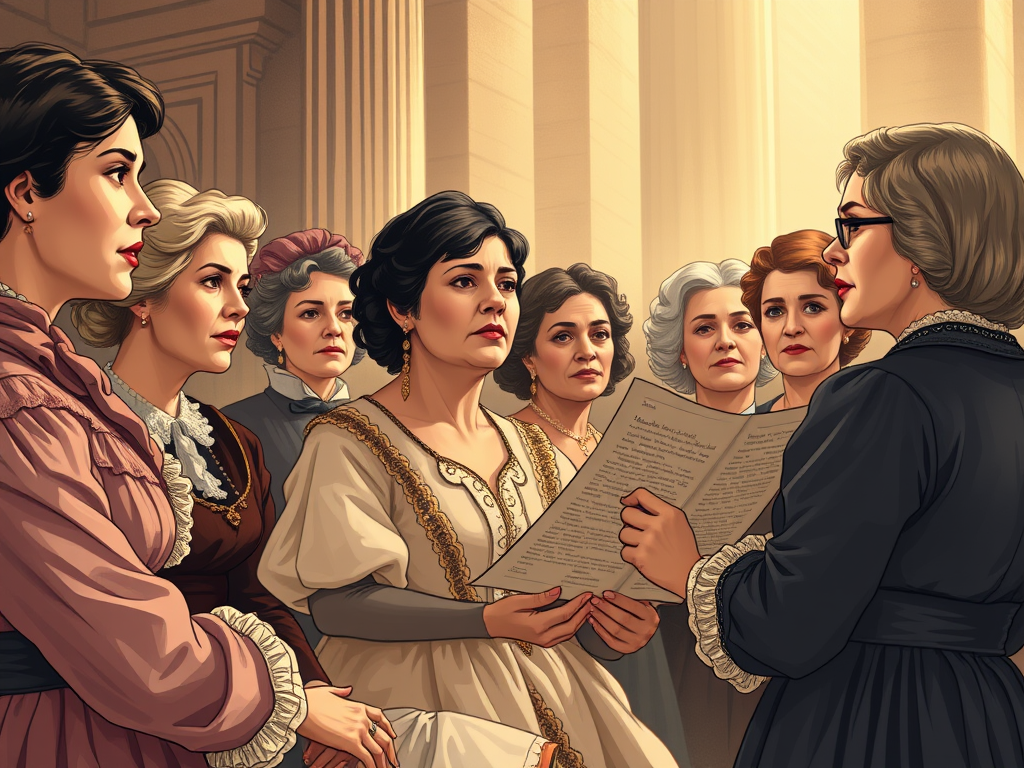
The right to vote, a cornerstone of democratic participation, was not universally granted. For centuries, women across the globe were systematically excluded from the political process, denied a voice in the laws that governed their lives. The Women’s Suffrage Movement was a sustained, often arduous, struggle by women and their allies to secure this fundamental right. It was born out of a broader feminist awakening in the 19th century, fueled by the realization that without political power, women would remain second-class citizens, limited in their ability to advocate for social, economic, or legal reforms.
The movement was far from monolithic, encompassing diverse strategies and ideologies. From polite petitions and reasoned arguments to public demonstrations, militant direct action, and acts of civil disobedience, suffragists employed every tool at their disposal to challenge deeply entrenched patriarchal norms. They faced formidable opposition, including societal ridicule, legal barriers, and even physical violence. Many early arguments against women’s suffrage were rooted in traditional gender roles, claiming women were too emotional, intellectually inferior, or simply belonged in the domestic sphere.
Despite these obstacles, the suffragists persevered, their dedication driven by a profound belief in equality and justice. Their fight was not just about casting a ballot; it was about asserting women’s full humanity, their capacity for independent thought, and their right to shape the future of their nations. The success of the suffrage movement in various countries, though often piecemeal and hard-won, marked a pivotal turning point in the broader struggle for women’s rights, laying the groundwork for further advancements in education, employment, and legal status. It taught invaluable lessons about social change, the power of collective action, and the slow, often frustrating, march towards true equality.
This article highlights ten key milestones in the women’s suffrage movement, tracing its evolution and impact across different parts of the world, and recognizing the pivotal moments that paved the way for women’s political enfranchisement.
1. The Seneca Falls Convention (1848): A Foundational Declaration
Often considered the official launch of the women’s rights movement in the United States, the Seneca Falls Convention was held in Seneca Falls, New York, on July 19-20, 1848. Organized primarily by Elizabeth Cady Stanton and Lucretia Mott, it was the first women’s rights convention ever held. The convention produced the “Declaration of Sentiments,” a groundbreaking document modeled after the Declaration of Independence. It boldly asserted that “all men and women are created equal” and listed a series of grievances and resolutions, including the radical demand for women’s suffrage. While immediate change was slow, the convention provided a crucial platform, articulated a clear agenda for women’s rights, and galvanized early activists, setting the stage for decades of organized struggle for the right to vote.
2. New Zealand Grants Women the Vote (1893): A World First
New Zealand holds the distinction of being the first self-governing country in the world to grant all women the right to vote in national elections. After years of persistent lobbying by suffragists, notably Kate Sheppard and the Women’s Christian Temperance Union, the Electoral Act 1893 was passed into law on September 19, 1893. This landmark achievement made New Zealand a beacon of progress and provided inspiration for suffrage movements worldwide. While New Zealand’s female suffrage was inclusive of Māori women from the outset, it’s worth noting that it did not include the right for women to stand for parliament until later. Nevertheless, its pioneering step shattered the notion that women’s political participation was impossible or undesirable, proving that suffrage could be successfully implemented without societal collapse.
3. The Formation of the WSPU (1903): The Rise of the Suffragettes
In the United Kingdom, frustration with the slow pace of parliamentary reform led Emmeline Pankhurst and her daughters Christabel and Sylvia to found the Women’s Social and Political Union (WSPU) in 1903. Unlike earlier, more moderate suffrage groups, the WSPU adopted increasingly militant tactics, earning its members the moniker “suffragettes.” Their motto became “Deeds, not words.” They engaged in acts of civil disobedience, including chaining themselves to railings, smashing windows, arson, and hunger strikes when imprisoned. While controversial, their radical actions generated immense public attention, forcing the issue of women’s suffrage into the forefront of political debate and challenging Victorian societal norms about female behavior. Their activism, though often met with harsh repression, significantly escalated the visibility and urgency of the suffrage cause.
4. “Votes for Women” Marches and Protests: Mass Mobilization
Across both the UK and the US, suffragists increasingly turned to large-scale public demonstrations to press their demands. The 1913 Woman Suffrage Procession in Washington D.C., organized by Alice Paul and the National American Woman Suffrage Association (NAWSA), saw thousands of women march on the eve of Woodrow Wilson’s presidential inauguration, facing hostility and violence. In the UK, major processions, like the “Mud March” of 1907, drew thousands despite inclement weather. These marches were crucial for demonstrating the widespread support for suffrage, challenging the stereotype of suffragists as a small, fringe group, and forcing the public and politicians to confront the issue. They utilized visual spectacle, banners, and coordinated efforts to convey their powerful message of unity and determination.
5. Hunger Strikes and Force-Feeding (Early 20th Century): The Brutality of the Fight
As suffragettes in the UK became more militant, many were arrested and imprisoned. To protest their incarceration and draw attention to their cause, many began hunger strikes. In response, the authorities resorted to brutal force-feeding, a painful and often life-threatening procedure where tubes were inserted down the nose or throat. This practice, exemplified by the experiences of figures like Marion Wallace Dunlop and Emmeline Pankhurst, caused public outrage and drew condemnation from medical professionals. The government’s “Cat and Mouse Act” (1913) allowed hunger-striking prisoners to be released when weakened and re-arrested once they regained strength, further highlighting the harsh repression faced by suffragists and fueling public sympathy for their plight.
6. The 19th Amendment in the U.S. (1920): A Century-Long Battle Won
After a fight spanning over 70 years, the 19th Amendment to the United States Constitution was finally ratified on August 18, 1920, guaranteeing American women the right to vote. The culmination of tireless efforts by generations of suffragists like Susan B. Anthony, Elizabeth Cady Stanton, and Alice Paul, the amendment declared that the right to vote “shall not be denied or abridged by the United States or by any State on account of sex.” Its passage marked a monumental victory for women’s rights and fundamentally altered the American political landscape. However, it’s crucial to acknowledge that while legally universal, voter suppression tactics continued to disproportionately affect Black women and other minority groups for decades afterward.
7. British Women’s Suffrage: Partial (1918) and Full (1928) Victory
In the United Kingdom, the road to universal suffrage for women was achieved in two stages. The Representation of the People Act 1918 granted the vote to women over 30 who met property qualifications or were university graduates. This partial victory was partly a recognition of women’s significant contributions to the war effort during World War I, which had put a temporary halt to the militant suffrage campaign. A decade later, the Equal Franchise Act 1928 finally granted all women over the age of 21 the right to vote on the same terms as men. This long-awaited full suffrage marked a triumph for the sustained and diverse efforts of both moderate suffragists and militant suffragettes, ending a century-long struggle for political equality.
8. The League of Nations and International Advocacy: Spreading the Message
While national movements were key, the interwar period saw a growing international dimension to women’s suffrage advocacy. The creation of the League of Nations after World War I provided a new platform for international women’s organizations, such as the International Alliance of Women (formerly the International Woman Suffrage Alliance), to lobby for women’s political rights globally. Article 7 of the League’s Covenant stipulated that all positions in the League were open equally to men and women, a significant symbolic victory. Although the League did not mandate suffrage, its very existence and the advocacy within its framework helped normalize the idea of women’s political participation and provided a forum for sharing strategies and coordinating efforts across borders, inspiring movements in countries yet to grant suffrage.
9. India and the Commonwealth: Post-Colonial Suffrage
The path to women’s suffrage in former colonial nations, particularly within the British Commonwealth, often intertwined with independence movements. In India, for example, women gained the right to vote in stages, influenced by provincial legislation in the 1920s and the Government of India Act 1935. However, universal adult suffrage, including for women, was fully enshrined with India’s independence and the adoption of its constitution in 1950. Similarly, in many African and Caribbean nations, the right to vote for women was often granted as part of broader independence and decolonization processes, becoming a feature of newly established democratic constitutions. These instances highlight how the fight for suffrage was sometimes embedded within larger struggles for self-determination and national sovereignty.
10. Saudi Arabia’s Recent Progress (2015): The Ongoing Global Struggle
Despite significant progress globally, the fight for women’s suffrage extended into the 21st century in some parts of the world. Saudi Arabia, for instance, remained one of the last countries to grant women the right to vote and stand in elections. In 2011, King Abdullah announced that women would be allowed to vote and run in municipal elections starting in 2015. This landmark decision marked a significant, albeit limited, step towards political inclusion for women in the ultra-conservative kingdom. While progress is ongoing and challenges remain, Saudi Arabia’s change underscores that the journey toward universal suffrage has been a staggered, often slow process, and for some, the fight for full political equality continues even today, highlighting the persistent need for advocacy and reform in various contexts.
The Women’s Suffrage Movement was a testament to courage, resilience, and unwavering belief in fundamental human rights. Its milestones, spanning over a century and crossing continents, remind us that equality is not given; it is fought for, piece by painstaking piece, shaping a more inclusive and just world.
Further Reading
- A History of Women’s Suffrage by Elizabeth Cady Stanton, Susan B. Anthony, Matilda Joslyn Gage, and Ida Husted Harper (A foundational primary source, though with biases)
- Iron Jawed Angels: The Story of the National Woman’s Party and Alice Paul by Linda G. Ford
- The Woman’s Hour: The Great Fight to Win the Vote by Elaine Weiss
- One Half the People: The Fight for Woman Suffrage by William L. O’Neill
- Suffragettes: The Fight for Votes for Women by Diane Atkinson
Here at Zentara.blog, our mission is to take those tricky subjects and unlock them, making knowledge exciting and easy to grasp for everyone. But the adventure doesn’t stop on this page! We’re constantly exploring new frontiers and sharing discoveries across the digital universe. Want to dive deeper into more mind-bending Top 10s and keep expanding your world? Come join us on our other platforms – we’ve got unique experiences waiting for you on each one!
Get inspired by visual wonders and bite-sized facts: See the world through Zentara’s eyes on Pinterest!
Pin our fascinating facts and stunning visuals to your own boards. Explore Pins on Pinterest: https://uk.pinterest.com/zentarablog/
Discover quick insights and behind-the-scenes peeks: Hop over to Tumblr for snippets, quotes, and unique content you won’t find anywhere else. It’s a different flavour of discovery! Follow the Fun on Tumblr: https://www.tumblr.com/zentarablog
Ready for deep dives you can listen to or watch? We’re bringing our accessible approach to video and potentially audio! Subscribe to our YouTube channel and tune into future projects that make learning pop! Subscribe on YouTube: https://www.youtube.com/@ZentaraUK
Seeking even more knowledge in one place? We’ve compiled some of our most popular topic deep dives into fantastic ebooks! Find them on Amazon and keep the learning journey going anytime, anywhere. Find Our Ebooks on Amazon: https://www.amazon.co.uk/s?k=Zentara+UK&ref=nb_sb_noss
Connect with us and fellow knowledge seekers: Join the conversation on BlueSky! We’re sharing updates, thoughts, and maybe even asking you what wonders we should explore next. Chat with Us on BlueSky: https://bsky.app/profile/zentarablog.bsky.social
Perfect for learning on the move! We post multiple 10-minute podcasts per day on Spotify. Pop on your headphones and fill your day with fascinating facts while you’re out and about! Listen on Spotify: https://open.spotify.com/show/3dmHbKeDufRx95xPYIqKhJFollow us on Instagram for bytesize knowledge! We post multiple posts per day on our official Instagram account. https://www.instagram.com/zentarablog/ Every click helps us keep bringing honest, accessible knowledge to everyone. Thanks for exploring with us today – see you out there in the world of discovery!




Leave a Reply