
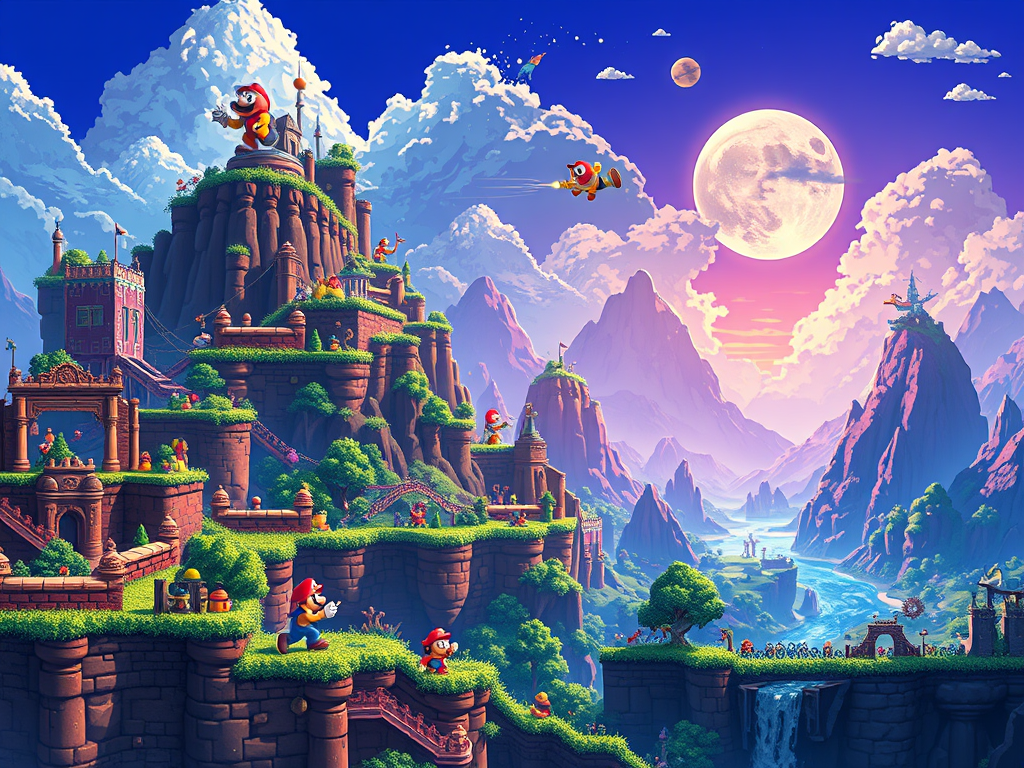
The evolution of video game graphics is one of the most remarkable technological and artistic journeys of the past 50 years. We’ve gone from arranging simple, blocky pixels into abstract shapes to rendering vast, lifelike worlds that are often indistinguishable from reality. This incredible leap wasn’t a single event but a series of groundbreaking innovations, each one building on the last, pushed forward by visionary programmers and artists determined to make the impossible possible.
This journey from pixels to photo-realism is a story of creativity born from limitation and artistry unlocked by technology. It’s a tale of how a handful of sprites gave way to millions of polygons, and how simple colours evolved into complex materials that react to light just as they would in the real world. To understand how we arrived at the breathtaking visuals of modern gaming, we need to look back at the ten pivotal advancements that forever changed what a video game could look like.
1. The Dawn of the Sprite: Giving Characters Life
In the earliest days of gaming, on-screen characters were often just a handful of pixels, indistinguishable from the background. The revolutionary concept of the sprite changed everything. A sprite is a 2D bitmap image that can be moved independently of the background. Think of it like a digital paper doll that the computer can place and move anywhere on the screen without having to redraw the entire scene frame by frame. This was a monumental leap in efficiency. Games like Taito’s Space Invaders (1978) were among the first to popularize sprites, allowing for dozens of enemies to move on screen at once. But it was characters like Pac-Man and Nintendo’s Mario in Donkey Kong (1981) that turned sprites into icons. This technology allowed developers to create distinct, recognizable characters, giving them personality and life. It was the first crucial step away from abstract representation and toward creating believable, animated beings that players could connect with on their digital adventures.
2. Parallax Scrolling: Creating the Illusion of Depth in 2D
As 2D games grew more ambitious, developers faced a new challenge: how to make a flat, side-scrolling world feel less, well, flat. The answer was a clever visual trick called parallax scrolling. This technique involves separating the background into multiple layers that move at different speeds as the player moves. The layers furthest “away” from the viewer scroll the slowest, while the layers closest scroll the fastest, perfectly mimicking the motion parallax effect we perceive in real life when looking out the window of a moving car. The 1982 arcade game Moon Patrol is often credited as one of the first to implement this technique effectively. By the era of the 16-bit consoles, it had become a hallmark of high-quality game design, used masterfully in titles like Sonic the Hedgehog to create a sense of speed and immersion. Parallax scrolling was a brilliant piece of artistry, a way to fake 3D depth and create rich, dynamic environments long before true 3D graphics were feasible.
3. The Leap to Polygonal 3D: Building Worlds in a New Dimension
The transition from 2D to 3D was arguably the most significant paradigm shift in the history of game graphics. Instead of sprites on a flat plane, developers began constructing characters and worlds out of polygons—typically triangles—arranged in a three-dimensional space. Early attempts like Battlezone (1980) used wireframe vector graphics, but it was the arrival of solid, filled polygons that truly kicked off the 3D revolution. Arcade games like Sega’s Virtua Racing (1992) and Virtua Fighter (1993) were watershed moments, showcasing the thrilling potential of this new dimension. When consoles like the Sony PlayStation and Nintendo 64 arrived, they brought polygonal 3D into the home. Games like Super Mario 64 (1996) didn’t just use 3D as a visual gimmick; they built the entire gameplay experience around navigating these new, expansive worlds. This leap allowed for unprecedented freedom of movement and exploration, fundamentally changing game design forever.
4. Texture Mapping: Giving 3D Shapes a Surface
Early polygonal 3D models were impressive, but they often looked like plain, plastic toys. They had shape but no substance. The technology that gave these shapes a soul was texture mapping. In essence, texture mapping is the process of wrapping a 2D image—a texture—onto a 3D model, like applying a decal to a model airplane. Suddenly, a simple grey polygon could look like rough stone, weathered wood, or gleaming metal. Id Software’s Quake (1996) was a landmark title that demonstrated the power of texturing to create dark, atmospheric, and believable environments. This advancement was crucial for realism and immersion. It allowed artists to add incredible detail to the world without needing to build it all with more polygons, which was computationally very expensive. Texture mapping gave artists a new canvas, allowing them to paint surfaces with the detail and grit that transformed sterile geometric worlds into places that felt tangible and real.
5. Skeletal Animation: Breathing Fluid Life into Characters
As 3D character models became more common, animating them realistically presented a new hurdle. Early methods were clunky, often involving moving individual vertices of a model, which resulted in rigid, puppet-like movement. The solution was skeletal animation. This system places a virtual “skeleton” or “rig” inside the 3D model. Instead of animating the model’s surface (the “skin”), animators move the bones of the skeleton, and the skin deforms naturally around them, just like a real body. This allows for far more fluid, believable, and efficient animation. The 1998 classic The Legend of Zelda: Ocarina of Time is a prime example of a game that used these principles to bring its characters to life with unprecedented grace. Link could run, jump, and swing his sword with a fluidity that made him feel like a living being. Skeletal animation became the industry standard, a fundamental technique for creating the lifelike character performances we expect in modern games.
6. Programmable Shaders: Unleashing Artistic Control Over Light
For a long time, how light and shadow behaved in a game was hard-coded into the graphics hardware. Developers had a limited menu of effects to choose from. The arrival of programmable shaders (specifically pixel shaders and vertex shaders) changed everything. A shader is a small program that runs on the Graphics Processing Unit (GPU) and tells it how to render each pixel or vertex. For the first time, this gave artists and programmers direct, granular control over the appearance of surfaces. They could now create their own complex visual effects, from the iridescent sheen of a beetle’s shell to the way light filters through water. The launch of the GeForce 3 GPU in 2001 brought this power to consumers, and games like The Elder Scrolls III: Morrowind (2002) used it to create stunningly realistic water effects that were a marvel at the time. Shaders were a turning point, transforming graphics programming from a rigid pipeline into a flexible, artistic tool.
7. Normal Mapping: Faking Detail with a Trick of the Light
As games moved into the HD era, player expectations for visual detail soared. But adding more polygons to every model to create every tiny crack and crevice was still computationally prohibitive. The ingenious solution was normal mapping. This technique uses a special texture (a normal map) to tell the game engine how light should behave on a surface, essentially faking the appearance of bumps, grooves, and intricate details on what is actually a flat, low-polygon model. Imagine a flat piece of paper that, through a trick of light and shadow, looks like a craggy rock face. This technique allows for an incredible illusion of complexity without the performance cost. Games like Doom 3 (2004) and Gears of War (2006) used normal mapping extensively to create gritty, highly detailed characters and environments that defined the look of that console generation, establishing a new standard for visual fidelity.
8. Physically-Based Rendering (PBR): Simulating Reality’s Rules
For years, artists created the illusion of different materials by hand-tuning colours, specular highlights, and reflections. The results were often artistic but not consistently realistic. Physically-Based Rendering (PBR) introduced a more unified and scientific approach. Instead of faking it, PBR models how light interacts with materials based on their real-world physical properties, such as roughness and metallicity. By adhering to principles of physics like energy conservation, PBR ensures that materials look correct and consistent under all lighting conditions. An iron sword will gleam like real iron, and a wooden shield will absorb light like real wood, whether it’s in a dark dungeon or out in the bright sun. Game engines like Unreal Engine 4 and Unity popularized this approach, and it has since become the standard for creating the stunningly lifelike materials seen in modern AAA games, from the worn leather of a backpack to the glossy finish on a sports car.
9. Photogrammetry: Digitizing the Real World
What’s the best way to make a digital rock look just like a real rock? Scan a real rock. This is the simple but revolutionary idea behind photogrammetry. The technique involves taking hundreds of high-resolution photographs of a real-world object or environment from every conceivable angle. Specialized software then analyzes these photos, triangulates points in space, and reconstructs the subject as an incredibly detailed and photo-realistic 3D model, complete with textures. This has allowed developers to create game assets with an unprecedented level of authenticity and detail, often in a fraction of the time it would take to create them from scratch. Games like The Vanishing of Ethan Carter (2014) and the Star Wars: Battlefront series famously used photogrammetry to create stunningly realistic environments and props, from forests in Poland to the original film props from the Lucasfilm archives, blurring the line between the real world and the digital one.
10. Real-Time Ray Tracing: The Holy Grail of Lighting
For decades, lighting in games has been a clever illusion, a collection of tricks like shadow maps and baked lighting to approximate how light behaves. Real-time ray tracing changes the game entirely. It simulates the actual physical behaviour of light, tracing the path of individual rays as they bounce off surfaces, get reflected, or are refracted through objects. This allows for perfectly accurate reflections on shiny surfaces, soft and realistic shadows that diffuse naturally, and global illumination that makes an entire scene feel cohesive and grounded in reality. Once considered the “holy grail” of graphics and confined to pre-rendered Hollywood CGI, the introduction of powerful GPUs like NVIDIA’s RTX series brought real-time ray tracing to consumer gaming. Games like Control (2019) and Cyberpunk 2077 showcased its power, creating scenes with a level of realism and immersion that was previously unimaginable, representing the current pinnacle in the long journey toward true photo-realism.
Further Reading
For those who wish to dive deeper into the fascinating intersection of art, technology, and video game history, these books are an excellent starting point:
- Blood, Sweat, and Pixels: The Triumphant, Turbulent Stories Behind How Video Games Are Made by Jason Schreier
- Masters of Doom: How Two Guys Created an Empire and Transformed Pop Culture by David Kushner
- The Art of Game Design: A Book of Lenses by Jesse Schell
- Game Engine Black Book: Wolfenstein 3D by Fabien Sanglard (A deep technical dive into early 3D graphics)
- Real-Time Rendering by Tomas Akenine-Möller, Eric Haines, and Naty Hoffman (The definitive technical reference on graphics)
Here at Zentara.blog, our mission is to take those tricky subjects and unlock them, making knowledge exciting and easy to grasp for everyone. But the adventure doesn’t stop on this page! We’re constantly exploring new frontiers and sharing discoveries across the digital universe. Want to dive deeper into more mind-bending Top 10s and keep expanding your world? Come join us on our other platforms – we’ve got unique experiences waiting for you on each one!
Get inspired by visual wonders and bite-sized facts: See the world through Zentara’s eyes on Pinterest!
Pin our fascinating facts and stunning visuals to your own boards. Explore Pins on Pinterest: https://uk.pinterest.com/zentarablog/
Discover quick insights and behind-the-scenes peeks: Hop over to Tumblr for snippets, quotes, and unique content you won’t find anywhere else. It’s a different flavour of discovery! Follow the Fun on Tumblr: https://www.tumblr.com/zentarablog
Ready for deep dives you can listen to or watch? We’re bringing our accessible approach to video and potentially audio! Subscribe to our YouTube channel and tune into future projects that make learning pop! Subscribe on YouTube: https://www.youtube.com/@ZentaraUK
Seeking even more knowledge in one place! We’ve compiled some of our most popular topic deep dives into fantastic ebooks! Find them on Amazon and keep the learning journey going anytime, anywhere. Find Our Ebooks on Amazon: https://www.amazon.co.uk/s?k=Zentara+UK&ref=nb_sb_noss
Connect with us and fellow knowledge seekers: Join the conversation on BlueSky! We’re sharing updates, thoughts, and maybe even asking you what wonders we should explore next. Chat with Us on BlueSky: https://bsky.app/profile/zentarablog.bsky.social
Perfect for learning on the move! We post multiple 10-minute podcasts per day on Spotify. Pop on your headphones and fill your day with fascinating facts while you’re out and about! Listen on Spotify: https://open.spotify.com/show/3dmHbKeDufRx95xPYIqKhJFollow us on Instagram for bytesize knowledge! We post multiple posts per day on our official Instagram account. https://www.instagram.com/zentarablog/ Every click helps us keep bringing honest, accessible knowledge to everyone. Thanks for exploring with us today – see you out there in the world of discovery!




Leave a Reply