
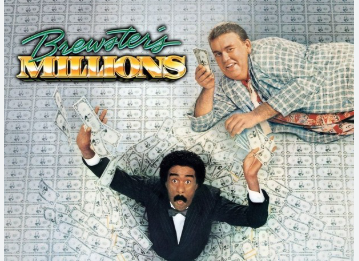
What would you do if you had to spend $30 million in 30 days to inherit a fortune of $300 million? This is the ultimate fantasy question at the heart of Brewster’s Millions, the iconic 1985 comedy that unleashed the brilliant minds of Richard Pryor and John Candy onto one of the greatest premises in movie history. The story of Montgomery “Monty” Brewster, a down-on-his-luck minor league baseball pitcher given an impossible task, is a hilarious and chaotic exploration of wealth, greed, and the surprising burden of having too much money. Paired with his lovable oaf of a best friend, Spike Nolan, Brewster embarks on a spending spree for the ages that is as wild and funny today as it was four decades ago.
But beyond the extravagant parties, the wacky political campaigns, and the frantic attempts to burn through cash, the making of Brewster’s Millions is a fascinating story in its own right. It’s a tale of an action movie director stepping out of his comfort zone, a story that has been told and retold for over a century, and a perfect storm of comedic talent. Here at Zentara.blog, we’ve dug into the vault to bring you the incredible stories behind this 80s classic. So, get ready to look at this comedy gem in a whole new way as we reveal 10 things you didn’t know about Brewster’s Millions.
1. A Tale as Old as Time (or at Least 1902)
While the 1985 version starring Richard Pryor is by far the most famous, the story of Brewster’s Millions was already a well-worn classic by the time it hit theaters. The tale originated with a 1902 novel of the same name by author George Barr McCutcheon. The book was an instant sensation and was adapted into a hit Broadway play just four years later. Its irresistible “what if” premise was a natural fit for Hollywood, and filmmakers returned to it again and again.
Before Pryor’s take, there were at least six other film versions. The first was a silent film in 1914, followed by another silent movie in 1921. A version called Miss Brewster’s Millions came out in 1926, flipping the gender of the protagonist. Sound versions were made in 1935 and 1945, and the story was even adapted in the UK and India. In these earlier tellings, the stakes were, of course, lower. The original Brewster only had to spend $1 million to inherit $7 million. The 1985 filmmakers updated the numbers for the go-go 80s, inflating the challenge to its now-famous $30 million, proving that a great story concept is truly timeless.
2. An Action Director Takes a Comedic Detour
The choice of director for a zany Richard Pryor comedy was, to say the least, unexpected. The man at the helm was Walter Hill, a filmmaker renowned for his gritty, violent, and testosterone-fueled action movies. His filmography included tough-guy classics like The Warriors, The Driver, and 48 Hrs. So, what was he doing directing a screwball comedy about spending money? In his own words, he did it for the money and to improve his “success quotient” in Hollywood.
Hill admitted in interviews that Brewster’s Millions was one of the few films he didn’t make out of pure passion, but rather as a strategic career move. However, his action-movie sensibilities brought a unique energy to the film. The pacing is relentless, much like one of his chase sequences, as Brewster races against the clock. Hill had previously directed Richard Pryor in the drama Some Kind of Hero, so he had an existing relationship with the comedian. While it seemed an odd pairing, Hill’s disciplined and efficient directing style provided a steady hand to guide the chaotic comedic energy of his two legendary stars.
3. The Unshakeable Rules of the Game
The entire plot of Brewster’s Millions hinges on the set of brilliantly restrictive rules that come with the inheritance. These rules aren’t just random obstacles; they are a masterfully crafted engine for comedy and conflict, designed to make spending a fortune as difficult as possible. Let’s break them down. First, Brewster must spend the entire $30 million in 30 days. Second, at the end of the 30 days, he can’t own any assets—nothing but the clothes on his back. Any possession he buys must be worthless by the end.
Third, and most importantly, he cannot simply give the money away. Charitable donations and gifts are capped at 5% of the total. Fourth, he can’t waste the money by gambling it away (another 5% cap) or by intentionally destroying valuable things he buys. He must get “value” for his money. Finally, the golden rule that creates all the interpersonal drama: he cannot tell anyone why he is doing it. These conditions force Brewster into a hilarious paradox where he must act like a responsible consumer while trying to achieve the most irresponsible goal imaginable, turning his dream-come-true into a waking nightmare.
4. The “None of the Above” Campaign Was Real… Sort Of
One of the most memorable and brilliant sequences in the film is Brewster’s plan to waste a huge chunk of money on a political campaign. He runs for Mayor of New York on a single platform: encouraging citizens to vote for “None of the Above.” His brutally honest slogan—”I’ll only make things worse! And that’s a promise!”—taps into public cynicism and, to everyone’s horror, starts to make him a popular candidate. This wasn’t just a funny movie invention; it was tapping into a real political concept.
The ballot option “None of the Above” (NOTA) actually exists in some jurisdictions around the world, including, famously, in the state of Nevada. It allows voters to formally express their disapproval of all available candidates. While the film uses it for satiric effect, it spoke to a genuine feeling of disillusionment with politics in the 1980s. The campaign becomes a razor-sharp commentary on how voters are often drawn to authenticity, even when that authenticity is a protest against the system itself. Brewster’s plan to throw his money away accidentally turns into a powerful grassroots movement, adding a layer of clever social satire to the comedy.
5. The Comedy Giants: Pryor and Candy’s Contrasting Styles
Putting Richard Pryor and John Candy together as best friends was a stroke of genius, pairing two of the most beloved comedians of their generation. However, their approaches to comedy were polar opposites. Richard Pryor was a revolutionary force in stand-up, known for his sharp, profane, and deeply personal observations on race, life, and his own demons. His energy on screen was often frenetic, unpredictable, and brilliantly manic.
John Candy, on the other hand, was the ultimate lovable everyman. His comedy came from a place of warmth, kindness, and often, a gentle clumsiness. He was the big-hearted friend you always wanted on your side. On set, this contrast created a unique dynamic. Walter Hill had to find a way to harness Pryor’s wild energy while giving Candy’s more subtle, reactive style the space to shine. The result is pure magic. Candy’s loyal and slightly baffled performance as Spike Nolan is the perfect anchor for Brewster’s manic spending spree, creating a friendship that feels genuine and provides the film with its emotional core.
6. The Ultimate Shopping Spree: Staging the Extravagance
Visualizing what spending $1 million a day looks like was one of the film’s biggest and most enjoyable challenges. The production had to dream up and execute a series of increasingly absurd spending montages. This included renting out the entire top floor of a luxurious New York hotel, hiring personal staff for every whim, and buying ridiculously expensive, one-of-a-kind items. One of the most famous examples is when Brewster buys a rare “Inverted Jenny” postage stamp for over a million dollars, only to use it to mail a letter, thereby destroying its collectible value.
The film’s climactic spending spree involves hiring the New York Yankees for a three-inning exhibition game against his own minor-league team, the Hackensack Bulls. This was a huge logistical undertaking, requiring the cooperation of Major League Baseball and filling a stadium with extras to create the feel of a real game. These scenes were meticulously planned to not only be funny but also to show the sheer scale of the task Brewster faced, making the abstract concept of $30 million feel tangible and delightfully overwhelming for the audience.
7. A Satire of 80s Greed Culture
While Brewster’s Millions is, on the surface, a laugh-out-loud comedy, it’s also a sharp satire of the “greed is good” mentality that defined the 1980s. The entire premise is a commentary on the absurdity of extreme wealth and consumerism. As Brewster frantically tries to get rid of his money, he discovers that the world is designed to make the rich even richer. His friends and advisors constantly try to invest his money wisely, accidentally making him millions more and nearly causing him to fail the challenge.
The film cleverly argues that money itself is not fulfilling. Brewster’s journey forces him to realize that the relationships he’s damaging—with his best friend Spike and his potential love interest, Angela—are far more valuable than the $300 million he stands to gain. He starts out wanting nothing more than to be rich, but the process of becoming truly wealthy teaches him the value of loyalty, integrity, and non-material happiness. In the end, his willingness to walk away empty-handed for the sake of his friends is what proves he is worthy of the inheritance.
8. The Unsung Hero Keeping It All Grounded
In a movie filled with the manic energy of Richard Pryor and the oversized heart of John Candy, the straight man is one of the most important roles. That duty fell to veteran character actor Pat Hingle, who played Edward Roundfield, the stern executor from the law firm overseeing the challenge. Hingle’s performance is a masterclass in quiet, understated comedy. With just a raised eyebrow or a weary sigh, he conveys the immense frustration and disbelief of watching Brewster’s antics.
Hingle acts as the embodiment of the rules, the establishment, and old-money sensibility. His character serves as a constant, grounding presence, reminding both Brewster and the audience of the serious stakes involved. Without his deadpan reactions to Brewster’s increasingly outlandish spending, the comedy wouldn’t land as effectively. He is the rock against which Pryor’s comedic waves crash, and his performance is essential to the film’s success.
9. A Tiny Detail on the Final Check
Filmmakers often hide small jokes and “Easter eggs” for sharp-eyed viewers, and Brewster’s Millions has a great one right at the climax. At the very end of the 30 days, Brewster is exhausted, penniless, and believes he has successfully spent every last cent. Just as he’s about to be declared the winner, his accountant Angela reveals she had secretly stashed a few thousand dollars of his per diem money, which now counts as an asset. In a panic, Brewster has to get rid of this last bit of cash.
He hires Angela as his new financial advisor and, in the film’s final moments, scribbles out a check to her for her services. If you look closely at the check as he writes it, the memo line reads: “In case I win.” It’s a tiny, hopeful detail that perfectly encapsulates Brewster’s character—even after a month of financial torture, he’s still a gambler at heart, making one last bet on himself. It’s a quick, clever nod that rewards attentive fans.
10. The Enduring Legacy of a High-Concept Comedy
Why do we still love and talk about Brewster’s Millions today? Its legacy lies in its brilliant, high-concept premise. The “what if” scenario is so powerful and relatable that it has become a cultural shorthand for the fantasy of sudden wealth and the surprising problems that come with it. The film became a blueprint for many 80s and 90s comedies built around a simple, easily marketable hook.
Furthermore, it captured two comedy legends at the height of their powers. It stands as one of Richard Pryor’s most accessible and beloved film roles and a perfect showcase for the irreplaceable warmth of John Candy. The film’s blend of slapstick, satire, and genuine heart has allowed it to endure far beyond its initial run. It remains a fixture on television and a go-to comfort movie for a generation that grew up with it, proving that the dream of having too much money is a fantasy that never gets old.
Conclusion
Brewster’s Millions is so much more than just a silly 80s comedy. It’s a story with a rich history, a film that brought together an unlikely team of creative talent, and a surprisingly sharp satire that has only become more relevant with time. Learning about the century-old source material, the action-director’s steady hand, and the specific rules that made the comedy engine run gives us a new layer of appreciation for this classic. It’s a film that perfectly balances its zany premise with a real heart, reminding us that the best things in life—friendship, loyalty, and integrity—can’t be bought, no matter how much money you have to spend. It’s a hilarious, enduring fable about how losing everything can sometimes be the only way to truly win.
So, we have to ask: if you were in Monty Brewster’s shoes, what would be the very first extravagant thing you would buy? Share your wildest ideas in the comments below!
Dive Deeper
Ready to explore the world of Brewster’s Millions even more? Check out these fantastic companion reads:
- Brewster’s Millions by George Barr McCutcheon: Go back to where it all began with the original 1902 novel. Discover the classic story that inspired over a half-dozen film adaptations and see how the tale has evolved.
- Pryor Convictions: And Other Life Sentences by Richard Pryor: The raw and unflinching autobiography from the comedy legend himself. Dive into the mind of the genius who brought Monty Brewster to life.
Wild and Crazy Guys: How the Comedy Mavericks of the ’80s Changed Hollywood Foreverby Nick de Semlyen: This book provides incredible context for the era in which Brewster’s Millions was made, exploring the careers of comedy icons like Pryor, Candy, Bill Murray, and Eddie Murphy.

Leave a Reply