
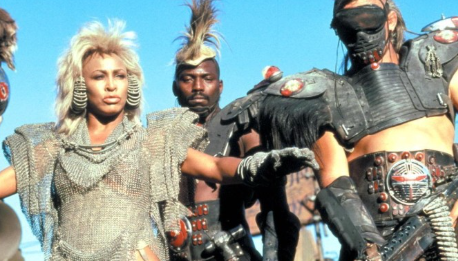
Welcome back to the Wasteland! In 1985, five years after the visceral, high-octane thrill ride of The Road Warrior, director George Miller invited audiences back to his post-apocalyptic vision with Mad Max Beyond Thunderdome. This third installment presented a different kind of world, one that was beginning to rebuild itself in strange and terrifying ways. From the chaotic, entrepreneurial hub of Bartertown to the innocent, hopeful tribe of lost children, the film expanded the lore of the Mad Max saga in ambitious and unexpected directions. It was bigger, grander, and infused with a sense of mythic storytelling that set it apart from its predecessors.
While it’s remembered for its iconic gladiator cage, the powerhouse presence of Tina Turner as Aunty Entity, and the chart-topping theme song “We Don’t Need Another Hero,” the story of how Beyond Thunderdome came to be is as dramatic and compelling as the on-screen action. It’s a tale of profound loss, creative partnership, grueling physical challenges, and the kind of innovative world-building that has cemented the franchise’s place in cinema history. Prepare to enter Bartertown and look beyond the dome as we reveal 10 surprising facts that will give you a whole new appreciation for this audacious and unforgettable chapter in the journey of Max Rockatansky.
1. A Tale of Two Georges: The Co-Directing Partnership
While the visionary George Miller is rightfully credited as the mastermind behind the Mad Max universe, he did not helm Beyond Thunderdome alone. The film was co-directed by his close friend and creative collaborator, George Ogilvie. This decision was born from a place of deep personal tragedy. In 1983, just as pre-production was beginning, Miller’s producing partner and soulmate of the franchise, Byron Kennedy, was tragically killed in a helicopter crash. Devastated by the loss, Miller found his passion for the project waning. He felt he couldn’t shoulder the immense logistical and creative weight of the action-heavy sequences on his own.
To ensure the film could be completed, Miller reached out to Ogilvie, a respected Australian theatre director with whom he had previously worked on a television miniseries. They divided the responsibilities: Miller, with his unparalleled expertise in kinetic action, would handle the spectacular chase sequences and the iconic Thunderdome duel. Ogilvie, with his strong background in performance and character work, would focus on directing the dramatic scenes, particularly the nuanced interactions within Bartertown and the sequences involving the tribe of lost children. This creative union allowed Miller the space to grieve while ensuring the film’s dramatic heart was as powerful as its action-packed spectacle.
2. The Queen of Rock Was Cast for Her “Positive Persona”
The casting of music legend Tina Turner as the formidable ruler of Bartertown, Aunty Entity, was a stroke of genius. But it wasn’t just her star power or electrifying stage presence that landed her the role. George Miller was specifically looking for an actress who could embody a different kind of antagonist. Unlike the purely chaotic villains of the previous films, Aunty Entity was a builder, a leader who had carved a form of civilization out of the dust. Miller envisioned her as a fallen hero, someone who started with noble intentions but had become a tyrant to maintain control.
To achieve this complexity, he wanted an actress the audience inherently liked and trusted. He felt Tina Turner, with her global reputation as a survivor and her overwhelmingly positive public image, was perfect. He believed her natural charisma would make Aunty’s descent into ruthlessness more tragic and compelling. Before Turner, actresses like Jane Fonda and Lindsay Wagner were considered, but Miller’s instinct was that Turner’s powerful, survivor persona would bring a unique and unforgettable energy to the role, making Aunty Entity a villain you couldn’t help but admire.
3. From Brick Pit to Bustling Metropolis: The Creation of Bartertown
The sprawling, chaotic, and ingeniously designed set of Bartertown was not built on a soundstage but in a vast, disused brick pit in Homebush Bay, Sydney. This real-world location provided the perfect foundation for the multi-level, ramshackle city. Construction foreman Max Worrall and his team embraced a design philosophy that was the antithesis of normal construction: nothing was to be plumb, square, or level. This gave the town its organic, cobbled-together aesthetic, as if it had grown over years of scavenging.
The town was a masterpiece of practical world-building. Buildings were constructed from a hodgepodge of materials, including light steel frames, chicken wire, hessian cloth, and sprayed concrete, with salvaged car parts and old machinery embedded into the walls. The attention to detail was incredible, creating a tangible, lived-in world. At the heart of this society was its power source: a subterranean pig farm where the animals’ waste was converted into methane gas. This “Underworld” was not just a clever plot device but a fully realized set, complete with hundreds of live pigs, creating an unforgettable and sensorially overwhelming environment for cast and crew.
4. “Two Men Enter, One Man Leaves”: The Thunderdome’s Jolly Jumper Origins
The iconic Thunderdome, the brutal arena where Bartertown settles its disputes, has become a permanent fixture in pop culture lexicon. Its single, immutable law—”Two men enter, one man leaves”—is instantly recognizable. The design of this gladiatorial cage was as innovative as it was brutal. A massive geodesic dome constructed from steel, it was designed to be a spectacle for the citizens of Bartertown, with crowds climbing all over its exterior to get the best view.
The truly ingenious element, however, was the use of elastic harnesses for the combatants. This allowed the fighters to launch themselves around the cage in a gravity-defying, three-dimensional ballet of violence. The inspiration for this came from a surprisingly innocent source: children’s “jolly jumpers,” the bouncy harnesses that allow toddlers to spring up and down. George Miller and his team took this simple concept and adapted it for deadly combat, creating a unique and visually stunning fight sequence that was unlike anything audiences had seen before. Mel Gibson and his opponent performed much of the wire-work themselves, adding to the visceral reality of the scene.
5. Surviving the Shoot: Extreme Heat and an On-Set Saint
While Bartertown was built in Sydney, the vast desert exteriors were filmed in and around Coober Pedy, a remote opal-mining town in South Australia known for its otherworldly landscapes and punishing climate. The production was plagued by extreme weather conditions. Temperatures on set regularly soared to a blistering 48 degrees Celsius (118 Fahrenheit). The heat was so intense that it took a severe physical toll on everyone involved.
The stunt performers, often clad in heavy leather and padding, were particularly at risk. It’s reported that on one brutally hot day, ten people collapsed from heat exhaustion. The vehicles, pushed to their limits for the chase sequences, also succumbed, with a dozen breaking down. Amidst this grueling environment, Tina Turner became an unsung hero. Aware of the dangers of dehydration, she took it upon herself to ensure everyone was staying hydrated, frequently handing out bottles of water to the cast and crew. In a gesture of solidarity and safety, George Miller banned all alcohol on the Coober Pedy set, knowing it would only exacerbate the risk of dehydration in the oppressive heat.
6. A “Lord of the Flies” Inspired Second Act
The film’s narrative takes a dramatic turn when Max, exiled from Bartertown, is rescued by a tribe of children and teenagers living in a hidden oasis they call “The Crack in the Earth.” This entire subplot was heavily inspired by William Golding’s classic 1954 novel, Lord of the Flies. The idea originated when co-writer Terry Hayes began describing a concept about a tribe of lost children who had formed their own society and language, waiting for the return of a messianic figure, “Captain Walker.”
Miller immediately recognized this as the heart of the third Mad Max film. The children represented hope, innocence, and the potential for a new beginning, a stark contrast to the cynical and brutal world of the adults in Bartertown. Their pidgin language was meticulously developed, and their home, a lush canyon oasis, was filmed at Mermaids Cave in the Blue Mountains, providing a beautiful and stark visual contrast to the harsh desert wasteland. This thematic shift divided some audiences and critics, but it gave Beyond Thunderdome a unique and surprisingly optimistic soul within the grim franchise.
7. The Hidden Spielberg Easter Egg
The production design team on Mad Max films have always been known for their incredible attention to detail, and Beyond Thunderdome is no exception. The sets of Bartertown are littered with clever and humorous touches that add to the texture of the world. One of the most delightful is a hidden tribute to one of Hollywood’s most famous directors.
If you look closely during the scenes in the bustling marketplace, you can spot a sign for a “Feed and Grain” store. Painted above the entrance are the words: “Proprietor: E.T. Spielberg.” This playful nod to Steven Spielberg and his beloved alien character is a fun Easter egg for sharp-eyed viewers and a little wink from one master of blockbuster cinema to another during an era when both were at the height of their powers.
8. Aunty’s Chariot and the Methane-Powered Fleet
The vehicles of the Mad Max saga are characters in their own right, and Beyond Thunderdome continued this tradition with a new design philosophy. Set fifteen years after The Road Warrior, gasoline is now all but a memory. The vehicles of this new era are powered by alternative fuels, primarily methane derived from the pig farm in Bartertown’s Underworld. This dictated a different look; the cars are more like cobbled-together skeletons, just an engine and a frame with scrap metal bolted on.
Tina Turner’s character, Aunty Entity, drove a particularly impressive vehicle. The original concept was for a grand chariot with twin supercharged engines and twin turbines. While this was downsized for the final film, her car was still a formidable machine. A fascinating practical consideration was made for its star driver: because Tina Turner could not drive a manual transmission, the vehicle was specially modified with an automatic gearbox so she could perform most of her own driving scenes, adding another layer of authenticity to her powerful performance.
9. From Critical Hit to Cultural Phenomenon
Upon its release, Mad Max Beyond Thunderdome received generally positive reviews from critics. The legendary Roger Ebert was a particularly vocal champion, naming it one of the best films of 1985 and praising its incredible imagination and world-building, comparing the richness of Bartertown to iconic cinematic locations like Oz or Casablanca. The film was a commercial success, earning over $36 million against a $10 million budget and solidifying Mel Gibson’s status as a global superstar.
However, its lasting legacy is arguably even greater. The concept of the “Thunderdome” has transcended the film to become a cultural touchstone for any no-holds-barred contest. The film’s theme song, “We Don’t Need Another Hero (Thunderdome),” performed by Tina Turner, became a worldwide smash hit, reaching #2 on the Billboard Hot 100 in the US and earning a Golden Globe nomination for Best Original Song. Its blend of epic action, mythic storytelling, and 80s pop culture bombast has allowed Beyond Thunderdome to endure as a beloved and endlessly watchable cult classic.
10. The Hopeful Ending and the Ruined Sydney
The film concludes on a surprisingly hopeful note. Max helps the children of the tribe, along with the redeemed pilot Jedediah (Bruce Spence, in a different role from his Gyro Captain in The Road Warrior), escape Bartertown and fly to their “Tomorrow-morrow Land.” In the final scene, years later, the tribe’s leader, Savannah Nix, recounts the story of their journey to a crowd of children in the ruins of a sand-swept Sydney.
This final poignant image of a devastated Sydney, with the Harbour Bridge and Opera House buried in sand, was achieved through stunningly detailed miniature work. The crew built a small-scale model of the ruined cityscape, which was then filmed to create the illusion of a vast, apocalyptic landscape. This ending provides a powerful sense of closure and hope. Max, the lone wanderer, once again becomes an unlikely savior, sacrificing his own peace to ensure the survival of the next generation and a flicker of civilization in the desolate wasteland. It is a testament to the idea that even in the darkest of worlds, humanity can find a way to begin again.
Mad Max Beyond Thunderdome stands as a unique and ambitious entry in one of cinema’s most revered franchises. It’s a film that dared to be different, trading some of the raw, nihilistic grit of its predecessors for a grander, more mythic, and ultimately more hopeful vision of the future. The incredible stories from its production—the creative partnership born from tragedy, the grueling physical endurance of its cast and crew, and the sheer ingenuity of its design—only deepen our admiration for what was accomplished. From the thunderous clashes in the dome to the quiet hope of a new generation, the film is a testament to the power of cinematic world-building.
It pushed the boundaries of the action genre and gave us one of the most memorable movie villains and hit songs of the decade. It proved that the Wasteland was a place not just of chaos and despair, but also of legend and hope. What is your favorite element of Mad Max Beyond Thunderdome—the action, the world-building, or its iconic characters? Let us know in the comments below!
Dive Deeper
For those who want to explore the art and legacy of the Wasteland further, here are some essential reads:
- “The Art of Mad Max: Fury Road” by Abbie Bernstein: While focused on the fourth film, this book provides incredible insight into George Miller’s creative process, with many details on the design philosophies that began in the original trilogy.
- “William Golding’s Lord of the Flies: A Novel” by William Golding: Read the classic novel that directly inspired the “lost tribe” narrative of Beyond Thunderdome and see the powerful thematic parallels for yourself.
“Miller and Max: George Miller and the Making of a Film Legend” by Luke Buckmaster: This book delves into the career of the visionary director, offering a comprehensive look at the challenges and triumphs of bringing the entire Mad Max saga to the screen.




Leave a Reply