
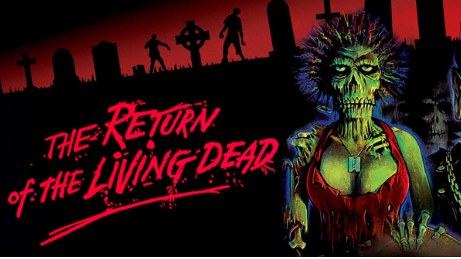
“Send more paramedics!” Welcome, boils and ghouls, to a deep dive into one of the most wildly entertaining, genre-defining, and punk rock horror films ever made: 1985’s The Return of the Living Dead. In a decade saturated with lumbering, slow-moving ghouls inspired by George A. Romero’s masterpieces, this film kicked down the cemetery gates with a blast of frantic energy, dark humour, and a killer soundtrack. Directed by Dan O’Bannon, the brilliant mind who penned Alien, this film wasn’t just another zombie movie; it was a shot of adrenaline to the heart of the genre. It gave us zombies that could run, zombies that could talk, and most importantly, zombies that famously craved “Braaaains!” The story of how a bumbling medical supply warehouse manager and his young protégé accidentally unleash a horde of unstoppable undead on a group of unsuspecting punks is a cornerstone of 80s horror. But the story behind the camera is just as chaotic, contentious, and wildly creative as the film itself. So, crank up The Cramps, watch out for Tarman, and join us as we unearth 10 mind-blowing, little-known facts about the making of The Return of the Living Dead.
1. The Film Was Born From a Bitter Divorce with George A. Romero
The title “Return of the Living Dead” wasn’t just a clever riff on a classic; it was the product of a messy and contentious creative divorce. After the success of the 1968 classic Night of the Living Dead, co-creators George A. Romero and John A. Russo went their separate ways. They made an agreement: Romero could create his own sequels using the “of the Dead” suffix (leading to Dawn of the Dead, Day of the Dead, etc.), while Russo retained the rights to use the “Living Dead” name. Russo co-wrote a novel titled “Return of the Living Dead,” and for years, he tried to get a serious, scary film adaptation made. At one point, The Texas Chain Saw Massacre‘s Tobe Hooper was attached to direct it as a 3D horror film. However, the project languished in development hell. When Dan O’Bannon (Alien, Dark Star) was eventually brought on, he despised the original script’s serious tone. He agreed to direct only if he could do a complete rewrite, turning it into the black comedy we know and love today. This legal split is why the film’s tone and zombie rules are so drastically different from Romero’s universe—it was a deliberate creative choice born from a legal necessity to be distinct.
2. It Single-Handedly Invented the “Zombies Crave Brains” Trope
It might be hard to believe, but before this film, zombies didn’t specifically crave brains. They were mindless cannibals who ate any part of a living human. The Return of the Living Dead completely invented the now-iconic trope that zombies are driven by an insatiable hunger for cerebral matter. Director Dan O’Bannon created this rule for a very practical reason. He wanted his zombies to be able to speak, but he needed a logical explanation for why these reanimated corpses would want to kill people in the first place. He reasoned that if the zombies were in a constant state of decay, being dead would be a painful experience. Therefore, he decided that consuming the brains of the living would provide a temporary relief from the agony of being dead. This is explained in the film’s most chilling scene, where the captured, writhing “half-corpse” screams that she eats brains “to make the pain go away!” This single, brilliant idea not only gave his zombies a clear motivation but also created one of the most enduring and parodied elements of zombie lore.
3. The Iconic Soundtrack Was a Punk Rock Revolution
While most horror films of the era relied on creepy, orchestral scores, The Return of the Living Dead defined its attitude with a blistering soundtrack of punk rock and deathrock anthems. This was a revolutionary choice that perfectly captured the film’s anarchic energy and anti-authoritarian spirit. The soundtrack features legendary punk acts like The Cramps, The Damned, and T.S.O.L., alongside gothic and deathrock pioneers like 45 Grave, whose song “Partytime” became the film’s unofficial theme. The producers specifically targeted these bands to create an authentic, edgy atmosphere that would appeal to the burgeoning punk subculture. The music wasn’t just background noise; it was the film’s lifeblood, scoring everything from Trash’s iconic graveyard dance to the final, apocalyptic finale. This fusion of horror and punk created a cultural touchstone and set a new standard for how soundtracks could define a film’s identity.
4. The Terrifying “Tarman” Was a Masterpiece of Puppetry
One of the most unforgettable monsters in horror history is the “Tarman,” the gooey, skeletal zombie that emerges from the forgotten military barrel. His raspy cries of “Brains!” have haunted audiences for decades. This iconic creature was not a man in a suit for most of its screen time. It was an incredibly complex and masterfully operated puppet. Designed by William Stout and brought to life by legendary effects artist Allan Trautman, the Tarman puppet required multiple operators to control its movements. Trautman himself was inside the lower half of the creature, controlling its shuffling walk and body language, while other puppeteers operated the head, eyes, and jaw. The glistening, tar-like sludge that covers him was a custom-made goo concocted from methycel and black ink, which gave him his signature slimy appearance. The result is one of the most uniquely terrifying and beloved zombies in cinema history.
5. Linnea Quigley Froze for Her Art as “Trash”
Scream queen Linnea Quigley’s performance as the punk rocker Trash, who performs a full-nude interpretive dance in a cemetery before becoming a zombie, is one of the most iconic scenes in 80s horror. What fans may not know is the gruelling conditions under which she filmed it. The graveyard scenes were shot outdoors over several cold, rainy winter nights in Los Angeles. Quigley, completely exposed for much of the shoot, had to endure the freezing temperatures while being hosed down with water to maintain a “wet” look. To combat the cold, the crew had a small space heater for her to use between takes, but it was still an incredibly challenging and physically demanding shoot. Her dedication to the role, and her fearless performance, created an unforgettable character and cemented her status as a horror icon.
6. The Film’s Zombies Are Intentionally the Opposite of Romero’s
Dan O’Bannon made a very conscious decision to ensure his zombies were nothing like the ones in George A. Romero’s films. This was partly to comply with the legal agreement to keep the properties separate, but it was also a creative choice to subvert audience expectations. Where Romero’s zombies were slow, mindless, and could be killed by a shot to the head, O’Bannon’s were the stuff of nightmares. They could run, they could think, they could set clever traps, and most terrifyingly, they could not be killed by conventional means. The only way to stop them was complete incineration. This concept of the fast, intelligent, and nearly indestructible zombie was a game-changer. It upped the ante on the threat level and would go on to influence a new generation of horror films, including 28 Days Later and the Dawn of the Dead remake, which popularized the “fast zombie” for the 21st century.
7. The Cast Included Real Punk Rockers
To ensure the film’s punk aesthetic felt authentic, the production team didn’t just rely on costumes; they cast real members of the L.A. punk scene. Many of the extras and supporting characters in the film were actual punks who were recruited from local clubs and concerts. This infusion of real-life counter-culture gave the film an undeniable edge of authenticity. The actors portraying the main punk characters, like Thom Mathews (Freddy) and Beverly Randolph (Tina), fully embraced the style, but having a supporting cast of genuine punks grounded the film’s world and made the central group of friends feel like a real part of a subculture, not just Hollywood’s interpretation of one. This commitment to authenticity is a key reason why the film has been so embraced by the punk community for decades.
8. The “Split Dog” Was a Real Taxidermied Animal
One of the film’s most grotesque and memorable special effects is the “split dog,” a bisected canine cadaver that is reanimated by the 2-4-5 Trioxin gas. The twitching, panting half-corpse is a masterpiece of practical effects. To create it, the production didn’t use a rubber model. They acquired a real dog that had died of natural causes and had its body taxidermied. The effects team then cut the preserved body in half and fitted it with a complex array of wires and puppetry mechanics to make it move. While this method would be unthinkable by today’s standards, it was a testament to the crew’s dedication to creating visceral, hyper-realistic effects in an era before CGI. The result is a truly unsettling and unforgettable piece of horror imagery.
9. The Opening Claim Is a Direct Jab at the Film’s Co-Creator
The film opens with a title card that audaciously claims: “The events portrayed in this film are all true. The names are real names of real people and real organizations.” This wasn’t just a clever, tongue-in-cheek gag; it was a direct and sarcastic jab at John A. Russo. In his original novel and his early, serious script for the film, Russo had insisted on a similar claim to make his story feel more like a true account. Dan O’Bannon found this idea ridiculous and pretentious. By including the “true story” card at the beginning of his outrageously comedic and over-the-top version, O’Bannon was not only satirizing Russo’s original intent but also perfectly setting the darkly comedic tone for the entire film, immediately letting the audience know not to take anything too seriously.
10. The Director Had a Love-Hate Relationship with Horror
Dan O’Bannon, the man who wrote the terrifying sci-fi horror classic Alien, had a complicated relationship with the genre he helped define. While he loved classic monster movies, he had grown tired of the slasher films and serious, grim horror that was popular in the early 80s. He believed that being relentlessly scared was not an enjoyable experience for an audience. His philosophy was that horror works best when it’s tempered with humour. He famously said, “If you’re going to scare people, you should also make them laugh.” This belief is the driving force behind The Return of the Living Dead. He masterfully blended genuine scares with laugh-out-loud black comedy, creating a film that could pivot from grotesque horror to slapstick humour in an instant. This unique tonal blend is what makes the film so special and why it has remained a beloved cult classic for nearly four decades.
Conclusion
The Return of the Living Dead is so much more than just a zombie movie. It’s a punk rock manifesto, a masterclass in horror-comedy, and a landmark film that completely rewrote the rules of the undead. Its influence can still be felt today in everything from the fast zombies of modern cinema to the enduring “braaaains” jokes that have become a pop culture staple. The film’s chaotic energy, born from a contentious production and the singular vision of Dan O’Bannon, created a perfect storm of horror, humour, and music that has never been duplicated. It’s a film that reminds us that sometimes, the end of the world isn’t just terrifying; it’s also a hell of a party. What is your favourite moment or line from this punk rock apocalypse? Let us know in the comments below!
Dive Deeper
- More Brains! A Return to the Living Dead (2011 documentary film): An essential, feature-length documentary that covers the entire history of the film. It features interviews with nearly every member of the cast and crew, providing an incredibly detailed and entertaining look at the chaotic production.
- The Complete History of the Return of the Living Dead by Christian Sellers and Gary Smart: A comprehensive book that delves into the making of the entire five-film series, with a heavy focus on the beloved original. It’s packed with rare photos, interviews, and production details.
Punk Rock: An Oral Historyby John Robb: To fully appreciate the film’s groundbreaking soundtrack and aesthetic, this book provides a fantastic history of the punk movement. It offers context for the bands featured in the film and the counter-culture that The Return of the Living Dead so perfectly captured.




Leave a Reply