
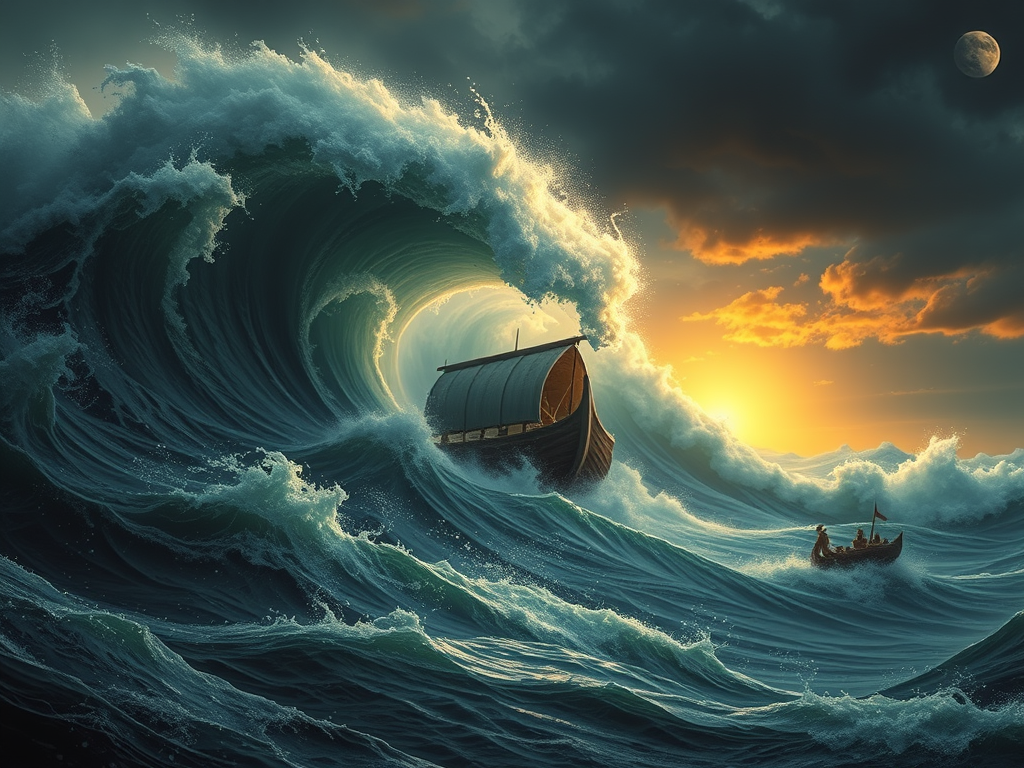
It is one of the oldest and most powerful stories humanity has ever told. A great flood, sent by angry gods, cleanses a corrupt world, wiping the slate clean. Only a handful of righteous survivors are saved in a specially built vessel, chosen to repopulate the Earth and begin a new chapter for humankind. The story of Noah’s Ark from the Book of Genesis is the most famous version of this tale, but it is far from the only one.
Remarkably, this narrative of a world-destroying deluge is a truly global phenomenon. Cultures on nearly every continent, many of whom had no contact with one another, developed their own distinct versions of a Great Flood myth. This startling universality raises a profound question: is the flood myth a distorted memory of a real, cataclysmic event, or does it speak to something deeper about the human psyche? Here are 10 facts about this enduring global myth.
1. It’s a Truly Universal Story, Found on Nearly Every Continent
While the Middle East is the most famous source of flood myths, it is by no means the only one. The story of a world-ending flood is one of the most common themes in all of comparative mythology. In ancient Greece, the myth of Deucalion and Pyrrha tells of the couple surviving a flood sent by Zeus in a wooden chest. Hindu tradition speaks of Manu, who is warned by the god Vishnu (in the form of a fish) to build a great boat to survive a deluge. The Aztec civilisation of Mesoamerica told tales of a “First Scouring” that wiped out a previous age of humanity. Versions of the myth can also be found among the K’iche’ people of Guatemala, in Norse mythology, among Indigenous Australian peoples, and in countless Native American traditions from North to South America. This incredible global distribution is what makes the flood myth so compelling to scholars.
2. The Biblical Story of Noah is a Later Version of an Older Myth
Many people assume the story of Noah’s Ark is the original flood narrative, but it is actually a relative latecomer. The Biblical account is a Hebrew version of a much older and more widespread Mesopotamian legend. The most famous predecessor is found in the Epic of Gilgamesh, written down nearly a thousand years before the oldest parts of the Bible. In this epic poem, the hero Gilgamesh meets an immortal man named Utnapishtim, who tells him how the gods sent a great flood to destroy mankind. A sympathetic god warned Utnapishtim in a dream, instructing him to build a massive boat and save his family, his craftsmen, and “the seed of all living things.” The parallels to the Noah story are astonishing: the divine warning, the construction of a huge ark, the saving of animals, landing on a mountain, and even sending out birds (a dove and a raven) to check for dry land.
3. The Central Theme is Divine Punishment and a Fresh Start
Across the vast majority of these myths, the flood is not a random act of nature. It is a deliberate act of divine judgment. The gods, or a single creator God, become angered by humanity’s behaviour. In Mesopotamia, the gods are annoyed by the noise and clamour of a burgeoning human population. In the Bible, God is grieved by mankind’s wickedness and corruption. The flood serves as a cosmic reset button, a violent purification of a world gone wrong. However, the story is not one of total annihilation. A small remnant—usually a single family deemed righteous or worthy—is chosen to survive. They become the ancestors of a new humanity, given a second chance to build a better world on the cleansed Earth. This powerful theme of destruction and recreation is a fundamental mythological archetype.
4. There is No Scientific Evidence for a Single, Global Flood
While the myth is powerful, it’s crucial to note that modern science has found no evidence for a single, global flood that covered the entire planet, including its highest mountains, within human history. Geologists have studied rock layers all over the world and have found no corresponding global sediment layer that such an event would have left behind. Furthermore, the fossil record does not support the idea that all animal life was wiped out and then radiated from a single point (like Mount Ararat) a few thousand years ago. While creationists continue to search for evidence, the overwhelming scientific consensus is that a planetary deluge as described in a literal reading of the myths did not happen.
5. But There is Compelling Evidence for Catastrophic Regional Floods
While a global flood is scientifically unsupported, the end of the last Ice Age was a period of immense climatic upheaval and catastrophic local flooding. As the massive glaciers that covered much of the globe melted, they released unimaginable quantities of water, causing sea levels to rise dramatically. One prominent scientific theory is the Black Sea deluge hypothesis. This theory posits that around 7,500 years ago, the rising Mediterranean Sea breached a rocky sill at the Bosporus strait and catastrophically flooded what was then a smaller, freshwater lake, creating the Black Sea as we know it today. The force of the water would have been terrifying, advancing as a wall of sound and fury, completely and permanently submerging villages. It’s highly likely that such landscape-altering, terrifying events were witnessed by our ancestors and the traumatic memories were passed down for generations, eventually becoming the basis for the epic myths.
6. The Hero is Often Divinely Warned, Not Just Lucky
A key feature of the most detailed flood myths is that the protagonist’s survival is not a matter of chance. The hero—be it Noah, Utnapishtim, or Manu—is chosen. They are often portrayed as righteous or wise, and they are given a specific warning by a god or divine being who, for one reason or another, feels humanity is worth saving. This element adds a layer of divine drama to the story. It shows a conflict among the gods themselves and establishes the moral worthiness of the survivor. This person isn’t just a lucky survivor of a natural disaster; they are a partner in a divine plan, tasked with the sacred duty of preserving life and beginning the world anew.
7. The Floating Zoo of Animals is Not a Universal Detail
While the image of animals marching two-by-two onto the ark is iconic, the collection of all Earth’s creatures is not a universal element of the flood myth. This detail is most prominent in the Mesopotamian and Biblical traditions. In many other versions, the focus is solely on the survival of the human family. In the Greek myth of Deucalion and Pyrrha, they survive in a chest or box, but there is no mention of them taking any animals along. Other versions of the myth focus on saving the seeds of important plants to ensure that agriculture can begin again after the waters recede. The emphasis on saving all animal life seems to be a specific feature of the Near Eastern stories, perhaps reflecting the importance of animal husbandry in that region.
8. The Story’s Details Adapt to the Local Environment
While the core archetype of a great flood remains consistent, the details of the story often change to reflect the local geography and culture of the people telling it. In Mesopotamia, a flat land defined by the unpredictable and often destructive floods of the Tigris and Euphrates rivers, the story logically involves building a massive boat to survive. In the mountainous terrain of Greece, the myth tells of the survivors finding safety on the peak of Mount Parnassus. For coastal or island cultures, the flood is often imagined as a gigantic tsunami. This cultural adaptation demonstrates how a universal myth can be shaped and coloured by the immediate environment and anxieties of a specific people, making the distant, abstract story feel local and real.
9. The Aftermath Often Involves a Sacrifice and a Divine Promise
The narrative doesn’t end when the hero steps onto dry land. What happens next is crucial for re-establishing order. In both the Epic of Gilgamesh and the story of Noah, the first act of the survivor is to build an altar and offer a sacrifice to the gods in gratitude for their salvation. This act pleases the gods, who then often make a covenant or promise with the new humanity. In the Bible, God sets a rainbow in the sky as a sign of his promise to never again destroy all life on Earth with a flood. This concluding chapter is vital; it moves the story from one of wrath and punishment to one of reconciliation and a restored relationship between the divine and the mortal.
10. The Myth Reflects a Universal Fear of Disaster and Hope for Rebirth
So why is this story found everywhere? The flood myth likely endures because it speaks to a deep and universal part of the human experience. On one level, it’s a reflection of our collective fear. Humanity has always lived at the mercy of nature, and the memory of devastating floods, tsunamis, and storms is embedded in our psyche. But on a deeper level, the flood myth is a profound story of hope. It acknowledges that the world can be destroyed, that civilisation is fragile, and that life can be wiped out in an instant. Yet, it ultimately asserts that humanity is resilient. It is a story that says, even in the face of a world-ending catastrophe, a remnant can survive, and a new beginning is always possible. It is the ultimate tale of destruction and rebirth.
Further Reading
For those who wish to explore the rich history and comparative mythology of this global story, these books are highly recommended:
- The Ark Before Noah: Decoding the Story of the Flood by Irving Finkel
- The Hero with a Thousand Faces by Joseph Campbell
- The Epic of Gilgamesh (a modern translation, for example, by Andrew George)
- Noah’s Flood: The New Scientific Discoveries About the Event That Changed History by William Ryan and Walter Pitman
Here at Zentara.blog, our mission is to take those tricky subjects and unlock them, making knowledge exciting and easy to grasp for everyone. But the adventure doesn’t stop on this page! We’re constantly exploring new frontiers and sharing discoveries across the digital universe. Want to dive deeper into more mind-bending Top 10s and keep expanding your world? Come join us on our other platforms – we’ve got unique experiences waiting for you on each one!
Get inspired by visual wonders and bite-sized facts: See the world through Zentara’s eyes on Pinterest!
Pin our fascinating facts and stunning visuals to your own boards. Explore Pins on Pinterest: https://uk.pinterest.com/zentarablog/
Discover quick insights and behind-the-scenes peeks: Hop over to Tumblr for snippets, quotes, and unique content you won’t find anywhere else. It’s a different flavour of discovery! Follow the Fun on Tumblr: https://www.tumblr.com/zentarablog
Ready for deep dives you can listen to or watch? We’re bringing our accessible approach to video and potentially audio! Subscribe to our YouTube channel and tune into future projects that make learning pop! Subscribe on YouTube: https://www.youtube.com/@ZentaraUK
Seeking even more knowledge in one place? We’ve compiled some of our most popular topic deep dives into fantastic ebooks! Find them on Amazon and keep the learning journey going anytime, anywhere. Find Our Ebooks on Amazon: https://www.amazon.co.uk/s?kZentara+UK&refnb_sb_noss
Connect with us and fellow knowledge seekers: Join the conversation on BlueSky! We’re sharing updates, thoughts, and maybe even asking you what wonders we should explore next. Chat with Us on BlueSky: https://bsky.app/profile/zentarablog.bsky.social
Perfect for learning on the move! We post multiple 10-minute podcasts per day on Spotify. Pop on your headphones and fill your day with fascinating facts while you’re out and about! Listen on Spotify: https://open.spotify.com/show/3dmHbKeDufRx95xPYIqKhJFollow us on Instagram for bytesize knowledge! We post multiple posts per day on our official Instagram account. https://www.instagram.com/zentarablog/ Every click helps us keep bringing honest, accessible knowledge to everyone. Thanks for exploring with us today – see you out there in the world of discovery!




Leave a Reply