
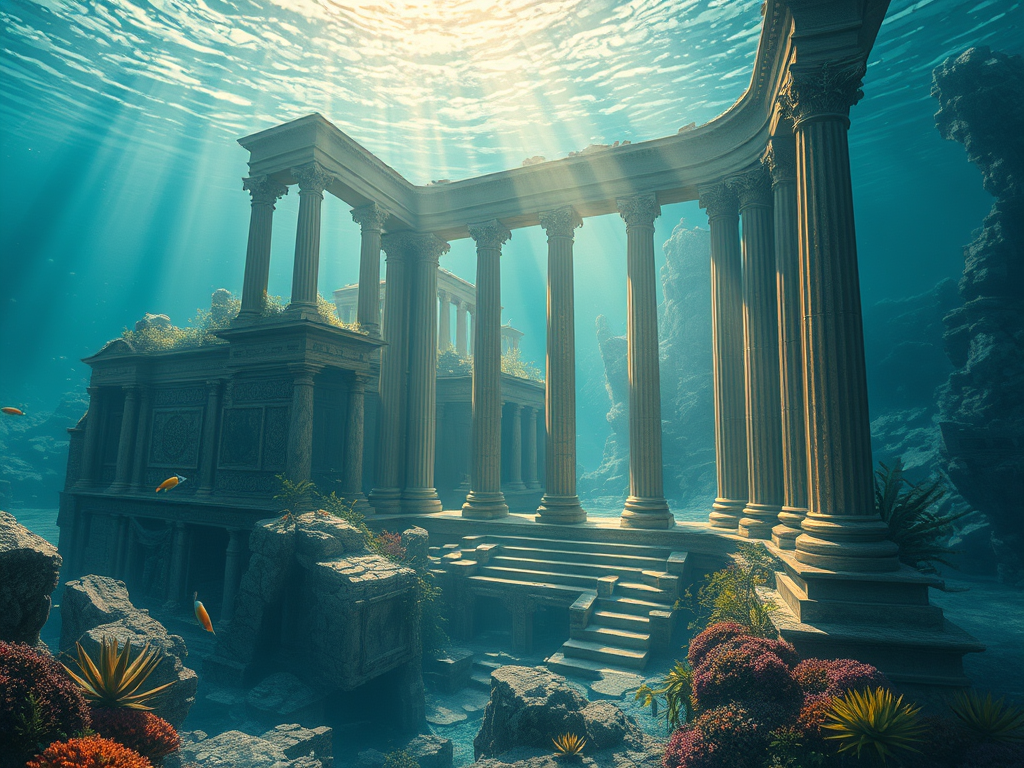
The Lost City of Atlantis is perhaps the most enduring legend of a lost world in human history. The name alone conjures images of a magnificent island civilisation, a utopia of advanced technology and wisdom, swallowed by the sea in a single, catastrophic day. For centuries, this tantalising story has inspired explorers, mystics, and dreamers to search for its sunken ruins across the globe.
But where did this powerful legend come from? Was Atlantis a real place, a historical memory of a forgotten tragedy? Or is it something else entirely? To understand the story of Atlantis, we must travel back not to a sunken kingdom, but to the mind of one of the world’s greatest philosophers. Here are 10 facts that separate the myth from the reality and explore the fascinating history of the world’s most famous lost city.
1. The Entire Legend Originates from a Single Source: Plato
This is the most crucial fact to understand about Atlantis. Unlike ancient myths like the Trojan War or the Epic of Gilgamesh, which exist in multiple sources and were part of a long oral tradition, the story of Atlantis comes from one man and one man only: the Greek philosopher Plato. He wrote about it in two of his philosophical dialogues, Timaeus and Critias, around 360 BCE. No other writer from antiquity—no historian, poet, or geographer—ever mentions Atlantis before Plato. For this reason, the vast majority of historians and archaeologists today believe that Atlantis was not a real historical place but a literary invention created by the philosopher for a specific purpose.
2. Atlantis Was Created as a Villain in a Cautionary Tale
Plato didn’t describe Atlantis as a perfect utopia. In his story, it was the antagonist. He used Atlantis as a literary device to make a philosophical point. The tale is framed as a conflict between two great powers that took place 9,000 years before Plato’s time. On one side was Atlantis, a massive, technologically advanced, and wealthy naval empire. On the other was an ancient, idealised version of Plato’s own city, Athens.
Plato’s story is a moral allegory: the greedy, arrogant, and power-hungry Atlanteans try to conquer the world, but they are single-handedly defeated by the smaller, more virtuous, and spiritually pure Athenians. The message was clear: a society built on civic virtue, moderation, and wisdom (Athens) is superior to one built on material wealth, technological power, and hubris (Atlantis). It was a philosophical lesson, not a historical record.
3. Divine Punishment Was the Cause of Its Destruction
According to Plato’s dialogue Critias, the Atlanteans weren’t always corrupt. They were descended from Poseidon, the god of the sea, and for many generations, they were noble and virtuous. However, as their mortal nature diluted their divine heritage, they became consumed by greed and arrogance. Plato writes that Zeus, the king of the gods, saw their moral decay and decided to punish them to bring them back to their senses. In “one grievous day and night,” the gods sent catastrophic earthquakes and floods that caused the entire island of Atlantis to sink beneath the waves, vanishing forever. This theme of divine retribution for human hubris is a classic element in Greek mythology and reinforces the story’s function as a moral fable.
4. Plato’s Description Was Fantastically Exaggerated
Plato provided a wealth of detail about Atlantis, but these details only serve to highlight the story’s fictional nature. He claimed the island was located “beyond the Pillars of Hercules” (the Strait of Gibraltar) and was larger than ancient Libya and Asia combined (essentially, larger than North Africa and Turkey). Its capital was a marvel of engineering, built of concentric rings of land and water connected by massive canals. The city boasted exotic wildlife, including elephants, and was adorned with precious metals like gold, silver, and the mythical orichalcum. Most tellingly, Plato dated the war between Atlantis and Athens to 9,000 years before his time (around 9600 BCE). This is thousands of years before the first cities, writing, or advanced civilisations are known to have existed, placing the story firmly in the realm of myth rather than history.
5. For Over 2,000 Years, It Was Widely Considered a Fable
While Plato’s story was known to scholars after his death, almost all of them treated it as he likely intended: an allegory. In fact, Plato’s most famous student, Aristotle, dismissed it out of hand, reportedly stating that “he who invented it also destroyed it.” Throughout the Roman Empire and the Middle Ages, the story of Atlantis was largely forgotten or regarded as fiction. There was no widespread belief in a literal lost continent and certainly no active search for it. The modern obsession with finding a real, historical Atlantis is a much more recent development.
6. A 19th-Century Politician Turned the Myth into a “Mystery”
The person most responsible for transforming Atlantis from a philosophical fable into a historical “fact” was an American congressman and amateur writer named Ignatius Donnelly. In 1882, he published a book titled Atlantis: The Antediluvian World, which became a massive international bestseller. Donnelly argued that Plato’s story was a literal history of a real place. He claimed Atlantis was the mother culture of all great ancient civilisations, from the Egyptians to the Mayans, and that it was destroyed in a great flood remembered in myths around the world. Though his “evidence” consisted of pseudoscience and flawed comparisons, his book was so popular that it single-handedly ignited the modern obsession with finding the lost city, a fervor that continues to this day.
7. The Minoan Eruption is the Most Plausible Real-World Inspiration
While most scholars agree Atlantis itself is a myth, many believe Plato may have been inspired by a real historical event: the catastrophic volcanic eruption of Thera (modern-day Santorini) around 1600 BCE. Thera was a major outpost of the Minoan civilisation, a powerful and sophisticated Bronze Age sea empire based on the island of Crete. The eruption was one of the largest in recorded history; it blew the island of Thera apart, generated massive tsunamis that devastated the coast of Crete, and likely contributed to the eventual collapse of the Minoan civilisation. It’s plausible that a distorted, centuries-old memory of this powerful island empire being suddenly wiped out by a natural disaster reached Plato and served as the historical seed for his fictional, cautionary tale.
8. Psychics and Mystics Added Crystals and Flying Machines
In the 20th century, the legend of Atlantis moved from the realm of pseudo-archaeology into pure mysticism. The most influential figure here was the American psychic Edgar Cayce, the “sleeping prophet.” In the 1920s and 30s, Cayce gave numerous psychic “readings” in which he described the history of Atlantis in great detail. His version had little to do with Plato’s; instead, he spoke of a highly advanced society with flying machines, laser-like technology, and giant, powerful energy crystals that ultimately malfunctioned and caused the island’s destruction. These ideas, which have no basis in any historical text, were enthusiastically adopted by New Age and occult movements, forever cementing the image of Atlantis as a lost technological paradise in popular culture.
9. The Hunt for Atlantis Has Covered the Entire Globe
Once the idea of a real Atlantis took hold, the search was on. Over the decades, enthusiastic amateurs and a few fringe researchers have proposed dozens of possible locations for the lost city, often based on scant evidence. Proposed sites have included the Azores islands, off the coast of Spain near Cádiz (thought to be the ancient city of Tarshish), the Bahamas (where a natural rock formation called the Bimini Road was claimed to be a man-made wall), and even more outlandish locations like Antarctica, the Caribbean, and the North Sea. Despite decades of searching with advanced oceanographic equipment like sonar and submersibles, not a single piece of credible archaeological evidence for a vast, sunken continent or city matching Plato’s description has ever been found.
10. Atlantis is a Powerful Idea, Not a Physical Place
The enduring power of the Atlantis legend has little to do with maps or archaeology. Atlantis is a myth in the truest sense of the word: not a falsehood, but a story that carries deep meaning. It speaks to a profound human yearning for a lost golden age, a paradise free from the problems of our own time. It’s a thrilling mystery, a story of a great civilisation erased from history, waiting to be rediscovered. Ultimately, the search for Atlantis tells us more about ourselves—our hopes, our fears, and our fascination with the unknown—than it does about any real place. The lost city may never be found on a map because its true location is in the landscape of the human imagination.
Further Reading
For those interested in exploring the fascinating history of this powerful myth, these books offer excellent insights:
- The Atlantis Story: A Short History of Plato’s Myth by Pierre Vidal-Naquet
- Meet Me in Atlantis: My Obsessive Quest to Find the Sunken City by Mark Adams
- Plato: Timaeus and Critias (translated by Desmond Lee) – To read the original story for yourself.
- The End of Atlantis: New Light on an Old Legend by J.V. Luce – Explores the Minoan/Thera connection in detail.
Here at Zentara.blog, our mission is to take those tricky subjects and unlock them, making knowledge exciting and easy to grasp for everyone. But the adventure doesn’t stop on this page! We’re constantly exploring new frontiers and sharing discoveries across the digital universe. Want to dive deeper into more mind-bending Top 10s and keep expanding your world? Come join us on our other platforms – we’ve got unique experiences waiting for you on each one!
Get inspired by visual wonders and bite-sized facts: See the world through Zentara’s eyes on Pinterest!
Pin our fascinating facts and stunning visuals to your own boards. Explore Pins on Pinterest: https://uk.pinterest.com/zentarablog/
Discover quick insights and behind-the-scenes peeks: Hop over to Tumblr for snippets, quotes, and unique content you won’t find anywhere else. It’s a different flavour of discovery! Follow the Fun on Tumblr: https://www.tumblr.com/zentarablog
Ready for deep dives you can listen to or watch? We’re bringing our accessible approach to video and potentially audio! Subscribe to our YouTube channel and tune into future projects that make learning pop! Subscribe on YouTube: https://www.youtube.com/@ZentaraUK
Seeking even more knowledge in one place? We’ve compiled some of our most popular topic deep dives into fantastic ebooks! Find them on Amazon and keep the learning journey going anytime, anywhere. Find Our Ebooks on Amazon: https://www.amazon.co.uk/s?k=Zentara+UK&ref=nb_sb_noss
Connect with us and fellow knowledge seekers: Join the conversation on BlueSky! We’re sharing updates, thoughts, and maybe even asking you what wonders we should explore next. Chat with Us on BlueSky: https://bsky.app/profile/zentarablog.bsky.social
Perfect for learning on the move! We post multiple 10-minute podcasts per day on Spotify. Pop on your headphones and fill your day with fascinating facts while you’re out and about! Listen on Spotify: https://open.spotify.com/show/3dmHbKeDufRx95xPYIqKhJFollow us on Instagram for bytesize knowledge! We post multiple posts per day on our official Instagram account. https://www.instagram.com/zentarablog/ Every click helps us keep bringing honest, accessible knowledge to everyone. Thanks for exploring with us today – see you out there in the world of discovery!




Leave a Reply