
For over seventy years, the magical world of Narnia has captivated the hearts and minds of readers, young and old. C.S. Lewis’s seven-book series, The Chronicles of Narnia, is more than just a collection of children’s stories; it’s a rich tapestry of mythology, theology, and profound human emotion, all accessible through the wondrous adventures of talking animals, valiant children, and the magnificent lion, Aslan. While millions have journeyed through the wardrobe, sailed on the Dawn Treader, and witnessed the creation and end of a world, the story behind the stories is just as enchanting. From hidden origins and secret timelines to personal tragedies and unexpected inspirations, the creation of Narnia is a tale filled with surprising details. Join us as we pull back the curtain on the lamppost and explore ten fascinating facts that reveal the deeper magic behind this beloved literary masterpiece.
1. The Chronicles Weren’t Written in a Chronological Order
One of the most common points of debate among fans is the “correct” order in which to read the books. Should you start with The Lion, the Witch and the Wardrobe, the first book published, or The Magician’s Nephew, which details Narnia’s creation? C.S. Lewis himself actually wrote and published the series in an order that is different from the timeline of events within the Narnian world. The publication order was: The Lion, the Witch and the Wardrobe (1950), Prince Caspian (1951), The Voyage of the Dawn Treader (1952), The Silver Chair (1953), The Horse and His Boy (1954), The Magician’s Nephew (1955), and The Last Battle (1956). This means readers were introduced to a fully formed Narnia first, and only later discovered its origin story. Lewis preferred the chronological order for reading, as he felt it made the most sense logically. However, many purists argue that the publication order preserves the mystery and sense of discovery intended by the author, allowing the world of Narnia to unfold for the reader just as it did for the Pevensie children.
2. Narnia Was Born from a Single, Vivid Image
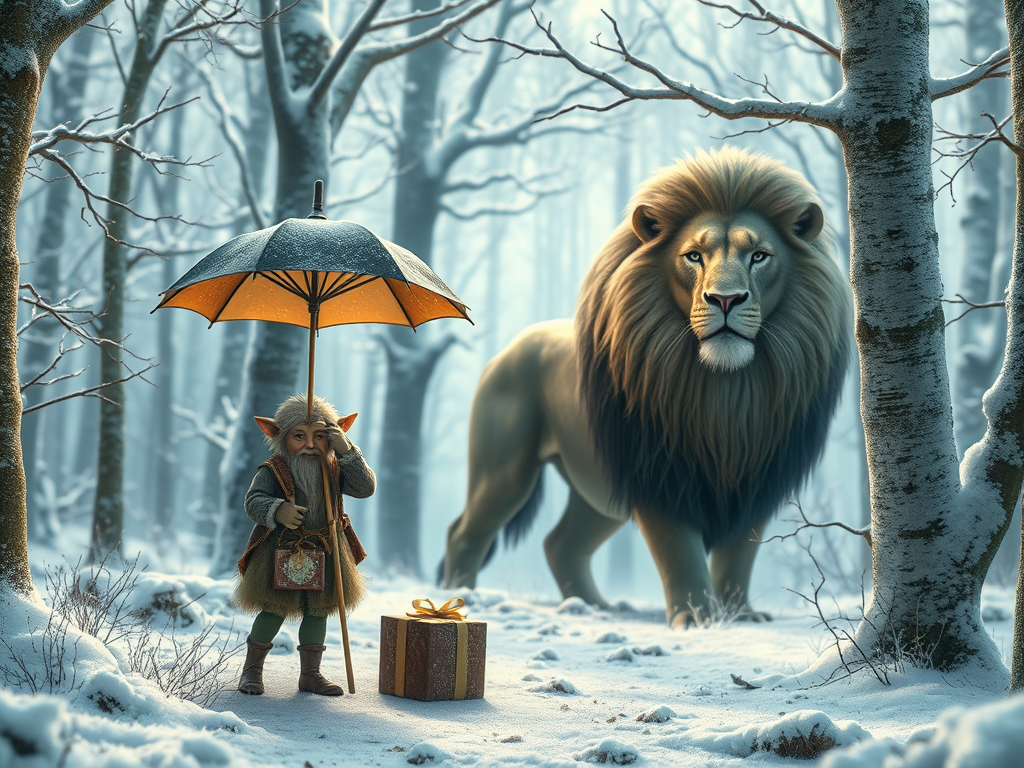
Great worlds often spring from the smallest seeds of inspiration. For C.S. Lewis, the entire universe of Narnia began not with a grand plot or a cast of characters, but with a single, peculiar image that had been lodged in his mind since he was a teenager. He described it as a picture of “a Faun carrying an umbrella and parcels in a snowy wood.” This whimsical, almost surreal image held a strange power over him for years. It was only during the turmoil of World War II, as child evacuees were being housed at his home, The Kilns, that this image began to weave itself into a narrative. He combined this mental picture with another recurring vision of a magnificent lion. The faun became Mr. Tumnus, the snowy wood became the land of Narnia under the White Witch’s spell, and the lion, of course, became the mighty Aslan. It’s a powerful reminder that the most epic stories can grow from the simplest, most persistent flashes of imagination.
3. Aslan Appears in Every Single Book
While the human visitors to Narnia change with almost every story, the one constant, unifying presence across all seven books is the great lion, Aslan. He is the heart and soul of the chronicles. In some books, like The Lion, the Witch and the Wardrobe and Prince Caspian, his role is central and dramatic. He is a creator, a saviour, and a commanding king who directly intervenes in the fate of Narnia. In other stories, his presence is more subtle, but no less significant. In The Horse and His Boy, he appears in disguise, guiding Shasta on his journey. In The Silver Chair, he appears to Jill Pole at a stream in his own country, providing her with the crucial signs she must follow to complete her quest. Even when he is not physically present, his laws, his name, and his influence are felt by all. This consistent presence reinforces his role as Narnia’s ultimate authority and protector, the unshakeable foundation upon which the entire world is built.
4. C.S. Lewis and J.R.R. Tolkien Were Close Friends, but Tolkien Disliked Narnia
C.S. Lewis (known as “Jack” to his friends) and J.R.R. Tolkien (“Tollers”) were colleagues at Oxford University and central members of the famous literary group, The Inklings. They shared a deep love of mythology and fantasy, and their mutual encouragement was instrumental in the creation of both Narnia and Middle-earth. Tolkien spent countless hours reading drafts of The Lord of the Rings aloud to Lewis, whose enthusiastic feedback helped sustain the project. However, the sentiment was not entirely returned. Tolkien, a meticulous world-builder, was not a fan of Narnia. He disliked Lewis’s approach of borrowing freely from a wide range of mythologies—a faun from Roman myth, a minotaur from Greek, dwarves from Norse, and Father Christmas from English folklore. To Tolkien, this created a jumbled and inconsistent world. He also felt the Christian allegory was too overt and heavy-handed. Despite his criticisms, their deep friendship endured, a testament to their mutual respect even in the face of starkly different creative philosophies.
5. Lucy Pevensie Was Named After Lewis’s Goddaughter
The character of Lucy Pevensie, the youngest, most faithful, and arguably the most important of the Pevensie siblings, holds a special place in the Narnia chronicles. She is the first to discover Narnia and consistently maintains the purest and most unwavering faith in Aslan. This beloved character was named after Lucy Barfield, C.S. Lewis’s own goddaughter. The dedication at the beginning of The Lion, the Witch and the Wardrobe is a moving personal letter from Lewis to Lucy. He writes, “I wrote this story for you, but when I began it I had not realized that girls grow quicker than books. As a result you are already too old for fairy tales… but some day you will be old enough to start reading fairy tales again.” Sadly, Lucy Barfield’s adult life was marked by health struggles, as she was diagnosed with multiple sclerosis in her twenties. She reportedly took great comfort in her connection to the stories and Lewis’s heartfelt dedication.
6. The “Dark” Final Book Won a Prestigious Award
The Last Battle, the seventh and final book in the series, is by far the most controversial and arguably the darkest. It deals with heavy themes of deception, apostasy, environmental destruction, and a violent, apocalyptic end to the world of Narnia. The tone is far more somber than the earlier books, featuring a false Aslan, the enslavement of talking beasts, and the tragic deaths of many beloved characters. The book culminates in the Pevensie children (minus Susan) dying in a train crash in our world to be reunited with Aslan in his country, a Narnian version of heaven. Despite its challenging themes and downbeat conclusion for the world itself, The Last Battle was critically acclaimed for its literary merit and profound philosophical depth. In 1956, it was awarded the Carnegie Medal, the most prestigious award in British children’s literature, a mark of its lasting power and significance.
7. The Dwarfs Present a Tragic Picture of Refusing Faith
One of the most powerful and sobering scenes in the entire series occurs in The Last Battle and involves a group of rebellious dwarfs. After being rescued from their Calormene captors, the dwarfs refuse to believe in Aslan or the hopeful reality presented to them. They find themselves in a beautiful, sunlit paradise but, due to their own cynicism and stubbornness, can only perceive it as a dark, filthy stable. They are offered a magnificent feast but believe they are only eating hay and dirty water. Aslan explains that their prison is entirely in their own minds. “They have chosen cunning instead of belief. Their prison is only in their own minds, yet they are in that prison; and so afraid of being taken in that they cannot be taken out.” This poignant episode is often interpreted as Lewis’s allegory for the state of damnation—a willed, self-imposed blindness to truth and joy, where individuals are so determined not to be fooled that they become incapable of accepting grace.
8. The Horse and His Boy is a Unique Entry in the Series
While most of the chronicles focus on children from our world travelling to Narnia, The Horse and His Boy stands apart. The entire story is set within the Narnian world and takes place during the Golden Age when the Pevensie siblings reigned as Kings and Queens at Cair Paravel, an era only briefly described at the end of The Lion, the Witch and the Wardrobe. The protagonists, Shasta and Aravis, are natives of Calormen, a neighbouring country to the south of Narnia. The book is also unique in its focus on a single, linear quest narrative, resembling an adventure travelogue more than the other books. It delves deeper into the geography and political landscape of the world, exploring themes of identity, freedom, and divine providence through the children’s perilous journey north to escape slavery and arranged marriage. It provides a fascinating, ground-level view of Narnian society during its most glorious period.
9. Susan Pevensie’s Fate is a Subject of Intense Debate
The ultimate fate of Susan Pevensie, the second-oldest sibling, is one of the most debated and often criticized aspects of the series. In The Last Battle, it is revealed that Susan is “no longer a friend of Narnia.” She is described as having become preoccupied with “nylons and lipstick and invitations” and has dismissed her childhood adventures as a silly game. As a result, she is the only one of the Pevensies not to die in the train crash and enter Aslan’s country. Many readers and critics, including authors like J.K. Rowling and Neil Gaiman, have interpreted this as Lewis unfairly punishing Susan for growing up and embracing her femininity. However, defenders of Lewis argue that Susan’s exclusion is not final. Lewis himself stated in a letter that Susan’s journey was not over and that she still had time to find her way back, suggesting her story is one of a spiritual crisis rather than a final damnation. Her story serves as a cautionary tale about losing one’s faith by prioritizing the mundane over the miraculous.
10. There’s a Real-Life “Narnian” Lamppost in Oxford
The image of the lone lamppost burning in the snowy woods is the iconic entry point into Narnia, the first strange and magical landmark Lucy encounters. While the inspiration for Narnia came from many sources, it is widely believed that a particular lamppost in Oxford, the city where Lewis taught for decades, played a role in sparking this image. Tucked away on St. Mary’s Passage, near the University Church and the Radcliffe Camera, stands an ornate, old-fashioned gas lamp. With its wrought-iron details and the stone doorway of a nearby college that features two carved fauns, it’s easy to see how this corner of Oxford could have fueled the author’s imagination. Lewis and Tolkien would have walked past this spot countless times on their way to local pubs like the Eagle and Child. While Lewis never explicitly confirmed this specific lamppost as the lamppost, the circumstantial evidence is compelling, and for fans visiting Oxford, it remains a beloved and tangible link to the magical world he created.
Further Reading
- “The Narnian: The Life and Imagination of C. S. Lewis” by Alan Jacobs
- “Planet Narnia: The Seven Heavens in the Imagination of C.S. Lewis” by Michael Ward
- “A Grief Observed” by C.S. Lewis (A profound look into Lewis’s own experience of loss, which deeply informs the themes of Narnia)
- “The Letters of C.S. Lewis” edited by W.H. Lewis (Offers direct insight into Lewis’s thoughts on his work, theology, and personal life)
- “Tolkien and C.S. Lewis: The Gift of Friendship” by Colin Duriez
Here at Zentara.blog, our mission is to take those tricky subjects and unlock them, making knowledge exciting and easy to grasp for everyone. But the adventure doesn’t stop on this page! We’re constantly exploring new frontiers and sharing discoveries across the digital universe. Want to dive deeper into more mind-bending Top 10s and keep expanding your world? Come join us on our other platforms – we’ve got unique experiences waiting for you on each one!
Get inspired by visual wonders and bite-sized facts: See the world through Zentara’s eyes on Pinterest!
Pin our fascinating facts and stunning visuals to your own boards. Explore Pins on Pinterest: https://uk.pinterest.com/zentarablog/
Discover quick insights and behind-the-scenes peeks: Hop over to Tumblr for snippets, quotes, and unique content you won’t find anywhere else. It’s a different flavour of discovery! Follow the Fun on Tumblr: https://www.tumblr.com/zentarablog
Ready for deep dives you can listen to or watch? We’re bringing our accessible approach to video and potentially audio! Subscribe to our YouTube channel and tune into future projects that make learning pop! Subscribe on YouTube: https://www.youtube.com/@ZentaraUK
Seeking even more knowledge in one place? We’ve compiled some of our most popular topic deep dives into fantastic ebooks! Find them on Amazon and keep the learning journey going anytime, anywhere. Find Our Ebooks on Amazon: https://www.amazon.co.uk/s?k=Zentara+UK&ref=nb_sb_noss
Connect with us and fellow knowledge seekers: Join the conversation on BlueSky! We’re sharing updates, thoughts, and maybe even asking you what wonders we should explore next. Chat with Us on BlueSky: https://bsky.app/profile/zentarablog.bsky.social
Perfect for learning on the move! We post multiple 10-minute podcasts per day on Spotify. Pop on your headphones and fill your day with fascinating facts while you’re out and about! Listen on Spotify: https://open.spotify.com/show/3dmHbKeDufRx95xPYIqKhJFollow us on Instagram for bytesize knowledge! We post multiple posts per day on our official Instagram account. https://www.instagram.com/zentarablog/ Every click helps us keep bringing honest, accessible knowledge to everyone. Thanks for exploring with us today – see you out there in the world of discovery!




Leave a Reply