
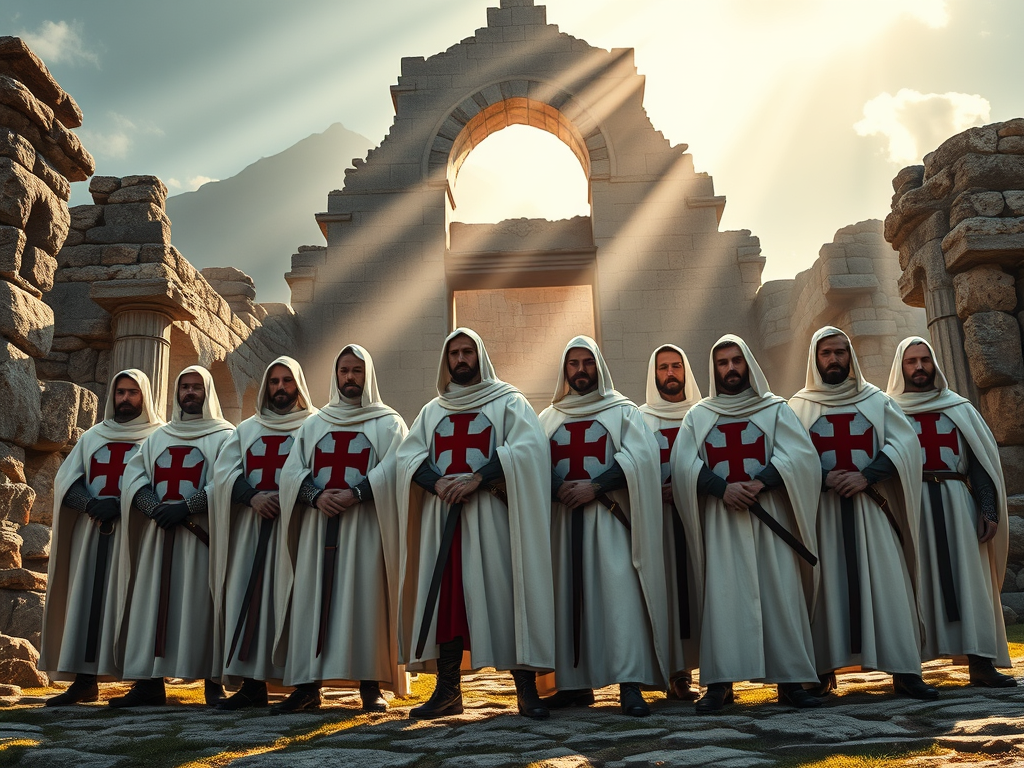
Whisper the name “Knights Templar,” and the mind conjures images of shadowy figures, warrior monks guarding the Holy Grail, and ancient conspiracies that echo into the modern day. For centuries, the Poor Fellow-Soldiers of Christ and of the Temple of Solomon have been subjects of intense fascination, their story shrouded in a captivating mix of myth and legend. From blockbuster novels to video games, their iconic red cross on a white mantle has become a symbol of chivalry, mystery, and lost secrets.
But what if their true legacy is even more astonishing than the fiction it inspired? If we peel back the layers of legend, we discover an organization that was not only a formidable military force but also a revolutionary power that shaped the course of medieval Europe. The Templars were innovators, diplomats, and entrepreneurs whose influence on finance, logistics, and corporate structure was centuries ahead of its time.
Their real story is not one of hidden bloodlines or supernatural artifacts, but of a brilliant group that built a global empire from nothing, only to see it brought down by the greed and fear of a powerful king. In this article, we journey beyond the shadows to uncover ten verifiable facts about the Knights Templar and explore the profound, tangible legacy they left behind—a legacy that continues to influence our world in ways you might never expect.
1. The World’s First Multinational Corporation: Pioneering International Banking
Long before the Medici family rose to prominence, the Knights Templar operated arguably the world’s first large-scale international banking system. Their innovation stemmed from a practical need: protecting the wealth of pilgrims traveling to the Holy Land. Carrying large sums of gold and silver across thousands of miles was incredibly dangerous. The Templars devised a brilliant solution. A pilgrim could deposit their money at a Templar preceptory, such as the Temple Church in London, and receive a letter of credit. This letter, written in a complex cipher, detailed the deposit. Upon arriving in Jerusalem, the pilgrim would present the letter to the Templars there and withdraw their funds. The Templars essentially invented the traveler’s cheque. This system was so secure and reliable that European monarchs and nobles began using the Order as their primary bank, entrusting them with national treasuries and using them to transfer huge sums to fund wars or royal projects. This financial network, spanning all of Christendom, gave them immense power and wealth, transforming them from simple pilgrim guards into the financial titans of their age.
- Lasting Legacy: Their system laid the groundwork for modern banking, including concepts of credit, trusts, and secure international fund transfers.
2. Truly Humble Beginnings: The Original Nine Knights
Unlike many monastic orders founded with grand royal charters and vast land grants, the Knights Templar began with remarkable humility. Around 1119, a French nobleman named Hugues de Payens and eight of his relatives and acquaintances approached King Baldwin II of Jerusalem. Their proposal was simple and noble: they would dedicate themselves to protecting Christian pilgrims on the perilous roads leading to the holy city. The king granted them a headquarters in a wing of the Al-Aqsa Mosque on the Temple Mount, which was believed to be the site of the ancient Temple of Solomon—hence their name. For the first decade of their existence, the “Poor Fellow-Soldiers” were just that: poor. They lived off donations, and their original seal depicted two knights riding a single horse, a symbol of their initial vow of poverty. It was not until the Council of Troyes in 1129, championed by the influential abbot Bernard of Clairvaux, that the Order received formal recognition from the Pope and a rule of conduct, setting the stage for their explosive growth.
- Lasting Legacy: Their story became a powerful recruitment tool, showing that even the most humble beginnings, driven by faith and purpose, could lead to immense influence and power.
3. Masters of Logistics: An Unrivaled Infrastructure Network
The Templars’ success was built on more than just fighting skill and financial acumen; they were masters of logistics and infrastructure. To support their operations in the Holy Land and manage their vast European assets, they established a sprawling network of thousands of commanderies, preceptories, farms, and garrisons across the continent and beyond. This network functioned like a perfectly coordinated supply chain. Their farms produced food and resources, their ship fleets transported men, horses, and supplies across the Mediterranean, and their commanderies acted as recruitment centers, training grounds, and administrative hubs. A knight in France could be confident that the warhorse he needed in Outremer would be waiting for him, all facilitated by the Order’s internal system. This vast, self-sufficient infrastructure allowed the Templars to operate with a level of efficiency and speed that was unmatched by any medieval kingdom. They could mobilize armies, transfer wealth, and communicate across vast distances with astonishing effectiveness, making them a truly international power.
- Lasting Legacy: Their organizational model served as a blueprint for later multinational entities, demonstrating the power of a centralized command structure combined with a decentralized network of operations.
4. Innovators in Agriculture and Land Management
While we remember them as warriors and bankers, a significant portion of the Templars’ wealth was generated through advanced agriculture. When the Order received land grants—often undeveloped or poorly managed tracts—they transformed them into highly productive and profitable agricultural enterprises. They were at the forefront of land management, applying techniques of crop rotation, animal husbandry, and land reclamation that were advanced for the time. They built mills, planted vineyards, and managed forests with a focus on long-term sustainability and profitability. The commanderies were not just military outposts but the centers of these large-scale farming operations, run by Templar sergeants and a host of lay workers. This agricultural empire not only fed their own members and supported their military campaigns but also generated a massive surplus that was channeled into their financial operations. They effectively ran their lands like a modern agribusiness, a key but often overlooked aspect of their economic power.
- Lasting Legacy: The Templars helped spread advanced agricultural techniques throughout Europe, improving land productivity and contributing to the economic development of many regions where they held sway.
5. A State Within a State: Answerable Only to the Pope
One of the most significant factors in the Templars’ rapid rise was their unique political status. In 1139, Pope Innocent II issued a papal bull titled Omne Datum Optimum. This decree was a game-changer. It placed the Knights Templar under the direct and sole authority of the Pope. This meant they were exempt from all local laws and taxes. They did not have to pay the tithe to local bishops, and their properties were considered sovereign papal territory. Kings and local lords could not command them or seize their assets. This incredible autonomy allowed them to operate across borders without interference, a privilege no other international entity enjoyed. While it enabled their success, this “state within a state” status also bred immense jealousy and suspicion among the European nobility and clergy, who resented the Templars’ power and secrecy. This resentment would ultimately play a key role in their downfall.
- Lasting Legacy: The concept of an international organization with diplomatic immunity and transnational authority has echoes in modern institutions like the Red Cross and certain United Nations bodies.
6. The Fall Was About Debt and Politics, Not Heresy
The dramatic arrest of the Knights Templar on Friday, October 13, 1307, was orchestrated by King Philip IV of France, who accused them of shocking heresies, including spitting on the cross, idol worship, and homosexuality. While these sensational charges captured the public imagination, the real motivation behind the attack was almost certainly financial and political. King Philip was deeply, almost bankruptingly, in debt to the Templar Order. He saw their immense wealth as a solution to his financial woes and their independent power as a threat to his authority. By levying charges of heresy—one of the few crimes that could override the Templars’ papal protection—he could legally seize their assets. The Pope, Clement V, was politically weak and heavily influenced by the French crown, leaving him unable to effectively protect the Order. While some knights confessed under brutal torture, many, including the Grand Master Jacques de Molay, later recanted, proclaiming their innocence before being burned at the stake.
- Lasting Legacy: The Templar trials stand as a stark historical example of how the charge of heresy could be weaponized for political and financial gain, a cautionary tale of the collision between church, state, and money.
7. Blueprints for a Modern Corporation
The internal organization of the Knights Templar was remarkably complex and hierarchical, mirroring the structure of a modern multinational corporation. At the top was the Grand Master, who functioned like a CEO, overseeing the entire Order. Below him was a stratified management structure. The world was divided into “provinces” (like France, England, and Aragon), each led by a Provincial Master who acted as a regional manager. Within each province were the commanderies, the local “branch offices” led by a Commander. The Order had distinct divisions, including warrior-knights (the elite combat force), sergeants (who handled administration, logistics, and skilled trades), and chaplains (who saw to their spiritual needs). This clear chain of command, specialization of roles, and system of internal audits and communication allowed them to manage a vast and complex enterprise with remarkable efficiency for nearly two hundred years.
- Lasting Legacy: Their organizational structure demonstrated the principles of hierarchy, division of labor, and centralized control that are fundamental to both modern corporate and military organizations.
8. More Than Warriors: A Diplomatic Corps
While their military prowess is legendary, the Knights Templar were also skilled diplomats and trusted political advisors. Because of their international network, immense wealth, and neutrality (in theory), they were often called upon to act as envoys and mediators between warring Christian factions and even between Christian and Muslim rulers. Templar knights, who were often highly educated members of the nobility, served as trusted treasurers and advisors in the courts of English and French kings. They were instrumental in negotiating treaties, arranging royal marriages, and brokering truces. Their ability to move freely across borders and their reputation for trustworthiness made them ideal intermediaries. This diplomatic role was crucial to their power, giving them a level of political influence that often rivaled that of kingdoms.
- Lasting Legacy: The Templars demonstrated the need for neutral, third-party mediators in international politics, a role now filled by diplomatic corps and international organizations.
9. An Enduring Architectural Footprint
One of the most tangible legacies of the Knights Templar is their unique architecture. The Order constructed hundreds of churches, castles, and preceptories, and many of their buildings had a distinctive feature: a round nave. The design of these round churches, such as the famous Temple Church in London and the Convento de Cristo in Tomar, Portugal, was inspired by the Church of the Holy Sepulchre in Jerusalem, the holiest site in Christendom. The circular design was meant to evoke the rotunda of the Sepulchre, constantly reminding the knights of their primary mission in the Holy Land. These buildings were not just places of worship but also fortified structures and administrative centers. Today, these surviving Templar structures stand as powerful physical reminders of the Order’s once-vast reach and unique identity, allowing us to literally step back into their world.
- Lasting Legacy: Templar castles and churches are architectural treasures that showcase medieval engineering and a unique symbolic style, providing a direct physical link to the history of the Crusades.
10. The Greatest Legacy May Be the Myth Itself
Perhaps the most ironic and enduring legacy of the Knights Templar is the very web of myths that surrounds them. Their sudden and brutal suppression created a power vacuum and an unresolved historical mystery. How could such a powerful organization vanish overnight? This question fueled centuries of speculation. The absence of definitive answers allowed legends to flourish, connecting them to everything from the Freemasons and the Holy Grail to the Shroud of Turin and hidden treasures. While historians work to uncover the factual reality of the Order, this powerful mythology has cemented their place in Western culture. The Templar legend speaks to our fascination with secrets, our belief in hidden knowledge, and our desire for justice for a group that was so wrongfully persecuted. In a way, their persecution and dissolution ensured they would achieve a kind of immortality that victory in battle never could have.
- Lasting Legacy: The Templar myth has become a cornerstone of popular culture, inspiring countless books, films, and discussions, and ensuring that the Order, in name and symbol, will never be forgotten.
Further Reading
To explore the factual history of this fascinating order, these books provide excellent, well-researched accounts that separate historical reality from popular myth.
- The Templars: The Rise and Spectacular Fall of God’s Holy Warriors by Dan Jones – A highly engaging and accessible narrative history that brings the Templars’ story to life, covering their formation, their centuries of power, and their dramatic downfall.
- The New Knighthood: A History of the Order of the Temple by Malcolm Barber – Considered one of the most authoritative and comprehensive scholarly accounts of the Knights Templar, this book is essential for anyone seeking a deep and detailed understanding of the Order.
- The Real History Behind the Templars by Sharan Newman – An excellent book for debunking common myths. Newman, a medieval historian, addresses popular theories and misconceptions one by one, grounding the Templar story in historical evidence.
- The Templars: History and Myth by Michael Haag – This book expertly weaves together the actual history of the Order with an exploration of how the legends and myths surrounding them developed over the centuries.
Here at Zentara.blog, our mission is to take those tricky subjects and unlock them, making knowledge exciting and easy to grasp for everyone. But the adventure doesn’t stop on this page! We’re constantly exploring new frontiers and sharing discoveries across the digital universe. Want to dive deeper into more mind-bending Top 10s and keep expanding your world? Come join us on our other platforms – we’ve got unique experiences waiting for you on each one!
Get inspired by visual wonders and bite-sized facts: See the world through Zentara’s eyes on Pinterest!
Pin our fascinating facts and stunning visuals to your own boards. Explore Pins on Pinterest: https://uk.pinterest.com/zentarablog/
Discover quick insights and behind-the-scenes peeks: Hop over to Tumblr for snippets, quotes, and unique content you won’t find anywhere else. It’s a different flavour of discovery! Follow the Fun on Tumblr: https://www.tumblr.com/zentarablog
Ready for deep dives you can listen to or watch? We’re bringing our accessible approach to video and potentially audio! Subscribe to our YouTube channel and tune into future projects that make learning pop! Subscribe on YouTube: https://www.youtube.com/@ZentaraUK
Seeking even more knowledge in one place? We’ve compiled some of our most popular topic deep dives into fantastic ebooks! Find them on Amazon and keep the learning journey going anytime, anywhere. Find Our Ebooks on Amazon: https://www.amazon.co.uk/s?k=Zentara+UK&ref=nb_sb_noss
Connect with us and fellow knowledge seekers: Join the conversation on BlueSky! We’re sharing updates, thoughts, and maybe even asking you what wonders we should explore next. Chat with Us on BlueSky: https://bsky.app/profile/zentarablog.bsky.social
Perfect for learning on the move! We post multiple 10-minute podcasts per day on Spotify. Pop on your headphones and fill your day with fascinating facts while you’re out and about! Listen on Spotify: https://open.spotify.com/show/3dmHbKeDufRx95xPYIqKhJFollow us on Instagram for bytesize knowledge! We post multiple posts per day on our official Instagram account. https://www.instagram.com/zentarablog/ Every click helps us keep bringing honest, accessible knowledge to everyone. Thanks for exploring with us today – see you out there in the world of discovery!

Leave a Reply