
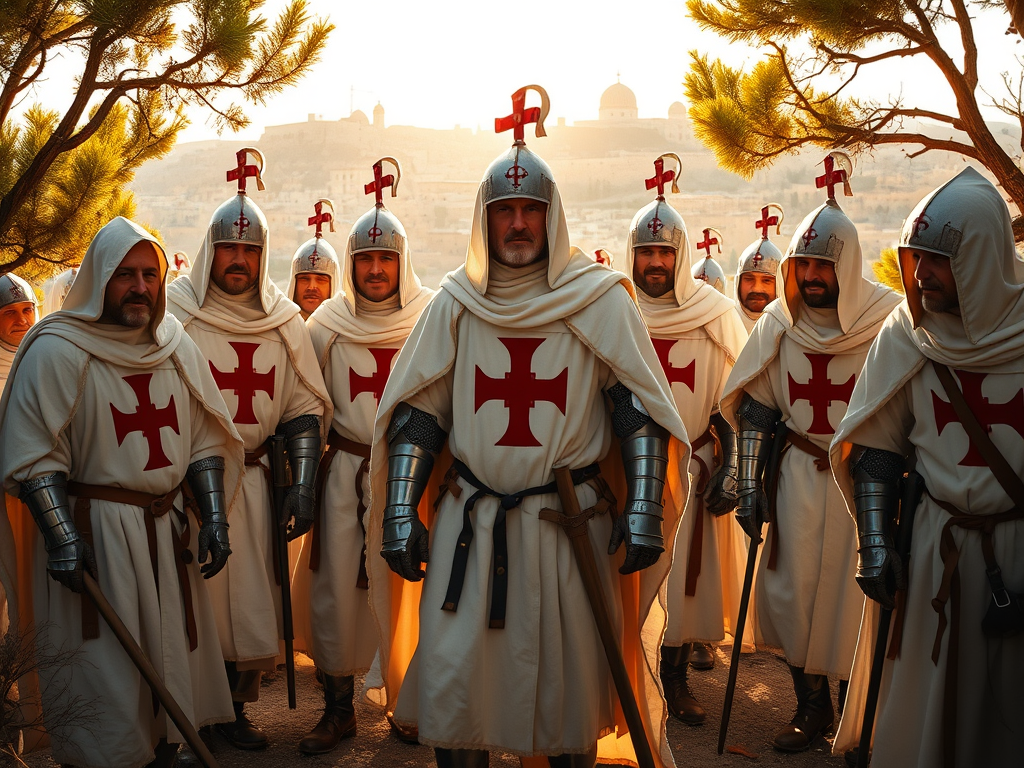
The Knights Templar, formally known as the Poor Fellow-Soldiers of Christ and of the Temple of Solomon, remain one of history’s most enigmatic and compelling organizations. Emerging in the early 12th century, this unique order combined the fervent piety of monks with the martial prowess of knights, dedicated to protecting Christian pilgrims in the Holy Land following the First Crusade. For nearly two centuries, they wielded immense power, wealth, and influence across Europe and the Middle East, becoming a formidable force in the Crusader states and a trusted financial institution for kings and commoners alike.
Their story is one of rapid ascent, profound impact, and ultimately, dramatic and tragic downfall. From their humble beginnings as a small band of devout warriors, they grew into a sophisticated international network with landholdings, castles, and a vast infrastructure that spanned continents. Their distinctive white mantles emblazoned with a red cross became a symbol of courage, devotion, and mystery, igniting the imaginations of generations and spawning countless legends.
This article delves into ten fascinating facts about the Knights Templar, exploring the realities behind the myths. We will uncover their unique structure, their extraordinary wealth, their pivotal role in medieval warfare, and the circumstances that led to their shocking dissolution. By examining their rise, their impact, and their ultimate demise, we aim to shed light on the true nature of these medieval warrior monks, separating historical fact from persistent fiction. Understanding the Templars offers a unique window into the religious, military, and economic complexities of the High Middle Ages and the enduring power of their historical legacy.
1. Their Humble Beginnings: Protecting Pilgrims, Not Just Fighting
Contrary to popular depictions of them as solely a fearsome fighting force, the Knights Templar originated from a much more modest and compassionate purpose. Founded around 1119 by a French nobleman named Hugues de Payens and eight other knights, their initial mission was explicitly stated: to protect Christian pilgrims traveling to and from the Holy Land, especially along the dangerous routes between the coastal cities and Jerusalem. Following the First Crusade, these routes were rife with banditry and hostile encounters, making pilgrimages perilous.
This small band of knights took monastic vows of poverty, chastity, and obedience, living a communal life dedicated to both prayer and defense. They were initially so poor that they had only one horse for every two knights, a symbol that became part of their seal. It wasn’t until the Council of Troyes in 1129, largely thanks to the advocacy of Bernard of Clairvaux, that the Order received official papal recognition and a rule, giving them legitimacy and paving the way for their rapid growth. Their early focus on pilgrim protection highlights their dual role as both monastic order and military force, a unique combination in medieval history.
2. A Unique Blend of Monk and Warrior: The “Poor Fellow-Soldiers of Christ”
The defining characteristic of the Knights Templar was their unprecedented fusion of monastic devotion with military service. Unlike traditional knights, who were primarily secular warriors, Templars took solemn vows akin to Benedictine monks. They pledged poverty, chastity, and obedience, renouncing personal possessions, remaining celibate, and dedicating their lives entirely to the Order and the Church. They engaged in daily prayers, observed fasts, and lived under a strict rule, initially drafted by Bernard of Clairvaux, that governed every aspect of their lives, from their attire to their meals.
However, beneath their white mantles beat the heart of formidable warriors. They were expertly trained, disciplined, and renowned for their ferocity and courage on the battlefield. Their unique status allowed them to fight against “infidels” without fear of sin, as their violence was sanctioned by the Church as a holy act. This spiritual justification for warfare, combined with intense military training, made them elite shock troops on the Crusader front lines. This monk-warrior ideal set them apart and made them a potent symbol of Christian knighthood and religious zeal.
3. Immense Wealth and Financial Innovation: The Proto-Bankers of Europe
Within decades of their founding, the Knights Templar amassed extraordinary wealth, transforming from impoverished knights into one of the most powerful financial institutions of the medieval world. Their wealth came from numerous sources: vast donations of land, money, and property from grateful European nobles, kings, and ordinary citizens, attracted by their piety and military success. They established a sophisticated network of preceptories (their administrative and financial centers) across Europe, which managed their assets and facilitated their financial operations.
Crucially, the Templars pioneered a rudimentary form of international banking. Pilgrims and Crusaders could deposit money in a Templar preceptory in their home country, receive a letter of credit, and then withdraw funds from another Templar house in the Holy Land. This innovative system circumvented the dangers of carrying large sums of cash, making travel safer and more efficient. They also acted as treasurers and moneylenders for European monarchs, including the King of France and the King of England. Their vast network and trusted reputation made them the medieval banking pioneers, a formidable financial powerhouse that played a crucial role in the Crusades’ economy.
4. Distinctive Attire: The White Mantle and Red Cross
The iconic uniform of the Knights Templar was instantly recognizable and deeply symbolic. The most prominent feature was the white mantle, initially granted to them by Pope Honorius II in 1128, symbolizing their purity and chastity. In 1147, Pope Eugenius III authorized the addition of a distinctive red cross, placed over the heart on the left shoulder of their mantles, signifying their willingness to die for Christ and their dedication to the Crusades.
This uniform was not merely ceremonial; it served a practical purpose on the battlefield, distinguishing Templar knights from other fighting forces and fostering a strong sense of unity and identity within the Order. For the Templars themselves, the mantle and cross were constant reminders of their sacred vows and their commitment to the defense of Christianity. For their enemies, it was a fearsome sight, a sign of relentless and often suicidal bravery. The white mantle and red cross became the enduring symbol of the Templars, representing their religious devotion and military might.
5. Battlefield Prowess: Elite Shock Troops of the Crusades
On the battlefields of the Holy Land, the Knights Templar were renowned as elite, disciplined, and utterly fearless warriors. They formed the vanguard in attacks and the rearguard in retreats, often fighting to the last man. Their strict military discipline, reinforced by their monastic vows, made them exceptionally reliable and cohesive fighting units. They were forbidden from retreating unless significantly outnumbered (typically by three to one) and only with the explicit order of their commander.
Their strategic importance was immense. In many key battles of the Crusades, such as the Battle of Harim (1164) and the Battle of Montgisard (1177), their disciplined charges and unwavering defense proved crucial. Though they suffered catastrophic losses in major defeats like the Battle of Hattin (1187), where almost all Templar knights present were killed or captured, their reputation for ferocity remained undimmed. Their military discipline and willingness to sacrifice made them the ultimate Crusader warriors, embodying the ideal of chivalric warfare in the Holy Land.
6. The Rule and Structure: A Hierarchical and Disciplined Organization
The Knights Templar operated under a detailed and rigorous rule, initially inspired by the Cistercian order and formally approved by the Church. This rule governed every aspect of their lives, from their daily prayers and meals to their military duties and administrative practices. The Order was highly hierarchical, headed by the Grand Master, who was elected for life and held immense authority, second only to the Pope.
Beneath the Grand Master were seneschals, marshals, commanders of various preceptories and provinces (such as Acre, Antioch, Tripoli, and later European provinces). Knights formed the elite fighting force, supported by sergeants (often non-noble, serving as light cavalry or infantry), chaplains (who ministered to the Order), and craftsmen/servants. This sophisticated organizational structure allowed them to manage their vast estates, maintain their military presence, and operate their complex financial network across continents. Their monastic rule and strict hierarchical system ensured their efficiency and cohesion as both a spiritual and military power.
7. Landholdings Across Europe: A Transnational Presence
While their primary mission was in the Holy Land, the Knights Templar possessed extensive landholdings and properties throughout Western Europe. These estates, often managed by local preceptories (commanderies), were vital for supplying the Order with men, money, and resources for their campaigns in the East. They operated agricultural estates, mills, vineyards, and other enterprises, generating substantial income.
Their presence was particularly strong in France, England, Portugal, and Spain, where they often served as royal advisors, military consultants, and custodians of royal treasuries. Many European monarchs granted the Templars significant privileges, including tax exemptions and judicial autonomy, recognizing their invaluable service to the Church and their military effectiveness. This vast European land network transformed them into a powerful transnational organization, demonstrating their significant economic influence and their embeddedness within the medieval feudal system beyond the Crusader states.
8. The Fall of Acre and the Loss of the Holy Land: A Turning Point
The fortunes of the Knights Templar were inextricably linked to the fate of the Crusader states in the Levant. As Muslim forces, particularly under Saladin and later the Mamluks, gradually pushed back the Crusader presence, the Templars found themselves fighting increasingly desperate battles. The fall of Acre in 1291, the last major Crusader stronghold in the Holy Land, marked a catastrophic turning point. Many Templars died valiantly defending the city, and their headquarters were effectively lost.
With the complete loss of the Holy Land, the very reason for the Templars’ existence as pilgrim protectors and frontline defenders in the East evaporated. While they still maintained immense wealth and power in Europe, their core mission was gone. This crisis of purpose, combined with their extraordinary wealth and perceived arrogance, left them vulnerable to new pressures and accusations. The loss of Acre was not just a military defeat; it precipitated an existential crisis for the Order and set the stage for their eventual demise of the Templars and the shift in focus from Crusader states defense.
9. Accusations, Torture, and Dissolution: Philip IV’s Vicious Campaign
The dramatic downfall of the Knights Templar began on Friday, October 13, 1307, when King Philip IV of France, heavily indebted to the Order and coveting their immense wealth, launched a coordinated, surprise arrest of Templars across France. He accused them of heresy, idolatry (including the worship of an idol called Baphomet), blasphemy, sodomy, and various other heinous crimes, most of which were fabricated.
Under torture, many Templars confessed to these charges, providing Philip with the “evidence” he needed. Philip then pressured Pope Clement V, who was largely under French influence and had moved the Papacy to Avignon, to initiate a wider investigation. Despite the weakness of the evidence and retractions from many Templars, the Pope eventually issued the papal bull “Vox in excelso” in 1312, officially dissolving the Order. The final act of this tragedy came in 1314 with the burning at the stake of the last Grand Master, Jacques de Molay, and other senior Templar leaders. This Templar suppression by King Philip IV marked a dark chapter of medieval persecution and the ruthless use of state power against a powerful institution.
10. Enduring Myths and Legends: The Templars’ Mystical Legacy
Even centuries after their dissolution, the Knights Templar continue to captivate the public imagination, becoming the subject of countless myths, legends, and conspiracy theories. From claims that they guarded the Holy Grail or the Ark of the Covenant, to speculation about their survival in secret societies like the Freemasons, the Templars have been imbued with a mystical and enduring allure. These legends often portray them as custodians of ancient secrets, possessing hidden knowledge or vast, undiscovered treasures.
While historians have largely debunked these fantastical claims, the persistence of these myths speaks to the powerful narrative of a secretive, powerful, and unjustly persecuted order. Their dramatic rise and fall, coupled with the secrecy inherent in their monastic-military structure and their immense wealth, made them fertile ground for speculation. The Templar myths and legends reflect a fascination with secret societies, forgotten histories, and the allure of untold riches and profound spiritual mysteries, ensuring their enduring legacy in popular culture and historical conspiracy theories.
Further Reading
- The Knights Templar: A New History by Helen Nicholson
- The New Knighthood: A History of the Order of the Temple by Malcolm Barber
- The Templars by Piers Paul Read
- God’s Bankers: A History of Money and Power in the Vatican by Gerald Posner (includes context on medieval banking, including the Templars)
- The Crusades: The Authoritative History of the War for the Holy Land by Thomas Asbridge (provides broader context of the Crusader period)
Here at Zentara.blog, our mission is to take those tricky subjects and unlock them, making knowledge exciting and easy to grasp for everyone. But the adventure doesn’t stop on this page! We’re constantly exploring new frontiers and sharing discoveries across the digital universe. Want to dive deeper into more mind-bending Top 10s and keep expanding your world? Come join us on our other platforms – we’ve got unique experiences waiting for you on each one!
Get inspired by visual wonders and bite-sized facts: See the world through Zentara’s eyes on Pinterest!
Pin our fascinating facts and stunning visuals to your own boards. Explore Pins on Pinterest: https://uk.pinterest.com/zentarablog/
Discover quick insights and behind-the-scenes peeks: Hop over to Tumblr for snippets, quotes, and unique content you won’t find anywhere else. It’s a different flavour of discovery! Follow the Fun on Tumblr: https://www.tumblr.com/zentarablog
Ready for deep dives you can listen to or watch? We’re bringing our accessible approach to video and potentially audio! Subscribe to our YouTube channel and tune into future projects that make learning pop! Subscribe on YouTube: https://www.youtube.com/@ZentaraUK
Seeking even more knowledge in one place? We’ve compiled some of our most popular topic deep dives into fantastic ebooks! Find them on Amazon and keep the learning journey going anytime, anywhere. Find Our Ebooks on Amazon: https://www.amazon.co.uk/s?k=Zentara+UK&ref=nb_sb_noss
Connect with us and fellow knowledge seekers: Join the conversation on BlueSky! We’re sharing updates, thoughts, and maybe even asking you what wonders we should explore next. Chat with Us on BlueSky: https://bsky.app/profile/zentarablog.bsky.social
Perfect for learning on the move! We post multiple 10-minute podcasts per day on Spotify. Pop on your headphones and fill your day with fascinating facts while you’re out and about! Listen on Spotify: https://open.spotify.com/show/3dmHbKeDufRx95xPYIqKhJ
Follow us on Instagram for bytesize knowledge! We post multiple posts per day on our official Instagram account. https://www.instagram.com/zentarablog/ Every click helps us keep bringing honest, accessible knowledge to everyone. Thanks for exploring with us today – see you out there in the world of discovery!




Leave a Reply