
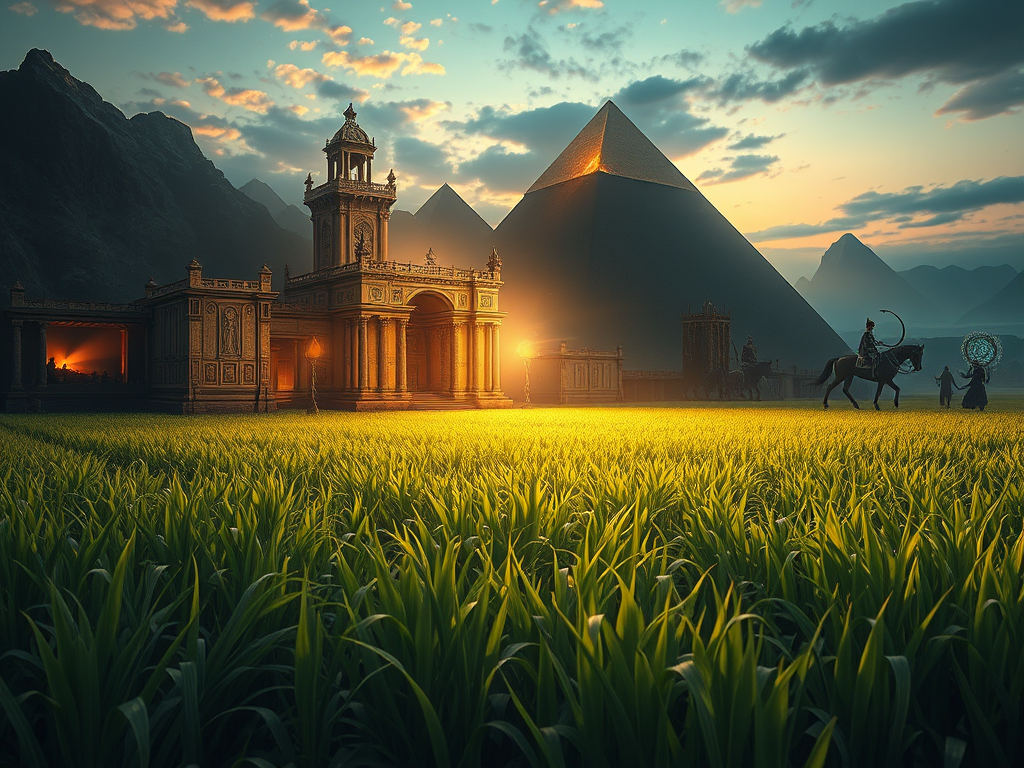
1. Ancient Egypt: The Field of Reeds 🌾
For the ancient Egyptians, the afterlife was not an ending but a complex and perilous continuation of life. Their ultimate goal was to reach Aaru, the Field of Reeds, an eternal and idealized version of the Nile River valley. However, the journey was fraught with danger. After death, the soul, or ba, had to navigate the treacherous underworld known as Duat, a realm filled with monstrous demons and difficult trials described in the Book of the Dead. The deceased would travel on a solar barge with the sun god Ra, battling the serpent of chaos, Apophis, each night.
The journey culminated in the Weighing of the Heart Ceremony. In the Hall of Two Truths, the deceased’s heart was weighed on a scale against the feather of Ma’at, the goddess of truth and justice. If the heart, heavy with sin, outweighed the feather, it was devoured by the demon Ammit, and the soul ceased to exist. If the heart was light and pure, the god Thoth would record the result, and Horus would lead the soul to Osiris, the king of the afterlife, to be granted entry into the Field of Reeds to live forever in blissful paradise.
2. Norse Mythology: Valhalla and Helheim ⚔️
The Viking afterlife was not a one-size-fits-all destination. Where a soul ended up depended entirely on how they died. For the elite warrior who died bravely in battle, the ultimate prize was Valhalla. The souls of these champions were chosen by the Valkyries, female warrior spirits, and escorted to Odin’s magnificent hall in Asgard. In Valhalla, these chosen warriors, known as the Einherjar, would spend their days in glorious combat, fighting each other to the “death,” only to be miraculously healed by nightfall. Their evenings were spent feasting on the inexhaustible boar Sæhrímnir and drinking mead from the udder of the goat Heiðrún. This wasn’t just an eternal party; it was a training ground. The Einherjar were Odin’s elite army, waiting to fight alongside the gods against the giants during Ragnarök, the prophesied end of the world.
For those who did not die a glorious death in battle—the vast majority who died of sickness, old age, or other mundane causes—the destination was the grim, misty realm of Helheim, ruled by the goddess Hel. It was not a place of punishment like the Christian Hell but a cold, shadowy, and boring reflection of life on Earth.
3. Ancient Greece: The Underworld of Hades 🏺
The ancient Greek concept of the afterlife was a vast and gloomy subterranean kingdom known as the Underworld or Hades, named after its grim ruler. When a person died, their soul was led by the god Hermes to the banks of the River Styx, the boundary between the living and the dead. There, the soul had to pay the ferryman, Charon, a coin to be rowed across the river—the reason why Greeks were often buried with a coin in their mouth.
Once across, the soul faced the three-headed dog Cerberus and then was judged by three demigod kings. Based on their life’s deeds, souls were sent to one of three main realms:
- The Asphodel Meadows: A neutral, shadowy place for the souls of ordinary people. Here, they wandered for eternity as listless, ghost-like figures with no memory of their former lives.
- Tartarus: A deep, dark pit of torment and punishment reserved for the truly wicked, such as the Titans who defied the gods.
- Elysium (or the Elysian Fields): A blissful paradise of sunshine and leisure for the truly righteous and heroic. It was the ultimate reward for a virtuous life.
4. Hinduism: The Cycle of Samsara and Liberation (Moksha) 🕉️
In Hinduism, the afterlife is not a single destination but an endless cycle of rebirth known as Samsara. This process is governed by the universal law of karma, the sum of a person’s actions and their consequences in this life and previous ones. The soul, or Atman, is considered an eternal, unchanging entity that is distinct from the body it inhabits. Upon death, the Atman is reincarnated into a new body—which could be human, animal, or even divine—based on its accumulated karma. A life of good deeds and righteousness leads to a better rebirth, while a life of evil leads to a lower form of existence.
This cycle of birth, death, and rebirth is seen not as a reward but as a state of suffering and illusion. The ultimate goal of the soul is not a better reincarnation but to escape the cycle altogether. This liberation is called Moksha. To achieve Moksha, a person must overcome ignorance and desire through spiritual pursuits like meditation, devotion, and self-realisation, ultimately understanding that their individual soul (Atman) is one with the ultimate reality of the universe (Brahman).
5. Buddhism: The State of Nirvana 🧘
Buddhism, which originated from Hinduism, shares the concept of a cycle of rebirth driven by karma. However, the ultimate goal and the nature of the soul are distinctly different. The central aim of a Buddhist is to attain Nirvana. Nirvana is not a heavenly place like paradise but a state of being—an “extinguishing” of the flames of desire, hatred, and ignorance that cause suffering.
Achieving Nirvana means the end of the self as we know it and the complete cessation of all suffering. It is a state of profound peace, enlightenment, and freedom from the endless cycle of death and rebirth. For those who do not achieve Nirvana upon death, their karmic energy is reborn into one of the Six Realms of existence, which include realms of gods, demigods, humans, animals, hungry ghosts, and hell-beings. These are not eternal destinations but temporary states in which one continues to experience the effects of their karma until they can finally follow the path to enlightenment and achieve Nirvana.
6. Aztec Beliefs: The Nine Levels of Mictlán 💀
For the Aztec civilization, the afterlife was a complex and arduous journey, and one’s final destination was determined not by their morality in life, but by the manner of their death. Most people who died a natural death were destined for Mictlán, the nine-level underworld. To reach their final resting place, the soul, accompanied by a spirit dog, had to embark on a harrowing four-year journey. This trek involved overcoming a series of terrifying obstacles, such as crossing a mountain range that crashed into itself, swimming a river of blood filled with jaguars, and traversing a field where the wind was made of sharpened blades.
Only after passing through all nine levels could the soul finally reach Mictlán-Opochcalocan, the deepest level of the underworld, where it would find eternal rest. Warriors who died in battle, women who died in childbirth, and those sacrificed to the gods were granted a more glorious afterlife, journeying with the sun god Huitzilopochtli across the sky.
7. Zoroastrianism: The Chinvat Bridge 🌉
Zoroastrianism, one of the world’s oldest monotheistic religions, originated in ancient Persia and had a profound influence on the afterlife concepts of Judaism, Christianity, and Islam. The Zoroastrian belief system involves a final judgment and a clear division between heaven and hell. After death, the soul is believed to linger on Earth for three days, meditating on its past deeds.
On the fourth day, the soul is led to the Chinvat Bridge, or the “Bridge of the Separator,” which spans a great chasm leading to the afterlife. At the entrance to the bridge, the soul is judged. If the person’s good deeds in life outweigh their bad deeds, the bridge appears wide and easy to cross, and they are greeted by a beautiful maiden (the personification of their conscience) who guides them to the “House of Song,” a paradise of eternal light and bliss. However, for a wicked person, the bridge narrows to the width of a razor’s edge. They are met by an old hag and plummet into the “House of Lies,” a dark, foul-smelling abyss of eternal punishment.
8. Spiritualism: The Progressive Summerland ☀️
Emerging in the 19th century, Spiritualism is a religious movement based on the belief that the spirits of the dead can and do communicate with the living, often through mediums. Their concept of the afterlife is notably optimistic and educational. Spiritualists do not believe in hell or eternal damnation. Instead, they believe the soul passes into a vibrant, multi-layered spirit world, the lowest sphere of which is often called The Summerland.
The Summerland is conceived as an idealized, perfected version of Earth—a beautiful world of nature, art, and intellectual pursuits. It is not a final resting place but a school for the soul. Souls in the Summerland continue to learn, grow, and progress spiritually, reflecting on their past lives and preparing for advancement to higher, more refined spiritual spheres. The ultimate goal is for the soul to progress through these spheres, moving ever closer to the ultimate source of divinity and perfection.
9. Jainism: The Realm of Liberated Souls (Siddhashila) ✨
Jainism, an ancient religion from India, also revolves around the cycle of reincarnation (samsara) driven by karma. However, the Jain concept of karma is unique; it is viewed as a physical substance, a type of subtle particle that clings to the soul (jiva) as a result of one’s actions, thoughts, and words. These karmic particles weigh the soul down, trapping it in the cycle of rebirth.
The ultimate goal for a Jain is to achieve liberation (moksha) by completely purifying the soul of all karmic residue. This is accomplished through a strict path of non-violence (ahimsa), non-attachment, and non-absolutism. A soul that has successfully shed all its karma is known as a siddha. Upon the death of its final physical body, the liberated soul, now weightless and pure, ascends to the highest level of the Jain universe, a celestial realm called Siddhashila. It is an abode of infinite consciousness, bliss, and knowledge, where the soul will exist for eternity in its pure, formless state.
10. Aboriginal Australian Beliefs: Return to The Dreamtime 🌀
For many Indigenous Australian cultures, the afterlife is not a journey to a distant heaven or underworld but an intrinsic part of the land and the spiritual realm known as The Dreamtime (or The Dreaming). The Dreamtime is the timeless, all-encompassing spiritual reality that created all life and order in the universe. It is both the ancient era of creation and the present, ongoing reality that sustains the world.
When a person dies, their spirit is believed to return to The Dreamtime. It does not go to a separate place but remains connected to the land, its sacred sites, and its living kin. The spirits of the ancestors are not remote figures; they are active presences that continue to influence the world and guide the living. Funerary rites are crucial for ensuring the spirit transitions smoothly back into this spiritual dimension, becoming part of the eternal ancestral power that flows through the country. This belief fosters a profound and unbroken connection between the past, present, future, the people, and the land itself.
Further Reading
To explore the rich tapestry of human beliefs about what lies beyond death, these books offer insightful and respectful perspectives.
- The Hero with a Thousand Faces by Joseph Campbell – A masterpiece of comparative mythology that explores the universal themes and journeys found in the world’s myths, including the journey to the underworld.
- The Power of Myth by Joseph Campbell and Bill Moyers – An accessible and engaging conversation that brings mythological concepts, including the afterlife, to life.
- A History of God: The 4,000-Year Quest of Judaism, Christianity and Islam by Karen Armstrong – A brilliant historical account of how the concept of God and the afterlife evolved in the major monotheistic traditions.
- The Tibetan Book of the Dead: The Great Book of Natural Liberation Through Understanding in the Between translated by Robert Thurman – A classic Buddhist text that serves as a guide for the consciousness of the deceased through the transitional state between death and rebirth.
Here at Zentara.blog, our mission is to take those tricky subjects and unlock them, making knowledge exciting and easy to grasp for everyone. But the adventure doesn’t stop on this page! We’re constantly exploring new frontiers and sharing discoveries across the digital universe. Want to dive deeper into more mind-bending Top 10s and keep expanding your world? Come join us on our other platforms – we’ve got unique experiences waiting for you on each one!
Get inspired by visual wonders and bite-sized facts: See the world through Zentara’s eyes on Pinterest!
Pin our fascinating facts and stunning visuals to your own boards. Explore Pins on Pinterest: https://uk.pinterest.com/zentarablog/
Discover quick insights and behind-the-scenes peeks: Hop over to Tumblr for snippets, quotes, and unique content you won’t find anywhere else. It’s a different flavour of discovery! Follow the Fun on Tumblr: https://www.tumblr.com/zentarablog
Ready for deep dives you can listen to or watch? We’re bringing our accessible approach to video and potentially audio! Subscribe to our YouTube channel and tune into future projects that make learning pop! Subscribe on YouTube: https://www.youtube.com/@ZentaraUK
Seeking even more knowledge in one place? We’ve compiled some of our most popular topic deep dives into fantastic ebooks! Find them on Amazon and keep the learning journey going anytime, anywhere. Find Our Ebooks on Amazon: https://www.amazon.co.uk/s?k=Zentara+UK&ref=nb_sb_noss
Connect with us and fellow knowledge seekers: Join the conversation on BlueSky! We’re sharing updates, thoughts, and maybe even asking you what wonders we should explore next. Chat with Us on BlueSky: https://bsky.app/profile/zentarablog.bsky.social
Perfect for learning on the move! We post multiple 10-minute podcasts per day on Spotify. Pop on your headphones and fill your day with fascinating facts while you’re out and about! Listen on Spotify: https://open.spotify.com/show/3dmHbKeDufRx95xPYIqKhJFollow us on Instagram for bytesize knowledge! We post multiple posts per day on our official Instagram account. https://www.instagram.com/zentarablog/ Every click helps us keep bringing honest, accessible knowledge to everyone. Thanks for exploring with us today – see you out there in the world of discovery!




Leave a Reply