
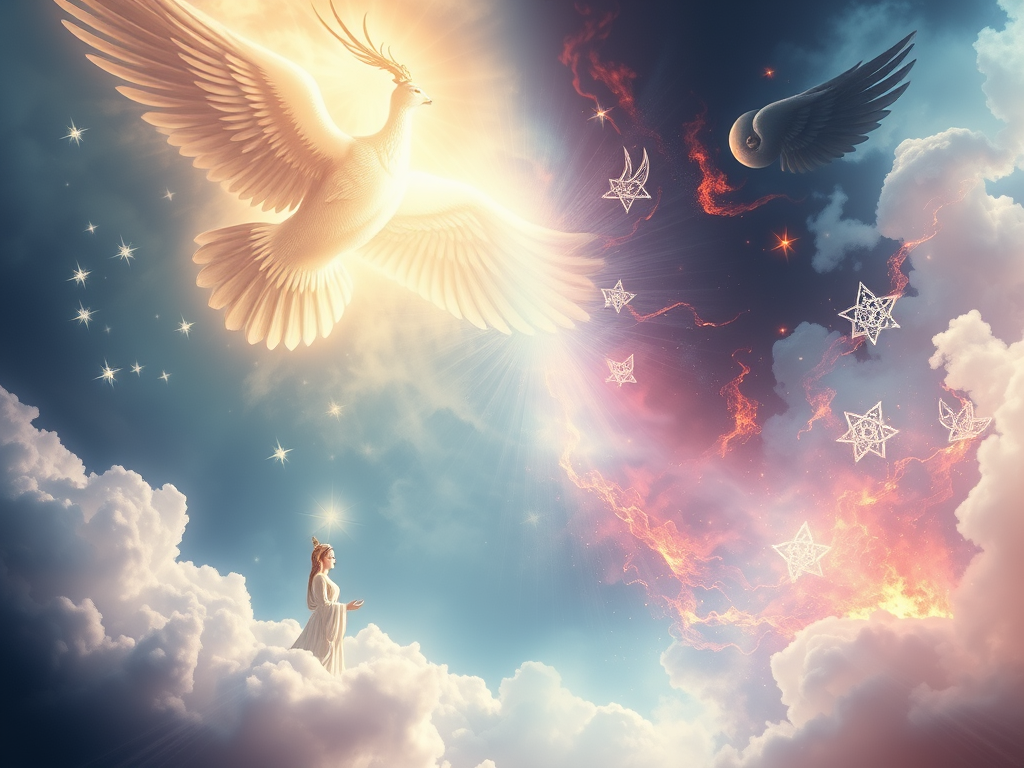
Death is an inescapable part of the human experience, a universal mystery that has fascinated and perplexed humanity since the dawn of consciousness. What happens after we die? Does our consciousness continue? Do we go to a new place, or are we reborn? Across cultures and throughout history, people have wrestled with these profound questions, giving rise to an astonishing diversity of beliefs about the afterlife. These concepts often reflect a society’s values, fears, hopes, and its relationship with the natural and spiritual worlds.
This article will explore ten fascinating concepts of the afterlife from various cultures and belief systems around the globe. We’ll journey through visions of paradise and punishment, cycles of rebirth, and the enduring connections between the living and the dead. Prepare to discover the incredible spectrum of human imagination when confronted with the ultimate unknown: what comes next?
1. Reincarnation and Karma (Hinduism and Buddhism)
One of the most widely held afterlife concepts, particularly in Eastern religions like Hinduism and Buddhism, is reincarnation (or rebirth) intricately linked with the principle of karma. In Hinduism, the soul (Atman) is believed to be eternal and undergoes a cycle of birth, death, and rebirth (samsara) across different forms of life until it achieves liberation (moksha). Karma, the sum of a person’s actions and intentions in one life, determines the nature of their next existence.
The why this is a fascinating concept is its emphasis on moral accountability and spiritual evolution. Good karma leads to a higher rebirth, while bad karma can result in a lower one. In Buddhism, while also believing in samsara and karma, the focus is on escaping this cycle of suffering through enlightenment (Nirvana), which frees the individual from rebirth. These beliefs offer a powerful framework for ethical living and a long-term perspective on spiritual growth that spans multiple lifetimes.
2. Heaven and Hell (Abrahamic Religions: Christianity, Islam, Judaism)
The Abrahamic religions (Judaism, Christianity, and Islam) generally share a linear view of the afterlife, where destiny is determined by one’s actions and faith during life. In Christianity, after death, souls face judgment, leading to eternal reward in Heaven (a paradisiacal communion with God) or eternal punishment in Hell (separation from God, often depicted with fire and suffering). Islam similarly describes Jannah (paradise) and Jahannam (hell) as ultimate destinations after a Day of Judgment by Allah.
The why these concepts are prominent is their emphasis on divine justice and individual accountability. While Judaism has diverse views on the afterlife, focusing more on life in this world, concepts of an “Olam Ha-Ba” (World to Come), resurrection, and sometimes a temporary punishment exist. These afterlife visions provide a powerful moral compass, encouraging righteous living and offering hope of eternal bliss or warning against eternal damnation, profoundly shaping believers’ actions and beliefs.
3. The Field of Reeds and the Underworld Journey (Ancient Egypt)
Ancient Egyptians held incredibly elaborate and optimistic beliefs about the afterlife, viewing death not as an end but as a transition to a new phase of existence. They believed the deceased’s soul (comprising various elements like the Ka, Ba, and Akh) embarked on a perilous journey through the Duat (underworld), facing trials, demons, and puzzles. The ultimate goal was to pass the “Weighing of the Heart” ceremony by Osiris, where the heart was weighed against the feather of Ma’at (truth and justice).
The why this concept is rich is its focus on preparation and ritual. A successful journey led to the blissful Aaru (Field of Reeds), a perfect version of earthly life, where one could live eternally. Mummification, elaborate tombs, funerary texts (like the Book of the Dead), and grave goods were all designed to aid the deceased in this complex journey and ensure their eternal well-being, highlighting a deep reverence for the continuation of life beyond physical death.
4. Valhalla, Fólkvangr, and Hel (Norse Mythology)
Norse mythology presented a diverse and often gritty view of the afterlife, with different destinations depending on how one lived and, crucially, how one died. The most famous is Valhalla, Odin’s hall in Asgard, reserved for warriors slain heroically in battle, where they feast, fight, and prepare for Ragnarök (the end of the world). Half of the fallen warriors, however, went to Fólkvangr, the field of the goddess Freyja. Most others, particularly those who died of illness or old age, went to Hel, a shadowy realm ruled by the goddess Hel, located beneath the roots of Yggdrasil, the world tree.
The why this is fascinating is its reflection of Viking warrior culture and fatalism. The afterlife was not always about moral judgment but about the manner of one’s death. Valhalla offered eternal glory and feasting, while Hel was a more neutral, shadowy place, not necessarily a place of punishment like Christian hell. This diversity speaks to a complex worldview that embraced both heroic glory and the inevitability of natural death, shaping the values of the Norse people.
5. The Dreaming (Australian Aboriginal Beliefs)
For many Australian Aboriginal cultures, the concept of the “Dreaming” (or “Dreamtime”) is central to their understanding of life, creation, and the afterlife. The Dreaming refers to the ancestral past, when ancestral beings created the world, its laws, and its creatures. It is not just a past event but an eternal, ongoing reality that permeates the present. After death, the spirit of a person is believed to return to the Dreaming, reuniting with the ancestral beings and the spiritual essence of the land.
The why this concept is profound is its emphasis on interconnectedness and cyclical existence. It blurs the lines between past, present, and future, and between the physical and spiritual realms. Death is not an ending but a transformation and a return to the sacred ancestral landscape, maintaining a continuous spiritual connection between the living, the deceased, and the very land itself. This worldview highlights a deep spiritual relationship with nature and ancestral heritage.
6. Ancestor Veneration and the Spirit World (Many African Traditional Religions)
Across numerous African traditional religions, the afterlife is often seen as a continuation of life in a spiritual realm, with a strong emphasis on ancestor veneration. The deceased are not truly gone but transition into a state of “living dead” or “ancestral spirits.” They retain their identity, remain part of the community, and can influence the lives of their descendants through blessings or warnings.
The why this is a powerful concept is its emphasis on community, continuity, and intergenerational connection. Ancestors are believed to be guardians and mediators between the living and the divine, often communicating through dreams, rituals, or diviners. Proper respect and rituals are crucial to maintaining good relations with ancestors. This belief system reinforces social cohesion, ethical behavior, and a deep respect for elders, as they eventually become powerful ancestral figures who continue to guide and protect their living relatives.
7. The Happy Hunting Ground (Some Native American Beliefs)
Many diverse Native American cultures share common themes regarding the afterlife, though specific beliefs vary greatly. A common concept is the “Happy Hunting Ground,” a paradisiacal realm where the spirits of the deceased reunite with their ancestors, living a peaceful existence filled with abundance, nature, and successful hunting. It’s often depicted as a beautiful land, free from suffering and want.
The why this concept resonates is its reflection of a deep reverence for nature, harmony, and community. It often implies a journey or a transition to this peaceful realm, sometimes requiring the living to perform specific rituals or mourn appropriately. This afterlife vision provides comfort and continuity, assuring that loved ones are in a better place and that the sacred relationship with nature continues even after death, highlighting a spiritual connection to the environment and ancestral ways of life.
8. Purgatory (Catholic Christianity)
Within Catholic Christianity, Purgatory is a distinct concept of the afterlife that serves as an intermediate state between earthly life and Heaven. It is believed to be a place or state of purification where souls who have died in God’s grace but are not yet perfectly pure undergo a cleansing process to achieve the holiness necessary to enter Heaven. It is not considered a permanent destination like Heaven or Hell, but a temporary stage of spiritual refinement.
The why this concept is significant is its emphasis on divine mercy and the ongoing journey of sanctification. It allows for the possibility of final purification for those who were not fully ready for Heaven at the moment of death, and it supports the practice of prayers for the dead by the living, as these prayers are believed to aid souls in Purgatory. This belief provides a nuanced understanding of post-mortem existence and highlights the importance of purity for ultimate union with God.
9. Spiritism and the Astral Plane (Modern Spiritual Movements)
Spiritism, a philosophy and religion founded in the 19th century by Allan Kardec, and later new age spiritual movements, often describe the afterlife as a multi-layered “spirit world” or “astral plane.” This realm is believed to be inhabited by spirits who continue to learn, evolve, and sometimes communicate with the living through mediums. Different “spheres” or “zones” within the astral plane correspond to the spiritual development and moral state of the departed.
The why this concept is compelling is its focus on continuous personal growth and direct communication with the deceased. It often proposes that individuals progress through these realms based on their spiritual progress, emphasizing self-improvement even after death. This offers a more fluid and less dogmatic view of the afterlife than traditional religious models, providing comfort through the belief that loved ones are simply in another phase of existence and can still be contacted.
10. The Void or Annihilation (Atheism, Some Philosophical Views)
While not a “concept” of an afterlife in the traditional sense, the belief that there is no afterlife – that consciousness simply ceases to exist upon death – is a widespread and significant perspective held by atheists, agnostics, and some philosophical materialists. In this view, the brain is the sole source of consciousness, and when it ceases to function, so does the individual’s awareness.
The why this perspective is important is its profound implications for how one lives. Without the promise of an afterlife, life’s meaning is often sought in the present moment, in human relationships, contributions to society, and the pursuit of knowledge. It challenges individuals to find purpose and morality within a single, finite existence, often leading to a heightened appreciation for the preciousness of life itself. This view, while often seen as bleak by those who believe in an afterlife, provides a framework for living a meaningful life without external supernatural motivation.
The human quest to understand what lies beyond death has given rise to an incredible tapestry of beliefs across cultures. From cycles of rebirth and journeys through spiritual realms to ultimate judgment or complete cessation, these diverse concepts of the afterlife reveal the depth of human spirituality, our universal longing for meaning, and the endless ways we grapple with the great unknown.
Further Reading
- Life After Death: A History of the Afterlife in the Western World by Alan F. Segal
- The Tibetan Book of Living and Dying by Sogyal Rinpoche
- Sum: Forty Tales from the Afterlives by David Eagleman
- Why I Am Not a Christian and Other Essays on Religion and Related Subjects by Bertrand Russell (for a philosophical perspective on non-belief in the afterlife)
- The Spirit World: The Universe of Spirits, Mediums, and the Afterlife by Robert L. DeMoss (for a broader look at spiritualist views)
Here at Zentara.blog, our mission is to take those tricky subjects and unlock them, making knowledge exciting and easy to grasp for everyone. But the adventure doesn’t stop on this page! We’re constantly exploring new frontiers and sharing discoveries across the digital universe.
Want to dive deeper into more mind-bending Top 10s and keep expanding your world? Come join us on our other platforms – we’ve got unique experiences waiting for you on each one!
- Get inspired by visual wonders and bite-sized facts: See the world through Zentara’s eyes on Pinterest! Pin our fascinating facts and stunning visuals to your own boards. Explore Pins on Pinterest: https://uk.pinterest.com/zentarablog/
- Discover quick insights and behind-the-scenes peeks: Hop over to Tumblr for snippets, quotes, and unique content you won’t find anywhere else. It’s a different flavour of discovery! Follow the Fun on Tumblr: https://www.tumblr.com/zentarablog
- Ready for deep dives you can listen to or watch? We’re bringing our accessible approach to video and potentially audio! Subscribe to our YouTube channel and tune into future projects that make learning pop! Subscribe on YouTube: https://www.youtube.com/@ZentaraUK
- Seeking even more knowledge in one place? We’ve compiled some of our most popular topic deep dives into fantastic ebooks! Find them on Amazon and keep the learning journey going anytime, anywhere. Find Our Ebooks on Amazon: https://www.amazon.co.uk/s?k=Zentara+UK&ref=nb_sb_noss
- Connect with us and fellow knowledge seekers: Join the conversation on BlueSky! We’re sharing updates, thoughts, and maybe even asking you what wonders we should explore next. Chat with Us on BlueSky: https://bsky.app/profile/zentarablog.bsky.social
- Perfect for learning on the move! We post multiple 10-minute podcasts per day on Spotify. Pop on your headphones and fill your day with fascinating facts while you’re out and about! Listen on Spotify: https://open.spotify.com/show/3dmHbKeDufRx95xPYIqKhJ
Every click helps us keep bringing honest, accessible knowledge to everyone. Thanks for exploring with us today – see you out there in the world of discovery!




Leave a Reply