
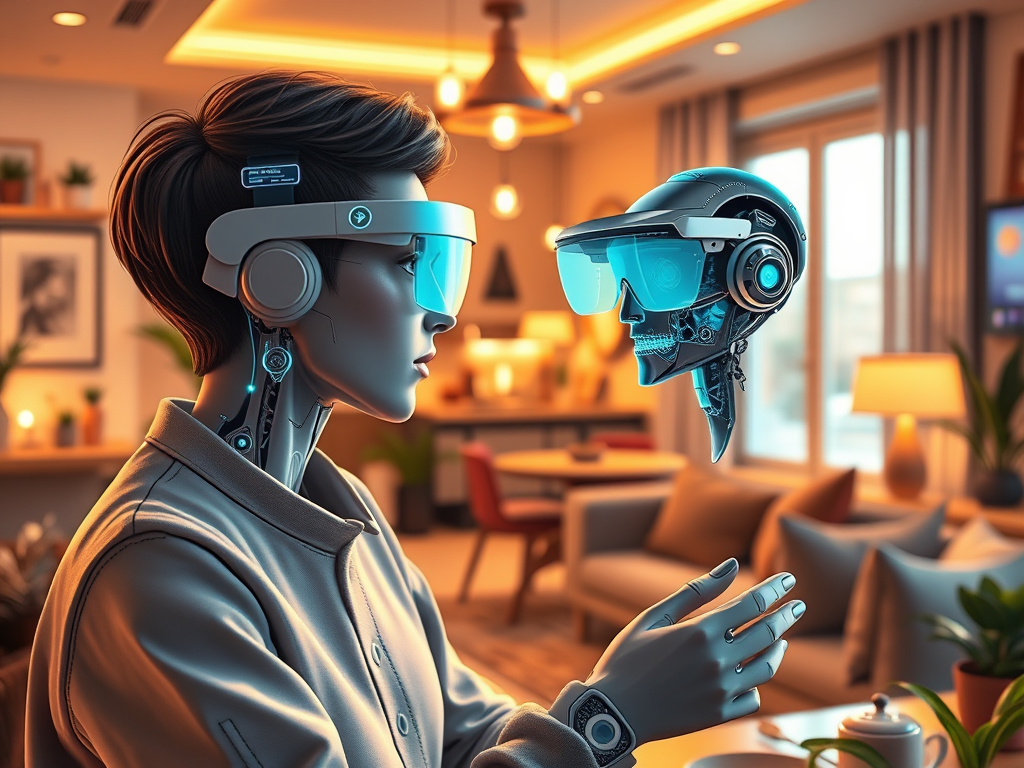
We are living in the dawn of a new conversational age. In just a few short years, AI chatbots, powered by Large Language Models (LLMs), have evolved from clunky novelties into remarkably capable tools that can write poetry, debug code, and explain complex topics. For many of us, “chatting” with an AI like Gemini or ChatGPT has already become a daily habit. But make no mistake: this is just the beginning. What we are experiencing today is the equivalent of the dial-up modem era for AI interaction. 🤖
The future of AI chatbots is not about a better text box. It’s about a fundamental shift in the human-computer relationship, moving from a reactive, command-based model to a proactive, collaborative, and deeply integrated partnership. The chatbots of tomorrow will not be applications we open; they will be ambient assistants woven into the fabric of our lives, understanding us with unprecedented depth and acting on our behalf with startling autonomy.
This evolution will be driven by breakthroughs in everything from emotional intelligence to multimodal understanding. The way we interact with our digital worlds is about to become more natural, more intuitive, and more powerful than ever before. Based on the current trajectories of AI development as of August 2025, here are 10 predictions for how our interactions with AI chatbots are set to change.
1. The ‘Everywhere’ Assistant: Proactive and Ambient Interaction
The Prediction: Today, we initiate almost every interaction with a chatbot. We open an app and type a prompt. In the future, this relationship will flip. AI assistants will become proactive and ambient, existing as an invisible layer in our environment—in our homes, our cars, and through augmented reality (AR) glasses. They will anticipate our needs and offer assistance without being asked.
The Interaction: Imagine you’re driving home from work. Your AI, aware of your calendar, the traffic conditions, and the contents of your smart fridge, chimes in through your car’s speaker: “Traffic is heavy on the M4, so I’ve tweaked your route. You’ll be home 15 minutes later than usual. Based on what you have in the fridge, I’ve found a 20-minute pasta recipe and preheated the oven for you. Shall I add some relaxing music for the rest of the drive?” This move from a reactive tool to a proactive partner will be the single biggest shift, making AI feel less like a computer and more like a thoughtful, hyper-efficient personal assistant.
2. Beyond Words: Fully Multimodal Conversations
The Prediction: The era of text-only interaction is ending. The future is multimodal, where chatbots can seamlessly understand, process, and respond using a rich blend of text, voice, images, video, and gestures.
The Interaction: You’ll be able to simply show your AI a problem instead of describing it. Point your phone’s camera at a flat-pack furniture instruction manual and a broken part, and ask, “I’m stuck here, and this piece is broken. What do I do?” The AI will “see” the problem, circle the correct diagram on your screen, verbally explain the next step, and simultaneously pull up a link to order a replacement part. This ability to communicate using the full spectrum of human senses will make interactions fluid and radically more effective for solving real-world problems. The AI won’t just be a conversationalist; it will be a collaborative partner that can see your world.
3. The Perfect Partner: Hyper-Personalization and Continuous Memory
The Prediction: Future AI chatbots will possess a flawless, persistent memory of your entire interaction history, personal preferences, and life context. This will allow for a level of hyper-personalization that makes today’s chatbots feel generic and forgetful.
The Interaction: Your AI will function as a true “second brain.” You could ask, “What were those career goals I was excited about last spring? Can you cross-reference them with the skills mentioned in that job description my friend sent me last week and draft a cover letter in the slightly more formal tone I used for my presentation in May?” The AI will know your writing style, your career history, your relationships, and your evolving goals. This continuous memory will transform it into an indispensable partner for personal development, a perfectly tailored tutor for learning, or even a therapeutic tool that can track your mental state and offer insights based on your long-term emotional patterns.
4. Feeling the Conversation: Emotional Intelligence and Empathy
The Prediction: AI will develop sophisticated emotional intelligence, often called affective computing. By analysing your tone of voice, facial expressions (via camera), and choice of words, the AI will be able to detect your emotional state—stress, joy, frustration, sadness—and tailor its response accordingly.
The Interaction: Picture venting to your AI after a stressful day. Instead of a generic “I’m sorry to hear that,” it will detect the strain in your voice and might respond with, “You sound really exhausted. Your breathing is a little fast. Let’s pause for a moment. Would you like me to guide you through a two-minute breathing exercise, or would you prefer to just talk it out?” This empathetic capability will be transformative for applications in mental health, customer service (imagine a support bot that can detect when you’re truly frustrated and escalate to a human), and companionship, making interactions feel significantly more human and supportive.
5. From Information to Action: Autonomous AI Agents
The Prediction: The primary function of chatbots will shift from providing information to autonomous task execution. We will interact with them as “AI agents,” delegating complex, multi-step goals which they will then carry out independently.
The Interaction: The prompt will no longer be “What are the best hotels in Rome?” but “Plan and book a five-day anniversary trip to Rome for me and my partner for the first week of October. You know our budget and our taste in hotels and food. Prioritise a hotel with a good view and book a table at a highly-rated carbonara restaurant for our anniversary dinner. Handle the flights and hotel booking, and just send the final itinerary to my calendar for approval.” These AI agents will be able to navigate websites, fill out forms, make payments, and communicate with other systems, turning a simple conversational instruction into a series of completed real-world actions.
6. A Cast of Characters: The Rise of Specialized AI Avatars
The Prediction: We won’t interact with a single, monolithic “AI.” Instead, we will engage with a diverse ecosystem of specialized AI avatars, each with a unique personality, knowledge base, and skill set.
The Interaction: You might start your morning brainstorming creative ideas with “Muse,” an eccentric and witty AI designed to foster divergent thinking. Later, for work, you’ll switch to “Analyst,” a formal, data-driven AI that helps you prepare reports. In the evening, your children might learn maths from “Tutor,” a patient and encouraging AI personality. These won’t just be different “skins” on the same model; they will be fine-tuned AIs that excel at their specific domain. We will choose our AI companions based on the task and the type of interaction we desire, creating a much richer and more versatile digital ecosystem.
7. The World as Your Interface: Integration with IoT and Robotics
The Prediction: Our conversations with AI will seamlessly extend into the physical world through deep integration with the Internet of Things (IoT) and robotics. The chatbot will become the central operating system for our environment.
The Interaction: A casual comment like, “Wow, it feels a bit stuffy in here,” could prompt your AI to check the air quality monitor and activate the smart air purifier. You could hold up a grocery bag and say, “Put all this away,” and a domestic robot would identify each item and store it in the correct place. This bridges the gap between digital instruction and physical action. Our words will directly manipulate our environment, making technology feel truly invisible and responsive to our natural language.
8. Real-Time Superpowers: Augmented Reality (AR) Overlays
The Prediction: When combined with AR glasses, AI chatbots will provide a real-time informational overlay on our perception of reality, accessible through natural conversation.
The Interaction: Imagine walking through a historic part of Cardiff. You look at a castle and ask, “Tell me about this place.” Information about the castle’s history and architecture instantly appears in your field of view. Later, you meet a colleague at a networking event and their name, title, and the last topic you discussed (pulled from your AI’s memory) discreetly appears next to them. This interaction model turns the AI into a true co-pilot for life, providing context, translations, and data exactly when and where you need it, all without ever having to look down at a screen.
9. The Digital Diplomat: AI Agents Negotiating on Your Behalf
The Prediction: A significant portion of our digital interactions will be handled by our AI agents communicating with other AI agents to achieve our goals.
The Interaction: You’ll tell your AI, “Find me the best deal on this specific new television before the weekend.” Your AI agent will then be released onto the internet to find all the vendors. It will then communicate directly with the vendors’ AIs, negotiating in real-time based on hidden discount codes, your loyalty status, and competing offers to secure the best possible price. The same will apply to scheduling; your AI will negotiate with your colleagues’ AIs to find the optimal meeting time for a whole team without the endless back-and-forth emails. Our AI will become our digital diplomat and deal-maker.
10. The AI Constitution: Deeply Embedded Ethics and Safety
The Prediction: As AI becomes more autonomous and integrated, interactions will be governed by sophisticated, transparent, and deeply embedded ethical frameworks. Safety will not be an afterthought; it will be a core part of the AI’s architecture.
The Interaction: These “AI Constitutions” will be far more complex than simple content filters. An AI designed for mental health support would automatically anonymise data and refuse to share sensitive information without explicit, multi-factor consent. An AI controlling physical systems (like a car or a home) would have hard-coded safety protocols that cannot be overridden by a simple user request. If you ask your AI for information on a dangerous or illegal topic, it won’t just refuse; it might explain the ethical reasoning behind its refusal, or in some cases, even suggest contacting relevant support services. This will make our interactions with powerful AI safer and build crucial public trust.
Further Reading
To explore the future of artificial intelligence and its impact on humanity, these books offer profound and accessible insights.
- Life 3.0: Being Human in the Age of Artificial Intelligence by Max Tegmark – A physicist’s exploration of the big questions surrounding AI, from the near-future impacts to the ultimate fate of consciousness in the cosmos.
- The Age of AI: And Our Human Future by Henry A. Kissinger, Eric Schmidt, and Daniel Huttenlocher – A fascinating look at how AI will transform society, written from the unique perspectives of a statesman, a tech CEO, and a computer scientist.
- Superintelligence: Paths, Dangers, Strategies by Nick Bostrom – A challenging but essential philosophical book that examines the potential long-term risks and rewards of creating an intelligence that surpasses our own.
- AI 2041: Ten Visions for Our Future by Kai-Fu Lee and Chen Qiufan – A collaboration between an AI expert and a sci-fi author, this book presents ten gripping short stories that imagine what our world might look like in 2041, each followed by a scientific analysis of the tech involved.
Here at Zentara.blog, our mission is to take those tricky subjects and unlock them, making knowledge exciting and easy to grasp for everyone. But the adventure doesn’t stop on this page! We’re constantly exploring new frontiers and sharing discoveries across the digital universe. Want to dive deeper into more mind-bending Top 10s and keep expanding your world? Come join us on our other platforms – we’ve got unique experiences waiting for you on each one!
Get inspired by visual wonders and bite-sized facts: See the world through Zentara’s eyes on Pinterest!
Pin our fascinating facts and stunning visuals to your own boards. Explore Pins on Pinterest: https://uk.pinterest.com/zentarablog/
Discover quick insights and behind-the-scenes peeks: Hop over to Tumblr for snippets, quotes, and unique content you won’t find anywhere else. It’s a different flavour of discovery! Follow the Fun on Tumblr: https://www.tumblr.com/zentarablog
Ready for deep dives you can listen to or watch? We’re bringing our accessible approach to video and potentially audio! Subscribe to our YouTube channel and tune into future projects that make learning pop! Subscribe on YouTube: https://www.youtube.com/@ZentaraUK
Seeking even more knowledge in one place? We’ve compiled some of our most popular topic deep dives into fantastic ebooks! Find them on Amazon and keep the learning journey going anytime, anywhere. Find Our Ebooks on Amazon: https://www.amazon.co.uk/s?k=Zentara+UK&ref=nb_sb_noss
Connect with us and fellow knowledge seekers: Join the conversation on BlueSky! We’re sharing updates, thoughts, and maybe even asking you what wonders we should explore next. Chat with Us on BlueSky: https://bsky.app/profile/zentarablog.bsky.social
Perfect for learning on the move! We post multiple 10-minute podcasts per day on Spotify. Pop on your headphones and fill your day with fascinating facts while you’re out and about! Listen on Spotify: https://open.spotify.com/show/3dmHbKeDufRx95xPYIqKhJFollow us on Instagram for bytesize knowledge! We post multiple posts per day on our official Instagram account. https://www.instagram.com/zentarablog/ Every click helps us keep bringing honest, accessible knowledge to everyone. Thanks for exploring with us today – see you out there in the world of discovery!




Leave a Reply