
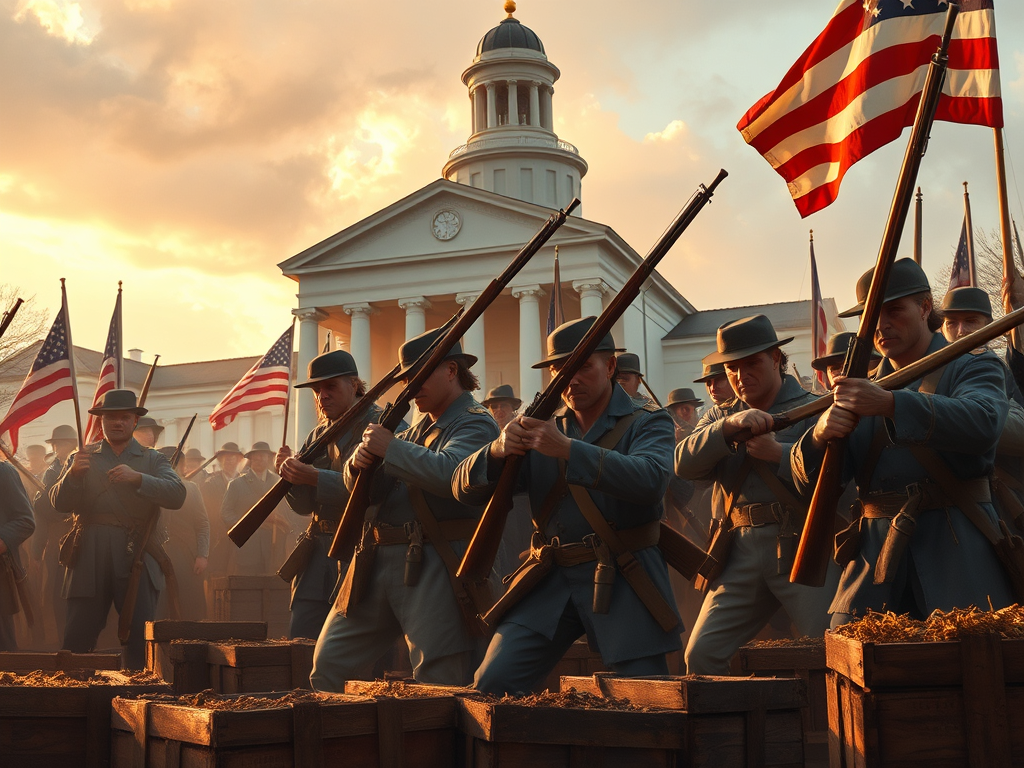
The American Revolution is a cornerstone of modern history, an epic tale of underdog colonists defying a global superpower to forge a new nation founded on the radical idea of liberty. The popular imagery is etched into our collective memory: Minutemen with muskets, the Boston Tea Party, George Washington bravely crossing the Delaware River. While these stories are iconic, they often simplify a conflict that was far more complex, sprawling, and uncertain than we imagine. The fight for independence was not a single, unified march toward freedom; it was a messy, desperate, and multifaceted struggle that was as much a brutal civil war and a global proxy conflict as it was a revolution. To truly understand the birth of the United States, we need to look beyond the myths and uncover the fascinating and often surprising truths about this pivotal period in world history.
1. It Was About More Than Just Tea and Taxes
The famous slogan “no taxation without representation” is often misinterpreted as a simple complaint about the cost of taxes. In reality, the issue was much deeper and centred on a fundamental principle of English rights. The American colonists were not necessarily opposed to the idea of paying taxes to the British Empire; they were, after all, beneficiaries of its protection. What they fiercely objected to was the fact that these taxes—like the Stamp Act of 1765 and the Townshend Acts—were being imposed by a British Parliament in which they had no elected representatives. To the colonists, this was a violation of their rights as Englishmen. The core of the dispute was not about money, but about power and consent. Who had the right to govern them? Who had the authority to take their property in the form of taxes? The colonists believed this right belonged only to their own local, elected assemblies, not a distant parliament 3,000 miles away.
2. The Conflict Was a Global Affair
The image of American colonists fighting alone against the might of the British Empire is a powerful but incomplete picture. The American Revolutionary War quickly escalated into a global conflict, what some historians consider an early “world war.” Seeing an opportunity to avenge its humiliating defeat in the Seven Years’ War (known as the French and Indian War in America), France became the colonists’ most crucial ally. In 1778, France formally recognized the United States and entered the war, providing essential financial aid, weapons, professional soldiers, and most critically, a powerful navy. The French fleet’s victory at the Battle of the Chesapeake in 1781 was the key that trapped the British army at Yorktown. Spain joined the fight in 1779 as an ally of France, attacking British holdings in Florida and along the Mississippi River. The Netherlands, a major trading power, also entered the war against Britain, further stretching British military and financial resources across the globe.
3. The Revolution Was America’s First Civil War
The notion that the American population was universally united behind the cause of independence is a myth. In reality, American society was deeply divided. John Adams famously estimated that about one-third of the colonists were Patriots who supported the revolution, one-third were Loyalists (or “Tories”) who remained faithful to the British Crown, and one-third were neutral or opportunistic, waiting to see which side would prevail. This division tore families, communities, and friendships apart. The conflict was particularly brutal in the Southern colonies, where Patriot and Loyalist militias engaged in vicious partisan warfare that resembled a civil war more than a traditional conflict. Loyalists were often subjected to public humiliation, property confiscation, and violence, and an estimated 60,000 of them became refugees, fleeing to Canada, Britain, or other parts of the empire after the war. This internal conflict highlights the fact that the revolution was a battle for the soul of America itself.
4. George Washington’s Genius Was in Survival, Not Victory
George Washington is rightly celebrated as the indispensable leader of the revolution, but his military record is not one of dazzling battlefield triumphs. In fact, Washington lost more major battles than he won. His forces were repeatedly outmanoeuvred and defeated by the more professional British army, especially in the early years of the war, such as the disastrous Battle of Long Island. Washington’s true genius lay not in tactical brilliance, but in strategic resilience. He understood that the Continental Army did not need to win battles; it simply needed to survive and remain a credible fighting force. His greatest achievement was holding the army together through incredible hardship—starvation at Valley Forge, rampant disease, mutinies over lack of pay, and mass desertion. His masterful strategic retreats saved the army from annihilation time and again, while his daring, calculated risks, like the surprise attack on Trenton on Christmas night in 1776, provided crucial morale-boosting victories that kept the revolutionary spirit alive.
5. The War Reached Far Beyond the 13 Colonies
While the most famous battles took place in Massachusetts, New York, and Virginia, the Revolutionary War was fought on a much larger stage. The conflict on the high seas was a critical, if often overlooked, theatre. The fledgling Continental Navy, with commanders like John Paul Jones, harassed British merchant shipping across the Atlantic, even launching audacious raids on British coastal towns. The war also raged along the western frontier, from the Ohio Valley to the Deep South. Here, the conflict involved complex alliances between the British, the Patriots, and various Native American nations, many of whom, such as the Iroquois and Cherokee, sided with the British in an attempt to halt the relentless westward expansion of American settlers. This frontier fighting was often brutal and had devastating long-term consequences for the indigenous populations, regardless of which side they supported.
6. Secret Agents and Spy Rings Were Crucial to Victory
The American Revolution was a war fought with intelligence and espionage as much as with muskets and cannons. General George Washington was a firm believer in the power of military intelligence and oversaw the creation of several spy networks. The most famous of these was the Culper Spy Ring, which operated in British-occupied New York City. Using a complex system of secret codes, invisible ink (developed by John Jay’s brother), and couriers who used dead drops and signals hidden in plain sight (such as the position of laundry on a clothesline), the Culper Ring provided Washington with invaluable information about British troop movements and plans. Their intelligence was instrumental in thwarting a British plan to ambush the newly arrived French army in 1780 and uncovering a plot to destabilize the American economy by printing massive amounts of counterfeit currency.
7. The Declaration of Independence Wasn’t Signed on July 4th
July 4th is celebrated as America’s birthday, the day the nation declared its independence. However, the famous painting by John Trumbull depicting all the delegates signing the Declaration of Independence on that day is a historical fiction. While the Second Continental Congress did formally adopt the final text of the Declaration on July 4, 1776, only two men actually signed it that day: John Hancock, the president of the Congress, and his secretary, Charles Thomson. The document was then sent to a printer to be made into copies that were distributed throughout the colonies. The official, engrossed copy on parchment that we now see in the National Archives wasn’t ready until early August. The majority of the 56 delegates signed this final version on August 2, 1776, and some signed even later. This detail doesn’t diminish the importance of July 4th, but it highlights the difference between a historical moment and its later commemoration.
8. A German Baron Forged the Continental Army at Valley Forge
The winter of 1777-1778 at Valley Forge, Pennsylvania, is remembered as the darkest hour for the Continental Army. Thousands of soldiers died from disease, starvation, and exposure. Yet, this brutal encampment was also the site of a remarkable transformation. The agent of this change was Baron Friedrich Wilhelm von Steuben, a former Prussian military officer who arrived at the camp with a recommendation from Benjamin Franklin. Although he spoke little English and was not actually a baron, von Steuben was a master of military drill and discipline. He took the ragtag, demoralized collection of soldiers and, through relentless and systematic training, forged them into a professional fighting force. He wrote a drill manual, taught them how to use bayonets effectively, and instilled a sense of order and pride. When the Continental Army emerged from Valley Forge in the spring, it was a more disciplined and capable army, able to meet the British regulars on equal terms for the first time at the Battle of Monmouth.
9. The War Didn’t Truly End at Yorktown
The surrender of Lord Cornwallis’s British army at Yorktown in October 1781 is rightly seen as the decisive moment of the war. It was the final major battle and the blow that convinced the British Parliament that the war was unwinnable. However, the fighting was not entirely over. Skirmishes, naval engagements, and frontier battles continued for well over a year. King George III was not yet ready to concede defeat, and a large British army still occupied New York City. The war officially came to an end only with the signing of the Treaty of Paris on September 3, 1783, nearly two years after Yorktown. This treaty formally recognized the United States as an independent nation and established its borders, extending from the Atlantic Ocean to the Mississippi River. The last British troops finally evacuated New York City in November 1783.
10. Roughly 25,000 Americans Died for Independence
The human cost of the American Revolution was immense. While precise figures are impossible to calculate, historical estimates suggest that around 25,000 Americans died in the fight for independence. This number represents about 1% of the total colonial population at the time. To put that in perspective, a similar per capita loss today would equate to over 3 million American deaths. The grim reality is that far more soldiers died from disease, malnutrition, and exposure in squalid prison camps and ships than were killed on the battlefield. The British prison ships anchored in New York Harbor were particularly notorious, with an estimated 11,000 American prisoners dying in horrific conditions aboard them—more than died in all the major battles of the war combined. This staggering sacrifice underscores the profound price that was paid to establish the United States.
Further Reading
To dive deeper into the complexities and drama of the American Revolution, consider these highly readable and acclaimed historical works:
- “1776” by David McCullough
- “The Glorious Cause: The American Revolution, 1763-1789” by Robert Middlekauff
- “Washington’s Spies: The Story of America’s First Spy Ring” by Alexander Rose
- “Almost a Miracle: The American Victory in the War of Independence” by John Ferling
- “American Revolutions: A Continental History, 1750-1804” by Alan Taylor
Here at Zentara.blog, our mission is to take those tricky subjects and unlock them, making knowledge exciting and easy to grasp for everyone. But the adventure doesn’t stop on this page! We’re constantly exploring new frontiers and sharing discoveries across the digital universe. Want to dive deeper into more mind-bending Top 10s and keep expanding your world? Come join us on our other platforms – we’ve got unique experiences waiting for you on each one!
Get inspired by visual wonders and bite-sized facts: See the world through Zentara’s eyes on Pinterest!
Pin our fascinating facts and stunning visuals to your own boards. Explore Pins on Pinterest: https://uk.pinterest.com/zentarablog/
Discover quick insights and behind-the-scenes peeks: Hop over to Tumblr for snippets, quotes, and unique content you won’t find anywhere else. It’s a different flavour of discovery! Follow the Fun on Tumblr: https://www.tumblr.com/zentarablog
Ready for deep dives you can listen to or watch? We’re bringing our accessible approach to video and potentially audio! Subscribe to our YouTube channel and tune into future projects that make learning pop! Subscribe on YouTube: https://www.youtube.com/@ZentaraUK
Seeking even more knowledge in one place? We’ve compiled some of our most popular topic deep dives into fantastic ebooks! Find them on Amazon and keep the learning journey going anytime, anywhere. Find Our Ebooks on Amazon: https://www.amazon.co.uk/s?k=Zentara+UK&ref=nb_sb_noss
Connect with us and fellow knowledge seekers: Join the conversation on BlueSky! We’re sharing updates, thoughts, and maybe even asking you what wonders we should explore next. Chat with Us on BlueSky: https://bsky.app/profile/zentarablog.bsky.social
Perfect for learning on the move! We post multiple 10-minute podcasts per day on Spotify. Pop on your headphones and fill your day with fascinating facts while you’re out and about! Listen on Spotify: https://open.spotify.com/show/3dmHbKeDufRx95xPYIqKhJFollow us on Instagram for bytesize knowledge! We post multiple posts per day on our official Instagram account. https://www.instagram.com/zentarablog/ Every click helps us keep bringing honest, accessible knowledge to everyone. Thanks for exploring with us today – see you out there in the world of discovery!




Leave a Reply