
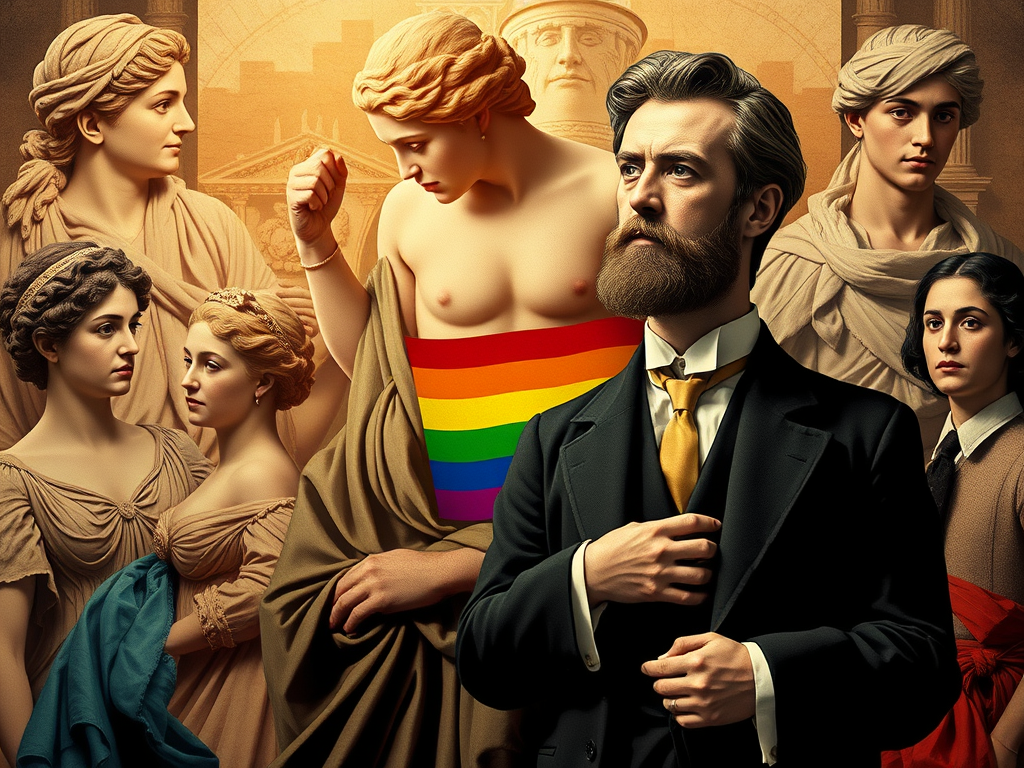
The tapestry of human history is woven with countless threads, but for too long, many of the most vibrant and important colors were hidden from view. The stories of LGBTQ+ individuals, who have shaped our world in profound and lasting ways, have often been relegated to the margins, whispered in secret, or erased entirely. This article is a journey to bring those stories into the light, celebrating the courage, resilience, and brilliance of ten remarkable figures who defied societal norms and left an indelible mark on history.
From ancient poets whose words transcended gender to modern-day activists who ignited revolutions, these individuals were not just defined by their identity, but by their incredible contributions to art, science, politics, and human rights. Their lives serve as a powerful reminder that progress is built on the shoulders of those who dare to be themselves, pushing against the tide of prejudice and paving the way for a more inclusive future. By exploring their legacies, we can gain a deeper understanding of the struggles and triumphs of the LGBTQ+ community and appreciate the rich diversity of human experience that has always existed.
The history of the LGBTQ+ community is not a footnote; it is a fundamental part of the human story. These are the trailblazers, the innovators, and the revolutionaries who refused to be silenced, and whose lives continue to inspire us today.
1. The Poet of Lesbos: Sappho’s Enduring Legacy
In the 7th century BCE, on the Greek island of Lesbos, a poet named Sappho penned verses that have echoed through millennia. She is one of the most famous lyric poets of antiquity, and her work is celebrated for its emotional depth and passionate exploration of love and desire. Many of her surviving fragments and poems express intense affection and longing for other women. This powerful, unapologetic expression of same-sex love is why her name and her home island of Lesbos are the etymological roots of the terms “sapphic” and “lesbian” today. To put her influence in perspective, imagine a modern musician whose love songs were so iconic that their name became synonymous with a form of love itself. Sappho’s poetry was not merely a private journal; it was a public and celebrated art form in her time, influencing other poets and philosophers. Her work gives us a rare, ancient window into a world where expressions of female same-sex attraction were not only acknowledged but revered. Her legacy reminds us that queer history is not a modern invention; it is as old as civilization itself, and its voices, though sometimes fragmented, can still be heard.
2. The Wit and Martyr: The Impact of Oscar Wilde
Oscar Wilde (1854-1900) was a quintessential figure of the Victorian era, a brilliant playwright, poet, and novelist whose sharp wit and flamboyant style made him a darling of London society. His literary masterpieces, such as The Picture of Dorian Gray and The Importance of Being Earnest, satirized the hypocrisies of his time with a masterful touch. However, Wilde’s life took a tragic turn when he was convicted of “gross indecency” for his homosexual relationships. His trial and subsequent imprisonment became a public spectacle, symbolizing the oppressive homophobia of the 19th century. Yet, in the face of immense prejudice, Wilde’s defiance and refusal to deny his identity made him a martyr for the cause of gay rights. His downfall highlighted the cruel and unjust laws that persecuted countless men for their private lives. In a way, his story is a powerful analogy for a lightning rod: he drew all the public’s judgment and cruelty to himself, forcing a conversation that had been long suppressed. His legacy is not just in his beautiful prose, but in his enduring status as an icon of resistance, his life a tragic yet essential chapter in the history of gay liberation.
3. The Enigma Codebreaker: Alan Turing’s Tragic Heroism
Often hailed as the father of modern computer science, Alan Turing (1912-1954) was a mathematical genius whose work during World War II proved instrumental in cracking the German Enigma code. His efforts at Bletchley Park shortened the war by an estimated two years and saved millions of lives. Despite his monumental contributions, Turing’s life was marred by a society that could not accept his sexual orientation. In 1952, he was prosecuted for “gross indecency” and given a choice between prison and chemical castration. He chose the latter, a horrific punishment that led to his physical and mental decline, and ultimately, his death by suicide. Turing’s story is a profound example of how societal prejudice can stifle genius and lead to immense suffering. His life’s work, which laid the theoretical groundwork for the digital age, was almost erased by the very country he helped save. The posthumous apology and royal pardon he received decades later are a powerful reminder of how far we have come, and how much we owe to individuals whose true identities were once a source of persecution. His legacy underscores the critical link between personal freedom and scientific innovation.
4. A Voice for the Disenfranchised: James Baldwin’s Revolutionary Prose
James Baldwin (1924-1987) was one of the most eloquent and profound writers of the 20th century. A novelist, essayist, and civil rights activist, Baldwin’s work unflinchingly explored the complexities of race, class, and sexuality in America. As an openly gay black man, he occupied a unique intersection in society, and his writing served as a powerful bridge between these often-isolated struggles. His essays, like those in Notes of a Native Son, and novels such as Go Tell It on the Mountain and Giovanni’s Room provided a raw, honest, and deeply human look at the marginalized experience. Baldwin used his words like a surgeon’s scalpel, cutting through the rhetoric of hate to expose the pain and humanity beneath. He challenged his readers to confront uncomfortable truths, arguing that the struggle for racial and LGBTQ+ equality were inextricably linked. His activism and intellectual courage were a beacon for a generation, proving that a person’s truth, when spoken without fear, can become a force for monumental social change.
5. The Mother of the Stonewall Uprising: Marsha P. Johnson
The Stonewall Uprising in 1969 is widely considered the pivotal moment that launched the modern LGBTQ+ rights movement. And at the heart of that protest was Marsha P. Johnson (1945-1992), a self-identified drag queen and transgender woman of color. Johnson was not just a participant; she was a leader, a mother figure, and a relentless advocate for the most vulnerable members of her community. She, along with her friend Sylvia Rivera, co-founded the Street Transvestite Action Revolutionaries (STAR), an organization dedicated to housing and supporting homeless queer youth. Johnson’s famous motto, “Pay It No Mind,” was a testament to her defiant spirit in the face of transphobia and homophobia. She was the living embodiment of the spirit of Stonewall: a rejection of a system that sought to dehumanize and oppress. Her activism was rooted in radical compassion, and her legacy is a vital reminder that the fight for LGBTQ+ rights was, and still is, led by trans women of color who have so often been erased from the historical narrative.
6. The Champion of Civil Rights: Bayard Rustin’s Quiet Revolution
While his name may not be as well-known as some of his contemporaries, Bayard Rustin (1912-1987) was one of the key architects of the American Civil Rights Movement. A brilliant strategist and pacifist, he was a close advisor to Martin Luther King Jr. and the chief organizer of the 1963 March on Washington for Jobs and Freedom. Rustin’s contributions were immense, but he was forced to remain largely in the shadows due to the homophobia of the time. As an openly gay man, his presence was seen as a potential liability to the movement’s public image. This is a classic example of a “Hidden Figure”—someone whose genius and sacrifice were essential but went unrecognized due to societal prejudice. Rustin’s life was a testament to the power of intersectional activism, as he fought for racial equality, economic justice, and LGBTQ+ rights simultaneously. His unwavering commitment to non-violent resistance and his strategic brilliance were foundational to the movement’s success, proving that a person’s private life should never overshadow their public achievements. His quiet courage paved the way for future generations of activists to lead with their full identity on display.
7. The First Openly Gay Elected Official: Harvey Milk’s Political Revolution
Before the internet and instant communication, grassroots organizing was the lifeblood of political change. Harvey Milk (1930-1978) understood this better than anyone. He was a San Francisco-based activist who, in 1977, became one of the first openly gay elected officials in the United States when he won a seat on the San Francisco Board of Supervisors. His campaign was a masterclass in community building, focusing on local issues and mobilizing the city’s burgeoning queer population. Milk’s election wasn’t just a political victory; it was a psychological one. His message of “hope” resonated far beyond his district, giving LGBTQ+ people everywhere a tangible symbol of progress and visibility. Like a dam breaking, his success showed that an openly gay person could not only run for office but win and effectively represent their constituents. His life was tragically cut short when he was assassinated just a year into his term, but his legacy continues to inspire political activists and leaders to this day. The message he left behind—that we must give people hope—remains a powerful rallying cry for social justice.
8. The Mother of the Gay Rights Movement: Barbara Gittings
Long before Stonewall, there was Barbara Gittings (1932-2007). Often called the “mother of the gay rights movement,” Gittings was a relentless and pioneering lesbian activist. In a time when homosexuality was classified as a mental illness by the American Psychiatric Association, Gittings worked tirelessly to change public perception and fight for visibility. She organized some of the earliest gay rights pickets in the 1960s, years before the more widely known protests. Her most significant achievement, however, came in 1972 when she played a crucial role in the movement to declassify homosexuality as a mental disorder. This was a monumental victory that shifted the public and medical conversation from viewing LGBTQ+ people as sick to seeing them as healthy, normal individuals. Gittings’s work was methodical, strategic, and rooted in a deep belief in her own worth and the worth of her community. She demonstrated that activism isn’t always about dramatic public clashes; it’s often about the slow, persistent, and vital work of changing institutions and minds from the inside out.
9. The Queen of Jazz and Activism: Josephine Baker
Josephine Baker (1906-1975) was a global superstar, a captivating dancer and singer who became a sensation in Paris during the Jazz Age. But her life was far more than just a performance. An openly bisexual woman, she used her immense fame as a platform for activism, fighting for racial justice and against the oppressive segregation in her native America. During World War II, she was a true patriot, working for the French Resistance and using her celebrity status to spy on German officials, smuggling messages in her sheet music. Baker’s life was a powerful fusion of art, identity, and activism. She adopted 12 children of different ethnicities, whom she called her “Rainbow Tribe,” to demonstrate that people of all races and backgrounds could live together in harmony. Her life serves as a beautiful and complex example of intersectionality in action, showing how one person could fight for both racial and sexual liberation on a global stage. She was a living symbol of defiance and compassion, proving that true artistry lies not just in performance but in the commitment to a more just world.
10. The Trailblazing Transgender Woman: Christine Jorgensen
In 1952, a story broke that captivated the world: a young American man had traveled to Denmark and undergone a series of surgeries to become a woman. Christine Jorgensen (1926-1989) was not the first person to undergo gender-affirming surgery, but she was the first to do so publicly and with immense grace. Her story, splashed across headlines, thrust the concept of gender identity into the public consciousness in a way it never had before. As she later said, she did not see her transition as “a sex change,” but as “a gender change.” Jorgensen became an unintentional spokesperson for a community that was almost entirely invisible. She used her platform to educate a curious, often hostile world about what it meant to be transgender. She was like an early explorer, venturing into uncharted territory and mapping out a new understanding of human identity for a bewildered public. Her courage and openness provided a crucial point of reference for future generations, transforming a previously unheard-of topic into a subject of conversation and paving the way for the transgender rights movement.
Further Reading
- The Gay Revolution: The Story of the Struggle by Lillian Faderman
- Giovanni’s Room by James Baldwin
- The Imitation Game: Alan Turing Deciphered by Jim Ottaviani
- Stonewall: The Riots That Sparked the Gay Revolution by David Carter
Here at Zentara.blog, our mission is to take those tricky subjects and unlock them, making knowledge exciting and easy to grasp for everyone. But the adventure doesn’t stop on this page! We’re constantly exploring new frontiers and sharing discoveries across the digital universe. Want to dive deeper into more mind-bending Top 10s and keep expanding your world? Come join us on our other platforms – we’ve got unique experiences waiting for you on each one!
Get inspired by visual wonders and bite-sized facts: See the world through Zentara’s eyes on Pinterest!
Pin our fascinating facts and stunning visuals to your own boards. Explore Pins on Pinterest: https://uk.pinterest.com/zentarablog/
Discover quick insights and behind-the-scenes peeks: Hop over to Tumblr for snippets, quotes, and unique content you won’t find anywhere else. It’s a different flavour of discovery! Follow the Fun on Tumblr: https://www.tumblr.com/zentarablog
Ready for deep dives you can listen to or watch? We’re bringing our accessible approach to video and potentially audio! Subscribe to our YouTube channel and tune into future projects that make learning pop! Subscribe on YouTube: https://www.youtube.com/@ZentaraUK
Seeking even more knowledge in one place? We’ve compiled some of our most popular topic deep dives into fantastic ebooks! Find them on Amazon and keep the learning journey going anytime, anywhere. Find Our Ebooks on Amazon: https://www.amazon.co.uk/s?k=Zentara+UK&ref=nb_sb_noss
Connect with us and fellow knowledge seekers: Join the conversation on BlueSky! We’re sharing updates, thoughts, and maybe even asking you what wonders we should explore next. Chat with Us on BlueSky: https://bsky.app/profile/zentarablog.bsky.social
Perfect for learning on the move! We post multiple 10-minute podcasts per day on Spotify. Pop on your headphones and fill your day with fascinating facts while you’re out and about! Listen on Spotify: https://open.spotify.com/show/3dmHbKeDufRx95xPYIqKhJFollow us on Instagram for bytesize knowledge! We post multiple posts per day on our official Instagram account. https://www.instagram.com/zentarablog/ Every click helps us keep bringing honest, accessible knowledge to everyone. Thanks for exploring with us today – see you out there in the world of discovery!




Leave a Reply