
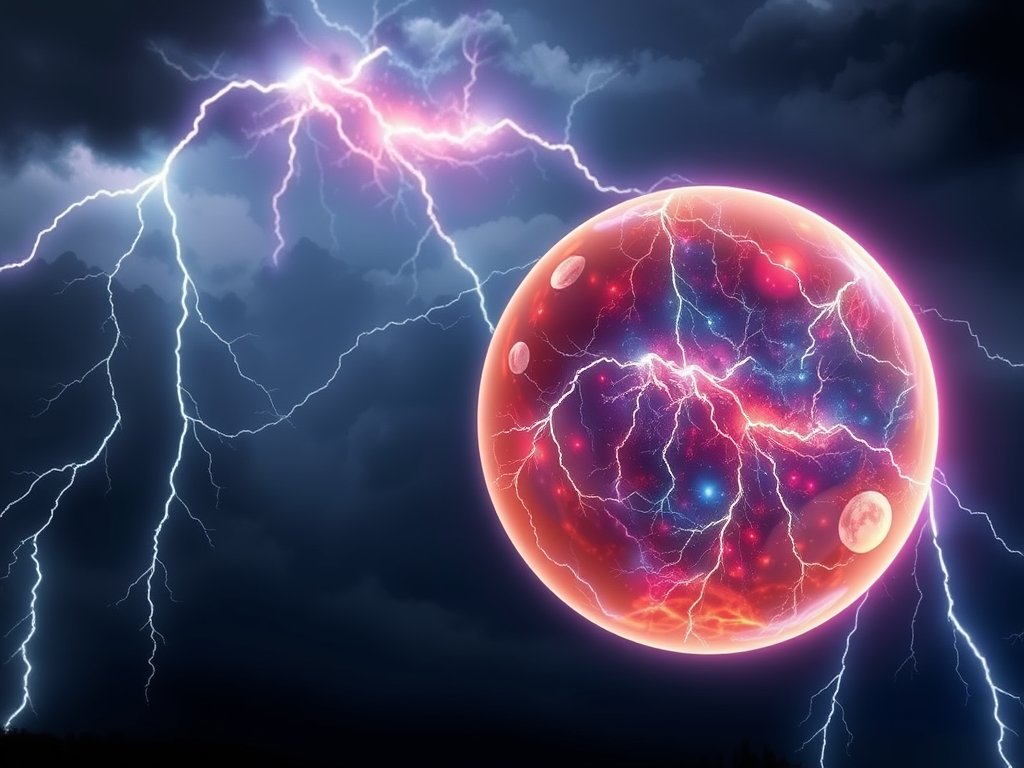
Our world is a theatre of marvels, a place where breathtaking beauty and bewildering mysteries coexist. Despite our incredible scientific advancements, there are still corners of our reality that remain shrouded in enigma. These are the natural phenomena that defy easy explanation, reminding us that we are still explorers on a planet of secrets. From the vastness of space to the intricacies of our own minds, these enduring puzzles challenge our understanding and fuel our quest for knowledge. Join us on a journey into the unknown as we delve into the top 10 natural phenomena that science, even in the 21st century, is still striving to fully comprehend.
10. The Enigmatic Glow of Ball Lightning
Imagine a sphere of light, sometimes as small as a golf ball, other times as large as a beach ball, silently drifting through the air during a thunderstorm. This is the perplexing phenomenon of ball lightning. For centuries, anecdotal reports have described these luminous orbs appearing out of nowhere, hovering, and then vanishing, sometimes with a fizzle and other times with a bang. The challenge for scientists is its fleeting and unpredictable nature, making it nearly impossible to study in a controlled environment.
Numerous theories have been proposed to explain ball lightning. One popular idea suggests it’s a form of plasma, a superheated state of matter, held together by its own magnetic fields. Another hypothesis posits that it’s a result of a lightning strike vaporizing silica in the soil, creating a glowing ball of silicon gas. There are even more exotic explanations involving microwaves, black holes, and antimatter. Despite these creative and scientifically grounded theories, no single one has been able to account for all the reported characteristics of ball lightning, such as its ability to pass through solid objects. It remains a fascinating and elusive mystery, a true ghost of the storm that continues to mystify researchers.
9. The Tunguska Event: A Cosmic Collision Without a Crater
In the summer of 1908, a cataclysmic explosion rocked a remote region of Siberia, flattening over 80 million trees across 2,000 square kilometers. The sheer power of the blast, estimated to be hundreds of times more powerful than the atomic bomb dropped on Hiroshima, was felt and heard for thousands of miles. This was the Tunguska event, a natural disaster of epic proportions that, over a century later, still holds a significant degree of mystery. The most perplexing aspect of this event is the complete absence of an impact crater.
The leading scientific consensus is that the Tunguska event was caused by the airburst of a meteoroid or a small comet entering Earth’s atmosphere at an incredible speed. The intense heat and pressure would have caused it to disintegrate and explode several kilometers above the ground, with the resulting shockwave causing the widespread devastation. However, the lack of any definitive fragments of the impactor has left the door open to a host of alternative, and sometimes wild, theories. These range from an encounter with a tiny black hole to an explosion of a massive underground pocket of natural gas, and even speculation about the crash of an extraterrestrial spacecraft. While the airburst theory is the most plausible, the lingering questions about the exact nature of the object and the specifics of its explosive demise keep the Tunguska event a captivating scientific whodunit.
8. The Eerie Premonition of Earthquake Lights
For centuries, there have been accounts of strange, luminous displays in the sky preceding or accompanying earthquakes. These earthquake lights, or EQL, have been described in various forms, from faint, shimmering glows to brilliant flashes of color that illuminate the night. The phenomenon was often dismissed as folklore or misidentification of more common atmospheric events. However, with the advent of modern recording technology, a growing body of evidence, including photographs and videos, has forced the scientific community to take a closer look at this mysterious and unsettling spectacle.
The mechanisms behind earthquake lights are still a subject of intense debate. One prominent theory suggests that the immense stress on rocks deep within the Earth’s crust before an earthquake generates an electrical charge. This charge could then travel to the surface and ionize the air, creating a light-emitting plasma. Another hypothesis proposes that the friction between shifting rock masses creates intense heat, leading to the vaporization of water and other materials, which then glow. While these and other theories offer potential explanations, a definitive understanding of what causes these spectral displays remains elusive. The connection between the inner workings of our planet and the skies above remains a profound and largely unsolved puzzle.
7. The Great Attractor: A Cosmic Anomaly Pulling Us In
Our Milky Way galaxy, along with thousands of other galaxies in our cosmic neighborhood, is being pulled in a specific direction at a staggering speed of over two million kilometers per hour. The source of this immense gravitational pull is a cosmic mystery known as the Great Attractor. Located some 150 million light-years away, this gravitational anomaly is hidden from our direct view by the dense plane of our own galaxy, a region of space known as the Zone of Avoidance. This cosmic curtain of stars, gas, and dust makes studying the Great Attractor incredibly challenging.
What we do know is that the Great Attractor is a massive concentration of matter, equivalent to tens of thousands of galaxies. However, the visible galaxies in that region don’t seem to have enough mass to account for the tremendous gravitational force being exerted. This has led to speculation that the Great Attractor’s pull may be due in part to vast, unseen structures of dark matter, the mysterious and invisible substance that is believed to make up the majority of the universe’s mass. As our technology for peering through the cosmic dust improves, we are slowly getting a clearer picture of this cosmic behemoth. But for now, the Great Attractor remains a powerful and enigmatic force, a reminder of the vast and unseen structures that shape our universe.
6. The Universe’s Missing Pieces: Dark Matter and Dark Energy
When astronomers look out at the cosmos, they are faced with a startling realization: everything we can see – the stars, galaxies, planets, and gas clouds – makes up less than 5% of the entire universe. The rest is composed of two invisible and profoundly mysterious components: dark matter and dark energy. Dark matter, which is thought to account for about 27% of the universe, is a form of matter that does not emit, absorb, or reflect any light, making it completely invisible to our telescopes. Its existence is inferred from its gravitational effects on visible matter, such as the way it holds galaxies together.
Even more enigmatic is dark energy, which is believed to make up the remaining 68% of the universe. Dark energy is the name given to the mysterious force that is causing the expansion of the universe to accelerate. While we can observe its effects, we have no idea what it is or where it comes from. The leading theory is that it is a property of space itself, a kind of “cosmological constant,” but this is far from a complete explanation. The quest to understand dark matter and dark energy is one of the most significant and exciting frontiers in modern physics, a cosmic puzzle that could revolutionize our understanding of reality itself.
5. The Mind’s Mysterious Power: The Placebo Effect
The placebo effect is a remarkable and well-documented phenomenon where a person experiences real physiological or psychological benefits from a treatment that has no active medicinal properties, such as a sugar pill or a saline injection. The simple belief that one is receiving a genuine medical treatment can be enough to trigger a measurable improvement in their condition. This powerful connection between the mind and the body has been observed in a wide range of medical contexts, from pain management and depression to Parkinson’s disease.
While the placebo effect is a powerful tool in clinical trials for testing the efficacy of new drugs, the underlying mechanisms that drive it are not fully understood. It is believed to involve a complex interplay of psychological factors, such as expectation and conditioning, and neurobiological processes, including the release of the body’s natural painkillers, endorphins, and the activation of specific brain regions associated with reward and pain perception. However, the precise pathways through which belief is translated into tangible physical changes remain a subject of active research. The placebo effect serves as a potent reminder of the profound and often untapped power of our own minds to influence our health and well-being.
4. Nature’s GPS: The Unsolved Mystery of Animal Migration
Every year, countless animals embark on epic journeys of migration, traveling thousands of miles with astonishing accuracy. From the monarch butterflies that fly from Canada to Mexico to the Arctic terns that travel from pole to pole, these incredible feats of navigation have long fascinated and perplexed scientists. How do these creatures, often with brains no bigger than a pinhead, navigate such vast and complex terrains with such unerring precision? This is the enduring mystery of animal migration.
Scientists have discovered that migrating animals use a variety of cues to find their way, including the Earth’s magnetic field, the position of the sun and stars, and their sense of smell. For example, it is believed that some birds have a form of “quantum compass” in their eyes that allows them to “see” the Earth’s magnetic field. Sea turtles are thought to use the magnetic field to create a mental map of the ocean. However, a complete understanding of how these different navigational systems are integrated and used by different species is still lacking. The intricate and sophisticated internal GPS that guides these remarkable journeys remains one of nature’s most impressive and not yet fully deciphered secrets.
3. The Curious Case of Star Jelly
Folklore and historical accounts are filled with stories of a strange, gelatinous substance found on the ground, often after a meteor shower, which has come to be known as star jelly. Descriptions of this enigmatic goo vary, but it is often described as a translucent or grayish-white blob that appears suddenly and then seems to evaporate or disappear shortly after being discovered. The association with meteor showers led to the romantic notion that it was some form of extraterrestrial substance that had fallen from the sky.
Scientific investigations into samples of star jelly have yielded more prosaic, yet still not entirely conclusive, explanations. In many cases, the substance has been identified as the regurgitated and partially digested remains of amphibians, such as frogs and toads, by predators like herons and buzzards. The gelatinous material is thought to be the unfertilized spawn of these animals, which swells up when it comes into contact with moisture. Other analyses have suggested that star jelly could be a type of cyanobacteria or slime mold. However, not all samples have been definitively identified, and the folklore surrounding this curious and ephemeral substance persists, a testament to our enduring fascination with the unexplained.
2. The Unheard Enigma: The Taos Hum
In the small town of Taos, New Mexico, a small percentage of residents are plagued by a persistent, low-frequency humming or buzzing sound of unknown origin. This phenomenon, known as the Taos Hum, is not audible to everyone, and its source has been a subject of intense speculation and investigation for decades. Those who can hear it, often referred to as “hearers,” describe it as a maddening and inescapable drone, similar to the sound of a distant diesel engine. The hum is often more pronounced indoors and at night, leading to sleep deprivation and other health problems for those affected.
Numerous scientific studies have been conducted to try and identify the source of the Taos Hum, but with little success. Investigations have ruled out common culprits such as industrial equipment, power lines, and seismic activity. Theories abound, ranging from the plausible, such as tinnitus or other auditory disorders in the hearers, to the more exotic, including secret military experiments and unusual geological phenomena. Similar unexplained hums have been reported in other parts of the world, but the Taos Hum remains the most famous and well-documented. It is a persistent and unsettling mystery, a sound that exists on the edge of our perception and understanding.
1. The Ultimate Question: The Origin of Life
Perhaps the most profound and fundamental mystery that science has yet to fully unravel is the question of how life on Earth began. We know that life emerged on our planet around 3.8 billion years ago, but the precise steps that led from a lifeless primordial soup of chemicals to the first self-replicating organisms remain a subject of intense scientific inquiry and debate. This is the grand puzzle of abiogenesis, the process by which life arises from non-living matter.
Scientists have proposed several compelling hypotheses to explain the origin of life. The “primordial soup” theory suggests that life began in a body of water on early Earth, where a combination of chemicals, energy from lightning, and volcanic activity led to the formation of the building blocks of life, such as amino acids and nucleotides. The “hydrothermal vent” theory posits that life may have originated in the hot, chemical-rich environments of deep-sea vents. Another intriguing idea is that the essential components of life were delivered to Earth from space by meteorites or comets. While researchers have been able to create some of the building blocks of life in laboratory settings, the leap from these simple organic molecules to a complex, self-replicating cell is a colossal one that we are still far from fully understanding. The origin of life remains the ultimate scientific mystery, a question that goes to the very heart of who we are and our place in the cosmos.
Further Reading
For those whose curiosity has been piqued by these enduring mysteries, here are a few books that offer a deeper dive into the world of the unexplained:
- “A Short History of Nearly Everything” by Bill Bryson
- “The Demon-Haunted World: Science as a Candle in the Dark” by Carl Sagan
- “Cosmos” by Carl Sagan
- “The Big Picture: On the Origins of Life, Meaning, and the Universe Itself” by Sean Carroll
- “Seven Brief Lessons on Physics” by Carlo Rovelli
Here at Zentara.blog, our mission is to take those tricky subjects and unlock them, making knowledge exciting and easy to grasp for everyone. But the adventure doesn’t stop on this page! We’re constantly exploring new frontiers and sharing discoveries across the digital universe. Want to dive deeper into more mind-bending Top 10s and keep expanding your world? Come join us on our other platforms – we’ve got unique experiences waiting for you on each one!
Get inspired by visual wonders and bite-sized facts: See the world through Zentara’s eyes on Pinterest!
Pin our fascinating facts and stunning visuals to your own boards. Explore Pins on Pinterest: https://uk.pinterest.com/zentarablog/
Discover quick insights and behind-the-scenes peeks: Hop over to Tumblr for snippets, quotes, and unique content you won’t find anywhere else. It’s a different flavour of discovery! Follow the Fun on Tumblr: https://www.tumblr.com/zentarablog
Ready for deep dives you can listen to or watch? We’re bringing our accessible approach to video and potentially audio! Subscribe to our YouTube channel and tune into future projects that make learning pop! Subscribe on YouTube: https://www.youtube.com/@ZentaraUK
Seeking even more knowledge in one place? We’ve compiled some of our most popular topic deep dives into fantastic ebooks! Find them on Amazon and keep the learning journey going anytime, anywhere. Find Our Ebooks on Amazon: https://www.amazon.co.uk/s?k=Zentara+UK&ref=nb_sb_noss
Connect with us and fellow knowledge seekers: Join the conversation on BlueSky! We’re sharing updates, thoughts, and maybe even asking you what wonders we should explore next. Chat with Us on BlueSky: https://bsky.app/profile/zentarablog.bsky.social
Perfect for learning on the move! We post multiple 10-minute podcasts per day on Spotify. Pop on your headphones and fill your day with fascinating facts while you’re out and about! Listen on Spotify: https://open.spotify.com/show/3dmHbKeDufRx95xPYIqKhJFollow us on Instagram for bytesize knowledge! We post multiple posts per day on our official Instagram account. https://www.instagram.com/zentarablog/ Every click helps us keep bringing honest, accessible knowledge to everyone. Thanks for exploring with us today – see you out there in the world of discovery!




Leave a Reply