
In the spring of 1982, a remote and sparsely populated archipelago in the South Atlantic became the unlikely stage for one of the most intense and dramatic conflicts of the late 20th century. The Falklands War, a 74-day struggle between Argentina and the United Kingdom, was a brutal, short, and sharp shock—a conventional war fought with modern weapons in an age of Cold War nuclear tension. It was a conflict born of a centuries-old sovereignty dispute, ignited by a military junta, and met with a determined and powerful response. The war unfolded with astonishing speed, moving from diplomatic crisis to full-scale naval and land warfare in a matter of weeks. To understand this remarkable conflict, one must follow its rapid and dramatic escalation, a 10-act play of political gambles, logistical miracles, and fierce, bloody battles. Here are the top 10 ways the Falklands War unfolded over 74 dramatic days.
1. The Spark: The South Georgia Incident (March 19)
The match that lit the Falklands powder keg was struck not on the Falkland Islands themselves, but on the even more remote British dependency of South Georgia, 800 miles to the east. On March 19, 1982, a group of Argentine scrap metal workers landed at Leith Harbour on South Georgia. They had a commercial contract to dismantle an old whaling station, but their arrival was deliberately provocative. They raised an Argentine flag and failed to seek the required permissions from the small British Antarctic Survey team that represented British authority on the island.
This seemingly minor event was a calculated test by the Argentine military junta, led by General Leopoldo Galtieri. Facing massive economic problems and civil unrest at home, the junta saw the long-running claim to the Falkland Islands—known as Las Malvinas in Argentina—as a powerful tool to generate a patriotic diversion. London’s measured diplomatic response was misinterpreted by Buenos Aires as a lack of resolve. When a British naval ice patrol ship, HMS Endurance, was dispatched to remove the men, the junta used it as a pretext to accelerate their invasion plans. This small act of defiance on a desolate island set in motion a chain of events that would lead to war in just two weeks.
2. Operation Rosario: The Argentine Invasion (April 2)
In the pre-dawn darkness of April 2, 1982, Argentina launched Operation Rosario, the full-scale amphibious invasion of the Falkland Islands. Argentine commandos and marines stormed the beaches near the capital, Stanley. They were met with spirited but token resistance from a small garrison of just 80 Royal Marines, who had been ordered to make a stand but not to the point of catastrophic losses. After a brief but intense firefight at Government House, the British governor, Rex Hunt, ordered his marines to surrender to avoid needless bloodshed against a vastly superior force. By mid-morning, the Union Jack had been lowered and the Argentine flag was flying over Stanley, which was renamed Puerto Argentino.
For the Argentine junta, the invasion was a stunning success and a massive domestic triumph. The streets of Buenos Aires, which had recently been filled with anti-government protests, were now packed with jubilant crowds celebrating the “recovery” of Las Malvinas. The junta had made a huge gamble, believing that the United Kingdom, a nation over 8,000 miles away and perceived to be in post-imperial decline, would not—or could not—mount a serious military response to reclaim the islands. It was one of the greatest political and military miscalculations of the 20th century.
3. “The Empire Strikes Back”: Britain’s Response and the Task Force (April 5)
The news of the invasion hit London with the force of a political earthquake. Prime Minister Margaret Thatcher’s government was initially stunned, but any Argentine hopes of British acquiescence were quickly dashed. Addressing a packed and furious emergency session of the House of Commons, Thatcher declared that the Falkland Islanders were of British tradition and stock and that their wishes were paramount. The government announced its decision to dispatch a major naval task force to reclaim the islands. The operation was codenamed Operation Corporate.
The response was a monumental logistical feat. In a matter of days, the Royal Navy assembled a fleet of over 100 ships, including two aircraft carriers, HMS Hermes and HMS Invincible, which were hastily prepared and sailed from Portsmouth on April 5 to a chorus of cheering crowds. Think of it as a modern-day Armada, a massive projection of power across a vast distance not seen since World War II. The Task Force, a combination of warships, submarines, and commandeered civilian vessels like the cruise liner QE2 and the P&O ferry Canberra, steamed south, carrying thousands of troops. The world watched, stunned, as Britain went to war.
4. The Diplomatic Clock Ticks and the Blockade Begins (April 12)
As the Task Force sailed south, a frantic diplomatic effort led by the United States, through Secretary of State Alexander Haig, attempted to find a peaceful resolution. Haig engaged in shuttle diplomacy between London and Buenos Aires, but the two positions were irreconcilable. Argentina, having seized the islands, would not relinquish sovereignty, and the UK would not negotiate under the duress of an invasion. The diplomatic clock was ticking, with the window for a peaceful solution closing with every mile the British fleet sailed.
Meanwhile, the UK established a 200-nautical-mile Maritime Exclusion Zone (MEZ) around the Falklands, which came into effect on April 12. This was a clear warning to the Argentine navy: any of their ships found within the zone would be considered hostile and could be sunk. This was later upgraded to a Total Exclusion Zone (TEZ), which included aircraft. The British strategy was to first isolate the Argentine garrison on the islands, cutting them off from seaborne resupply, before launching any attempt to retake them. The naval blockade was the first move in a deadly chess match that was about to turn violent.
5. First Blood: The Recapture of South Georgia (April 25)
The first major military action of the war took place not on the Falklands, but back where the crisis had begun: South Georgia. The island had been seized by Argentina on April 3. On April 25, a British special forces operation, involving the Special Air Service (SAS) and Special Boat Service (SBS), was launched to retake it. The operation was not without difficulties; two helicopters crashed in blizzard conditions. However, the mission proceeded. The British forces detected the Argentine submarine, the ARA Santa Fe, which they badly damaged with helicopters, forcing it to limp back to the main port.
With the submarine threat neutralized, Royal Marines were landed. The commander of the Argentine garrison, Alfredo Astiz (later notorious as the “Blond Angel of Death” for his role in Argentina’s Dirty War), saw that his position was hopeless. He surrendered without a fight. The news was relayed back to London in a now-famous message: “Be pleased to inform Her Majesty that the White Ensign flies alongside the Union Jack in South Georgia. God save the Queen.” The swift and bloodless recapture of South Georgia was a huge morale boost for the British and a clear signal of their military capability and intent.
6. The Naval War Intensifies: The Sinking of the Belgrano and HMS Sheffield (May 2-4)
The war entered a new and deadly phase in early May. On May 2, the British nuclear-powered submarine, HMS Conqueror, detected the Argentine cruiser, ARA General Belgrano. The Belgrano, a former US Navy vessel that had survived Pearl Harbor, was outside the Total Exclusion Zone but was seen as a threat to the British Task Force. After a direct order from Thatcher’s War Cabinet, HMS Conqueror fired two torpedoes, sinking the cruiser. The sinking resulted in the loss of 323 Argentine lives, the single greatest loss of life in the war. The act remains controversial but was decisive; after the sinking of the Belgrano, the entire Argentine surface fleet was ordered back to port and played no further major part in the war.
Just two days later, on May 4, Argentina struck a devastating blow of its own. An Argentine naval Super Étendard jet, flying low to avoid radar detection, fired a French-made Exocet sea-skimming missile at the British fleet. The missile slammed into the destroyer HMS Sheffield, starting a catastrophic fire that would eventually sink the ship, killing 20 British sailors. The sinking of the Sheffield was a profound shock to the British public and the Royal Navy, demonstrating the vulnerability of modern warships to sophisticated missile technology. These two events, in the space of 48 hours, ended any remaining hope of a diplomatic solution and proved the war would be fought to a bloody conclusion.
7. The Air War Over “Bomb Alley” (May 21 onwards)
After weeks of naval posturing and special forces raids, the main British amphibious landing took place on May 21 at San Carlos Water, a sheltered bay on the west side of East Falkland. The landing was successful and largely unopposed on the ground. However, as the British ships remained in the bay to unload troops and supplies, they became sitting ducks for the Argentine Air Force. The stretch of water became known as “Bomb Alley.” For days, Argentine pilots flying from the mainland flew daring, low-level attacks, showing incredible bravery as they pressed home their assaults against the British fleet.
Several British ships were hit. The frigates HMS Ardent and HMS Antelope were sunk, and many other vessels were damaged. However, the Argentine air force paid a heavy price. They lost dozens of aircraft to British Sea Harrier jets and the formidable ship-based missile and gun defenses. A crucial flaw in the Argentine attacks was that their bombs were often released from too low an altitude, meaning they didn’t have time to arm themselves before hitting their targets. Many bombs that struck British ships failed to explode. The battle for “Bomb Alley” was ferocious, but the British beachhead held.
8. The “Yomp” Across the Island: Goose Green and Mount Kent (May 28 – June 1)
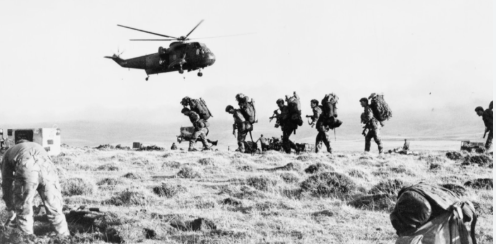
With the troops ashore, the land war began in earnest. The main British objective was the capital, Stanley, some 50 miles to the east across boggy, unforgiving terrain. While some troops were moved by helicopter, most of the infantry had to march, or “yomp,” across the island carrying immense loads. The first major land battle took place at Goose Green. The 2nd Battalion, The Parachute Regiment (2 Para), was ordered to take the settlement. They were outnumbered and attacking a well-dug-in enemy position. The ensuing battle was one of the fiercest of the war, lasting all day and into the night. After the death of their commanding officer, Lieutenant-Colonel ‘H’ Jones (who was posthumously awarded the Victoria Cross), the British paras eventually forced the surrender of over 1,000 Argentine soldiers.
Simultaneously, the SAS launched a daring raid on Mount Kent, a strategic peak overlooking Stanley. Securing this high ground was crucial for the final assault on the capital. The successful captures of Goose Green and Mount Kent were vital for British morale and momentum, proving that their ground troops could defeat the Argentine army in direct combat.
9. The Final Assault: The Battle for the High Ground (June 11-14)
The final phase of the land war was the battle for the ring of mountains and hills that surrounded Stanley. The Argentine forces had established strong defensive positions on peaks with evocative names: Mount Longdon, Two Sisters, Mount Harriet, and later, Tumbledown Mountain and Wireless Ridge. Starting on the night of June 11, British forces—a combination of Parachute Regiment soldiers, Royal Marines, and Scots and Welsh Guards—launched a series of brutal, nighttime bayonet assaults up the rocky, frozen slopes.
These were grim, close-quarters infantry battles fought in freezing darkness against determined resistance. Each peak had to be cleared in bloody, painstaking fighting. The battle for Mount Longdon, in particular, was one of the most savage of the war. But one by one, the hills were taken. The loss of this crucial high ground, from which the British could now direct artillery fire down into Stanley itself, completely broke the morale of the Argentine defenders. The strategic and psychological blow was decisive.
10. The Liberation of Stanley and the Argentine Surrender (June 14)
With the high ground lost and their positions untenable, the Argentine forces in Stanley were in a state of collapse. On the morning of June 14, white flags began to appear over the town. The Argentine commander, General Mario Menéndez, recognizing the futility of further resistance, agreed to a ceasefire and entered into negotiations with the British commander, Major General Jeremy Moore. That evening, at Government House, General Menéndez formally surrendered all Argentine forces on the Falkland Islands. After 74 days of occupation and conflict, the war was over.
The news of the surrender prompted jubilant celebrations in the United Kingdom. For Argentina, the defeat was a national humiliation that directly led to the collapse of the military junta and the restoration of democracy the following year. The Falklands War, a conflict that unfolded with breathtaking speed, left a lasting legacy: 255 British and 649 Argentine servicemen lost their lives, but the islands remained under British control, their inhabitants’ right to self-determination secured.
Further Reading
For those who wish to delve deeper into the 74-day conflict, these books provide compelling and accessible accounts of the Falklands War:
- The Falklands War by Max Hastings and Simon Jenkins – Written immediately after the conflict, this remains one of the definitive and most balanced accounts, covering the political, diplomatic, and military aspects of the war.
- Falklands: The Air War by Rodney Burden, Michael Draper, et al. – An incredibly detailed, day-by-day account of the crucial air campaign, essential for understanding the technological and tactical aspects of the conflict.
- No Picnic: 3 Commando Brigade in the South Atlantic by Major General Julian Thompson – A firsthand account from the commander of the British land forces, offering a candid and authoritative perspective on the challenges and realities of the ground war.
- Razor’s Edge: The Unofficial History of the Falklands War by Hugh Bicheno – A gritty, unvarnished, and often controversial account of the war, told from the perspective of the soldiers, sailors, and airmen on both sides.
Here at Zentara.blog, our mission is to take those tricky subjects and unlock them, making knowledge exciting and easy to grasp for everyone. But the adventure doesn’t stop on this page! We’re constantly exploring new frontiers and sharing discoveries across the digital universe. Want to dive deeper into more mind-bending Top 10s and keep expanding your world? Come join us on our other platforms – we’ve got unique experiences waiting for you on each one!
Get inspired by visual wonders and bite-sized facts: See the world through Zentara’s eyes on Pinterest!
Pin our fascinating facts and stunning visuals to your own boards. Explore Pins on Pinterest: https://uk.pinterest.com/zentarablog/
Discover quick insights and behind-the-scenes peeks: Hop over to Tumblr for snippets, quotes, and unique content you won’t find anywhere else. It’s a different flavour of discovery! Follow the Fun on Tumblr: https://www.tumblr.com/zentarablog
Ready for deep dives you can listen to or watch? We’re bringing our accessible approach to video and potentially audio! Subscribe to our YouTube channel and tune into future projects that make learning pop! Subscribe on YouTube: https://www.youtube.com/@ZentaraUK
Seeking even more knowledge in one place? We’ve compiled some of our most popular topic deep dives into fantastic ebooks! Find them on Amazon and keep the learning journey going anytime, anywhere. Find Our Ebooks on Amazon: https://www.amazon.co.uk/s?k=Zentara+UK&ref=nb_sb_noss
Connect with us and fellow knowledge seekers: Join the conversation on BlueSky! We’re sharing updates, thoughts, and maybe even asking you what wonders we should explore next. Chat with Us on BlueSky: https://bsky.app/profile/zentarablog.bsky.social
Perfect for learning on the move! We post multiple 10-minute podcasts per day on Spotify. Pop on your headphones and fill your day with fascinating facts while you’re out and about! Listen on Spotify: https://open.spotify.com/show/3dmHbKeDufRx95xPYIqKhJFollow us on Instagram for bytesize knowledge! We post multiple posts per day on our official Instagram account. https://www.instagram.com/zentarablog/ Every click helps us keep bringing honest, accessible knowledge to everyone. Thanks for exploring with us today – see you out there in the world of discovery!




Leave a Reply