
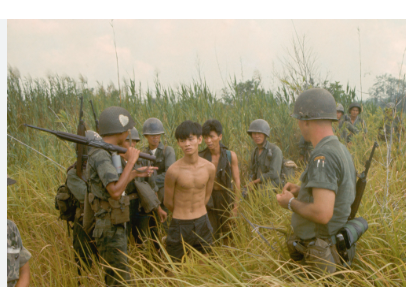
The Vietnam War, a conflict that defined a generation, was not just a clash of ideologies but also a collision of technologies. Fought in the dense jungles, sprawling rice paddies, and skies of Southeast Asia, it became a brutal testing ground for a new generation of warfare. From the iconic roar of helicopter blades to the silent, insidious creep of chemical defoliants, technology played a pivotal role in shaping tactics, determining outcomes, and leaving a legacy that endures to this day. Here are ten of the most significant technologies that defined the Vietnam conflict.
1. The UH-1 “Huey” Helicopter: The Flying Cavalry
No single piece of technology is more synonymous with the Vietnam War than the Bell UH-1 Iroquois, universally known as the “Huey.” This versatile helicopter was the workhorse of the U.S. military, fundamentally changing the nature of ground warfare. In a country with few roads and dense jungle terrain, the Huey provided unprecedented air mobility. It was the “flying Jeep” of the war, capable of rapidly inserting troops into a “hot” landing zone (LZ), evacuating the wounded in critical minutes, and providing close air support with door-mounted M60 machine guns and rocket pods. This strategy, known as “air cavalry,” allowed U.S. forces to bypass the challenges of the terrain and engage the enemy in remote areas. The iconic whump-whump-whump of its rotor blades was a sound of both hope for American soldiers and dread for their adversaries. The Huey didn’t just support the war; it created an entirely new way of fighting it.
2. The M16 Rifle: A Controversial Revolution in Arms
The M16 rifle was a stark departure from the heavy wood-and-steel battle rifles of previous wars. Lightweight, with a distinctive plastic stock and carrying handle, it fired a small-caliber, high-velocity 5.56mm round. The design philosophy was revolutionary: the lighter ammunition allowed soldiers to carry more rounds, and the high-velocity bullet was designed to tumble upon impact, creating devastating wounds. The M16 gave American troops a significant firepower advantage in terms of rate of fire and ammunition load over opponents initially armed with older rifles. However, its introduction was plagued with problems. Early versions were issued without cleaning kits and with the wrong type of gunpowder, leading to frequent jamming in the harsh, humid conditions of the Vietnamese jungle. These reliability issues cost American lives and created a lasting controversy, but after improvements were made, the M16 and its variants became the standard-issue rifle for the U.S. military for decades to come.
3. Napalm: The Fire That Rains from the Sky
One of the most terrifying weapons deployed in Vietnam was napalm, a jellied gasoline mixture designed to stick to surfaces and burn at incredibly high temperatures. Dropped from fighter jets in large canisters, it created an inferno that could incinerate entire swaths of jungle, destroying enemy cover and fortifications. Its psychological impact was immense, earning it the nickname “liquid fire.” The infamous photograph of a nine-year-old girl, Phan Thị Kim Phúc, running naked and severely burned from a napalm strike in 1972, brought the horrifying reality of this weapon to the world’s attention. While militarily effective for clearing bunkers and halting enemy advances, napalm’s indiscriminate nature caused horrific burns and civilian casualties, making it a powerful and enduring symbol of the brutality of the conflict. It highlighted the devastating human cost of modern chemical warfare.
4. The AK-47: The People’s Rifle
Just as the M16 defined the American soldier, the AK-47 (Avtomat Kalashnikova) was the iconic weapon of the North Vietnamese Army (NVA) and the Viet Cong. Designed by Mikhail Kalashnikov, the AK-47 was a masterpiece of simplicity and reliability. It was rugged, easy to maintain, and could withstand the mud, water, and humidity of the jungle with remarkable dependability. While less accurate at long ranges than the M16, its powerful 7.62mm round could punch through dense vegetation and cover. Its legendary reliability gave NVA and Viet Cong fighters immense confidence in their primary weapon, a crucial factor in jungle warfare. The stark contrast between the often-jamming M16 and the ever-reliable AK-47 became a major point of contention and a symbol of the war’s technological asymmetries. The AK-47’s effectiveness ensured it would become the most produced and widely used assault rifle in history.
5. The B-52 Stratofortress and “Arc Light”: Thunder from Above
The B-52 Stratofortress, a Cold War-era strategic bomber, was adapted for a devastating tactical role in Vietnam. In missions codenamed Operation Arc Light, these high-altitude giants would fly in three-plane cells, too high to be seen or heard from the ground, and saturate a “box” a mile long and half a mile wide with up to 30 tons of high-explosive bombs each. The resulting explosions were apocalyptic, capable of obliterating everything on the surface and collapsing tunnel networks deep underground. The goal was to destroy enemy base camps, supply lines, and troop concentrations in remote jungle areas. For the soldiers on the ground, the sheer destructive power of an Arc Light strike was awe-inspiring and terrifying. While its strategic effectiveness in a guerrilla war is still debated, the B-52 represented the overwhelming industrial and technological might of the United States.
6. Agent Orange: A Poisonous Legacy
In an effort to deny cover to the Viet Cong and NVA, the U.S. military initiated Operation Ranch Hand, a massive herbicidal warfare program. The most well-known of the chemicals used was Agent Orange, a powerful defoliant sprayed from aircraft over millions of acres of forests and farmland. The goal was to strip away the jungle canopy and destroy enemy food crops. While it was effective at defoliation, Agent Orange was contaminated with an extremely toxic dioxin. This poison had catastrophic, long-term consequences. It entered the food chain and water supply, causing severe health problems, including cancers, birth defects, and neurological disorders, for millions of Vietnamese people for generations. It also had devastating health effects on thousands of U.S. veterans who were exposed to it. The tragic legacy of Agent Orange serves as a grim reminder that the technological wounds of war can last long after the fighting stops.
7. Jet Fighters and Surface-to-Air Missiles (SAMs): The Duel in the Skies
The skies over North Vietnam became a deadly arena for some of the most advanced military aircraft of the era. The United States relied on powerful fighter-bombers like the F-4 Phantom II and the F-105 Thunderchief to carry out bombing campaigns such as Operation Rolling Thunder. These jets were fast, heavily armed, and versatile. However, they were met with a surprisingly sophisticated air defense network. The North Vietnamese, supplied by the Soviet Union, used the agile and deadly MiG-21 jet fighter to challenge American air superiority. More significantly, they deployed a network of radar-guided Surface-to-Air Missiles (SAMs), primarily the SA-2 Guideline. The presence of SAMs forced American pilots to fly at lower altitudes, putting them within range of deadly anti-aircraft artillery. This created a high-stakes duel between American pilots, their electronic countermeasures, and the North Vietnamese missile crews, forever changing the calculus of air power.
8. The Viet Cong Tunnels: An Underground World of War
While the U.S. wielded high-tech weaponry, the Viet Cong’s most effective technology was often decidedly low-tech and ingenious. Their vast and complex tunnel systems, most famously at Củ Chi, were an extraordinary feat of engineering and a critical component of their guerrilla warfare strategy. These tunnels were not just hiding places; they were sprawling underground networks containing living quarters, hospitals, command centers, and supply depots. They allowed Viet Cong fighters to appear as if from nowhere to ambush American patrols and then vanish without a trace. The tunnels effectively neutralized American air power and artillery, forcing a terrifying, close-quarters war underground. U.S. soldiers known as “tunnel rats” had the harrowing job of navigating these dark, narrow, and often booby-trapped passages. The tunnels represented a brilliant asymmetric response to technological superiority, proving that ingenuity could be as powerful as firepower.
9. Sensor Technology and Operation Igloo White
To combat the flow of troops and supplies down the Ho Chi Minh Trail, the U.S. launched Operation Igloo White, one of the most technologically ambitious undertakings of the war. It was an attempt to create an “electronic barrier” monitored by the U.S. Air Force. Thousands of air-dropped seismic and acoustic sensors, many disguised as plants, were scattered throughout the jungle. These sensors would detect movement and transmit signals to orbiting aircraft, which would then relay the data to a massive intelligence center in Thailand. Analysts would interpret the data and call in air strikes on suspected targets. While a groundbreaking experiment in electronic warfare, the system had mixed results. The North Vietnamese quickly learned how to deceive the sensors using decoys and by moving supplies during heavy rains. Igloo White was a precursor to modern networked warfare but also a lesson in the limitations of technology against a determined and adaptive enemy.
10. Television Media: Bringing the War Home
Perhaps the most transformative technology of the Vietnam War was not a weapon, but a medium: television. Vietnam was the first “living-room war.” For the first time in history, journalists had relatively uncensored access to the battlefield and could send footage back to be broadcast on the nightly news. This brought the brutal reality of the conflict—the firefights, the casualties, the civilian suffering—into American homes in a visceral and unprecedented way. Images from the Tet Offensive in 1968, for instance, starkly contradicted official reports that the war was being won, creating a “credibility gap” that eroded public support. While it didn’t single-handedly cause America to lose the war, television’s unfiltered portrayal of the conflict played a crucial role in shaping public opinion, fueling the anti-war movement, and ultimately influencing political decisions in Washington D.C. It proved that in modern warfare, the battle for hearts and minds at home can be as important as the battle on the ground.
Further Reading
- The Things They Carried by Tim O’Brien
- A Rumor of War by Philip Caputo
- The Best and the Brightest by David Halberstam
- Chickenhawk by Robert Mason
- Fire in the Lake: The Vietnamese and the Americans in Vietnam by Frances FitzGerald
Here at Zentara.blog, our mission is to take those tricky subjects and unlock them, making knowledge exciting and easy to grasp for everyone. But the adventure doesn’t stop on this page! We’re constantly exploring new frontiers and sharing discoveries across the digital universe. Want to dive deeper into more mind-bending Top 10s and keep expanding your world? Come join us on our other platforms – we’ve got unique experiences waiting for you on each one!
Get inspired by visual wonders and bite-sized facts: See the world through Zentara’s eyes on Pinterest!
Pin our fascinating facts and stunning visuals to your own boards. Explore Pins on Pinterest: https://uk.pinterest.com/zentarablog/
Discover quick insights and behind-the-scenes peeks: Hop over to Tumblr for snippets, quotes, and unique content you won’t find anywhere else. It’s a different flavour of discovery! Follow the Fun on Tumblr: https://www.tumblr.com/zentarablog
Ready for deep dives you can listen to or watch? We’re bringing our accessible approach to video and potentially audio! Subscribe to our YouTube channel and tune into future projects that make learning pop! Subscribe on YouTube: https://www.youtube.com/@ZentaraUK
Seeking even more knowledge in one place! We’ve compiled some of our most popular topic deep dives into fantastic ebooks! Find them on Amazon and keep the learning journey going anytime, anywhere. Find Our Ebooks on Amazon: https://www.amazon.co.uk/s?k=Zentara+UK&ref=nb_sb_noss
Connect with us and fellow knowledge seekers: Join the conversation on BlueSky! We’re sharing updates, thoughts, and maybe even asking you what wonders we should explore next. Chat with Us on BlueSky: https://bsky.app/profile/zentarablog.bsky.social
Perfect for learning on the move! We post multiple 10-minute podcasts per day on Spotify. Pop on your headphones and fill your day with fascinating facts while you’re out and about! Listen on Spotify: https://open.spotify.com/show/3dmHbKeDufRx95xPYIqKhJFollow us on Instagram for bytesize knowledge! We post multiple posts per day on our official Instagram account. https://www.instagram.com/zentarablog/ Every click helps us keep bringing honest, accessible knowledge to everyone. Thanks for exploring with us today – see you out there in the world of discovery!




Leave a Reply