
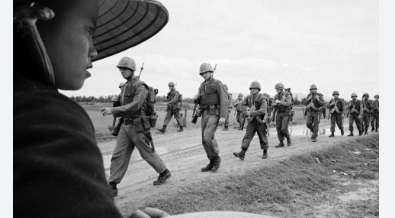
World War II looms in the collective imagination as the archetypal “good war.” It was a monumental, globe-spanning conflict with clearly defined enemies, unambiguous objectives, and a level of national unity that seems almost unimaginable today. It was a war of front lines, industrial might, and a generation of soldiers who returned home as unambiguous heroes. Less than twenty years after its conclusion, the United States found itself embroiled in a profoundly different kind of conflict in the jungles and rice paddies of Southeast Asia. The Vietnam War was a war fought in shades of grey. It lacked clear battlefronts, had complex and often shifting objectives, and it fractured American society in ways that have never fully healed. For the soldiers on the ground and the generals in command, the lessons learned on the battlefields of Europe and the Pacific were not just irrelevant; they were often dangerously misleading.
To understand how the nature of conflict was so radically redefined in just two decades, here are the top 10 ways the Vietnam War was fought differently from World War II.
1. A War of Front Lines vs. a War Without a Front
World War II was largely a conventional war of territory. Armies advanced and retreated along clear, defined front lines. The goal was to seize ground, capture cities, and push the enemy back in a relentless march toward their capital. Soldiers knew, for the most part, which direction the enemy was in. The Vietnam War completely obliterated this concept. It was a 360-degree war with no front, no rear, and no “safe” areas. The enemy, primarily the guerrilla fighters of the Viet Cong, was everywhere and nowhere at once. A seemingly peaceful village could be a fortified enemy base. A child on the roadside could be a spotter. The soldier on patrol wasn’t fighting to gain ground, but simply to survive the day in a landscape where a threat could emerge from a hidden tunnel, a dense patch of jungle, or a booby-trapped trail at any moment. This created a pervasive and constant psychological strain that was fundamentally different from the experience of a WWII soldier on the European front.
2. Total War vs. a Limited War of Attrition
The objective in World War II was unconditional surrender. It was a “total war” where the entire industrial and human resources of the Allied nations were mobilized to utterly destroy the Axis powers’ ability to wage war. In stark contrast, the Vietnam War was a “limited war” for the United States. The goal was not the conquest of North Vietnam or the overthrow of its government, but the “containment” of communism and the preservation of an independent, non-communist South Vietnam. Unable to invade the North for fear of drawing China or the Soviet Union into the conflict, U.S. strategy devolved into a grim war of attrition. Success was not measured in miles gained or cities captured, but in a gruesome metric: the “body count.” The prevailing theory was that if the U.S. could kill enemy soldiers faster than the North could replace them, they would eventually give up. This strategy proved to be a catastrophic failure.
3. Conventional Armies vs. a Guerrilla Insurgency
While WWII had its share of partisan and resistance fighters, the conflict was primarily a clash between the uniformed, conventional armies of nation-states. Tanks, battleships, and bomber fleets were the decisive weapons. In Vietnam, the United States military, the most powerful conventional force on Earth, found itself fighting an elusive, peasant-based guerrilla army. The Viet Cong used classic insurgent tactics: ambushes, hit-and-run attacks, terrorism, and booby traps. They blended in with the civilian population, making it nearly impossible to distinguish friend from foe. This “asymmetrical warfare” negated many of America’s technological advantages. What good was a B-52 bomber against a squad of soldiers who could vanish into a network of underground tunnels? The U.S. was prepared to fight another World War II, but the enemy in Vietnam refused to play by those rules.
4. Clear Objectives vs. Ambiguous Political Goals
For the Allies in WWII, the mission was crystal clear: defeat Hitler, Mussolini, and Imperial Japan, and liberate the conquered nations. The moral and political justification for the war was unambiguous. In Vietnam, the goals were far more abstract and harder to grasp. The U.S. was fighting to uphold the “domino theory”—the fear that if South Vietnam fell to communism, all of Southeast Asia would follow. It was propping up a series of corrupt, unpopular, and unstable governments in Saigon. For the average soldier, the question of “what are we fighting for?” was much more difficult to answer than it was for their fathers in WWII. This lack of a clear, compelling, and achievable objective contributed to a crisis of morale on the battlefield and a crisis of confidence back home.
5. A United Home Front vs. a Deeply Divided Nation
The American home front during WWII was a model of national unity. People planted victory gardens, bought war bonds, endured rationing, and went to work in factories with a shared sense of patriotic purpose. The cause was seen as just and necessary. The Vietnam War, however, cleaved American society in two. As the war escalated, so did a powerful anti-war movement, which grew from college campus protests to massive demonstrations in the streets of Washington. The military draft became a huge point of contention, and the conflict fueled a bitter “culture war” between the pro-war “hawks” and the anti-war “doves.” For the first time in a major conflict, American soldiers were fighting a war that a significant portion of their fellow citizens actively and vocally opposed.
6. The “Living-Room War”: Censored Newsreels vs. Unfettered TV Coverage
The way each war was seen by the public was radically different. During WWII, news coverage was heavily censored by the military. Newsreels shown in cinemas were designed to be patriotic and morale-boosting, focusing on victories and the righteousness of the Allied cause. Vietnam was the first “television war.” For the first time in history, journalists had unprecedented access to the battlefield, and every night, networks broadcasted raw, uncensored footage of combat, death, and destruction directly into American living rooms. Images like the summary execution of a Viet Cong prisoner or napalmed children fleeing their village had a profound and visceral impact on public opinion, eroding support for the war in a way that had never been possible before.
7. The Experience of the Soldier: Heroes vs. Scapegoats
The soldiers of the “Greatest Generation” fought what was seen as a noble crusade and returned home to victory parades and the G.I. Bill. They were, and still are, celebrated as heroes. The experience of the Vietnam veteran was tragically different. Fighting in a deeply unpopular and controversial war, they were often young draftees who served a one-year tour of duty in brutal, terrifying conditions. When they returned home, it was often not to a hero’s welcome, but to public indifference, misunderstanding, or even outright hostility from anti-war protesters. Their service was often questioned, and the psychological wounds they carried (what we now call PTSD) were poorly understood. They were, in many ways, the scapegoats for a failed national policy.
8. Industrial Might vs. the Primacy of the Helicopter
WWII was a war of industrial production. The decisive battles were often titanic clashes of machinery—thousands of tanks maneuvering on the Eastern Front, vast fleets of ships clashing in the Pacific. The icon of American power was the factory. In Vietnam, a war fought in roadless jungles and swamps, the helicopter became the new icon of warfare. The UH-1 “Huey” was the workhorse of the war, used to rapidly transport troops into battle, provide fire support, and evacuate the wounded. This new “airmobility” was revolutionary, but it also defined the nature of the ground war. Instead of taking and holding territory, U.S. strategy focused on “search and destroy” missions, where troops were dropped into hostile territory to find and kill the enemy, only to be extracted again, ceding control of the area back to the jungle.
9. Formal Declaration of War vs. Escalation by Resolution
The legal and political basis for each conflict was starkly different. America’s entry into World War II was prompted by the attack on Pearl Harbor and followed by a formal declaration of war by Congress, as required by the U.S. Constitution. This created an unambiguous state of total war. In contrast, the U.S. never formally declared war on North Vietnam. Instead, American involvement grew through a process of gradual escalation under three different presidents. The primary legal justification for the massive troop buildup was the Gulf of Tonkin Resolution, a 1964 act of Congress, based on a now-disputed naval incident, that granted President Lyndon B. Johnson broad authority to use military force without a formal declaration of war.
10. The Definition of Victory: Surrender on a Battleship vs. “Peace with Honor”
Victory in WWII was tangible and absolute. It was marked by the signing of surrender documents on the deck of the USS Missouri and the raising of flags over the ruins of Berlin. The enemy governments were dismantled and their nations were occupied. In Vietnam, the very concept of “victory” was an elusive ghost. With no territory to conquer and a seemingly endless supply of enemy troops, a military victory in the traditional sense was impossible. The goal shifted from winning the war to finding a way out without admitting defeat. President Richard Nixon’s objective was to achieve “peace with honor,” which ultimately meant withdrawing U.S. troops while leaving the South Vietnamese government to fend for itself. The fall of Saigon in 1975, two years after the U.S. withdrawal, provided the final, tragic answer to what victory and defeat truly meant in this new kind of war.
Further Reading
For those who wish to delve deeper into the complex and challenging history of the Vietnam War, these books offer powerful, ground-level perspectives on the conflict:
- A Bright Shining Lie: John Paul Vann and America in Vietnam by Neil Sheehan – A Pulitzer Prize-winning masterpiece that tells the story of the war through the eyes of one American military advisor, capturing the complexities, contradictions, and tragedy of the entire conflict.
- Dispatches by Michael Herr – Considered one of the greatest works of war journalism ever written, this book offers a surreal, visceral, and intensely personal account of the war from the perspective of the soldiers on the ground.
- We Were Soldiers Once… and Young by Lt. Gen. Harold G. Moore and Joseph L. Galloway – A gripping and harrowing account of the Battle of Ia Drang, one of the first major battles between U.S. and North Vietnamese forces, told by the commander who was there and a journalist who witnessed it.
Here at Zentara.blog, our mission is to take those tricky subjects and unlock them, making knowledge exciting and easy to grasp for everyone. But the adventure doesn’t stop on this page! I’m constantly exploring new frontiers and sharing discoveries across the digital universe. Want to dive deeper into more mind-bending Top 10s and keep expanding your world? Come join us on my other platforms – I’ve got unique experiences waiting for you on each one!
Get inspired by visual wonders and bite-sized facts: See the world through Zentara’s eyes on Pinterest!
Pin our fascinating facts and stunning visuals to your own boards. Explore Pins on Pinterest: https://uk.pinterest.com/zentarablog/
Discover quick insights and behind-the-scenes peeks: Hop over to Tumblr for snippets, quotes, and unique content you won’t find anywhere else. It’s a different flavour of discovery! Follow the Fun on Tumblr: https://www.tumblr.com/zentarablog
Ready for deep dives you can listen to or watch? I’m bringing my accessible approach to video and potentially audio! Subscribe to my YouTube channel and tune into future projects that make learning pop! Subscribe on YouTube: https://www.youtube.com/@ZentaraUK
Seeking even more knowledge in one place? I’ve compiled some of my most popular topic deep dives into fantastic ebooks! Find them on Amazon and keep the learning journey going anytime, anywhere. Find Our Ebooks on Amazon: https://www.amazon.co.uk/s?k=Zentara+UK&ref=nb_sb_noss
Connect with us and fellow knowledge seekers: Join the conversation on BlueSky! I’m sharing updates, thoughts, and maybe even asking you what wonders I should explore next. Chat with Us on BlueSky: https://bsky.app/profile/zentarablog.bsky.social
Perfect for learning on the move! I post multiple 10-minute podcasts per day on Spotify. Pop on your headphones and fill your day with fascinating facts while you’re out and about! Listen on Spotify: https://open.spotify.com/show/3dmHbKeDufRx95xPYIqKhJFollow us on Instagram for bytesize knowledge! I post multiple posts per day on my official Instagram account. https://www.instagram.com/zentarablog/ Every click helps us keep bringing honest, accessible knowledge to everyone. Thanks for exploring with us today – see you out there in the world of discovery!




Leave a Reply