
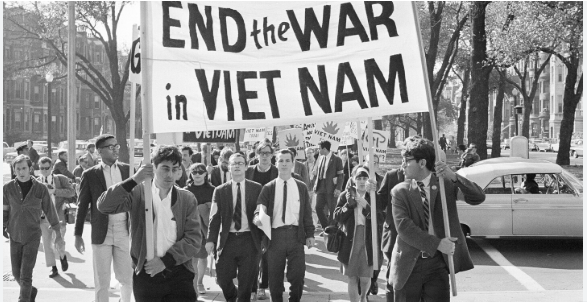
The Vietnam War was a conflict unlike any America had ever fought. It was the first “television war,” where the brutal realities of combat were beamed into living rooms nightly, shattering the disconnect between the home front and the battlefield. As the conflict escalated through the 1960s and into the 70s, a powerful counterculture movement rose in opposition, and its primary language was music. From the coffeehouses of Greenwich Village to the muddy fields of Woodstock, a generation of artists gave voice to the confusion, anger, and heartbreak of a nation divided. These weren’t just songs; they were anthems, declarations, and rallying cries that defined an era and forever changed the relationship between music and social change. Here are the top 10 protest songs that became the unforgettable soundtrack to the Vietnam War era.
1. “Blowin’ in the Wind” – Bob Dylan (1963)
Before the anti-war movement had a name, it had an anthem. While written before the major escalation in Vietnam, Bob Dylan’s “Blowin’ in the Wind” laid the philosophical groundwork for nearly all the protest music that followed. With its series of poignant, rhetorical questions—”How many roads must a man walk down / Before you call him a man?” and “How many times must the cannonballs fly / Before they’re forever banned?”—the song transcended any single issue. It wasn’t a direct attack on government policy, but a poetic and profound meditation on peace, humanity, and the frustrating persistence of injustice. Dylan’s genius was in asking the questions without providing easy answers, suggesting they were floating on the wind for all to grasp. The song’s folk simplicity and universal themes allowed it to be embraced by both the Civil Rights movement and the burgeoning anti-war movement, making it the foundational text for a generation determined to challenge the status quo.
2. “For What It’s Worth” – Buffalo Springfield (1966)
With its signature, haunting guitar riff and Stephen Stills’ cautious opening line, “There’s something happening here,” this song perfectly captured the paranoia and tension of the mid-60s. While its specific inspiration was the Sunset Strip curfew riots in Los Angeles, its message resonated far beyond a local conflict. The lyrics spoke of “battle lines being drawn,” “a man with a gun over there,” and the urgent need for people to “stop, hey, what’s that sound.” This sense of escalating conflict and confusion mirrored what many Americans were feeling about the Vietnam War. “For What It’s Worth” wasn’t an angry, fist-pumping protest song; it was a wary, observational dispatch from a society on the brink. Its ambiguity was its strength, allowing it to become a timeless anthem for any situation where citizens find themselves at odds with authority, making it a cornerstone of the Vietnam War era soundtrack.
3. “I-Feel-Like-I’m-Fixin’-to-Die Rag” – Country Joe and the Fish (1967)
If Dylan’s protest was poetic, Country Joe’s was pure, unadulterated satire. This song is a masterclass in dark humour, setting the most cynical lyrics imaginable to an upbeat, jaunty, ragtime tune. The song cheerily invites young men to go to Vietnam, be the “first one on your block to have your boy come home in a box,” all while spelling out the financial motives behind the conflict (“There’s plenty of good money to be made / By supplying the Army with the tools of its trade”). The song’s most famous moment came at Woodstock in 1969, where Country Joe led half a million people in the infamous “Fish Cheer,” a cathartic and profane call-and-response that ended with spelling “F-I-S-H.” It was a moment of collective defiance and gallows humour that perfectly encapsulated the counterculture’s attitude toward the war: a tragic, absurd, and ultimately pointless meat grinder. The song was a gleeful and subversive middle finger to the establishment.
4. “Fortunate Son” – Creedence Clearwater Revival (1969)
With a driving guitar riff and John Fogerty’s raw, snarling vocals, “Fortunate Son” was a blast of rock and roll fury that took aim at the class hypocrisy of the Vietnam War. The song’s central message was brutally simple: the elites and politicians who waved the flags and started the wars were not the ones sending their own children to fight and die in the jungle. Fogerty’s lyrics rage against the “senators’ sons” and “millionaires’ sons” who were born “silver spoon in hand” and could use their privilege to avoid the draft. It became a powerful anthem for the working-class kids and blue-collar soldiers who felt they were bearing the true burden of the conflict. Unlike the folk songs that dominated the early movement, “Fortunate Son” was loud, angry, and undeniable. It spoke not just to the peacenik hippies, but to the soldiers themselves, many of whom felt abandoned by the very country they were supposed to be fighting for.
5. “Give Peace a Chance” – Plastic Ono Band (1969)
Recorded with a group of friends in a hotel room during John Lennon and Yoko Ono’s famous “Bed-In for Peace,” this song is the epitome of simplicity as a revolutionary act. The lyrics are little more than a list of modern-day buzzwords and ideologies—”revolution, evolution, masturbation, flagellation, regulation”—which are all dismissed in favour of a single, unifying message: “All we are saying is give peace a chance.” This stripped-down, repetitive chorus was its superpower. It wasn’t a complex argument; it was a mantra, a chant, a universal plea that anyone could join in on. The song was quickly adopted by the anti-war movement and became the de facto anthem of the massive Moratorium to End the War in Vietnam in November 1969, where half a million protestors, led by Pete Seeger, sang the chorus for ten minutes straight in Washington, D.C. It proved that sometimes the most powerful protest is also the most peaceful.
6. “War” – Edwin Starr (1970)
There is nothing subtle about this song. From its opening horn fanfare to Edwin Starr’s explosive vocal delivery, “War” is a direct, passionate, and funky indictment of armed conflict. The song poses a simple question: “War, huh, yeah / What is it good for?” and provides an unequivocal answer: “Absolutely nothing!” Originally a more contemplative track by The Temptations, the song was re-recorded by Starr at a faster tempo with a raw, powerful arrangement that turned it into a global phenomenon. Released at a time when the Vietnam conflict was at its peak, the song’s directness was electrifying. It cut through all the political doublespeak and complex justifications for the war, boiling the issue down to a fundamental moral truth. Its placement on the Motown label also brought the anti-war message squarely into the pop and R&B mainstream, proving that protest music could have a groove.
7. “Ohio” – Crosby, Stills, Nash & Young (1970)
This song is a raw nerve captured on vinyl. Neil Young wrote it in a fit of rage and grief just hours after seeing the horrifying photos of the Kent State shootings on May 4, 1970, where the Ohio National Guard opened fire on unarmed student protestors, killing four. The band recorded and released it with astonishing speed, and the song hit the airwaves while the nation was still reeling. The lyrics are a visceral, on-the-ground report: “Tin soldiers and Nixon coming / We’re finally on our own / This summer I hear the drumming / Four dead in Ohio.” The song’s pained harmonies and Young’s jagged guitar captured the profound shock and horror that the war had finally come home, with the government turning its weapons on its own children. “Ohio” was a pivotal moment for the protest movement, marking a loss of innocence and a hardening of the lines between the establishment and the youth counterculture.
8. “What’s Going On” – Marvin Gaye (1971)
While many protest songs were shouts of anger, Marvin Gaye’s “What’s Going On” was a soulful, sorrowful whisper. The song is a masterpiece of empathy, sung from the perspective of a Vietnam veteran returning home to a world he no longer recognizes, filled with police brutality, injustice, and misunderstanding. Instead of pointing fingers, Gaye asks questions: “Father, father / We don’t need to escalate / You see, war is not the answer / For only love can conquer hate.” The song’s smooth, layered production and Gaye’s pleading vocals created a sound that was both beautiful and heartbreaking. It expanded the scope of the protest song, weaving the Vietnam War into a broader tapestry of social issues and arguing for understanding and dialogue over confrontation. It was a plea for humanity from a man who saw a world tearing itself apart, and it remains one of the most profound pieces of social commentary ever recorded.
9. “Eve of Destruction” – Barry McGuire (1965)
Released in the summer of 1965, just as President Johnson began to significantly escalate the number of U.S. troops in Vietnam, this song was a raw, apocalyptic howl of despair. With Barry McGuire’s gravelly, urgent voice, the track catalogues a litany of the world’s ills: the nuclear arms race, civil rights struggles, hypocrisy in politics, and, centrally, the war in Southeast Asia. The song’s most potent line directly addressed the draft: “You’re old enough to kill, but not for votin’.” This stark observation resonated deeply with the young men being sent to war. The song was so blunt and pessimistic that it was banned by many radio stations, which, of course, only made it more popular with the youth movement. It was one of the first folk-rock hits to bring such an aggressive and explicit anti-war message to the top of the pop charts, acting as a wake-up call for a generation on the “eve of destruction.”
10. “I Ain’t Marching Anymore” – Phil Ochs (1965)
No artist of the 1960s was more dedicated to the craft of the topical protest song than Phil Ochs. While Bob Dylan was becoming more poetic and abstract, Ochs remained a musical journalist, and “I Ain’t Marching Anymore” was his definitive statement on war. The song is a powerful, first-person declaration of pacifism, with the narrator tracing his presence through every major American conflict—from the War of 1812 to the bombing of Hiroshima—and finally declaring that he is done fighting. “It’s always the old to lead us to the war / It’s always the young to fall,” Ochs sings, perfectly summarizing the generational divide. The song became a deeply personal anthem for conscientious objectors and draft card burners. It wasn’t just a protest against the Vietnam War, but against the very institution of war itself, delivered with an unwavering conviction that defined the most committed wing of the peace movement.
Further Reading
- We Gotta Get Out of This Place: The Soundtrack of the Vietnam War by Doug Bradley and Craig Werner
- Protest Songs: A Musical History by Dorian Lynskey
- 1965: The Most Revolutionary Year in Music by Andrew Grant Jackson
- There’s a Riot Goin’ On: Revolutionaries, Rock Stars, and the Rise and Fall of the ’60s by Peter Doggett
Here at Zentara.blog, our mission is to take those tricky subjects and unlock them, making knowledge exciting and easy to grasp for everyone. But the adventure doesn’t stop on this page! We’re constantly exploring new frontiers and sharing discoveries across the digital universe. Want to dive deeper into more mind-bending Top 10s and keep expanding your world? Come join us on our other platforms – we’ve got unique experiences waiting for you on each one!
Get inspired by visual wonders and bite-sized facts: See the world through Zentara’s eyes on Pinterest!
Pin our fascinating facts and stunning visuals to your own boards. Explore Pins on Pinterest: https://uk.pinterest.com/zentarablog/
Discover quick insights and behind-the-scenes peeks: Hop over to Tumblr for snippets, quotes, and unique content you won’t find anywhere else. It’s a different flavour of discovery! Follow the Fun on Tumblr: https://www.tumblr.com/zentarablog
Ready for deep dives you can listen to or watch? We’re bringing our accessible approach to video and potentially audio! Subscribe to our YouTube channel and tune into future projects that make learning pop! Subscribe on YouTube: https://www.youtube.com/@ZentaraUK
Seeking even more knowledge in one place? We’ve compiled some of our most popular topic deep dives into fantastic ebooks! Find them on Amazon and keep the learning journey going anytime, anywhere. Find Our Ebooks on Amazon: https://www.amazon.co.uk/s?k=Zentara+UK&ref=nb_sb_noss
Connect with us and fellow knowledge seekers: Join the conversation on BlueSky! We’re sharing updates, thoughts, and maybe even asking you what wonders we should explore next. Chat with Us on BlueSky: https://bsky.app/profile/zentarablog.bsky.social
Perfect for learning on the move! We post multiple 10-minute podcasts per day on Spotify. Pop on your headphones and fill your day with fascinating facts while you’re out and about! Listen on Spotify: https://open.spotify.com/show/3dmHbKeDufRx95xPYIqKhJFollow us on Instagram for bytesize knowledge! We post multiple posts per day on our official Instagram account. https://www.instagram.com/zentarablog/ Every click helps us keep bringing honest, accessible knowledge to everyone. Thanks for exploring with us today – see you out there in the world of discovery!




Leave a Reply