
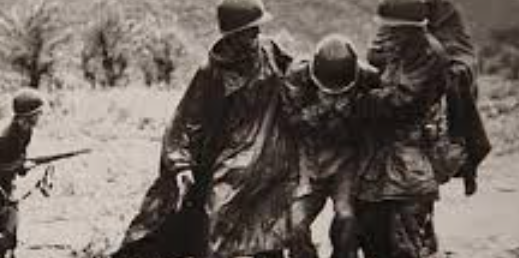
The Korean War, often dubbed “The Forgotten War,” was a brutal and pivotal conflict of the 20th century, a flashpoint where the burgeoning Cold War erupted into open flame. It was not a spontaneous combustion but the culmination of years of simmering tensions, colonial ambitions, and ideological fervor. To understand how the Korean peninsula, a land with a rich and ancient history, became the theater for a devastating international war, one must trace the chain of events that inexorably led to the North Korean invasion of the South on June 25, 1950.
These events are like a series of dominoes, each one toppling the next, gathering momentum until the final, catastrophic fall. From the decline of ancient dynasties to the ambitious machinations of global superpowers, the path to war was paved by decisions made in distant capitals and the fervent aspirations of the Korean people themselves. This list unravels the ten most significant events that set the stage for this tragic conflict, exploring the intricate web of history, politics, and ideology that directly precipitated the outbreak of the Korean War.
1. The End of Japanese Rule: A Power Vacuum on the Peninsula
For 35 years, from 1910 to 1945, Korea was under the harsh rule of Imperial Japan. This period of colonial occupation was marked by systematic attempts to erase Korean culture, language, and national identity. When Japan surrendered to the Allied forces in August 1945, ending World War II, it was a moment of profound jubilation for the Korean people. Freedom, it seemed, was finally at hand. However, this liberation was not the straightforward restoration of sovereignty many had hoped for. Instead, the abrupt collapse of Japanese authority created a dangerous power vacuum. Imagine a dam holding back immense pressure suddenly being removed; the resulting flood is chaotic and unpredictable. Decades of suppressed political aspirations and nationalist sentiments erupted onto the surface. Various Korean political groups, from ardent nationalists to committed communists, vied for influence, each with a different vision for the nation’s future. The absence of a unified, internationally recognized Korean government left the peninsula vulnerable to the competing interests of the victorious Allied powers, who were already beginning to view the world through the suspicious lens of the emerging Cold War. This post-liberation chaos was the fertile ground in which the seeds of division were sown.
2. The Yalta and Potsdam Conferences: Superpowers Draw a Line in the Sand
As World War II drew to a close, the leaders of the Allied powers—the United States, the Soviet Union, and Great Britain—met to decide the fate of the post-war world. At conferences in Yalta (February 1945) and Potsdam (July-August 1945), the “Big Three” made decisions that would have far-reaching and often tragic consequences. Korea, a nation that had been under Japanese colonial rule, was one of the territories whose future was on the negotiating table. The initial agreement was for a four-power trusteeship (involving the U.S., USSR, Britain, and China) to guide Korea towards independence. However, the practicalities of disarming the Japanese forces on the peninsula led to a fateful, and seemingly temporary, solution. Soviet forces were to accept the surrender of Japanese troops north of the 38th parallel, while American forces would do the same to the south. This arbitrary line, chosen by American military planners for its convenience on a map, was never intended to be a permanent political border. Yet, it became the de facto division of the country. This decision, made thousands of miles away without any Korean consultation, effectively cut the nation in two, laying the groundwork for two separate and ideologically opposed states to emerge. The 38th parallel became a symbol of the burgeoning superpower rivalry, a scar drawn across the heart of Korea.
3. The Soviet-American Cold War: An Ideological Battleground in Korea
The division of Korea at the 38th parallel might have remained a temporary military expedient were it not for the rapid deterioration of relations between the United States and the Soviet Union. The end of their wartime alliance gave way to a new kind of global conflict: the Cold War. This was a battle of ideologies—American-led democratic capitalism versus Soviet-led communism—and Korea found itself caught directly in the crossfire. The peninsula became a microcosm of the larger global struggle. The Soviet Union, which had a significant military presence in the north, moved quickly to install a communist regime that aligned with its interests. They backed Kim Il-sung, a former anti-Japanese guerrilla fighter, and helped him establish the Democratic People’s Republic of Korea (DPRK). In the south, the United States, wary of the spread of communism, supported the fiercely anti-communist Syngman Rhee, who would become the first president of the Republic of Korea (ROK). Korea was no longer just a newly liberated nation; it was a critical front in the Cold War. The U.S. and the USSR used their respective zones of influence to build up client states, each armed and ideologically primed to view the other as an existential threat. The internal Korean political divide was now amplified and solidified by the immense power and resources of the two superpowers.
4. The Failure of Unification Efforts: A Divided Nation Solidifies
In the years following the initial division, there were numerous attempts to reunify Korea. The United Nations, in particular, sought to oversee nationwide elections to establish a single, independent government for the entire peninsula. A UN commission was established to facilitate this process. However, these efforts were doomed by the deepening Cold War and the intransigence of the two Korean regimes and their superpower patrons. The Soviet Union and the North Korean authorities refused to allow the UN commission to operate in the north, arguing that the UN was a tool of American foreign policy. Consequently, UN-supervised elections were held only in the south in May 1948, leading to the formal establishment of the Republic of Korea (ROK) with Syngman Rhee as its president. In response, the north held its own elections, officially creating the Democratic People’s Republic of Korea (DPRK) in September 1948, with Kim Il-sung as its premier. The international community, largely led by the United States, recognized the ROK as the only legitimate government in Korea. This solidified the division, transforming a temporary military line into a fortified political border. Both governments claimed sovereignty over the entire peninsula, creating a volatile situation where unification by force seemed increasingly likely.
5. The Rise of Kim Il-sung and Syngman Rhee: Two Leaders Bent on Unification
The division of Korea was not merely a product of superpower politics; it was also driven by the fervent nationalism and personal ambitions of the two leaders who came to power on either side of the 38th parallel. In the north, Kim Il-sung, a charismatic and ruthless leader, consolidated his power with Soviet backing. He envisioned a unified, communist Korea under his absolute rule. He built a powerful military, the Korean People’s Army (KPA), and actively sought support from both the Soviet Union and the newly established People’s Republic of China for a military campaign to “liberate” the south. In the south, Syngman Rhee was an equally uncompromising figure. A staunch anti-communist and ardent nationalist, he had spent decades agitating for Korean independence. Rhee also dreamed of a unified Korea, but under his authoritarian, right-wing government. He frequently spoke of marching north to reunify the country by force and presided over a brutal crackdown on suspected communists and political opponents within South Korea. The presence of these two ideologically opposed and unyielding leaders, each viewing the other as illegitimate and each determined to rule the entire peninsula, created an incredibly volatile and dangerous dynamic. The stage was set for a civil war, with both sides actively preparing for a military confrontation.
6. The Soviet and Chinese Communist Support for North Korea
Kim Il-sung’s ambition to unify Korea by force could not have been realized without the backing of his powerful communist patrons, the Soviet Union and the newly formed People’s Republic of China. Initially, Soviet leader Joseph Stalin was hesitant to greenlight an invasion, fearing it could provoke a direct military confrontation with the United States. However, several factors changed his calculation. The successful Soviet test of an atomic bomb in 1949 and the communist victory in the Chinese Civil War, which established the People’s Republic of China under Mao Zedong, emboldened Stalin. He saw an opportunity to expand the communist sphere of influence and test American resolve without directly involving Soviet troops. From late 1949 through early 1950, Kim Il-sung made several trips to Moscow to plead his case. With the promise of support from Mao Zedong, who agreed to provide assistance if needed, Stalin finally gave his approval. The Soviet Union provided North Korea with a massive infusion of modern military aid, including tanks, heavy artillery, and aircraft, and sent military advisors to help plan the invasion. This crucial support transformed the North Korean army into a formidable fighting force, far superior to its South Korean counterpart, and gave Kim Il-sung the means to launch his ambitious invasion.
7. The Acheson Line Speech: A Perceived Green Light for Invasion
In January 1950, U.S. Secretary of State Dean Acheson delivered a speech at the National Press Club in Washington D.C., in which he outlined the American “defensive perimeter” in the Pacific. This perimeter, he explained, ran along the Aleutian Islands to Japan, then to the Ryukyu Islands, and from there to the Philippines. Crucially, both South Korea and Taiwan were outside of this explicitly stated defensive line. While Acheson did state that any attack on nations outside this perimeter would be a matter for the United Nations, his omission of South Korea was interpreted by the communist powers—Stalin, Mao, and Kim Il-sung—as a clear signal that the United States would not intervene militarily to defend South Korea. It appeared to be a “green light” for the North Korean invasion. Historians debate the true impact of this speech, with some arguing that the decision to invade had already been made. However, at the very least, Acheson’s words reinforced the belief in Moscow, Beijing, and Pyongyang that a quick and decisive North Korean victory was achievable without significant American interference. This perceived lack of American commitment removed a major potential obstacle in the minds of the communist leaders and likely accelerated the final preparations for the invasion.
8. The Withdrawal of US and Soviet Troops: Removing the Tripwires
By the end of 1949, both the Soviet Union and the United States had withdrawn the bulk of their combat troops from the Korean peninsula. The Soviets completed their withdrawal from the north in 1948, leaving behind military advisors. The United States followed suit, withdrawing its last combat units from the south in the summer of 1949, also leaving behind a small group of military advisors. On the surface, this might seem like a step towards de-escalation. In reality, it had the opposite effect. The presence of American and Soviet troops had served as a deterrent, a “tripwire” that made both Korean regimes hesitant to launch a full-scale attack, as it could have immediately drawn their superpower patrons into a direct conflict. With the American and Soviet armies gone, the primary restraining influence was removed. The conflict became “Koreanized,” and the decision to go to war was now largely in the hands of Kim Il-sung and Syngman Rhee. The withdrawal of foreign troops, combined with the continued military and economic support for their respective client states, created the worst of both worlds: it removed the deterrent to war while leaving both sides armed and motivated for a fight.
9. Escalating Border Clashes at the 38th Parallel
In the two years leading up to the full-scale invasion in June 1950, the 38th parallel was anything but a peaceful border. It was the scene of constant, low-level warfare. Both North and South Korean forces engaged in a series of increasingly violent border clashes, raids, and guerrilla incursions. These were not minor skirmishes; they were significant military engagements involving thousands of troops, resulting in hundreds of casualties. Each side provoked the other, testing defenses and attempting to gain strategic advantages. The South Korean government, under Syngman Rhee, was fighting a persistent communist-backed insurgency within its own borders, particularly in places like Jeju Island and the mainland’s southern provinces. These internal conflicts were often supported and supplied by the North. The escalating violence along the 38th parallel created a climate of perpetual crisis and normalized the use of military force as a means of resolving disputes. It habituated both armies to combat and hardened the resolve of both governments to pursue unification through military means. These border clashes were, in essence, a rehearsal for the main event, a prelude that made the transition to a full-scale war a much smaller step to take.
10. The Invasion of South Korea: The Final Domino Falls
After months of planning and preparation, and with the explicit approval and support of the Soviet Union, North Korea launched its full-scale invasion of South Korea in the pre-dawn hours of June 25, 1950. The Korean People’s Army (KPA), well-equipped with Soviet tanks and artillery, stormed across the 38th parallel in overwhelming numbers. The Republic of Korea (ROK) Army, which was poorly equipped and lacked tanks, heavy artillery, and effective anti-tank weapons, was caught largely by surprise and quickly overwhelmed. The invasion was the culmination of all the preceding events: the post-colonial power vacuum, the superpower division of the country, the ideological entrenchment of two hostile regimes, the ambitions of their uncompromising leaders, and the miscalculations of international diplomacy. The crossing of the 38th parallel was the final, irreversible act that transformed the Korean cold war into a hot war. It triggered an immediate international response, with the United States and the United Nations intervening on behalf of South Korea, and eventually, the People’s Republic of China intervening on behalf of the North. The Korean peninsula became the first major battleground of the Cold War, a devastating conflict that would rage for three years and whose legacy of division and tension continues to this day.
Further Reading
- The Coldest Winter: America and the Korean War by David Halberstam
- The Korean War: A History by Bruce Cumings
- This Kind of War: A Study in Unpreparedness by T.R. Fehrenbach
- On the Brink: The Dramatic Behind-the-Scenes Saga of the Reagan-Gorbachev Summit by Jay Winik (Note: While focused on a later period, it provides excellent context on Cold War decision-making)
- Korea: The War Before Vietnam by Callum A. MacDonald
Here at Zentara.blog, our mission is to take those tricky subjects and unlock them, making knowledge exciting and easy to grasp for everyone. But the adventure doesn’t stop on this page! We’re constantly exploring new frontiers and sharing discoveries across the digital universe. Want to dive deeper into more mind-bending Top 10s and keep expanding your world? Come join us on our other platforms – we’ve got unique experiences waiting for you on each one!
Get inspired by visual wonders and bite-sized facts: See the world through Zentara’s eyes on Pinterest!
Pin our fascinating facts and stunning visuals to your own boards. Explore Pins on Pinterest: https://uk.pinterest.com/zentarablog/
Discover quick insights and behind-the-scenes peeks: Hop over to Tumblr for snippets, quotes, and unique content you won’t find anywhere else. It’s a different flavour of discovery! Follow the Fun on Tumblr: https://www.tumblr.com/zentarablog
Ready for deep dives you can listen to or watch? We’re bringing our accessible approach to video and potentially audio! Subscribe to our YouTube channel and tune into future projects that make learning pop! Subscribe on YouTube: https://www.youtube.com/@ZentaraUK
Seeking even more knowledge in one place? We’ve compiled some of our most popular topic deep dives into fantastic ebooks! Find them on Amazon and keep the learning journey going anytime, anywhere. Find Our Ebooks on Amazon: https://www.amazon.co.uk/s?k=Zentara+UK&ref=nb_sb_noss
Connect with us and fellow knowledge seekers: Join the conversation on BlueSky! We’re sharing updates, thoughts, and maybe even asking you what wonders we should explore next. Chat with Us on BlueSky: https://bsky.app/profile/zentarablog.bsky.social
Perfect for learning on the move! We post multiple 10-minute podcasts per day on Spotify. Pop on your headphones and fill your day with fascinating facts while you’re out and about! Listen on Spotify: https://open.spotify.com/show/3dmHbKeDufRx95xPYIqKhJFollow us on Instagram for bytesize knowledge! We post multiple posts per day on our official Instagram account. https://www.instagram.com/zentarablog/ Every click helps us keep bringing honest, accessible knowledge to everyone. Thanks for exploring with us today – see you out there in the world of discovery!




Leave a Reply