
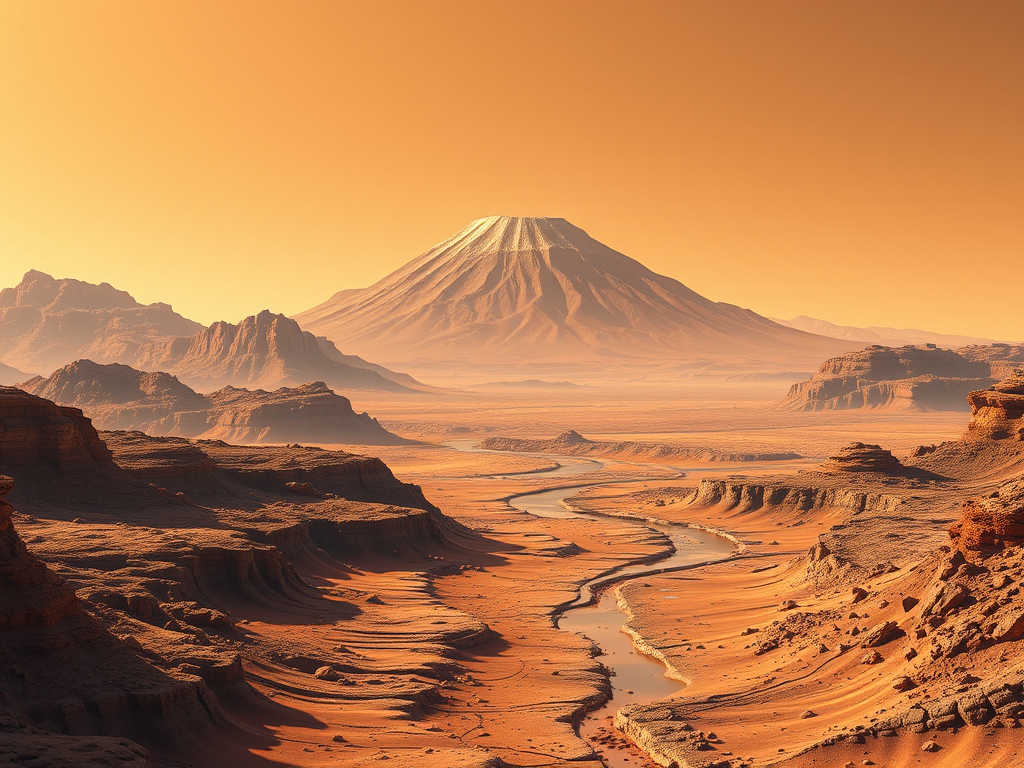
For millennia, Mars has been a captivating speck of red in our night sky, a namesake for the god of war, and a canvas for our wildest imaginings. We’ve pictured it as a dying world of ancient canals, a home to “little green men,” and the next great frontier for humanity. But over the last 50 years, thanks to a relentless fleet of orbiters, landers, and rovers, science has peeled back the layers of myth. The Mars we now know is infinitely more complex, nuanced, and fascinating than we ever dreamed.
What we’ve found is a world of staggering contrasts. It is a planet of extremes, boasting the tallest volcano and the deepest canyon in the solar system. It’s a world that was once warm, wet, and potentially habitable, but is now a frozen, irradiated desert. The story of Mars is a captivating detective story, and with every mission, we uncover another clue.
Join us as we explore the 10 most important, fundamental, and awe-inspiring discoveries scientists have made about our enigmatic neighbor, the Red Planet.
1. Mars Was Once a Water World
The single most profound discovery about Mars is the undeniable evidence that it was once covered in liquid water. Today, Mars is a bone-dry, freezing desert where liquid water cannot last on the surface—its thin atmosphere means water instantly boils away or freezes. But billions of years ago, the planet was a very different place.
How do we know? Our robotic geologists have found a planet-wide trail of clues. Orbiters have photographed vast, dried-up ancient riverbeds, channels that meander for hundreds of miles. They’ve spotted enormous lakebeds nestled inside craters and even the shoreline of a suspected northern ocean.
On the ground, rovers like Curiosity and Perseverance have driven through these exact locations. They found rounded pebbles, smoothed and tumbled by an ancient, flowing stream—indistinguishable from river rocks on Earth. They’ve drilled into sedimentary rock, which is made of fine layers of mud and silt that could only have formed at the bottom of a long-standing lake. We’ve even found specific minerals, like hematite “blueberries” (found by the Opportunity rover) and hydrated sulfates, which are “smoking guns” for the past presence of liquid water. This discovery fundamentally changed our view of Mars from a static, dead rock to a world that once had all the key ingredients for life as we know it.
2. It Has the Tallest Volcano in the Solar System
Earth’s geology is impressive, but Mars makes our grandest features look quaint. The Red Planet is home to Olympus Mons, the largest volcano in the entire solar system. This single shield volcano is a staggering 16 miles (25 km) high—nearly three times the height of Mount Everest. Its base is so wide (374 miles or 601 km) that it would cover the entire state of Arizona.
If you were to stand at its base, you couldn’t even see the summit. The volcano is so broad and its slopes so gentle that the peak would be hidden over the curve of the planet’s horizon.
Why did it get so colossal? Mars has two key differences from Earth. First, its lower surface gravity (about 38% of Earth’s) means that mountains can grow much taller before collapsing under their own weight. Second, and more importantly, Mars does not have active tectonic plates. On Earth, a “hot spot” in the mantle will create a chain of volcanoes as the crustal plate moves over it (like the Hawaiian islands). On Mars, the crust stayed put. A single, massive hot spot fed the same location for hundreds of millions of years, allowing Olympus Mons to just grow, and grow, and grow.
3. It Also Has the Deepest Canyon
As if having the tallest volcano wasn’t enough, Mars also holds the title for the grandest canyon. Forget the Grand Canyon; Valles Marineris, the “Mariner Valley,” dwarfs it. This is not just a canyon; it is a vast system of chasms that stretches for 2,500 miles (4,000 km) along the Martian equator. That’s long enough to span the entire continental United States, from New York to Los Angeles.
In places, the canyon plunges to depths of 4 miles (7 km). For comparison, the Grand Canyon is about 1 mile (1.6 km) deep.
But Valles Marineris wasn’t carved by a river, as the Grand Canyon was (though water has since flowed through parts of it). Scientists believe this colossal scar is a tectonic feature—a giant crack in the crust. It’s thought that the same volcanic activity that created Olympus Mons and the nearby Tharsis Bulge (a massive volcanic plateau) put immense stress on the planet’s crust. The crust stretched, ripped apart, and collapsed, forming the immense rift valley we see today. It stands as a silent, gaping testament to the planet’s violent geological past.
4. Mars Is Red Because It’s Rusty
The most obvious feature of Mars, visible even from Earth, is its distinctive red color. The ancient Romans named it for their god of war because the color reminded them of blood. As it turns out, the real reason is much more chemical, but no less dramatic. Mars is red for the same reason old, neglected metal turns red: it’s covered in rust.
The Martian surface is rich in iron. The soil, rocks, and dust contain iron-bearing minerals. Billions of years ago, this iron reacted with oxygen (likely from water molecules being broken apart by sunlight) in a process called oxidation. The result is iron oxide—or, as we commonly call it, rust.
This fine-grained rust dust is everywhere. It’s suspended in the thin atmosphere, giving the Martian sky its pale, pinkish-tan color. It covers the ground in a fine layer, earning Mars its famous nickname: the Red Planet. When rovers like Curiosity drill just a few inches beneath the surface, they often find rock that is a completely different color, like gray or blue, revealing that the planet’s signature “redness” is, quite literally, only skin-deep.
5. It Has a Thin, Toxic, and Dusty Atmosphere
Anyone dreaming of one day walking on Mars without a helmet will be disappointed. The Mars atmosphere is a harsh and alien environment. First, it is incredibly thin. The atmospheric pressure at the surface is less than 1% of Earth’s.
Analogy: Standing on Mars would feel like being at an altitude of over 20 miles (32 km) on Earth—far higher than any commercial jet flies. There is simply not enough pressure to support liquid water or for a human to survive.
Second, its composition is toxic to us. While Earth’s air is mostly nitrogen and oxygen, the Martian atmosphere is about 95% carbon dioxide (CO2). This is great for plants, but deadly for animals that need oxygen to breathe.
Finally, the atmosphere is filled with the fine iron-oxide dust that gives the planet its color. This dust can be kicked up by winds to create towering “dust devils” (which have conveniently cleaned off our rovers’ solar panels) or, more ominously, can grow into planet-encircling global dust storms that blot out the sun for weeks at a time. These storms were responsible for the “death” of the Opportunity rover, which, unable to see the sun, could no longer charge its batteries.
6. We Have Found the “Building Blocks” of Life
This is one of the most exciting and fast-evolving areas of Mars science. While we haven’t found life (past or present), we have found compelling evidence that Mars could have supported it. The most significant discovery in this area is the detection of organic molecules.
Organic molecules are carbon-based compounds that are the fundamental “building blocks” of all known life. They include things like methane and more complex molecules like benzene. NASA’s Curiosity rover has definitively detected both.
This is not proof of life. Organic molecules can be created by geological processes that have nothing to do with biology. However, finding them in an ancient lakebed (like Gale Crater, where Curiosity is exploring) is thrilling. It means that billions of years ago, Mars had all the right ingredients in one place: liquid water, a source of energy (from volcanoes or the sun), and the raw chemical materials (organic molecules) that life needs to get started. The potential for life on Mars just became much more plausible.
7. Mars Has Two Tiny, Lumpy Moons
Unlike Earth’s large, spherical Moon, Mars has two small, lumpy companions named Phobos (Fear) and Deimos (Panic), named after the sons of the Greek god of war, Ares (the Greek equivalent of Mars). These moons are less like our Moon and more like captured asteroids.
They are tiny. Phobos, the larger of the two, is only about 14 miles (22 km) across, while Deimos is a mere 7.5 miles (12 km) wide. Both are potato-shaped, pockmarked with craters, and orbit very close to the planet.
Their origin is still a mystery. The leading theory is that they are indeed asteroids, long ago snared by Mars’s gravity. A competing idea suggests they were formed from debris blasted off Mars during a massive impact, much like our own Moon.
Their fates are sealed. Deimos orbits far enough away to be stable. But Phobos is in a “death spiral.” It orbits Mars faster than the planet rotates and is being slowly dragged closer by the planet’s gravity. In about 50 million years, it will either be ripped apart by tidal forces, forming a faint ring around Mars, or it will slam into the planet in a cataclysmic impact.
8. We Have Pieces of Mars Here on Earth
We don’t have to go all the way to Mars to study it. In a few rare cases, Mars has come to us. Scientists have identified a special class of meteorites found on Earth that are definitively Martian meteorites.
How do we know they’re from Mars? It’s a fascinating bit of detective work. Billions of years ago, a large asteroid or comet struck Mars with such force that it blasted chunks of the Martian crust into space. After drifting for millions of years, a few of these rocks were caught by Earth’s gravity and fell as meteorites.
We can identify them by their unique chemical “fingerprint.” But the real “smoking gun” came from the Viking landers in the 1970s, which directly measured the composition of the Martian atmosphere. Decades later, scientists examining a meteorite named ALH84001 found tiny pockets of gas trapped inside it. When they tested the gas, its composition was a perfect match for the Martian atmosphere. It was the ultimate proof of origin. These meteorites are invaluable, allowing us to study Martian geology in labs on Earth with tools far too large and complex to send on a rover.
9. Mars Still Has Water Ice and Maybe Liquid Brine
While the era of vast lakes and rivers is long gone, Mars is not completely dry. We have discovered vast quantities of water ice on Mars. Both of its poles are capped with permanent ice caps, just like Earth. These are made of a combination of water ice and frozen carbon dioxide (dry ice) that grows and shrinks with the seasons.
But the most exciting discovery is the amount of ice buried just beneath the surface at the mid-latitudes. Data from orbiters shows that in some places, you would only need to dig a foot or two to hit a layer of permafrost or even massive glaciers of pure water ice, hidden beneath a protective layer of dust.
Is there any liquid water? Possibly. Orbiters have spotted mysterious dark streaks, called Recurring Slope Lineae (RSL), that appear on steep crater walls during the warmest months and then fade as it gets cold. The leading hypothesis is that these are not pure water, but rather, extremely salty brines. This salty mixture would have a much lower freezing point, allowing it to flow in a liquid state, at least temporarily, in the harsh Martian environment.
10. Rovers Have Become Our Robotic Geologists
Perhaps the most inspiring discovery is simply that we can explore Mars. The success of the Mars rover missions is one of the greatest scientific achievements in human history. Starting with the tiny, microwave-sized Sojourner in 1997, we have landed a series of increasingly sophisticated mobile laboratories on the planet’s surface.
The twin Spirit and Opportunity rovers, which landed in 2004, were a revelation. Designed to last just 90 days, Spirit explored for six years, and Opportunity roamed the planet for an astonishing 15 years. They were the first to find definitive proof of ancient, water-rich environments.
The nuclear-powered Curiosity rover, which landed in 2012, is a car-sized chemistry lab. It was the first to drill into rocks, analyze their composition, and find the organic molecules that point to a past habitable environment. Its successor, Perseverance (landed in 2021), is actively drilling and caching the most promising rock samples, which a future mission will, for the first time, return to Earth. These rovers are our eyes, hands, and laboratories on another world, conducting the most ambitious field science ever attempted.
Further Reading
The story of Mars is still being written, but these books offer a fantastic deep dive into what we know and what we hope to find.
- The Case for Mars: The Plan to Settle the Red Planet and Why We Must by Robert Zubrin: A foundational and passionate book that lays out a practical plan for sending humans to Mars. It’s the “why-to” and “how-to” guide that inspired a generation of engineers and entrepreneurs.
- Packing for Mars: The Curious Science of Life in the Void by Mary Roach: A witty and incredibly entertaining look at the bizarre, unglamorous, and hilarious human challenges of space travel. This book answers all the questions you were too afraid to ask about living in space.
- Roving Mars: Spirit, Opportunity, and the Exploration of the Red Planet by Steve Squyres: Written by the principal scientist for the Spirit and Opportunity missions, this is a thrilling, firsthand account of the challenges, failures, and ultimate triumphs of the twin rovers that changed our understanding of Mars.
- The Sirens of Mars: Searching for Life on Another World by Sarah Stewart Johnson: A beautifully written and personal book that blends the history of Mars exploration with the profound, philosophical search for life beyond Earth.
Here at Zentara.blog, our mission is to take those tricky subjects and unlock them, making knowledge exciting and easy to grasp for everyone. But the adventure doesn’t stop on this page! We’re constantly exploring new frontiers and sharing discoveries across the digital universe. Want to dive deeper into more mind-bending Top 10s and keep expanding your world? Come join us on our other platforms – we’ve got unique experiences waiting for you on each one!
Get inspired by visual wonders and bite-sized facts: See the world through Zentara’s eyes on Pinterest!
Pin our fascinating facts and stunning visuals to your own boards. Explore Pins on Pinterest: https://uk.pinterest.com/zentarablog/
Discover quick insights and behind-the-scenes peeks: Hop over to Tumblr for snippets, quotes, and unique content you won’t find anywhere else. It’s a different flavour of discovery! Follow the Fun on Tumblr: https://www.tumblr.com/zentarablog/
Ready for deep dives you can listen to or watch? We’re bringing our accessible approach to video and potentially audio! Subscribe to our YouTube channel and tune into future projects that make learning pop! Subscribe on YouTube: https://www.youtube.com/@ZentaraUK
Seeking even more knowledge in one place? We’ve compiled some of our most popular topic deep dives into fantastic ebooks! Find them on Amazon and keep the learning journey going anytime, anywhere. Find Our Ebooks on Amazon: https://www.amazon.co.uk/s?k=Zentara+UK&ref=nb_sb_noss
Connect with us and fellow knowledge seekers: Join the conversation on BlueSky! We’re sharing updates, thoughts, and maybe even asking you what wonders we should explore next. Chat with Us on BlueSky: https://bsky.app/profile/zentarablog.bsky.social
Perfect for learning on the move! We post multiple 10-minute podcasts per day on Spotify. Pop on your headphones and fill your day with fascinating facts while you’re out and about! Listen on Spotify: https://open.spotify.com/show/3dmHbKeDufRx95xPYIqKhJFollow us on Instagram for bytesize knowledge! We post multiple posts per day on our official Instagram account. https://www.instagram.com/zentarablog/ Every click helps us keep bringing honest, accessible knowledge to everyone. Thanks for exploring with us today – see you out there in theworld of discovery!




Leave a Reply