
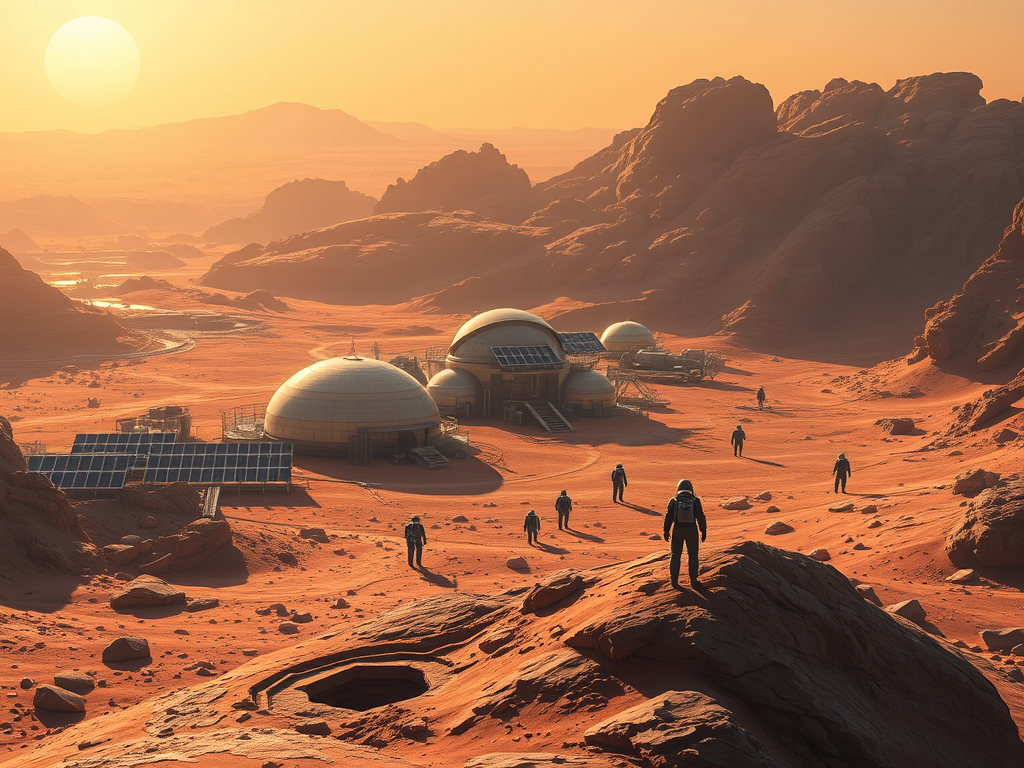
Have you ever looked up at the night sky and wondered about the bright red spot? That’s Mars, our closest planetary neighbor, and it’s captured human imagination for centuries. For a long time, it was just a distant light, a subject for science fiction stories about little green men. But today, thanks to incredible advances in science and technology, sending humans to Mars and maybe even living there isn’t just a dream anymore – it’s a real possibility that scientists and engineers are working towards right now!
You might ask, “Why bother? Earth is our home!” And that’s true. Earth is beautiful and unique. But humans have always been explorers. From the earliest people crossing continents to sailors discovering new lands, exploration is in our nature. It’s how we learn, how we grow, and how we spread out. Thinking about colonizing Mars is the next giant leap in that long history of exploration.
There are many big, important reasons why we should colonize Mars. Some are about making sure humanity has a long-term future, others are about unlocking new knowledge, and some are just about the incredible challenge and inspiration it provides. It’s not an easy task – Mars is cold, has a thin atmosphere, and is a long way away – but the potential rewards are huge.
So, let’s explore ten compelling reasons for Mars colonization. Get ready to see why setting up a new home among the stars could be one of the most important things humanity ever does!
1. Ensuring the Long-Term Survival of Humanity
Okay, let’s start with a big one. Earth is our only home right now, and while it’s amazing, it’s not invincible. What if a giant asteroid hit us, like the one that wiped out the dinosaurs? What if there was a global catastrophe, like a supervolcano eruption or a devastating pandemic that Earth couldn’t recover from? If all of humanity is on one planet, a single terrible event could potentially end everything. By establishing a self-sustaining colony on Mars, we create a backup plan for humanity. Think of it like having copies of important files on a separate hard drive. If something happens to the main computer (Earth), you still have the information saved somewhere else. Setting up a second home on Mars provides a vital insurance policy for the human race, ensuring that our species could survive even if something catastrophic happened to Earth. This is one of the most powerful benefits of colonizing Mars from a long-term perspective.
2. Driving Incredible Technological Innovation
Trying to figure out how to live on a place like Mars forces us to invent amazing new technologies. Mars is a challenging environment: it’s freezing cold, has dangerous radiation from space, very little air, and dust storms. To survive there, we need to develop super-advanced life support systems, better ways to recycle water and air, ingenious methods for growing food in harsh conditions, new types of power sources, and even ways to build structures using local Martian materials. We also need faster and safer ways to travel through space. The effort required for human settlement on Mars pushes the boundaries of what we think is possible in engineering, robotics, material science, and many other fields. These inventions don’t just stay on Mars; they often lead to breakthroughs that can improve life here on Earth, from more efficient solar panels to better ways to purify water. The challenges of making Mars habitable spur innovation that benefits everyone.
3. Unlocking Secrets About the Formation of Our Solar System
Mars is like a time capsule for the early solar system. Unlike Earth, which has been constantly changed by things like plate tectonics and erosion by liquid water (for billions of years, anyway), large parts of Mars’s surface are incredibly ancient and have remained relatively unchanged. By studying Mars up close, especially by drilling into its rocks and exploring its ancient riverbeds and lakebeds, we can learn so much about what the conditions were like billions of years ago. This helps us understand how rocky planets, including our own Earth, formed and evolved. Did Mars once have life? Was it ever warm and wet for long periods? Finding answers to these questions on Mars can teach us about Earth’s past and even help us understand the potential for life elsewhere in the universe. Exploring Mars is key to understanding the history of our cosmic neighborhood, which is a crucial reason for Mars colonization for scientists.
4. The Search for Evidence of Past or Present Life
One of the most exciting reasons why we should colonize Mars is the possibility of finding life, or evidence of past life. We know that billions of years ago, Mars was a warmer, wetter place, potentially much more like early Earth. There is strong geological evidence of ancient lakes, rivers, and perhaps even oceans. Where there was liquid water, there might have been life. Although the surface of Mars is harsh today, it’s possible that simple microbial life could have existed in the past and perhaps even survived in protected pockets underground. Sending humans to Mars allows for much more detailed and flexible exploration than robotic missions alone. Astronauts could explore caves, drill deeper for samples, and make on-the-spot decisions about where to look next in a way robots cannot. Finding evidence of even simple life on Mars would be one of the most profound discoveries in human history, changing our understanding of life’s place in the cosmos.
5. Providing a New Frontier for Exploration and Discovery
Humans are explorers at heart. We have an innate drive to see what’s over the next hill, across the next ocean, or on the next planet. Mars represents the ultimate frontier in our current age. It’s a whole new world, waiting to be explored, mapped, and understood. Every mountain, canyon, and plain on Mars holds the potential for new discoveries. Setting up a colony provides a base camp for extended exploration of the planet. Scientists, geologists, and other experts could spend years studying Mars in depth, uncovering its secrets layer by layer. This kind of persistent, on-site exploration is impossible with short robotic missions. The sheer wonder and excitement of exploring another planet is a powerful motivator, inspiring new generations of scientists, engineers, and explorers. It fuels our curiosity and reminds us of the vast universe waiting to be discovered beyond Earth. This sense of wonder is a compelling reason why we should colonize Mars.
6. Creating a Second Node of Civilization
Building a self-sufficient colony on Mars means creating a whole new society from scratch. This isn’t just about survival; it’s about building a community, developing new ways of living, and maybe even creating a unique Martian culture. While the first colonists will rely heavily on Earth, the long-term goal is independence – generating their own power, growing their own food, manufacturing their own tools, and governing themselves. Establishing a second home for humanity means we wouldn’t have all our eggs in one basket. If a major global conflict or disaster severely impacted Earth, the Martian colony could potentially survive and continue human civilization. This is a powerful argument for colonizing Mars as a step towards becoming a multi-planetary species. It represents a significant diversification of human presence, making our long-term survival less vulnerable to events confined to a single planet. It’s about building a new branch on the tree of human civilization.
7. Advancing Resource Utilization and Sustainability
Living on Mars requires extreme efficiency and sustainability. We can’t just ship everything we need from Earth; it’s too expensive and difficult. This means Martian colonists will need to become experts at “in-situ resource utilization” (ISRU) – using materials found on Mars to meet their needs. This includes extracting water ice from the soil for drinking, oxygen production, and rocket fuel, using minerals in rocks to build structures, and potentially using the thin Martian atmosphere to create fuel or breathing air. The techniques developed for living sustainably on Mars, where resources are scarce and replenishment from Earth is difficult, can provide valuable lessons for living more sustainably here on Earth. As our planet’s resources face pressures, the innovations in recycling, resource extraction, and self-sufficiency required for human settlement on Mars could offer solutions for challenges we face at home.
8. Inspiring Future Generations in STEM Fields
The Apollo missions to the Moon in the 20th century had a huge impact, inspiring a generation of young people to pursue careers in science, technology, engineering, and mathematics (STEM). Similarly, the ambitious goal of colonizing Mars can serve as a powerful inspiration for today’s youth. Imagine the excitement of knowing that humans are building a new home on another planet! This grand vision can capture imaginations, fill classrooms, and motivate students to study the subjects needed to make it happen – physics, chemistry, biology, engineering, computer science, and more. The complex challenges of colonizing Mars require bright, creative minds from all disciplines. A vibrant Mars program can lead to a new wave of innovation and scientific discovery driven by a highly motivated workforce, ensuring continued progress not just in space exploration but across many scientific and technological fields. It provides a tangible, awe-inspiring goal that makes learning exciting and relevant.
9. Fostering Global Cooperation and Peace
Undertaking something as massive and complex as colonizing Mars is likely too big a job for any single nation alone. It requires a global effort, pooling resources, knowledge, and talent from countries around the world. International collaboration in space has a history of promoting peace and understanding; the International Space Station is a prime example, where astronauts from different nations live and work together harmoniously. A joint mission to establish human settlement on Mars could build on this, fostering unprecedented levels of international cooperation. Working together towards a common, incredibly challenging goal can help bridge political and cultural divides here on Earth. It provides a shared purpose that transcends national interests and focuses humanity’s energy on constructive exploration and creation rather than conflict. The sheer scale of the endeavor makes global partnership a practical necessity and a potential force for good in international relations.
10. Pushing the Boundaries of Human Achievement
Finally, and perhaps most simply, colonizing Mars is an ultimate challenge. It represents pushing the boundaries of what humanity is capable of. For centuries, we’ve dreamed of traveling to other worlds. Making that dream a reality requires overcoming immense technical, physical, and psychological hurdles. Succeeding would be a monumental achievement, a testament to human ingenuity, perseverance, and our adventurous spirit. It would change our perspective on our place in the universe and demonstrate our ability to overcome seemingly impossible odds. Every great civilization has had ambitious goals that defined it; reaching for the stars by colonizing Mars could be a defining goal for humanity in the 21st century and beyond. It’s a bold statement about who we are and what we aspire to be – explorers, innovators, and builders of futures beyond our home planet.
Exploring the reasons for Mars colonization reveals a mix of practical concerns like survival and resource use, alongside aspirational drivers like discovery, inspiration, and pushing the limits of human potential. While the challenges of colonizing Mars are significant – from radiation and distance to creating a breathable atmosphere and growing food – the potential rewards, from ensuring humanity’s long-term future to unlocking profound scientific secrets, make it a compelling goal. Making Mars habitable and establishing human settlement on Mars represents the next giant leap in our journey as a species, one that promises to drive innovation, inspire generations, and perhaps even change our understanding of life itself.
Further Reading
Interested in learning more about Mars and the future of space travel? Check out these books:
- Mars: A Tour of the Human Future on the Red Planet by Alistair Humphreys
- The Case for Mars: The Plan to Settle the Red Planet and Why We Must by Robert Zubrin
- Welcome to Mars: Making a Home on the Red Planet by Sandra Markle
- Elon Musk: Tesla, SpaceX, and the Quest for a Fantastic Future by Ashlee Vance (Includes significant detail on SpaceX’s Mars ambitions)
Here at Zentara.blog, our mission is to take those tricky subjects and unlock them, making knowledge exciting and easy to grasp for everyone. But the adventure doesn’t stop on this page! We’re constantly exploring new frontiers and sharing discoveries across the digital universe.
Want to dive deeper into more mind-bending Top 10s and keep expanding your world? Come join us on our other platforms – we’ve got unique experiences waiting for you on each one!
- Get inspired by visual wonders and bite-sized facts: See the world through Zentara’s eyes on Pinterest! Pin our fascinating facts and stunning visuals to your own boards. Explore Pins on Pinterest: https://uk.pinterest.com/zentarablog/
- Discover quick insights and behind-the-scenes peeks: Hop over to Tumblr for snippets, quotes, and unique content you won’t find anywhere else. It’s a different flavour of discovery! Follow the Fun on Tumblr: https://www.tumblr.com/zentarablog
- Ready for deep dives you can listen to or watch? We’re bringing our accessible approach to video and potentially audio! Subscribe to our YouTube channel and tune into future projects that make learning pop! Subscribe on YouTube: https://www.youtube.com/@ZentaraUK
- Seeking even more knowledge in one place? We’ve compiled some of our most popular topic deep dives into fantastic ebooks! Find them on Amazon and keep the learning journey going anytime, anywhere. Find Our Ebooks on Amazon: https://www.amazon.co.uk/s?k=zentara+uk&crid=2273NA7RAJ1EU&sprefix=zentara+uk%2Caps%2C90&ref=nb_sb_noss
- Connect with us and fellow knowledge seekers: Join the conversation on BlueSky! We’re sharing updates, thoughts, and maybe even asking you what wonders we should explore next. Chat with Us on BlueSky: https://bsky.app/profile/zentarablog.bsky.social
- Perfect for learning on the move! We post multiple 10-minute podcasts per day on Spotify. Pop on your headphones and fill your day with fascinating facts while you’re out and about! Listen on Spotify: https://open.spotify.com/show/3dmHbKeDufRx95xPYIqKhJ
Every click helps us keep bringing honest, accessible knowledge to everyone. Thanks for exploring with us today – see you out there in the world of discovery!




Leave a Reply